
Peptides
October 16, 2026
Pemvidutide's glucagon component: what the mechanism can explain
On this page
Glucagon is usually introduced as the hormone that helps raise blood glucose when fuel is needed. That makes its inclusion in a medicine being studied for obesity and fatty liver disease sound surprising. Why stimulate a glucose-raising pathway in people who may already have metabolic problems?
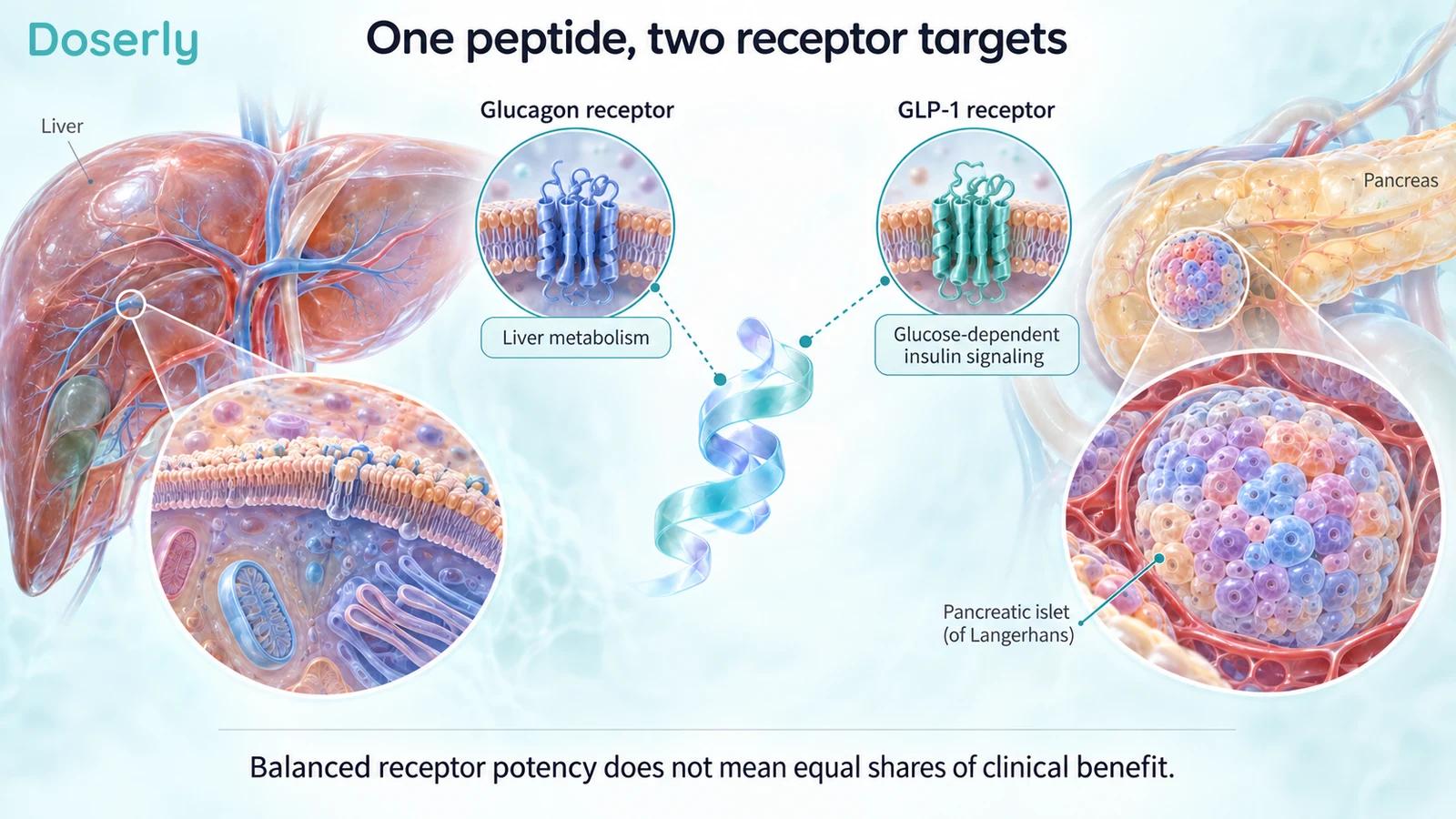
The answer is that glucagon does more than influence glucose, and pemvidutide does more than activate the glucagon receptor. It combines glucagon and GLP-1 receptor activity in one peptide. Researchers are investigating whether that combination can affect food intake and liver metabolism in a useful way. The design is biologically plausible, and human studies have shown substantial reductions in liver fat. Neither observation tells us exactly how much of the benefit came from each receptor.
Understanding that distinction helps explain both the interest in pemvidutide and the limits of claims that its glucagon component is a proven metabolic advantage. For the broader clinical program, see the Doserly pemvidutide guide.
Why combine these two signals?
GLP-1 signaling can support glucose-dependent insulin secretion and reduce food intake. Glucagon signaling is important in liver metabolism, including glucose production and pathways involved in handling fat. Combining them is an attempt to obtain complementary effects while managing the glucose consequences of glucagon activity.
A small human experiment illustrates the rationale. In a randomized crossover study, ten volunteers with overweight or obesity but without diabetes received infusions of GLP-1, glucagon, both hormones or placebo on separate occasions. Glucagon increased resting energy expenditure and raised glucose. Adding GLP-1 preserved the increase in energy expenditure while reducing the glucose excursion. Original human infusion study
That experiment was a physiological test, not a pemvidutide treatment trial. It involved short infusions of hormones, rather than months of exposure to a long-acting engineered peptide. Its value is showing that the combination has a human biological rationale. It cannot establish durable weight loss, long-term safety or the size of an energy-expenditure effect during pemvidutide treatment.
The difference matters whenever a mechanism is described as if it were a clinical result. “This pathway can increase energy expenditure under experimental conditions” and “this medicine increases a patient's daily energy expenditure by a known amount” require different evidence. Only the second would justify a specific numerical promise about the medicine.
What “balanced” means in pemvidutide's design
The original molecular-design paper described selecting ALT-801, subsequently called pemvidutide, for potent, approximately balanced activity at human GLP-1 and glucagon receptors in laboratory assays. The peptide was also modified to prolong its action, with albumin binding and pharmacokinetic experiments informing its development. The reported animal pharmacokinetics supported further clinical testing. Original design and characterization study
Balanced receptor potency does not mean half the weight loss comes from one receptor and half from the other. It also does not mean equal receptor activation in every organ throughout a dosing interval. Potency in an assay is a measurement made under particular experimental conditions. Clinical effects arise in a whole body with different tissues, receptor availability, drug exposure and feedback systems.
Think of the “balanced” description as a property of the molecule's intended pharmacology, rather than a division of its eventual health benefit. It is useful when distinguishing drug designs. It is insufficient when deciding which treatment works better for a person with a particular disease.
Similarly, the amount of drug administered is not a measurement of receptor occupancy. A dose in milligrams describes the amount of the peptide, not separate doses of a GLP-1 medicine and a glucagon medicine. Pemvidutide is one engineered molecule; it is not a recommendation to combine available products to imitate its receptor profile.
Why the liver is central to the hypothesis
In metabolic dysfunction-associated steatotic liver disease, or MASLD, excess fat accumulates in the liver in the setting of metabolic risk factors. Researchers are interested in glucagon activity because liver-fat metabolism could respond through pathways beyond the effect of eating less and losing weight. The pemvidutide liver-trial authors specifically describe stimulation of fatty-acid oxidation and inhibition of new fat synthesis as part of the rationale. Original MASLD trial
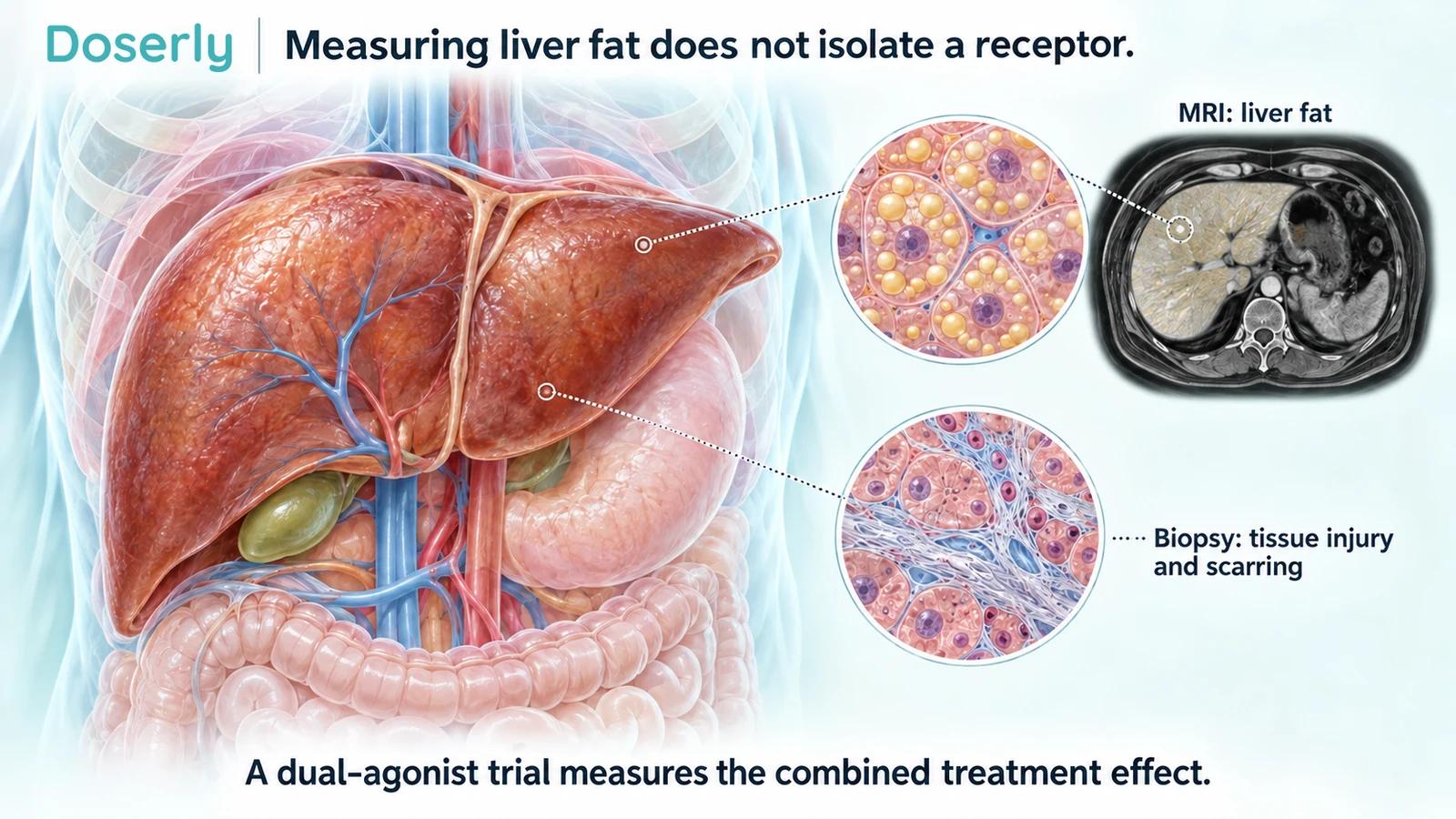
That is a proposed explanation for an effect, not a receptor-specific measurement in the trial participants. An MRI can show that liver fat changed. It cannot identify which receptor caused that change, quantify every metabolic pathway involved or show whether inflammation and scarring improved to the same extent.
A helpful way to read the research is to keep three questions separate. First, can the molecule activate the intended receptors? Second, does treatment change a measurable feature of disease? Third, does it improve outcomes that matter to patients over time? A positive answer to the first makes the second worth testing; it does not answer the third automatically.
The liver is also not isolated from the rest of the body. Weight change, food intake, glucose regulation and other metabolic effects may occur together. Calling every liver-fat reduction a “direct glucagon effect” skips over those interacting possibilities. The clinical question can still be important even when the exact contribution of each pathway remains unresolved.
What the animal study contributes
A 2022 study compared ALT-801 with semaglutide, elafibranor and vehicle in male mice with diet-induced obesity and biopsy-confirmed steatohepatitis. Over 12 weeks, ALT-801 improved several metabolic and liver measures, including body weight, liver fat and markers of inflammation and fibrosis. The study supported advancing the molecule as a candidate for human liver disease. Original mouse study
Those findings cannot rank pemvidutide and semaglutide for human patients. The species, experimentally induced disease, exposures, treatment schedules and endpoints differ from clinical practice. Even a carefully controlled animal comparison is not a substitute for a randomized human comparison using appropriate doses and patient-relevant outcomes.
The study is valuable because it connects receptor design with measurable effects in an intact organism. Its role is strongest as support for a hypothesis and as a way to investigate biology. Its role is weaker when used to predict the exact amount of human weight loss or claim that liver scarring will reverse in a particular patient.
What the first human liver study actually showed
The 12-week randomized trial enrolled 94 people with MASLD, a BMI of at least 28 and MRI-measured liver fat of at least 10%. About 29% had type 2 diabetes. Relative reductions in liver fat were 46.6%, 68.5% and 57.1% across the three pemvidutide groups, compared with 4.4% with placebo. The study also measured weight, liver enzymes and an MRI marker of liver tissue changes. Original MASLD trial
These results support a treatment effect on liver fat in the studied population. They do not split that effect into GLP-1 and glucagon components. The comparator was placebo, not an otherwise identical molecule with its glucagon activity removed. The trial therefore tested the combined intervention.
The pattern across doses also cautions against a simple “more glucagon stimulation means more benefit” story. The middle-dose group had the largest reported average liver-fat reduction at 12 weeks. Small groups and sampling variation make it inappropriate to declare an optimal clinical dose from that ranking. The research doses describe the experiment, not a self-escalation strategy.
One common argument is that liver-fat improvement was large relative to weight loss, so the change must have been independent of weight. That observation can motivate a mechanistic study, but comparing two percentages does not establish independence. Liver fat and body weight are different quantities with different starting values. A correlation analysis or statistical adjustment also needs assumptions; it does not automatically isolate a receptor's causal contribution.
What longer follow-up adds—and what it does not
A subsequent publication followed 64 participants who entered a 12-week extension while retaining their assigned treatment. At 24 weeks in total, relative liver-fat reductions were 56.3%, 75.2% and 76.4% in the pemvidutide groups, compared with 14.0% with placebo. This provided evidence that the imaging effect could continue with longer treatment. Original extension trial
It was an extension of the earlier study, not an independent new replication in another population. People who completed the initial period and continued are a selected group. That does not erase the findings, but it affects how confidently they can be generalized to everyone who might start treatment.
Longer exposure answers a different question from receptor attribution. A sustained imaging response remains a response to the whole drug. It does not, by itself, demonstrate that glucagon activity maintained the response or that the result would be superior to a GLP-1-only medicine at comparable weight loss.
The biopsy trial is a more demanding clinical test
IMPACT studied people with biopsy-confirmed MASH, the inflammatory form of metabolic fatty liver disease, and stage F2 or F3 fibrosis. Its 24-week results supported MASH resolution without worsening fibrosis. They did not establish a statistically significant benefit on the separate primary endpoint of fibrosis improvement without worsening MASH. Original IMPACT report
This distinction is especially useful when assessing the mechanism story. A convincing biological rationale did not make every clinical endpoint positive. A favorable MRI result did not guarantee a successful fibrosis endpoint. Each measurement had to be tested, and the findings need to be described separately.
“Without worsening fibrosis” is a condition attached to the MASH-resolution result. It does not mean existing scar tissue disappeared. Likewise, a statistically inconclusive fibrosis comparison does not prove that no participant improved. It means the trial did not establish the specified treatment benefit with the required statistical evidence.
Glucose effects still require measurement
The glucose-raising role of glucagon is not erased merely by placing GLP-1 activity in the same molecule. The infusion study showed that the combination could moderate that effect under its experimental conditions; it did not guarantee identical glucose responses with every dual agonist or in every population. Original human infusion study
This makes actual glucose outcomes and tolerability part of the development question. A favorable liver-fat response should not be assumed to establish a diabetes indication. Equally, the presence of glucagon activity alone is not enough to predict that a medicine will worsen glucose control. The whole molecule, exposure and patient population must be studied. Keeping the observed outcome separate from a receptor-based prediction avoids both unwarranted reassurance and unwarranted alarm.
What would establish a glucagon-specific advantage?
Several kinds of research could strengthen the case. A carefully designed comparison with a GLP-1-only treatment could test whether the overall dual-agonist strategy produces better outcomes under comparable conditions. Direct measurements of energy expenditure or liver-fat metabolism could investigate proposed pathways. Studies that account for differences in weight change and exposure could further clarify interpretation.
No single design removes every difficulty. Matching weight loss may help with one question while changing the treatment comparison. Measuring metabolism during a brief laboratory visit may not capture months of behavior and adaptation. A mechanistic finding is most persuasive when it fits with reproducible clinical results and a tolerability profile that allows people to remain on treatment.
For patients, the useful conclusion is that pemvidutide's glucagon activity is a serious research rationale, not a finished explanation of every observed benefit. The molecule has progressed from receptor and animal work to human imaging and biopsy trials. The next questions concern the durability, safety and clinical importance of the combined treatment—and whether comparative studies can show what the glucagon component adds.
Explore the research
- Molecular design study — receptor potency and preclinical pharmacokinetics.
- Human glucagon/GLP-1 infusion study — short physiological experiment, not pemvidutide treatment.
- ALT-801 mouse study — preclinical liver-disease model.
- 12-week MASLD trial — randomized human MRI findings.
- 24-week extension — continuation in a selected subset.
- IMPACT primary report — biopsy-defined MASH and fibrosis outcomes.