
Peptides
October 16, 2026
Pemvidutide and MASH: what the IMPACT liver biopsies showed
On this page
Pemvidutide is being developed for liver disease because it combines GLP-1 and glucagon receptor activity, with potential effects on appetite, weight and liver metabolism. Its IMPACT trial went beyond measuring liver fat: researchers examined liver biopsies in people who already had inflammatory fatty liver disease and moderate or advanced fibrosis.
The 24-week findings were encouraging for MASH resolution without worsening fibrosis. The trial did not establish a statistically significant benefit on its other primary endpoint, fibrosis improvement without worsening MASH. Both statements belong in an accurate account of the study. IMPACT primary report.
That distinction is important if you are concerned about liver scarring. Resolving the inflammatory disease pattern is valuable to investigate, but the words “without worsening fibrosis” do not mean that scar tissue disappeared. We'll explain the biopsy outcomes, the later noninvasive findings and what the next phase of research is designed to answer. Our pemvidutide guide covers the wider development program.
What are MASH and fibrosis?
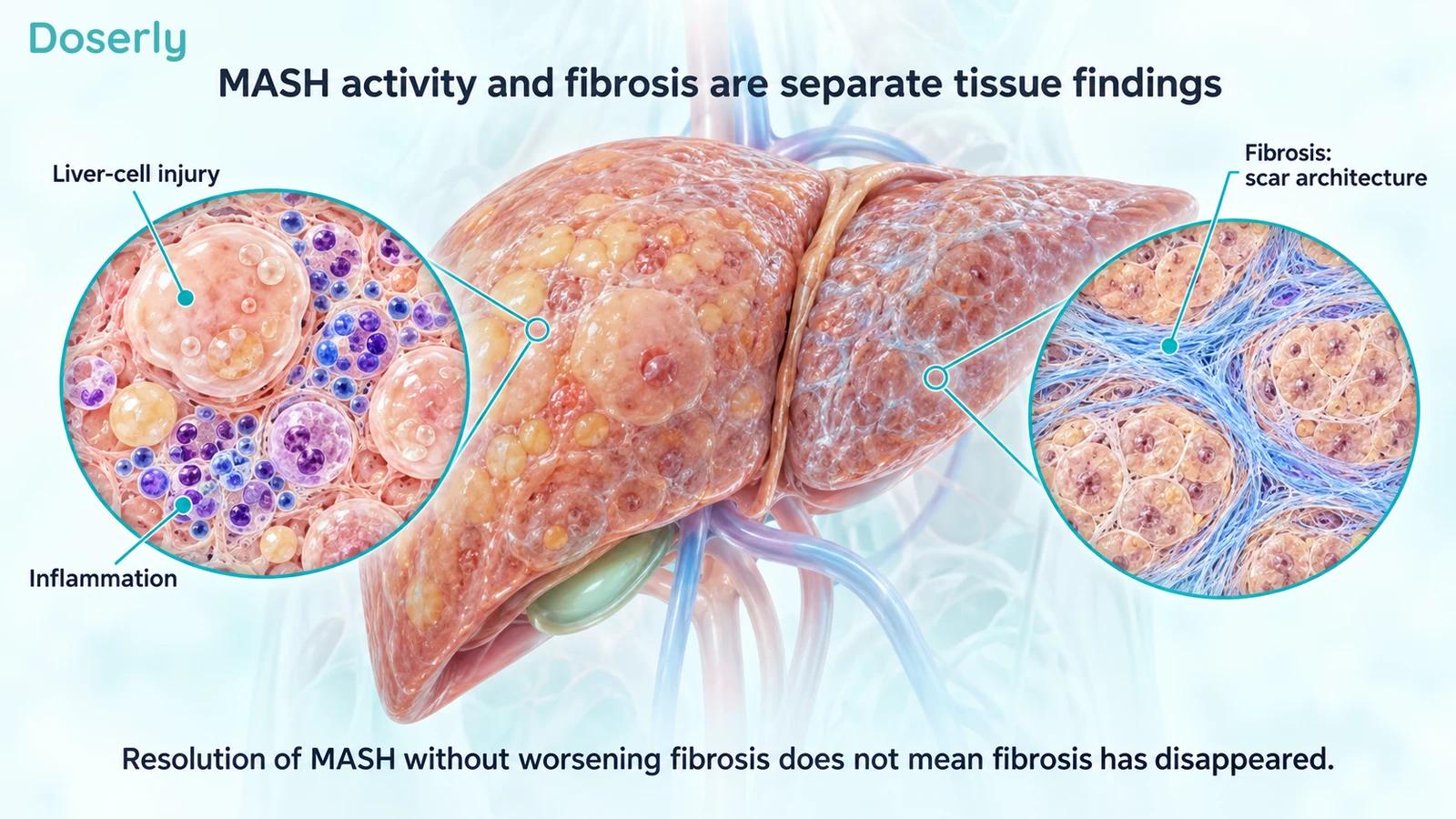
Metabolic dysfunction-associated steatohepatitis, or MASH, is a form of metabolic fatty liver disease involving inflammation and liver-cell injury. Fibrosis is scar tissue that can accumulate with ongoing injury. Researchers stage fibrosis to describe its extent and architecture; F2 and F3 indicate meaningful scarring before the F4 stage associated with cirrhosis. NIH MASLD information.
These are related dimensions of disease. Inflammation can change without a corresponding one-stage fibrosis improvement over the same period. A scarred liver can still require follow-up after an inflammatory endpoint improves.
A biopsy removes a small tissue sample for examination. Pathologists can assess fat, inflammatory activity, injured or ballooned liver cells and scar architecture. It provides information that a fat measurement alone cannot, although the sample represents only a small part of the organ and interpretation has limitations.
Who participated in IMPACT?
IMPACT enrolled 212 people with biopsy-confirmed MASH and F2 or F3 fibrosis at sites in the United States and Australia. Participants were assigned to weekly subcutaneous pemvidutide 1.2 mg, pemvidutide 1.8 mg or placebo. The published randomized groups contained 41, 85 and 86 participants, respectively. Treatment identity was masked. IMPACT.
Eligibility also included BMI of at least 27, MRI-measured liver fat of at least 8%, and a minimum liver-stiffness measurement. Some participants had type 2 diabetes. This was a selected liver-disease population, not a study of everyone with obesity or an incidental fatty-liver finding.
The primary tissue assessment was at 24 weeks, while treatment and other assessments continued through 48 weeks. Three pathologists independently read biopsies while masked to patient, treatment and sampling sequence. The trial was funded by Altimmune, which participated in design, analysis, interpretation and reporting. Primary methods.
Those details help establish where the evidence applies. The study doesn't provide a treatment estimate for healthy people, for every cause of liver disease, or for established cirrhosis. It also cannot tell us what years of treatment will do simply because biopsies changed after six months.
What counted as MASH resolution?
The trial's resolution endpoint required a defined improvement in a tissue activity score, no hepatocyte ballooning, and minimal or absent lobular inflammation, without worsening the fibrosis stage. Hepatocytes are liver cells; ballooning describes an injury-related appearance. The definition is more specific than “a healthier-looking liver.” IMPACT endpoint definitions.
The published model-based response percentages were approximately 58% with 1.2 mg, 52% with 1.8 mg and 20% with placebo. The reported treatment differences versus placebo were 38 and 32 percentage points, respectively. These are response proportions under the trial's analysis, not percentages of liver tissue repaired.
The positive finding means more people receiving pemvidutide met that combined tissue definition. It doesn't mean everyone improved, nor does it mean every responder lost scar tissue. A participant can meet “without worsening” when fibrosis remains at the same stage.
The paper specified a sequential testing order beginning with the 1.8-mg MASH endpoint, followed by its fibrosis endpoint, then the 1.2-mg comparisons. Because the fibrosis test did not succeed, later comparisons in that sequence should not be treated as independent confirmatory successes simply because their nominal p-values are small. The central positive finding remains the MASH-resolution signal, rather than a claim that every primary comparison succeeded.
What happened to fibrosis?
The second primary endpoint required at least a one-stage improvement in fibrosis without worsening the activity score. Reported response percentages were about 33% with 1.2 mg, 36% with 1.8 mg and 28% with placebo. Neither active-versus-placebo comparison was statistically significant. IMPACT primary results.
For the 1.2-mg comparison, the estimated difference was five percentage points, with a 95% confidence interval from −13 to +22. For 1.8 mg, it was eight points, with an interval from −6 to +22. Both intervals include zero, so the data did not clearly distinguish a benefit from no difference at this time point.
This isn't proof that pemvidutide can never affect fibrosis. It is a limit on what this experiment established. Longer treatment, a different study population or a larger study could produce a different answer. Those possibilities do not change the result already observed.
Nor should the numerically higher MASH response at 1.2 mg be used to select a dose. The trial's treatment comparisons were against placebo, the lower-dose group was smaller, and the estimates have uncertainty. The paper doesn't establish that one dose is the best personal choice.
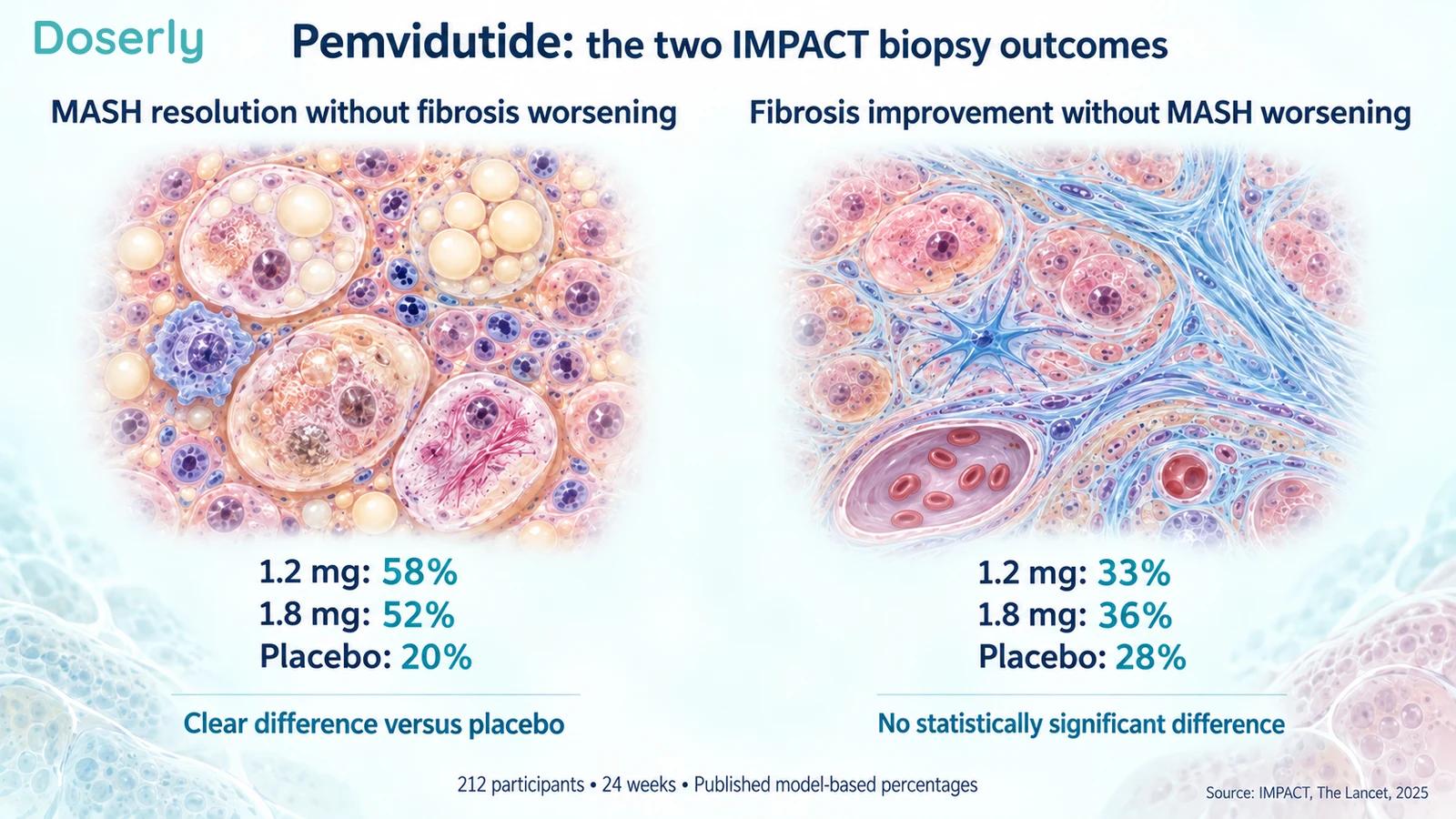
Image sources: Source
Why does the placebo response matter?
A proportion of placebo participants met both kinds of response definition. That is one reason a treated-group percentage cannot be interpreted alone. Changes can reflect background care, variation in disease, sampling and measurement, alongside other influences. Randomization helps researchers estimate the additional effect of assignment to treatment.
If 36% of a treated group meets a fibrosis endpoint, the result sounds very different when the comparison group is 28% than it would if the comparison were 2%. The contrast and its uncertainty are the clinically informative quantities.
Missing assessments matter too. IMPACT treated missing primary outcomes associated with missing biopsies or treatment discontinuation as nonresponse under its analysis strategy. That avoids presenting only the people with favorable completed follow-up as though they represented everyone assigned treatment. It is still an analytical assumption that readers should know about. IMPACT statistical methods.
A future report using a different analysis population or missing-data rule could produce a different percentage. The response definition, population and analysis must travel with the result.
What did the later 48-week results measure?
In December 2025, Altimmune reported improvements in noninvasive tests, including the Enhanced Liver Fibrosis score and liver-stiffness measurements, at week 48. The company also reported further weight reduction in the 1.8-mg group. These were sponsor-reported topline results. 48-week announcement filed with the SEC.
Those findings add information about the course of treatment, but they aren't a new 48-week biopsy endpoint. The trial's primary biopsies were planned at week 24; week-48 follow-up focused on safety, weight and noninvasive measurements.
ELF is a blood-based fibrosis-related score. Liver stiffness estimates a tissue property through an imaging technique. They can be useful indicators, but neither is identical to a pathologist assigning a fibrosis stage to a biopsy. A favorable direction across several tests strengthens the reason to investigate; it doesn't erase the unsuccessful primary fibrosis comparison.
That distinction also prevents a timeline error. “The 48-week study showed fibrosis improvement” can imply a repeated histological result that the report did not provide. The accurate description names the test and the time point.
How should we understand digital pathology findings?
The primary paper included a post-hoc analysis using an AI-based system to estimate the proportionate area of pathological fibrosis in biopsy slides. Post-hoc means the analysis was developed after the original planning stage relevant to the principal test. It can reveal a useful signal, but it has a different evidentiary role from the prespecified primary endpoint. IMPACT.
In May 2026, Altimmune also described EASL conference analyses using qFibrosis, a digital method based on specialized tissue imaging. The announcement reported favorable continuous fibrosis and stage-related findings. This was a report of additional analyses of IMPACT material, not an independent new randomized population. EASL sponsor report.
The methods should not be merged into a single label such as “the AI result.” The primary paper's Liver Explore analysis and the later qFibrosis work use different approaches. A continuous measure of collagen area can change while the architectural features determining a conventional fibrosis stage remain insufficiently changed to cross a category boundary.
These findings may help explain what to examine next. They don't justify silently replacing the original endpoint after seeing which measurement looks most favorable. Replication and validation against meaningful outcomes remain important.
What about tolerability?
At 24 weeks, most reported adverse events were mild or moderate. Adverse-event treatment discontinuation occurred in none of the 41 participants assigned 1.2 mg, one of 85 assigned 1.8 mg and two of 86 assigned placebo. IMPACT safety report.
Low discontinuation is encouraging, but 212 participants and six months of primary follow-up cannot rule out uncommon or delayed harms. It also isn't a head-to-head demonstration that pemvidutide is easier to tolerate than every other medicine used in liver or weight management.
A benefit-risk discussion needs both the outcome being sought and the uncertainty that remains. A promising tissue signal does not make an investigational product appropriate for self-treatment, and a trial regimen is not a personal dosing recommendation.
Does the trial describe everyone with fatty liver?
No. IMPACT's entry criteria selected people with inflammatory disease and established F2–F3 fibrosis, confirmed by biopsy. That is a different clinical starting point from an incidental scan showing fat, and from cirrhosis. The same result should not be assigned to all three groups simply because each involves the liver. IMPACT primary report.
For someone reading because of their own diagnosis, the first useful question is therefore which disease features have actually been established. A clinician can explain whether the concern is fat accumulation, active inflammation, fibrosis or another liver condition, and which evidence applies. Trial percentages cannot resolve that diagnostic distinction on their own.
What is the next trial designed to answer?
In August 2026, Altimmune announced that enrollment had begun in PERFORMA, its phase 3 program. The described design includes biopsy-assessed MASH and fibrosis outcomes at 52 weeks, a broader safety cohort and longer follow-up for liver-related events. These are study plans and development milestones, not completed efficacy results. PERFORMA initiation announcement.
The distinction between tissue and clinical outcomes matters even when a biopsy endpoint succeeds. A surrogate endpoint is a measurement expected to predict a future clinical benefit. Avoiding liver failure, transplantation or death requires longer observation than detecting a change in a tissue score. FDA's review of resmetirom, a different medicine, illustrates why biopsy endpoints and confirmatory clinical follow-up have separate roles. FDA Rezdiffra trial review.
For patients, the most useful questions are concrete: what is my fibrosis stage, which outcome does this evidence address, and how does the proposed treatment fit the care available now? Pemvidutide's MASH signal deserves attention. Its primary fibrosis result and the limits of later analyses deserve equal clarity.
Explore the research
- IMPACT primary report, The Lancet, 2025: population, biopsy definitions, results and safety.
- NIH MASLD information: disease and assessment context.
- Altimmune's 48-week IMPACT report, December 2025: noninvasive measurements, not a new biopsy endpoint.
- Altimmune's EASL 2026 report: additional digital and noninvasive analyses.
- PERFORMA initiation, August 2026: announced phase 3 design, not results.
- FDA Rezdiffra trial snapshot: regulatory context for biopsy-based endpoints in another medicine.