
Peptides
October 16, 2026
MOTS-c and AMPK: what the cellular energy pathway actually explains
On this page
MOTS-c attracts interest partly because of its connection with AMPK, a protein involved in how cells respond to energy demand. If you're hoping to improve metabolic health or exercise capacity, that connection sounds promising. A substance that influences how muscle uses fuel could, in principle, have useful effects.
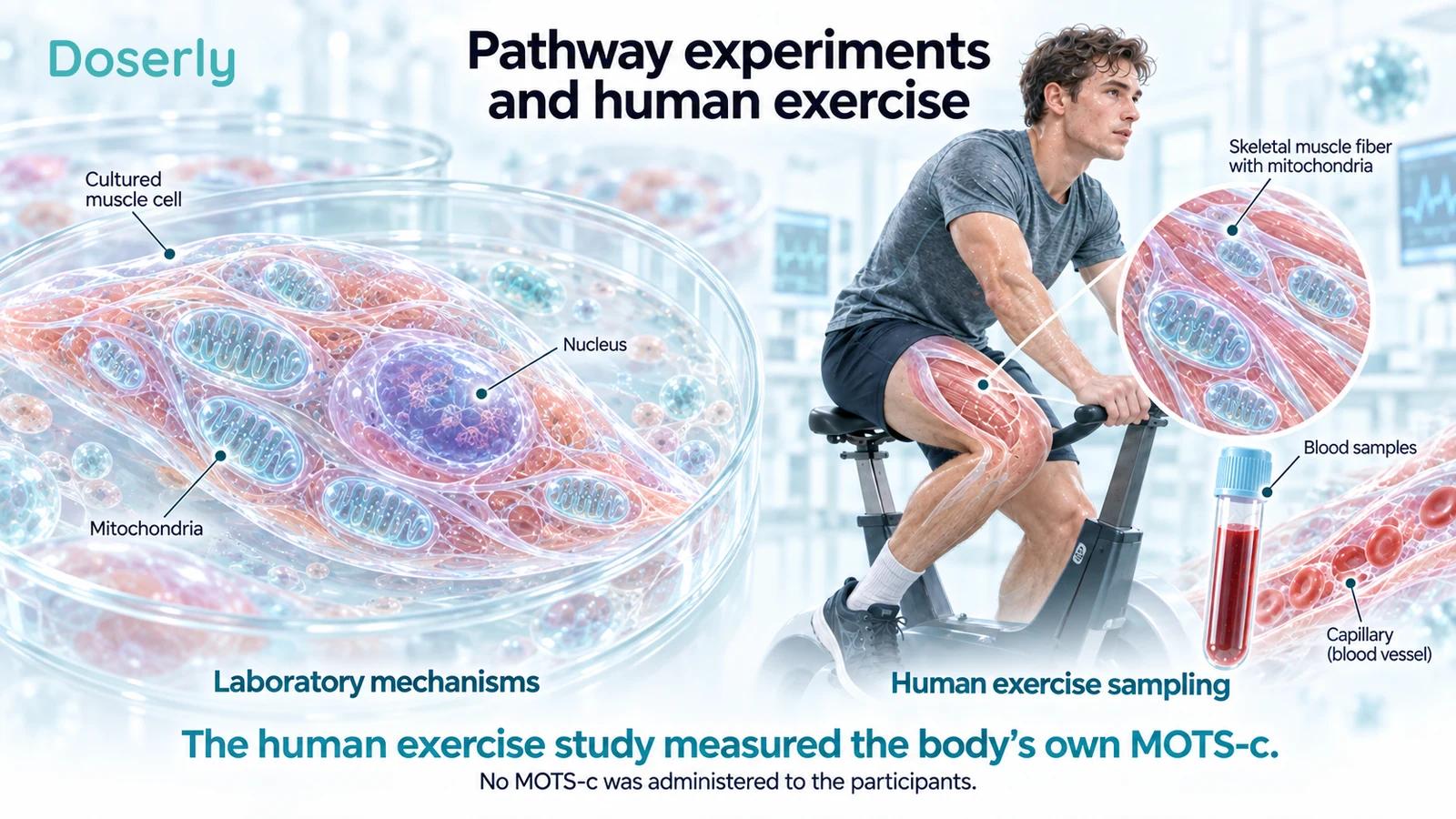
The important question is what researchers have actually connected. Cell and animal experiments link MOTS-c with AMPK-related metabolic responses. Human exercise studies measure the body's own MOTS-c. These findings help explain why scientists are interested, but they do not establish that administering MOTS-c improves human endurance or reproduces the benefits of exercise.
Understanding the pathway makes that distinction clearer. It also shows why describing AMPK as a “fuel gauge” can be a useful starting point but a misleading stopping point. Our MOTS-c guide covers the wider research; this article focuses on what the proposed mechanism means.
What AMPK does in a cell
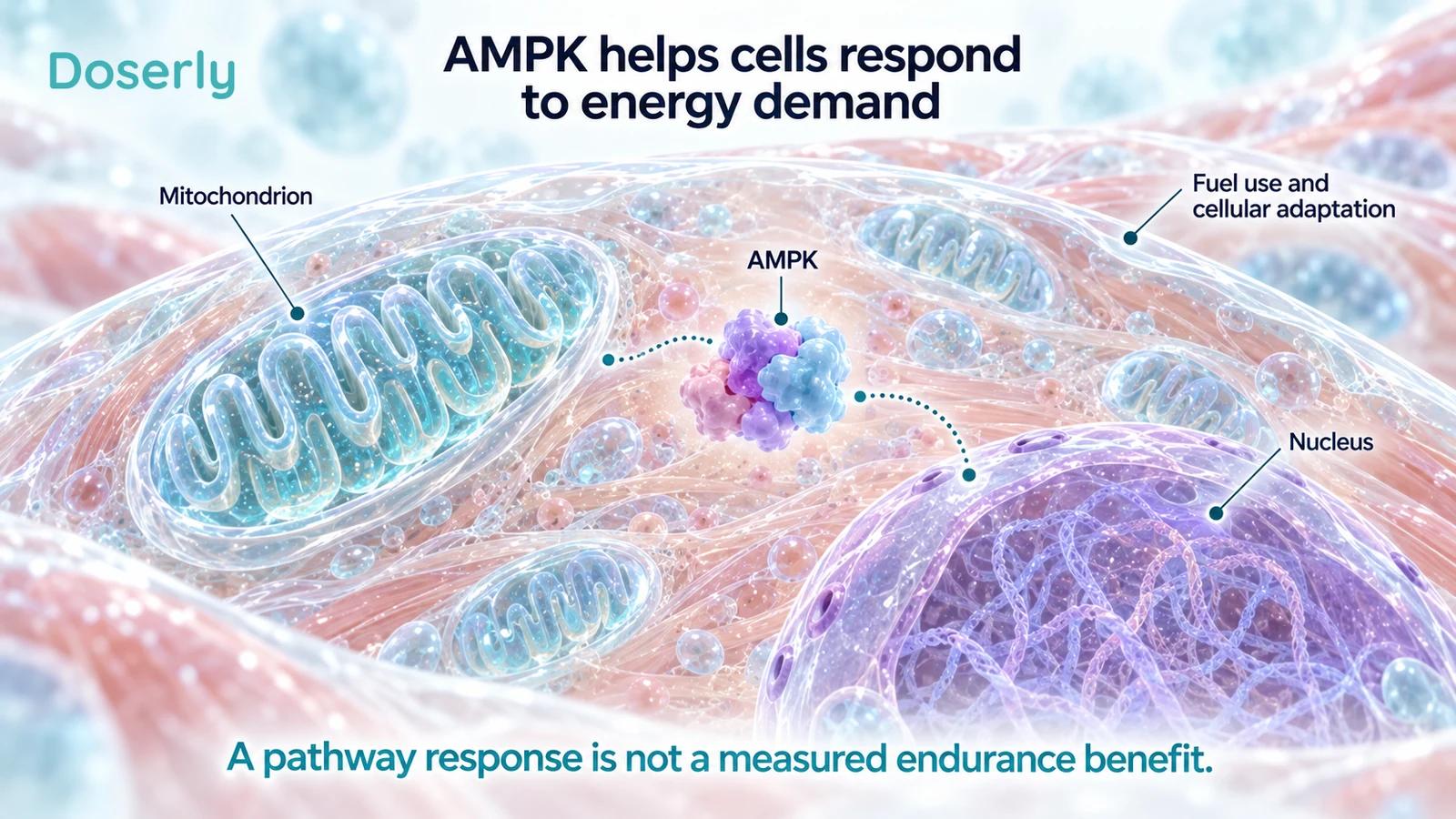
AMPK stands for AMP-activated protein kinase. A kinase is a protein that can add a phosphate group to another molecule, helping change its activity. AMPK participates in coordinating energy use and supply rather than simply displaying how much energy a cell contains.
Cells use ATP to transfer energy for work. As ATP is used and regenerated, related molecules including ADP and AMP help communicate the cell's energetic state. AMPK is part of the response to those changing conditions. Calling it a fuel gauge captures the idea that energy status matters, but leaves out the active decisions that follow.
The response can affect how fuels are processed and which energy-consuming activities receive priority. This is why researchers study AMPK in relation to glucose and fat metabolism. In the foundational MOTS-c work, the investigators linked the peptide with a folate–purine–AMPK pathway and changes in cellular metabolism. Lee and colleagues, 2015
A gauge also suggests that one reading summarizes the whole organism. AMPK biology is more local and conditional. A measurement in cultured cells, a muscle specimen or an animal experiment describes that system at the sampled time. It isn't a score for a person's overall energy, fitness or biological age.
How MOTS-c became connected with AMPK
The original 2015 study identified MOTS-c as a short peptide associated with mitochondrial genetic information and investigated its metabolic effects. The researchers reported changes involving the folate cycle and purine synthesis, with accumulation of AICAR, a metabolic intermediate linked to AMPK activation. Cell experiments and mouse studies supported a role in glucose handling and metabolic regulation. Original discovery report
That sequence matters because “MOTS-c activates AMPK” can sound like a complete description of a direct drug–receptor interaction. The evidence instead involves a network of metabolic changes. Knowing that a pathway participates in an effect doesn't mean every step, target and tissue response has been established.
Folate is familiar as a nutrient, but the folate cycle here refers to a set of cellular chemical reactions. Purine synthesis concerns building molecules used in several essential cellular processes. Neither term turns this experimental mechanism into advice to alter folate intake, add another supplement or combine substances to amplify a response.
For a treatment, the next questions would be practical: what exposure reaches the relevant tissue, how long it lasts, which effects occur at that exposure and whether the person benefits. The discovery experiments generated a biological rationale. They did not answer those human treatment questions.
A pathway can be necessary without explaining everything
Researchers often investigate a mechanism by interrupting part of it. If a response becomes smaller when AMPK activity is disrupted, that supports AMPK's involvement under the experimental conditions. It is stronger mechanistic evidence than observing two changes side by side.
Even so, the conclusion has limits. The pathway may be necessary for one measured effect while other pathways explain different effects. The experimental intervention used to disrupt it can also affect the system in additional ways. Researchers therefore look for agreement across methods and models rather than treating one manipulation as a universal explanation.
A 2026 primary study specifically examined MOTS-c and intrinsic muscle mitochondrial bioenergetics. Its reported findings connected mitochondrial responses with both AMPK and PGC-1α, a protein involved in coordinating gene activity. It also examined human exercise-related measurements, which are distinct from the experimental administration work. Gudiksen and colleagues, 2026
For readers, the important advance is a more specific question about mechanism: which cellular machinery is required for a particular response? The paper's pathway-dependent result is not a clinical estimate of how much faster a person would run, how much weight they would lose or whether they would feel less fatigued.
MOTS-c also connects with the nucleus
A cell's nucleus contains most of its genetic information. Mitochondria have their own genetic material, and communication between these parts of the cell helps coordinate responses to changing conditions.
In a 2018 laboratory study, metabolic stress was associated with MOTS-c moving into the nucleus through an AMPK-dependent process. The researchers reported effects on nuclear gene regulation, including stress-responsive pathways. This expanded the proposed biology beyond a simple change in immediate fuel use. Kim and colleagues, 2018
The finding helps explain why the phrase “turning on the fuel gauge” is incomplete. Cellular adaptation can involve where molecules are located, which genes are active and how the cell responds over time. It isn't one switch with a single predictable consequence.
It also gives a useful boundary to the illustration. A diagram can show a conceptual relationship between mitochondria, cytoplasm and nucleus. It cannot show that a person's tissues have been rejuvenated, that damaged DNA has been repaired or that a treatment has reversed aging unless studies actually establish those outcomes. The nuclear-localization experiment did not establish those claims in people.
What animal metabolism studies add
Animal studies allow investigators to examine a whole organism while controlling factors such as diet and treatment exposure. They can connect a cellular hypothesis with changes in blood metabolites, tissue biology and function. They also involve species, doses and experimental conditions that differ from human care.
A 2019 mouse study examined plasma metabolites after MOTS-c administration in diet-induced obesity. The report described changes in several metabolic pathways and insulin sensitivity. The experiment used six mice per group and a short treatment period. It adds information about how the peptide may affect metabolism in that model, rather than establishing a treatment effect in people with diabetes. Kim and colleagues, 2019
Notice the distinction between metabolites, the small molecules involved in chemical reactions, and a person's clinical outcome. A metabolite pattern can suggest what a treatment is doing. It doesn't by itself tell us whether that treatment reduces symptoms, prevents disease complications or remains safe over months or years.
The appropriate next step is to test a defined human question, not to translate the animal schedule into a personal protocol. A mechanism can help researchers choose measurements for such a trial, but cannot replace the trial.
Does exercise use the same machinery?
Exercise changes energy demand in working muscle, so overlap with energy-regulating pathways is plausible. But an overlap is not equivalence. Exercise is a coordinated activity involving muscle contraction, circulation, oxygen delivery, neural control and recovery. Sharing one signaling pathway does not reproduce that entire process.
In the human portion of the 2021 Reynolds study, ten sedentary healthy young men completed stationary cycling. Researchers measured endogenous MOTS-c in blood and muscle around the exercise session. They observed increases associated with exercise; participants did not receive MOTS-c as a drug. Separate mouse experiments in the same paper examined administered peptide and physical performance. Reynolds and colleagues, 2021
That separation is easy to lose when a headline summarizes the entire paper. “MOTS-c and exercise in humans” accurately describes the sampling experiment. “MOTS-c improves human endurance” would require an administration trial measuring human endurance, which that experiment was not.
The 2026 bioenergetics paper adds another nuance: the authors reported increased interstitial MOTS-c during human exercise without a corresponding change in the arterial–venous difference. That finding questions a simple assumption that exercising muscle necessarily explains circulating changes. Gudiksen and colleagues
The direction of communication and the source of a circulating signal remain research questions. A neat arrow from muscle to blood can overstate what has been measured.
Why more pathway activity doesn't automatically mean more benefit
A biological response has a purpose and a context. Its usefulness depends on the tissue, the initial condition, the size of the change and its duration. Treating a pathway as a score to maximize removes those details.
For example, a study could show a signaling change after treatment while finding no improvement in the chosen functional outcome. That would still be informative: the treatment affected the measured biology, but the hoped-for benefit didn't follow under those conditions. Conversely, a clinical benefit might occur without confirming the proposed pathway, leaving its explanation unresolved.
These are different questions, and a good study can investigate both. The relevant human outcomes might include a defined measure of insulin sensitivity, a standardized exercise test or a symptom scale. The choice should follow the health question rather than whichever laboratory marker is easiest to change.
This is also why a blood MOTS-c concentration isn't an AMPK activity test. They are measurements of different things. A high circulating result cannot be assumed to mean stronger muscle AMPK signaling, and a low result cannot identify a dose needed to restore it.
What remains unknown about administration in people
FDA's July 2026 assessment of MOTS-c-related bulk drug substances identified substantial gaps in human administration evidence, including pharmacokinetic, safety and effectiveness information. Pharmacokinetics describes what the body does to a substance, including its distribution and clearance. Without adequate human data, a pathway diagram cannot tell us a reliable exposure, dosing interval or benefit–risk balance. FDA briefing, pages 27–30
Modified molecules also need to be kept separate from the native peptide. A drug candidate designed from MOTS-c may behave differently, so results for an analogue cannot simply be assigned to MOTS-c itself. Likewise, evidence for a different AMPK-related substance is not interchangeable evidence for this peptide.
The unresolved questions don't erase the mechanistic findings. They explain why the findings remain a rationale for research rather than a proven personal treatment strategy. In particular, there is no basis here for choosing a combination or sequence intended to “activate AMPK harder.”
How to discuss an AMPK claim usefully
When someone proposes MOTS-c for energy or metabolic health, ask what outcome they expect to improve and which human study measured it. Then ask how the proposed mechanism relates to that outcome. This makes it possible to discuss promising biology without confusing it with established benefit.
A clear answer should identify the molecule, the study population and whether the finding comes from cultured cells, animals, endogenous human measurements or an actual treatment trial. It should also distinguish the proposed biological explanation from the result the person would notice.
AMPK is a useful part of the MOTS-c story because it gives researchers specific hypotheses to test. It is not a shortcut around questions of human exposure, safety and meaningful outcomes. For the wider picture, the MOTS-c guide explains how this mechanism fits with the existing research and its remaining gaps.
Sources
- Lee and colleagues, 2015: foundational cellular and mouse research connecting MOTS-c with metabolic regulation.
- Kim and colleagues, 2018: AMPK-dependent nuclear localization under metabolic stress.
- Kim and colleagues, 2019: metabolomics in diet-induced obese mice.
- Reynolds and colleagues, 2021: human endogenous exercise measurements and separate mouse treatment experiments.
- Gudiksen and colleagues, 2026: AMPK/PGC-1α-related mitochondrial responses and human exercise measurements.
- FDA MOTS-c briefing, July 2026: human administration evidence gaps.