
Peptides
October 16, 2026
Can MOTS-c improve human endurance? What exercise studies have tested
On this page
MOTS-c is a small peptide connected with cellular responses to energy demand. Researchers have found that exercise changes the body's own MOTS-c measurements, and experiments administering the peptide to rodents have reported improvements in physical performance. Those findings explain the interest in it as a possible endurance treatment.
They don't yet answer the question most people mean: would taking MOTS-c help me cycle longer, run faster or tolerate activity better? The human exercise studies discussed here measured endogenous MOTS-c, the peptide already present in the body. They did not give it to participants and compare their endurance with placebo.
The distinction becomes clearer when we examine the actual tasks, participants and measurements. It also helps separate endurance from related ideas such as muscle strength, cellular energy production and feeling less tired. Our MOTS-c guide covers the broader biology and safety questions.
What counts as endurance?
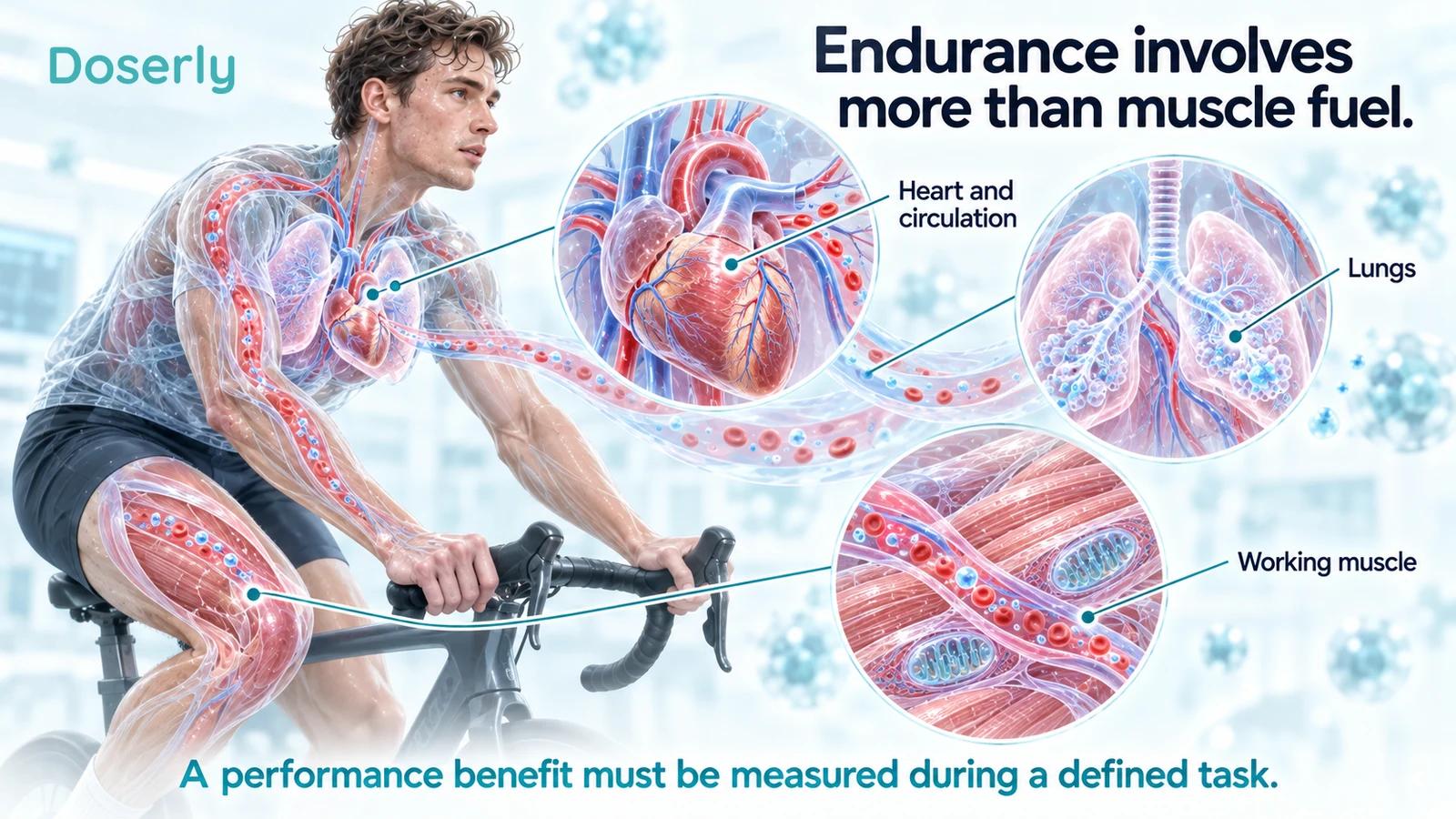
Endurance concerns sustaining a task over time. A runner completing a fixed distance faster, a cyclist maintaining a workload longer and someone with illness walking farther are all functional outcomes, but they describe different tasks and populations.
Time to exhaustion measures how long a participant continues under a specified protocol. A time trial measures the time needed to finish a set amount of work or distance. These are not interchangeable tests. A percentage improvement in one cannot be assumed to produce the same percentage improvement in the other, especially across species.
Muscle strength is different again: it concerns the force someone can produce. A blood measurement concerns a substance in circulation. A scan or tissue experiment might investigate how muscle produces energy. These can help explain performance, but they do not substitute for measuring the performance itself.
This matters particularly for people with fatigue. Being less tired during daily life and tolerating a laboratory cycling test are both worthwhile goals, but a study needs to specify which one it is trying to improve. Otherwise, the phrase “more energy” can conceal several different questions.
The human cycling study measured a response to exercise
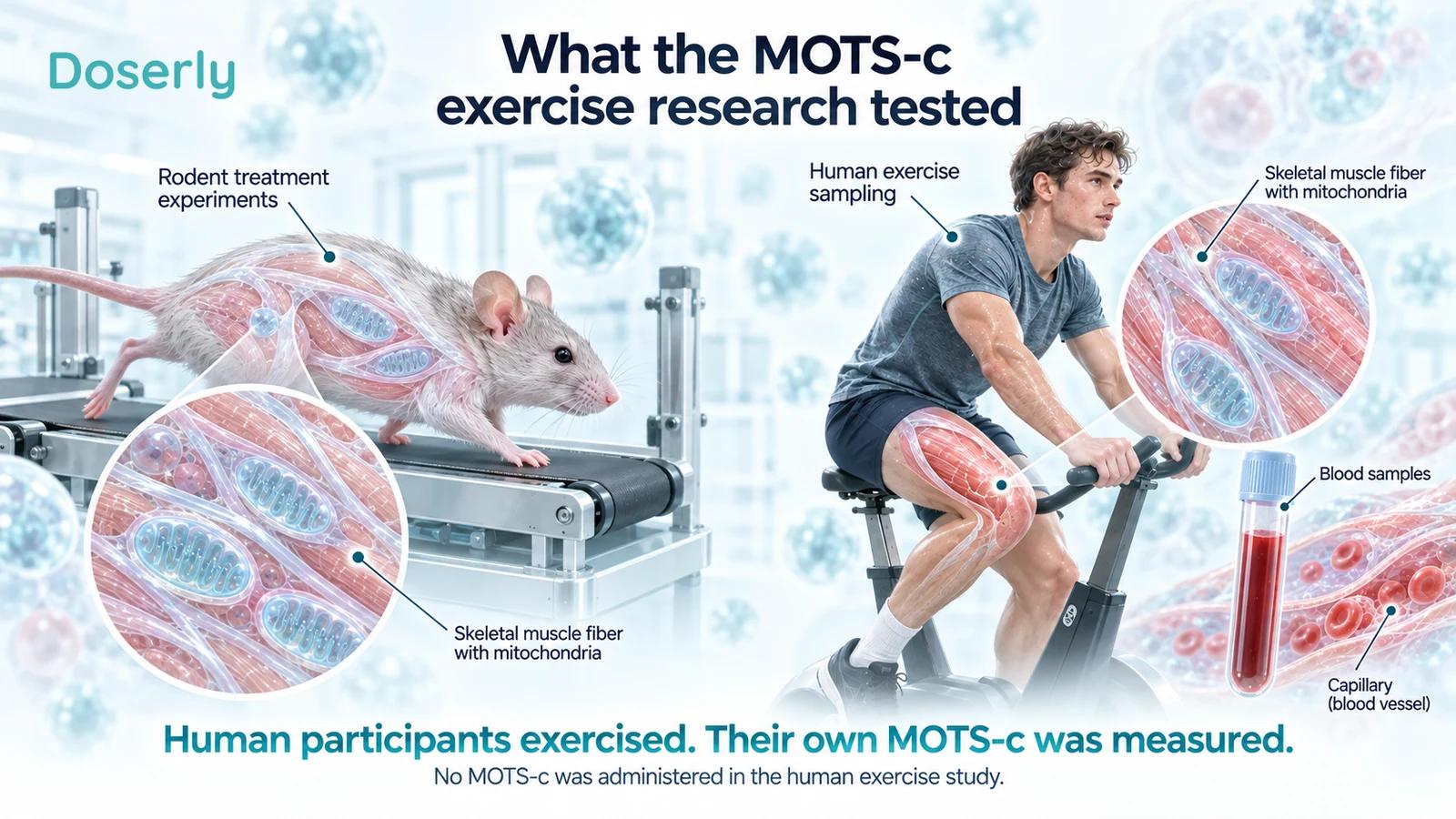
The human portion of a 2021 study involved ten sedentary healthy young men. They completed a stationary-bike exercise session, and investigators collected muscle and blood samples around exercise and recovery. MOTS-c measurements rose with exercise; circulating measurements returned toward baseline after four hours of rest. Reynolds and colleagues, 2021
This is a useful finding about human physiology. It suggests that MOTS-c participates in, or accompanies, the response to exertion. The study did not randomly assign those men to MOTS-c or placebo, and it did not show that giving additional peptide improved their performance.
The small, narrowly defined cohort also matters. The participants were young men who were sedentary but otherwise healthy. Their response does not establish the same pattern in trained athletes, older adults, women or people whose exercise capacity is limited by disease.
A rise during exercise also doesn't establish that the rise caused the exercise benefit. Exercise changes many processes at once. A measured substance might contribute to adaptation, reflect that adaptation or respond to another part of the exercise stimulus. Those possibilities require different experiments to separate.
Why the same paper can sound like a treatment trial
The Reynolds paper also included mouse experiments in which MOTS-c was administered and physical performance was assessed. Those experiments are a different part of the study from the human blood and muscle sampling. Its broad findings therefore span both an endogenous human response and experimental treatment in animals. Original report
A summary that compresses the whole paper into “MOTS-c improves exercise performance and was studied in humans” can accidentally merge those two lines of evidence. The reader may reasonably imagine a human treatment trial that did not occur.
The most useful way to read a mixed-species paper is to attach each verb to its subject. Who received the peptide? Who exercised? Whose samples were collected? Which group showed a functional change? Those questions preserve the actual finding without dismissing the animal work.
Rodent performance results can justify further development. They can identify promising mechanisms, suitable measurements and reasons to investigate safety. They do not provide a human effect size or an established administration schedule.
What did the later single-dose performance study involve?
A 2022 primary paper examined long-term physical activity, muscle MOTS-c and acute performance after an administered dose. Its experiments involved rodents. The report described increased muscle MOTS-c after sustained voluntary activity and improved acute exercise performance after peptide administration. Hyatt, 2022
The “single dose” phrase is especially easy to overinterpret. It describes a particular experimental exposure in an animal model, followed by a particular performance assessment. It does not establish a one-dose human endurance benefit, a reliable time to effect or a safe regimen for an athlete.
Nor do the training and administration findings mean those interventions are equivalent. Long-term exercise changes the animal through repeated activity; an acute peptide experiment tests a different exposure. A shared association with MOTS-c does not make every consequence of training reproducible through administration.
The practical information for a human reader is that the performance hypothesis has animal support. The unresolved step is testing it directly in people with a defined goal and an appropriate comparison.
Does newer mitochondrial research close that gap?
A 2026 mechanistic study investigated MOTS-c and muscle mitochondrial bioenergetics, with findings involving AMPK and PGC-1α, proteins connected with metabolic regulation and gene activity. It also examined human exercise-related measurements. The authors reported increased interstitial MOTS-c without a corresponding arterial–venous difference during exercise, raising questions about how muscle relates to circulating peptide. Gudiksen and colleagues, 2026
Interstitial refers to the space around cells. An arterial–venous comparison examines blood arriving at and leaving a tissue. These measurements can help investigate local production, uptake or release. They do not directly measure whether administering peptide lets a person complete more exercise.
This is valuable progress because it makes the biological model more specific. It also shows why the familiar description of MOTS-c as a simple muscle-to-blood exercise signal remains incomplete. Better understanding of a mechanism can refine the treatment hypothesis while leaving the treatment question unanswered.
What about CB4211 human results?
CB4211 is a modified molecule developed from MOTS-c, rather than the native peptide itself. CohBar's original 2021 presentation described a four-week randomized phase 1b study in adults with obesity and fatty liver. Twenty-three participants were randomized and twenty completed the final assessments. Safety and tolerability were the main objectives; metabolic and liver-related measurements were exploratory. Original sponsor presentation filed with the SEC
That is human administration evidence for a related drug candidate. It is not a native MOTS-c endurance trial. The molecule, population and outcomes differ from the question of whether a healthy person can improve athletic performance.
The source also matters: these were sponsor-reported early results, not a large confirmatory trial. Even if an exploratory metabolic marker improves, the result cannot be converted into a prediction about running or cycling. It would take a study measuring those outcomes to make that connection.
What does the regulatory review say about human administration?
FDA's July 2026 review of MOTS-c-related bulk drug substances reported that it had not identified clinical studies or human exposure data adequate to assess administration of the substances under review. It identified gaps in human pharmacokinetics and safety as well as effectiveness evidence. FDA briefing, pages 27–30
This is consistent with the central distinction in the exercise literature: measuring a peptide produced by the body does not establish the effects of administering it. The briefing should not be misread as a claim that nobody has ever used MOTS-c. It describes the evidence available to the agency's evaluation, not a complete record of every personal experience.
Safety uncertainty matters to an endurance claim because benefit and harm belong in the same assessment. An athlete or patient would need to know more than whether a performance signal is plausible. They would need reliable information about the exposure, adverse effects and whether the benefit persists.
What would a useful human endurance trial need to show?
The first choice would be the population. A study in trained cyclists asks a different question from a study in sedentary adults or patients with exercise intolerance. Participants' baseline capacity and training background would shape both the expected change and its usefulness.
The trial would then need a defined formulation, randomized comparison and performance outcome chosen in advance. Repeated testing should use consistent conditions, and familiarization can help separate learning the test from improving physical capacity. If participants train during the study, the training exposure needs to be accounted for.
The result should show the difference between treatment and control, with uncertainty around that difference. Improvement from a person's own baseline is not enough: a control group may also improve through training, familiarity or ordinary variation. Adverse events, withdrawals and follow-up after treatment would be part of the result.
Measurements of MOTS-c, muscle metabolism or signaling could help explain what happened. They would complement the functional outcome, rather than replace it. A trial might find a biological response without an endurance benefit; that would answer an important question too.
How to use this evidence if your goal is better performance
The available research supports interest in MOTS-c as an exercise-related signal and a potential therapeutic candidate. It does not supply a proven human endurance benefit or a reliable estimate of its size.
If someone offers MOTS-c specifically to improve performance, ask for the human administration study that tested the same molecule and the outcome you care about. A study of endogenous blood levels, a rodent treadmill experiment or early results for CB4211 answers a different question. Clarifying that difference makes the conversation more useful than debating whether the peptide is simply “promising” or “unproven.”
If your concern is a new loss of exercise capacity, describe the change and its impact to a clinician rather than assuming a mitochondrial peptide deficiency. The MOTS-c guide provides background for discussing its mechanisms and remaining treatment uncertainties without turning the exercise findings into a dosing plan.
Sources
- Reynolds and colleagues, 2021: endogenous sampling in ten young men and separate mouse treatment experiments.
- Hyatt, 2022: rodent activity, muscle expression and acute administration experiments.
- Gudiksen and colleagues, 2026: mitochondrial mechanisms and human exercise measurements, not a human endurance-treatment trial.
- CohBar original presentation, 2021: sponsor-reported CB4211 phase 1 findings.
- FDA MOTS-c briefing, July 2026: human administration, safety and effectiveness evidence gaps.