
Peptides
October 16, 2026
Mazdutide versus tirzepatide: what their different targets tell us
On this page
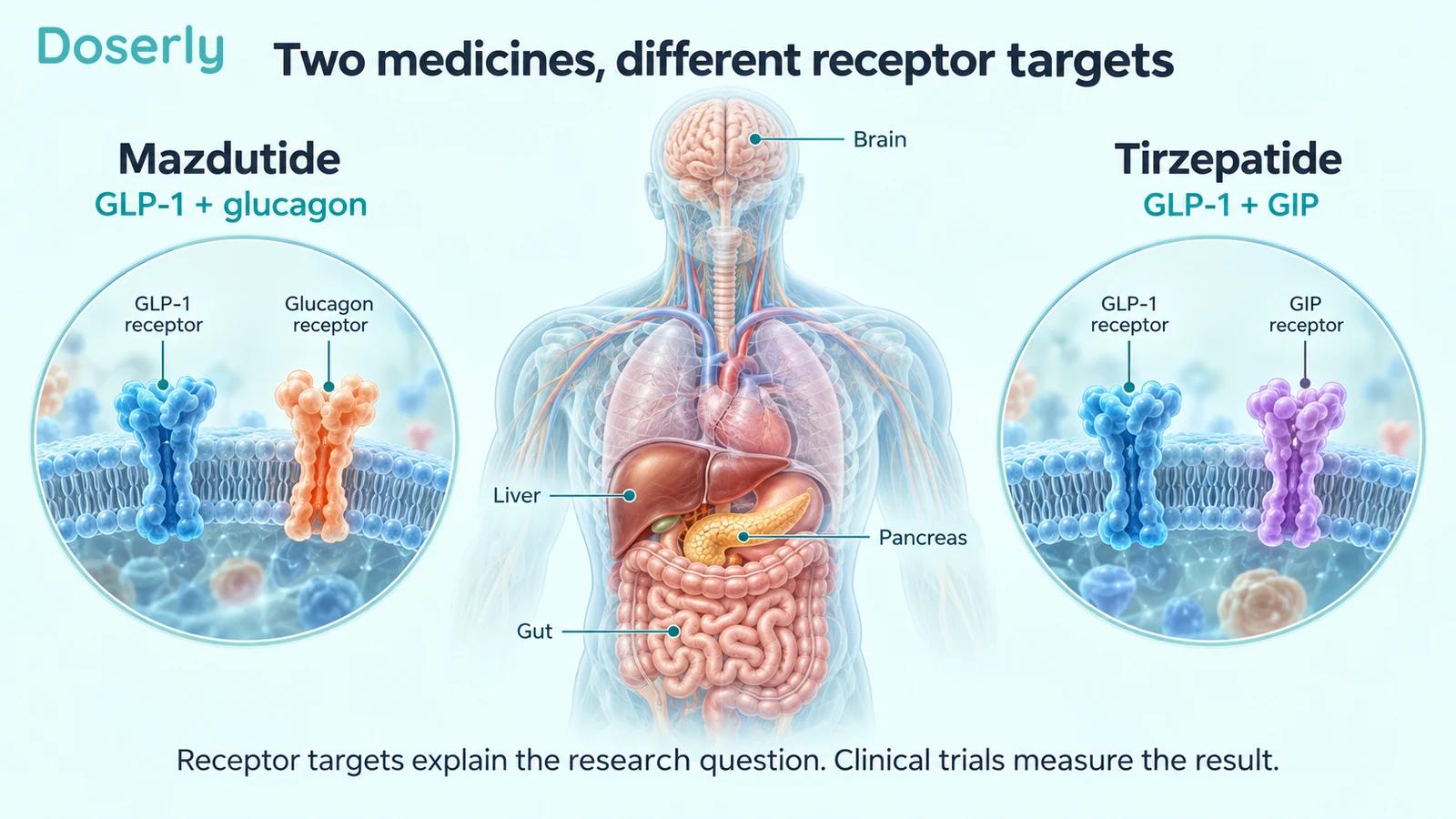
Mazdutide and tirzepatide both act on hormone receptors involved in appetite and metabolism. Each activates two receptor types, but they share only one of them. Mazdutide targets GLP-1 and glucagon receptors; tirzepatide targets GLP-1 and GIP receptors. That difference gives scientists good reasons to study them separately. It doesn't tell someone choosing treatment which medicine will produce better weight loss, fewer side effects or a healthier liver.
The useful comparison begins with your health question. Someone managing diabetes may prioritize blood-sugar control. Someone with obesity and heart failure needs evidence about symptoms and serious heart-failure events. Someone worried about fatty liver needs to know whether a study measured fat, inflammation or scarring. A receptor diagram cannot answer all three questions.
Below, we'll connect the biology with the human trials and explain why widely shared weight-loss percentages aren't a direct contest. Our mazdutide guide and tirzepatide guide provide the broader background on each medicine.
What do GLP-1, GIP and glucagon do?
GLP-1, short for glucagon-like peptide-1, helps coordinate responses to eating. GLP-1 receptor activation can influence appetite, glucose-dependent insulin secretion and stomach emptying. GIP, glucose-dependent insulinotropic polypeptide, is another hormone involved in the response to nutrients. Tirzepatide activates both receptors. Its clinical effects come from the whole drug acting in a person, rather than two independent effects that can simply be added together. Tirzepatide prescribing information.
Glucagon helps the body maintain fuel availability, including by affecting glucose production in the liver. Scientists are interested in combining glucagon-receptor activity with GLP-1 activity because the combined approach could influence body weight and metabolism differently from either pathway alone. Mazdutide was developed around that idea. Its early human research assessed safety, drug exposure and weight change, rather than assuming that the proposed combination would work. First mazdutide phase 1b study.
The word agonist means a substance activates a receptor. “Dual agonist” tells you that two receptor types are involved. It does not describe how strongly a particular dose affects each receptor in every tissue, how long the effect lasts, or how much weight a person will lose. Two medicines can therefore both be dual agonists while differing in clinically important ways.
Nor does a shared target make medicines interchangeable. A milligram is a mass measurement, not a standardized unit of GLP-1 activity. Comparing 6 mg of one molecule with 15 mg of another doesn't establish that one delivers more treatment or is more potent. The meaningful comparison is between the tested regimens and their outcomes.
What did the main mazdutide obesity trial find?
GLORY-1 randomly assigned 610 adults in China to weekly mazdutide 4 mg, mazdutide 6 mg or placebo for 48 weeks. Participants qualified with a BMI of at least 28, or 24 to below 28 plus a weight-related condition. Average starting BMI was 31.1 and weight was 87.2 kg. Its main weight endpoints were assessed at week 32. GLORY-1 primary report.
At week 48, average weight change was −11.00% with 4 mg, −14.01% with 6 mg and +0.30% with placebo. These are changes within the assigned groups. For example, subtracting the placebo change from the 6-mg change gives a 14.31-percentage-point difference, not an observed 14.31% loss in the treated group.
The analysis assessed treatment effects regardless of early discontinuation or starting another obesity treatment. This matters because it addresses the consequences of assignment to a treatment strategy, including circumstances in which people don't remain on the original regimen. Gastrointestinal events were most common and mostly mild or moderate. The trial was funded by Innovent. GLORY-1.
Those findings establish that mazdutide reduced weight compared with its placebo group. They don't tell us how the same participants would have done on tirzepatide. There was no tirzepatide arm to supply that answer.
How does that compare with tirzepatide's obesity evidence?
SURMOUNT-1 randomized 2,539 adults without diabetes to weekly tirzepatide 5, 10 or 15 mg, or placebo, for 72 weeks. Eligibility included BMI of at least 30, or at least 27 with a weight-related complication. Treatment included a 20-week dose-escalation period. Average weight changes were −15.0%, −19.5% and −20.9%, respectively, compared with −3.1% on placebo. SURMOUNT-1 primary report.
These are substantial reductions. But placing the largest tirzepatide percentage beside GLORY-1's largest percentage leaves out differences in follow-up, eligibility, starting body size and treatment schedules. Even the placebo groups moved differently: one lost weight on average, while the other had a small gain. That alone shows why the trials cannot be treated as if their participants came from one shared randomized experiment.
Subtracting each trial's placebo result improves the description of each trial. It does not automatically remove differences between trials. A formal indirect comparison must make assumptions about whether the populations and methods are sufficiently comparable. A social-media graphic that subtracts two percentages rarely examines those assumptions.
The practical conclusion is specific: both medicines have randomized evidence of weight reduction against placebo. The size of the published percentages does not by itself establish which would be better for the same person under the same conditions.
What does a genuine head-to-head comparison look like?
SURMOUNT-5 offers a useful example, although it compared tirzepatide with semaglutide, not mazdutide. Researchers randomized 751 adults with obesity without diabetes to the maximum tolerated doses specified for the two medicines and followed them for 72 weeks. Mean weight change was −20.2% with tirzepatide and −13.7% with semaglutide. The trial was open-label, meaning treatment identity was known. SURMOUNT-5.
Randomization within one study makes the comparison more informative than borrowing percentages from separate trials. Both groups were recruited under the same rules, followed on the same schedule and assessed using a common analysis. The open-label design remains a limitation, but it does not erase the value of the direct comparison.
It would be a mistake to substitute mazdutide for semaglutide in that conclusion. Sharing GLP-1 activity does not make mazdutide the drug that was tested. A result belongs to the actual treatments, doses, participants and follow-up period in the experiment.
Mazdutide also has an active-comparator diabetes trial against dulaglutide, another GLP-1 medicine. DREAMS-2 found greater reductions in HbA1c with the studied mazdutide doses than with dulaglutide 1.5 mg in adults receiving background oral diabetes medicines. That answers a diabetes question against a particular comparator; it does not establish superiority over tirzepatide for obesity. DREAMS-2 primary report.
Does glucagon activity mean better liver or heart outcomes?
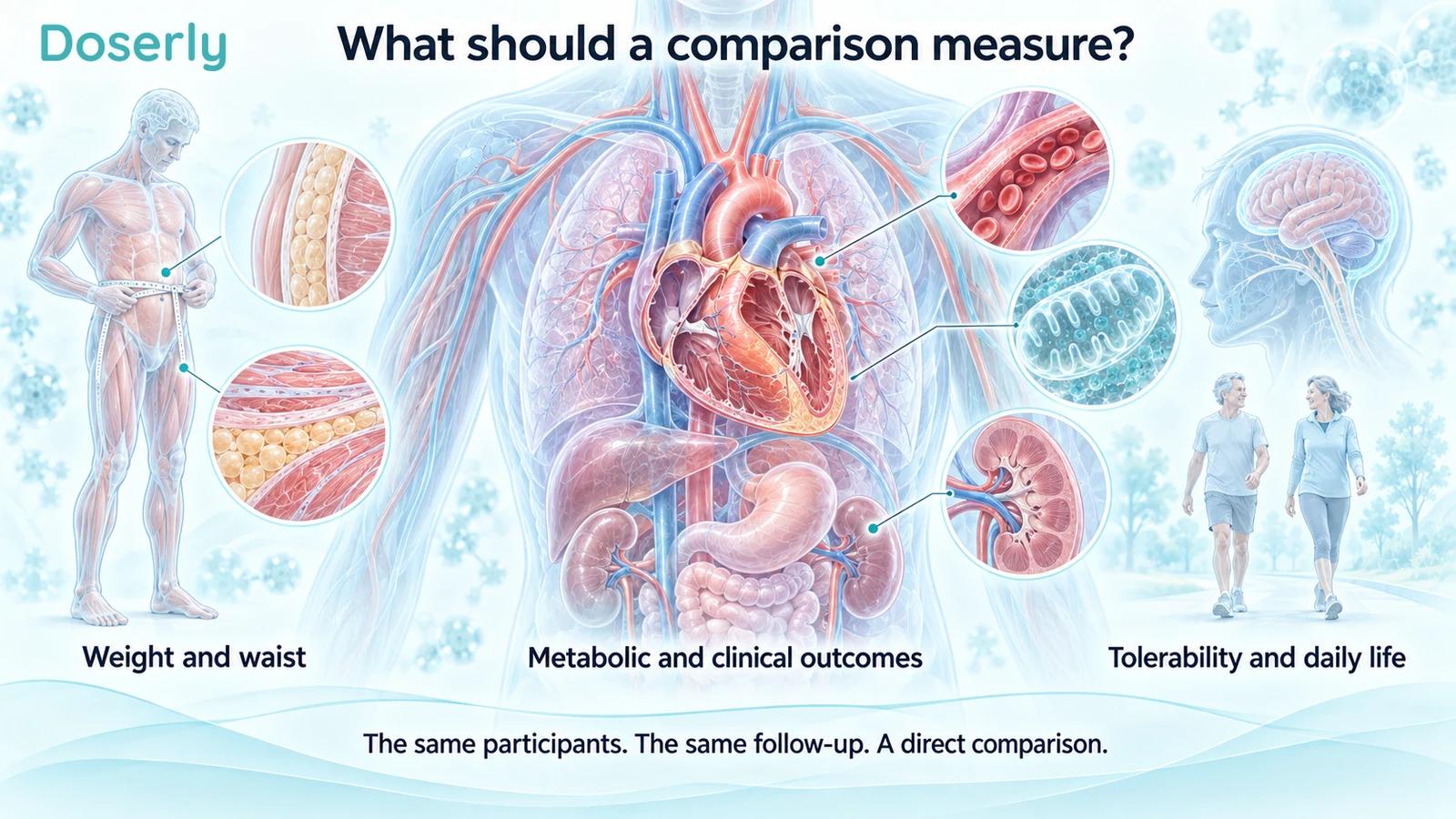
It creates a biological question worth investigating. It does not establish the answer. A change in liver fat is different from a change in liver scarring, and either is different from preventing liver failure. Similarly, changes in blood pressure or cholesterol are different from a reduction in heart attacks or heart-failure events.
For illustration, tirzepatide's SUMMIT trial enrolled 731 people with obesity and heart failure with preserved ejection fraction. This form of heart failure can occur even when the proportion of blood pumped out with each beat remains relatively preserved. The combined outcome of cardiovascular death or worsening heart failure occurred in 9.9% of the tirzepatide group and 15.3% of the placebo group; the hazard ratio was 0.62, with a 95% confidence interval of 0.41–0.95. SUMMIT primary report.
That is clinical-outcome evidence in a particular heart-failure population. It is more directly relevant to that question than a receptor diagram. It doesn't prove tirzepatide is superior to mazdutide, because mazdutide wasn't tested in SUMMIT. It also doesn't establish the same benefit in people without that form of heart failure.
A useful comparison therefore distinguishes an absent study from a negative study. If a medicine hasn't been tested for a particular outcome in a comparable population, we lack that answer. We shouldn't describe the gap as demonstrated failure, but we shouldn't fill it with a mechanistic promise either.
Could one be easier to tolerate?
Possibly, but the receptor names don't settle that question. Gastrointestinal symptoms matter because they can affect eating, hydration and willingness to continue treatment. Trial results are useful only when their definitions and follow-up are considered alongside the percentages.
The Zepbound prescribing information identifies gastrointestinal adverse reactions and includes warnings concerning severe gastrointestinal problems, kidney injury associated with volume depletion, gallbladder disease and pancreatitis. It also has specific contraindications, including a personal or family history of medullary thyroid carcinoma or MEN2. These are product-specific prescribing considerations that need a clinician's review. They are not a complete safety summary for mazdutide. Zepbound prescribing information.
Someone who stops a medicine because of symptoms has a different experience from someone who tolerates it and reaches the target regimen. When comparing trials, look for both the adverse events and the proportion who discontinued. A lower discontinuation rate in a different population or a shorter study isn't enough to declare a medicine universally gentler.
Individual tolerability also cannot be predicted from another person's experience. A dated record of symptoms, meals, medication changes and weight can help a clinician understand what happened. It cannot reveal which receptor caused a symptom or establish how an untried alternative would behave.
A comparison also needs a timeframe. Someone asking about the first month is asking about a different stage from someone planning a year of treatment. Escalation, maintenance and follow-up after discontinuation should be identified separately, rather than treating every measurement as a result at the final dose.
Another useful distinction is between an average treatment effect and the chance that one person reaches a particular goal. A larger average weight reduction does not tell you how many people reached the same threshold, how widely responses varied, or whether those who stopped treatment remained in the analysis. Those details can change a comparison even when two headlines use the same percentage symbol.
What would make the comparison useful for you?
Begin with an outcome you can name. “Better metabolic health” is too broad to choose the most relevant study. “Lower HbA1c while taking my current diabetes medicines,” “less breathlessness with established heart failure,” or “sustained weight reduction that I can tolerate” gives the conversation a clearer purpose.
Next, compare yourself with the participants. Diabetes status, existing complications and background medicines can change which evidence applies. Consider how long people were followed and whether the result describes everyone assigned treatment or only a selected group who remained on it. These details explain what a percentage means in practice.
Finally, ask about the actual prescription product and the local treatment options. A trial of a manufactured medicine does not establish the quality, contents or effectiveness of an online vial carrying the same compound name. Nor does a paper describing an investigational dose supply a personal switching or combination schedule.
For now, the scientifically useful distinction is that mazdutide and tirzepatide test different combinations of hormone-receptor activity. Their clinical evidence should guide the discussion one outcome at a time. The mazdutide evidence section and tirzepatide guide can help you prepare specific questions about the treatments actually being considered.
Explore the research
- GLORY-1, 2025: mazdutide versus placebo in 610 Chinese adults.
- Early mazdutide phase 1b trial, 2021: initial human safety, exposure and weight research.
- SURMOUNT-1, 2022: tirzepatide versus placebo over 72 weeks.
- SURMOUNT-5, 2025: direct tirzepatide-versus-semaglutide comparison.
- DREAMS-2: mazdutide versus dulaglutide in type 2 diabetes.
- SUMMIT: tirzepatide in obesity with established heart failure.
- Zepbound prescribing information: pharmacology, contraindications and warnings.