
Peptides
October 16, 2026
Higher-dose mazdutide: what the trials tell us about benefit and tolerability
On this page
Mazdutide activates GLP-1 and glucagon receptors, two hormone pathways involved in appetite and metabolism. Researchers have tested higher doses because an effective medicine at one dose may produce additional benefits at another. The important question is whether any extra benefit remains worthwhile when side effects, discontinuation and longer-term uncertainty are included.
Early reports of roughly 20% weight loss attracted attention. Those results came from a small phase 1 study, not a prediction for everyone using mazdutide. A larger US phase 2 paper published in 2026 now adds a more informative finding: higher-dose treatment produced substantial weight reduction, but adverse-event discontinuation was most frequent in the 16-mg group. US phase 2 report.
These studies are useful for understanding drug development. They aren't instructions to increase a dose, reproduce a research schedule or substitute an online preparation for a trial product. Our mazdutide guide explains the wider evidence and product context.
Dose, exposure and time describe different things
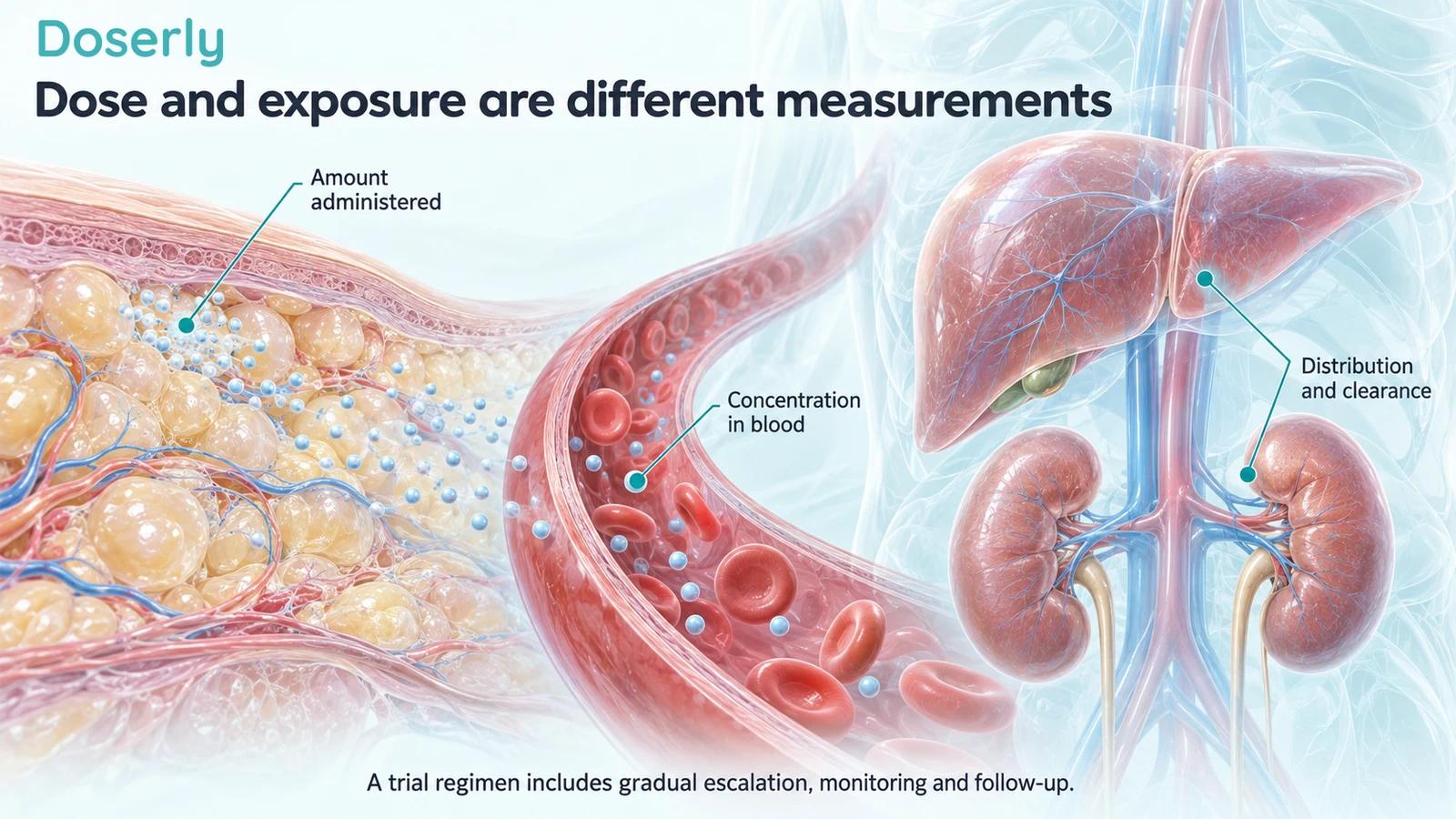
A dose is the amount administered. Exposure describes how much drug is present in the body over time, often assessed from concentrations in blood. A regimen includes when doses are given, how the dose changes and how long treatment continues. Those distinctions matter when a headline compresses a months-long experiment into “mazdutide 16 mg.”
In the high-dose phase 1 study, researchers gradually increased treatment over 16 weeks before four weeks at the 16-mg target. The reported week-20 result therefore describes the whole course, including escalation. It does not mean participants took the maximum dose from the first week. The paper also measured drug concentrations and reported an approximate eight-day half-life at that dose. Phase 1 full report.
A half-life is the approximate time for a concentration to fall by half during the relevant elimination phase. It is not a countdown to the drug disappearing, and it doesn't tell you how long appetite effects will last in one person. Repeated administration and gradual changes in concentration make treatment history important. A single number written on a vial cannot describe that history.
What did the small 16-mg trial establish?
The randomized, blinded phase 1 trial enrolled 32 adults with overweight or obesity without diabetes. Twenty-four received mazdutide in two escalation cohorts; eight received placebo. At week 20, model-estimated mean weight changes were −20.0% and −21.0% in the mazdutide cohorts, versus −0.1% with placebo. Primary abstract.
Those findings supplied a strong reason to continue studying higher exposure. They did not establish a precise expected response across the wider population. With only 12 treated participants in each escalation cohort, a few people's outcomes can substantially affect the average. The study also wasn't a direct randomized comparison of 16 mg against every lower mazdutide dose.
The full report provides context that a weight-loss headline omits. Three treated participants stopped early because of gastrointestinal adverse events. No serious adverse events were reported, but the small sample cannot exclude uncommon harms. Pulse-rate changes were observed, reinforcing why vital signs and symptoms need attention alongside body weight. Phase 1 safety results.
“Serious” has a regulatory meaning related to outcomes such as hospitalization or life-threatening events. A symptom can fail to meet that definition and still be distressing enough to stop treatment. Conversely, the absence of serious events in a small trial shouldn't be translated into certainty that a higher-dose regimen is safe for everyone.
What changed with the larger US phase 2 study?
The US trial randomized 179 adults without type 2 diabetes at 24 centers to placebo or mazdutide regimens targeting 3–6, 10 or 16 mg, over 48 weeks. The main endpoint was weight change at week 32. Its primary efficacy estimand addressed a hypothetical treatment-adherence scenario, rather than simply averaging every observed result regardless of stopping. US phase 2 primary report.
At week 32, estimated mean changes were −7.3%, −15.6% and −18.1%, respectively, versus −0.9% on placebo. In the lowest-dose regimen, participants remained at 3 mg until week 32 before increasing to 6 mg. The week-32 number should therefore not be described as the result of 32 weeks on 6 mg.
Adverse-event discontinuation was most frequent in the 16-mg group, at 20%, primarily associated with gastrointestinal disorders. That finding belongs beside the weight result, not in a footnote. It helps explain why a promising efficacy estimate and a challenging treatment experience can both be true. US phase 2.
For someone reading about future treatment choices, the question becomes more practical: what does the additional average weight reduction mean after accounting for who can remain on treatment? A regimen that works well under the study's efficacy assumptions may have a different average result when treatment interruptions and discontinuations are incorporated.
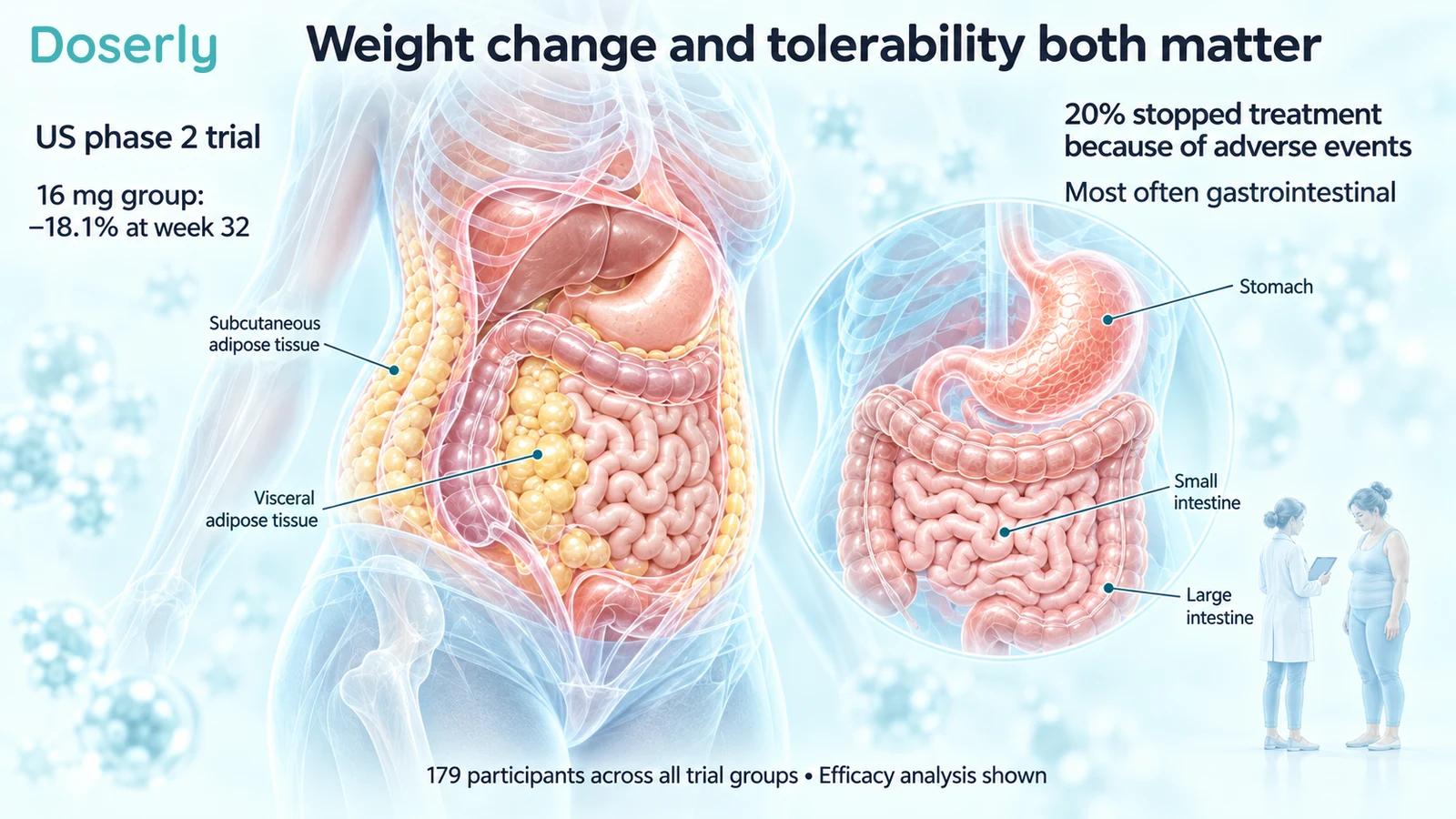
Image sources: Source
Why the analysis method matters
An estimand is a precise description of the treatment effect researchers want to estimate. It specifies the population, treatment, outcome and approach to events such as stopping treatment or using another medicine. The term sounds technical, but the underlying questions are familiar.
One question is, “What might happen if participants remained on their assigned treatment under specified conditions?” Another is, “What happens after people are assigned this strategy, including when some stop?” Both can be useful. They are different questions, so their percentages can differ without either calculation being fraudulent.
GLORY-1, the larger Chinese phase 3 trial, used a treatment-policy analysis for its main endpoints, including outcomes regardless of early discontinuation or starting a new obesity therapy. In 610 adults, weekly 4- and 6-mg mazdutide regimens reduced weight compared with placebo. That design and analysis differ from the higher-dose phase 1 experiment and the US phase 2 primary efficacy analysis. GLORY-1.
It would therefore be misleading to subtract a lower-dose percentage from one paper from a higher-dose percentage in another and present the result as the benefit of increasing your own dose. Differences in participants, treatment duration and analysis may contribute to the apparent gap.
What does the 9-mg Chinese study add?
A separate phase 2 trial randomized 80 Chinese adults with BMI at least 30 and no diabetes: 60 received mazdutide 9 mg and 20 placebo for 24 weeks. Mean weight change was −12.78% versus +1.80%, giving an estimated treatment difference of −14.58 percentage points, with a 95% confidence interval from −18.00 to −11.16. 9-mg phase 2 report.
The distinction between weight loss and treatment difference matters here. Participants receiving mazdutide did not lose an average of 14.58% of their initial weight. That larger number incorporates the placebo group's gain. Nausea, diarrhea and vomiting were common in the treated group, predominantly mild or moderate. This study supports further development in the population tested; it doesn't define a universally best dose.
The trial also cannot tell us whether someone already responding well to a lower dose would obtain enough additional benefit to justify a change. Answering that would require a design that actually studies the decision—such as randomizing comparable responders to continue or intensify treatment—with outcomes and tolerability assessed together.
Can early weight loss predict long-term health?
Weight is a meaningful outcome, but it is not every outcome. A study designed around weight change doesn't automatically establish effects on heart attacks, liver failure, strength, fertility or survival. Those questions need their own measurements and sufficient follow-up.
The same distinction applies to how weight is lost. A scale doesn't separate fat, lean tissue and fluid. A high-dose study could show substantial total weight reduction while leaving questions about body composition or physical function unanswered. It would be inappropriate to add a muscle-preservation claim simply because the weight-loss percentage is large.
Nor should a short follow-up be extended into a lifetime prediction. A response seen during escalation can change later. People may reach a plateau, encounter tolerability problems, change other medicines or discontinue. The protocol's observation period defines what was observed; anything beyond it is an extrapolation.
The first mazdutide phase 1b trial illustrates the role of early research: it centered on safety and tolerability, with weight changes helping determine whether larger studies were justified. Later trials can answer more, but they don't make every early estimate a dependable individual forecast. Initial phase 1b study.
An average is not a promise or a response rate
A mean weight change combines the experiences of people who lose different amounts. It does not tell you that most participants lost exactly that percentage. A response threshold answers a different question: how many people reached at least a specified reduction? Both descriptions can be helpful, but they should retain their original labels.
Imagine two hypothetical groups with the same average loss. In one, nearly everyone stays close to the average. In the other, some lose much more and others barely change. The mean alone cannot distinguish those situations. This is an arithmetic example, not a reconstruction of individual mazdutide results.
Uncertainty around the estimated mean is also different from the range of individual responses. A narrow confidence interval can make the population average more precise without making the outcome predictable for a particular patient. Similarly, a standard error describes precision of an estimate; it is not a statement that nearly everyone falls within that distance of the mean.
These distinctions matter when setting expectations. The trial can support a discussion about average effects under its conditions. Your own progress still needs to be assessed over time, alongside tolerability and the health goal treatment is meant to address.
A useful dose comparison also needs the time spent at each level. Two participants can finish a study on the same nominal dose after different periods of exposure or interruptions. The final dose label cannot reconstruct that history. This is one reason the regimen and analysis population belong beside the result rather than being omitted from a headline.
What should a patient take from this research?
Higher-dose mazdutide research supports continued investigation of additional weight reduction. The newer US trial also makes the tradeoff more visible: the regimen with the greatest estimated loss had the most adverse-event discontinuation. That is useful information for researchers choosing future regimens and for clinicians interpreting the development program.
For an individual discussion, bring your actual goal and current response. An average trial percentage cannot determine whether further weight reduction is desirable, whether symptoms are acceptable or whether another condition changes the balance. Ask what evidence supports the proposed product and regimen in people like you, and how benefit and tolerability would be assessed.
It also helps to separate a target from an obligation. A maximum dose in a study is not a statement that every participant—or every patient—should reach it. Researchers test a regimen under defined eligibility rules, supervision and stopping procedures. Those conditions are part of the evidence.
A useful tracking record includes dates of prescribed changes, weight trends, relevant symptoms and any interruption, rather than only the highest dose reached. That makes it easier to discuss what happened over time without claiming that the record proves causation. For context on the broader development program, see the mazdutide human evidence section.
Explore the research
- High-dose phase 1 primary abstract, 2025: 32 participants and the week-20 estimates.
- US phase 2 trial, 2026: 179 participants and higher-dose efficacy/tolerability.
- Chinese 9-mg phase 2 trial, 2026: 80 participants followed for 24 weeks.
- GLORY-1, 2025: lower-dose phase 3 context and treatment-policy analysis.
- Initial phase 1b trial, 2021: early safety and tolerability research.