
Peptides
October 16, 2026
Mazdutide, fat loss and lean mass: what the body-composition numbers mean
On this page
When a medicine reduces body weight, many readers want to know what was lost. Less fat may be welcome, but preserving strength and the ability to manage daily life matters too. Mazdutide's weight-management research includes body-composition measurements that help address part of that question.
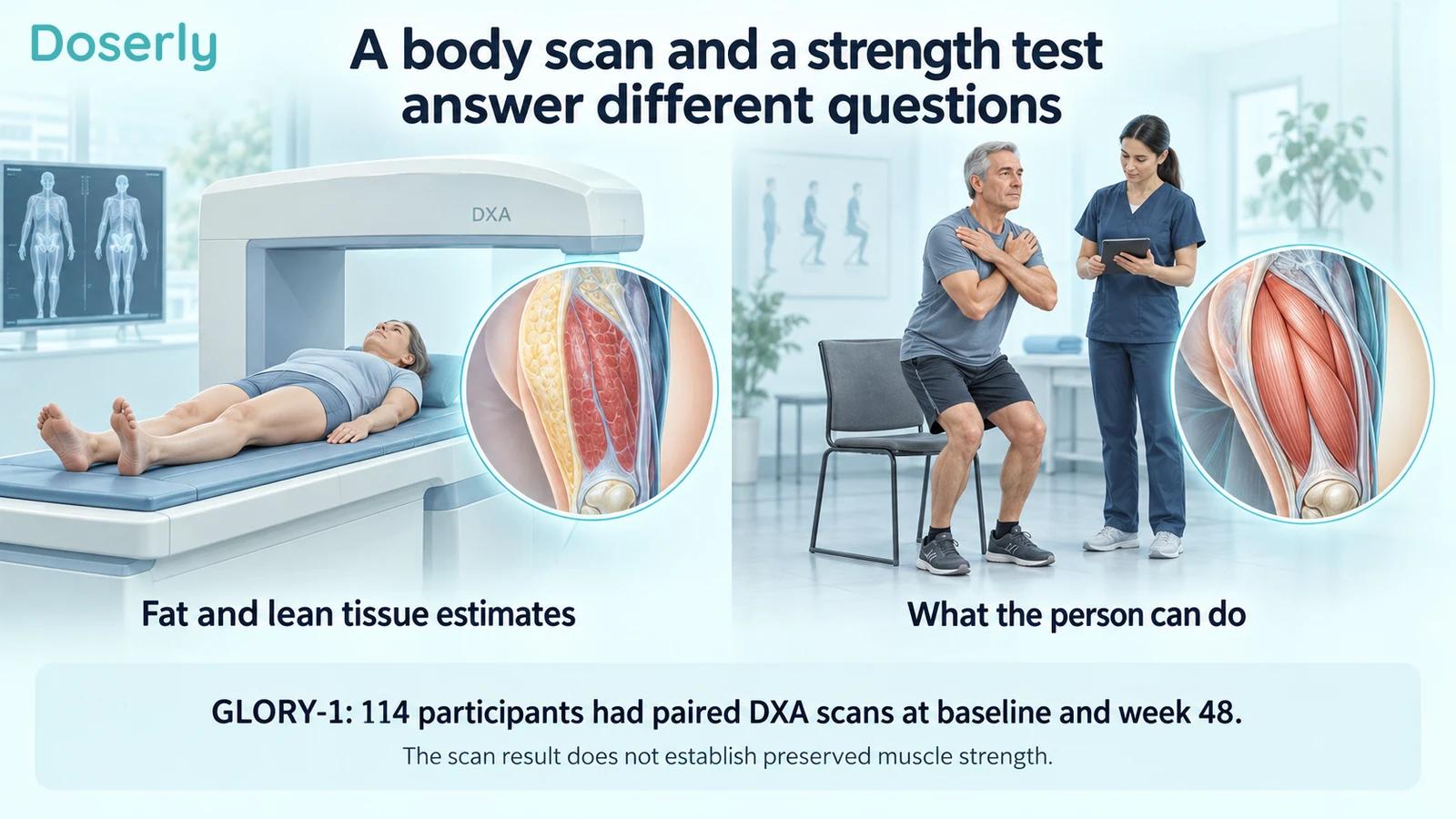
The key GLORY-1 finding is limited but useful: among participants with paired scans, the reduction in total fat mass appeared greater than the reduction in total lean mass. That does not mean no lean tissue was lost, and it does not establish that muscle strength was preserved. GLORY-1 primary report.
A second source of confusion is the percentage itself. “Fat as a share of body weight,” “percentage decrease in fat mass,” and “fat as a share of weight lost” have different denominators. They can all describe the same person while producing very different numbers. Understanding that arithmetic helps you interpret a claim without dismissing a real fat-loss benefit or overlooking a possible muscle concern.
What does a body-composition scan measure?
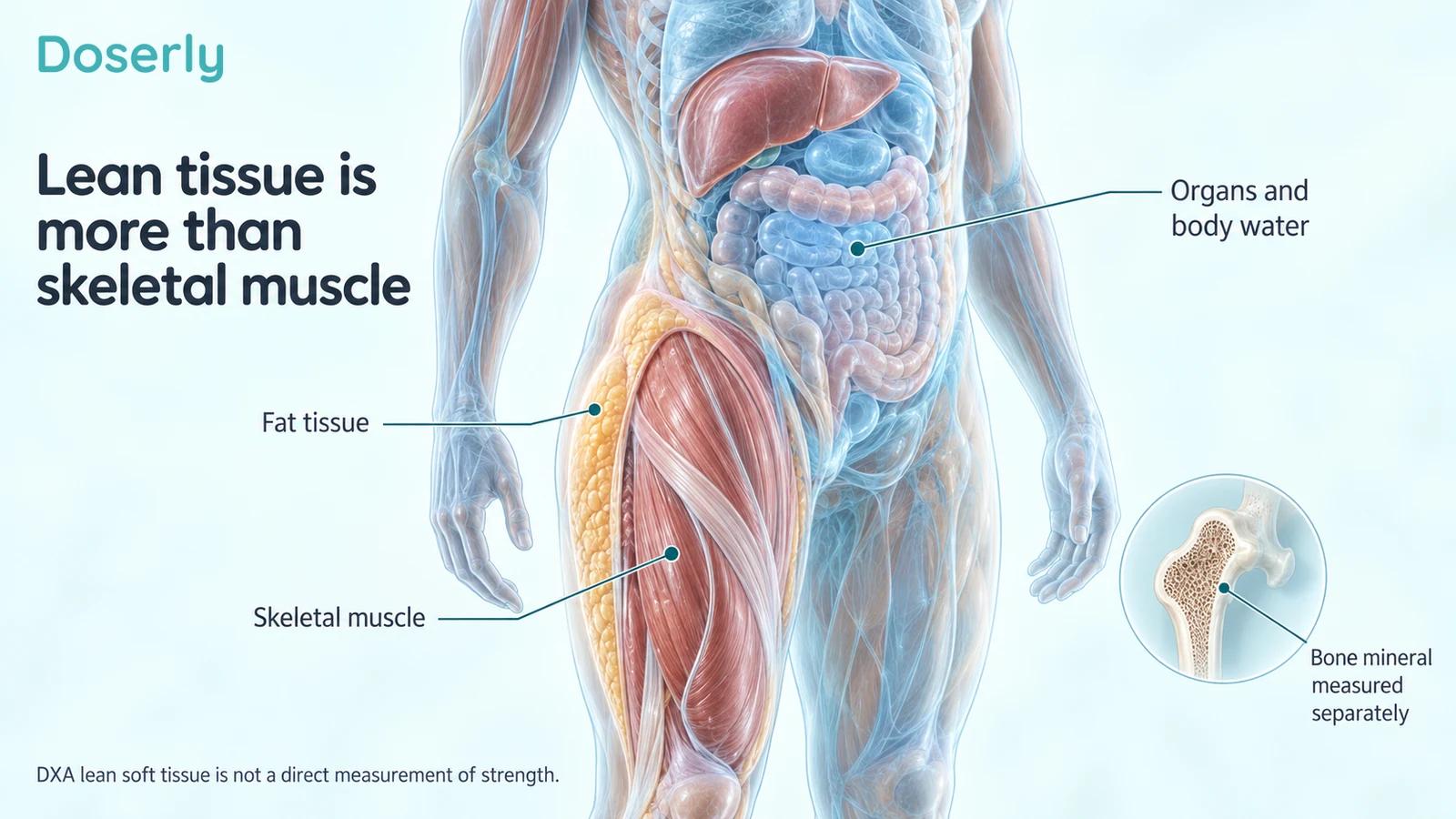
Dual-energy X-ray absorptiometry, usually called DXA or DEXA, uses low-dose X-rays to estimate body compartments. A whole-body assessment reports fat, lean soft tissue and bone mineral measurements. Lean soft tissue includes skeletal muscle, but also organs and water-containing nonfat tissue. It isn't a direct count of muscle fibers. International Society for Clinical Densitometry positions.
This distinction becomes important when the term “lean mass” is rewritten as “muscle” in an advertisement or social-media post. A change in estimated lean soft tissue can include more than a change in skeletal muscle. The measurements still matter, but their names need to remain accurate.
Nor does a scan measure force production. Strength tests, walking assessments and other functional measures ask what a person can do. A scan and a performance test can complement each other because they describe different aspects of physical health. One should not be substituted for the other.
What did GLORY-1 contribute?
GLORY-1 randomized 610 Chinese adults to mazdutide 4 mg, mazdutide 6 mg or placebo over 48 weeks. The main trial addressed weight management. Its body-composition assessment was a smaller part of the study: 114 participants had DXA measurements at baseline and week 48. The primary report describes a greater apparent reduction in fat mass than lean mass in both mazdutide groups, referring to its supplementary figure. GLORY-1.
The difference between 610 and 114 matters. The first is the parent trial's randomized population. The second is the group with the paired scans supporting the body-composition description. Saying “a 610-person scan study proved muscle preservation” would change both the denominator and the conclusion.
The report also included participant-reported physical-function questionnaires. Those are relevant to how people experience their health, but they aren't direct muscle-strength measurements. Improvement in a questionnaire doesn't establish that a particular lean-tissue change caused the improvement, or that muscle tissue was preserved unchanged.
A careful summary therefore retains three separate observations: weight changed, body compartments were estimated in a subgroup, and participants reported aspects of physical function. The study doesn't collapse these into one universal “muscle protection” result.
Three percentages that are easy to confuse
Consider a hypothetical person weighing 100 kg, with 40 kg of fat and 60 kg of fat-free mass. Here, fat-free mass is a simplified whole-body remainder that includes bone; it is not exactly the same compartment as DXA lean soft tissue. Suppose their weight later becomes 90 kg, with 32 kg of fat and 58 kg of fat-free mass.
This example is invented to explain arithmetic, not taken from a mazdutide participant. It deliberately keeps the compartments simple so we can see what each denominator does.
Question
What share of starting body weight was fat?
- Calculation
- 40 ÷ 100
- Result
- 40%
Question
What share of later body weight is fat?
- Calculation
- 32 ÷ 90
- Result
- About 35.6%
Question
How much did fat mass decrease relative to its starting amount?
- Calculation
- 8 ÷ 40
- Result
- 20%
Question
What share of the 10-kg weight loss was fat?
- Calculation
- 8 ÷ 10
- Result
- 80%
Question
How much did fat-free mass decrease relative to its starting amount?
- Calculation
- 2 ÷ 60
- Result
- About 3.3%
All five statements can be true at once. The person lost 20% of their starting fat mass, and 80% of the weight lost was fat. Those are not competing estimates; they answer different questions.
The remaining 20% of weight lost was fat-free mass in this simplified example. That does not mean the person lost 20% of their original muscle. It doesn't even identify how much of the fat-free change came from skeletal muscle, because the example doesn't measure that separately.
A higher lean percentage can accompany a lower lean amount
In the example, fat-free mass starts at 60% of body weight. After weight loss, 58 divided by 90 is about 64.4%. Its share of body weight rose even though the absolute amount fell from 60 to 58 kg.
This happens because the denominator—total weight—fell faster. It is a basic property of ratios, not a biological contradiction. A statement such as “lean proportion increased” therefore cannot establish that no lean tissue was lost.
The reverse misunderstanding is possible too. A reduction in lean mass doesn't by itself quantify loss of strength or worsening function. To interpret clinical importance, you need the absolute change, the measurement method, the starting condition and functional information. A person beginning with little muscle reserve may have a different concern from someone with substantial reserve and good function.
This is why a useful report gives kilograms and percentages where available, identifies the compartment, and explains the population. A favorable ratio can coexist with an issue worth monitoring. An unfavorable-looking percentage can also be misleading if its denominator is left unstated.
What another drug's substudy can—and cannot—teach us
A dedicated SURMOUNT-1 DXA report provides a clear example of the terminology. It assessed 160 people with baseline and week-72 scans: 124 across pooled tirzepatide doses and 36 receiving placebo. In the tirzepatide group, body weight, fat mass and lean mass changed by −21.3%, −33.9% and −10.9%, respectively. Approximately 75% of weight lost was fat and 25% lean mass in both groups. SURMOUNT-1 body-composition report.
Notice that a 10.9% decrease in starting lean mass is not the same as a 25% lean share of weight lost. The two percentages refer to different starting quantities. The study makes the distinction visible because it reports both.
This is a tirzepatide finding, not a mazdutide estimate. It shouldn't be imported into a mazdutide infographic or used to claim that one medicine protects muscle better. The drugs, participants, durations and analyses differ. The example is helpful for understanding how results are reported, not for supplying missing mazdutide numbers.
Why scanning the same people twice matters
A paired comparison assesses change within people measured at both time points. Without a baseline scan, a later scan cannot tell you how much tissue was lost or gained during treatment. Without follow-up, the baseline tells you nothing about that participant's change.
But a paired-scan subgroup can also be selected. Participants who return for the final scan may differ from those who stop treatment or miss assessments. That doesn't invalidate the scans; it affects how confidently their results can be applied to the whole randomized group.
Measurement conditions matter as well. ISCD guidance addresses standardized acquisition, analysis and precision assessment for body-composition work. Comparing reports from different systems or methods requires care. A small apparent change should not automatically be treated as a precise biological change without considering measurement variability. ISCD positions.
A bathroom scale, a consumer impedance device and a clinical DXA scanner do not produce interchangeable measurements. If you are following body composition over time, retain the device or method, date and original report. A series of numbers stripped of their methods may be harder to interpret than a smaller set of comparable measurements.
Why strength deserves its own attention
Strength can change through training, muscle quality, coordination, pain, disease and body size. It should be measured when it is the outcome of interest. A person may move more easily after losing weight even while a scan estimates less lean tissue. Another may lose weight and become less able to manage daily tasks. A tissue ratio alone cannot distinguish these experiences.
A randomized trial in 160 older adults with obesity compared exercise approaches during dietary weight loss. Resistance training and combined aerobic/resistance training produced less lean-mass loss than aerobic training alone, while functional outcomes also changed. The trial demonstrates why researchers can assess body composition and performance together. It did not test mazdutide. Exercise trial.
NIDDK likewise describes strength training as a way to help maintain muscle during aging or weight loss. This is general health guidance, not evidence that exercise eliminates every medication-related concern. Appropriate activity depends on health, mobility and experience. NIDDK health tips.
For someone worried about weakness, discussing the symptom is more useful than simply requesting a favorable body-fat percentage. Changes in rising from a chair, carrying groceries or walking can give a clinician concrete information. The right assessment depends on the person's condition rather than a universal scan schedule.
Does glucagon activity prove that mazdutide protects muscle?
No. Mazdutide's GLP-1/glucagon receptor activity offers a reason to investigate how weight and metabolism change. It does not supply a muscle-preservation outcome that hasn't been measured. A mechanistic explanation cannot turn lean-tissue estimates into direct strength results.
The clinical question is also more specific than “mostly fat.” A treatment could produce greater absolute fat loss and still reduce lean tissue. Whether that tradeoff is acceptable depends on the size and composition of the change, the person's starting health, their nutritional intake and physical function, and the benefits being sought.
A convincing claim of better muscle preservation would need a suitable comparison, explicit muscle or lean-tissue measures, and ideally strength or performance outcomes. It should report who completed the assessments and how uncertainty was handled. A changing lean percentage alone cannot establish all of that.
A useful follow-up question is whether the reported change exceeded the measurement method's expected variation under that study's conditions. More decimal places do not answer that question. Consistent acquisition and interpretation matter when comparing a person's scans over time. ISCD measurement positions.
What to bring to a treatment discussion
Bring the actual wording and numbers from the claim: kilograms or percentage, the denominator, the type of tissue, the measurement method and the time interval. If a source says “muscle,” check whether the study measured skeletal muscle specifically or DXA lean soft tissue.
Then explain your own priority. You may want to reduce fat while keeping up with work, maintain strength as you age, or avoid worsening an existing mobility problem. Those goals help determine which measurements are useful and whether a symptom needs investigation.
Mazdutide's body-composition findings support discussing fat and lean changes alongside total weight. They don't justify promising unchanged muscle mass or strength. Our mazdutide guide places the scan findings beside the broader trial results, while the arithmetic above helps keep each percentage attached to the question it actually answers.
Explore the research
- GLORY-1 primary publication: 114 paired DXA assessments within a 610-person trial.
- SURMOUNT-1 body-composition report, 2025: distinct denominators in tirzepatide research, not mazdutide results.
- ISCD official adult positions: body-composition acquisition, interpretation and reporting.
- Aerobic or Resistance Exercise, or Both, in Dieting Obese Older Adults, 2017: randomized exercise evidence, separate from peptide treatment.
- NIDDK health tips for adults: general strength-training context.