
Peptides
October 16, 2026
How to read a pemvidutide announcement without losing the clinical meaning
On this page
If you are following pemvidutide because of fatty liver disease, a headline about improved liver biopsies can feel immediately relevant. The difficult part is deciding what the result means for scarring, future health and treatment options. Announcements often place several different findings together, even when they answer different questions.
Pemvidutide's IMPACT program is a useful example. Its first major announcement highlighted a positive MASH-resolution result, a separate fibrosis result that was not statistically significant, and an encouraging supplementary digital analysis. Later reports added longer follow-up and other ways of measuring the same tissue. These developments deserve attention, but they should not collapse into the claim that every measure proved liver recovery.
The goal is to read a sponsor announcement neither as a treatment verdict nor as something automatically untrustworthy. It is an early account of a study, written by an interested party, that can be checked against the study's methods and subsequent publication. Our pemvidutide guide provides the broader clinical background.
Start with the disease and the people studied
IMPACT enrolled 212 people with biopsy-confirmed metabolic dysfunction-associated steatohepatitis, or MASH, and stage F2 or F3 fibrosis. MASH describes an inflammatory liver-disease pattern; fibrosis is scar tissue. The study did not enroll a general sample of everyone with fat visible in the liver, and F2–F3 disease is not the same as established cirrhosis. Original IMPACT report
This is the first question to answer before considering a percentage: does the population resemble the clinical situation you care about? A finding in people with biopsy-confirmed inflammatory disease may be relevant to drug development without directly answering what someone with an incidental fatty-liver scan should do.
Eligibility also sets limits on safety interpretation. A short trial in selected participants cannot cover every combination of age, other medicines, advanced illness or competing causes of liver injury. The announcement's disease label is therefore part of the result, not an optional detail that can be removed to make the headline simpler.
Read the entire endpoint, including its second half
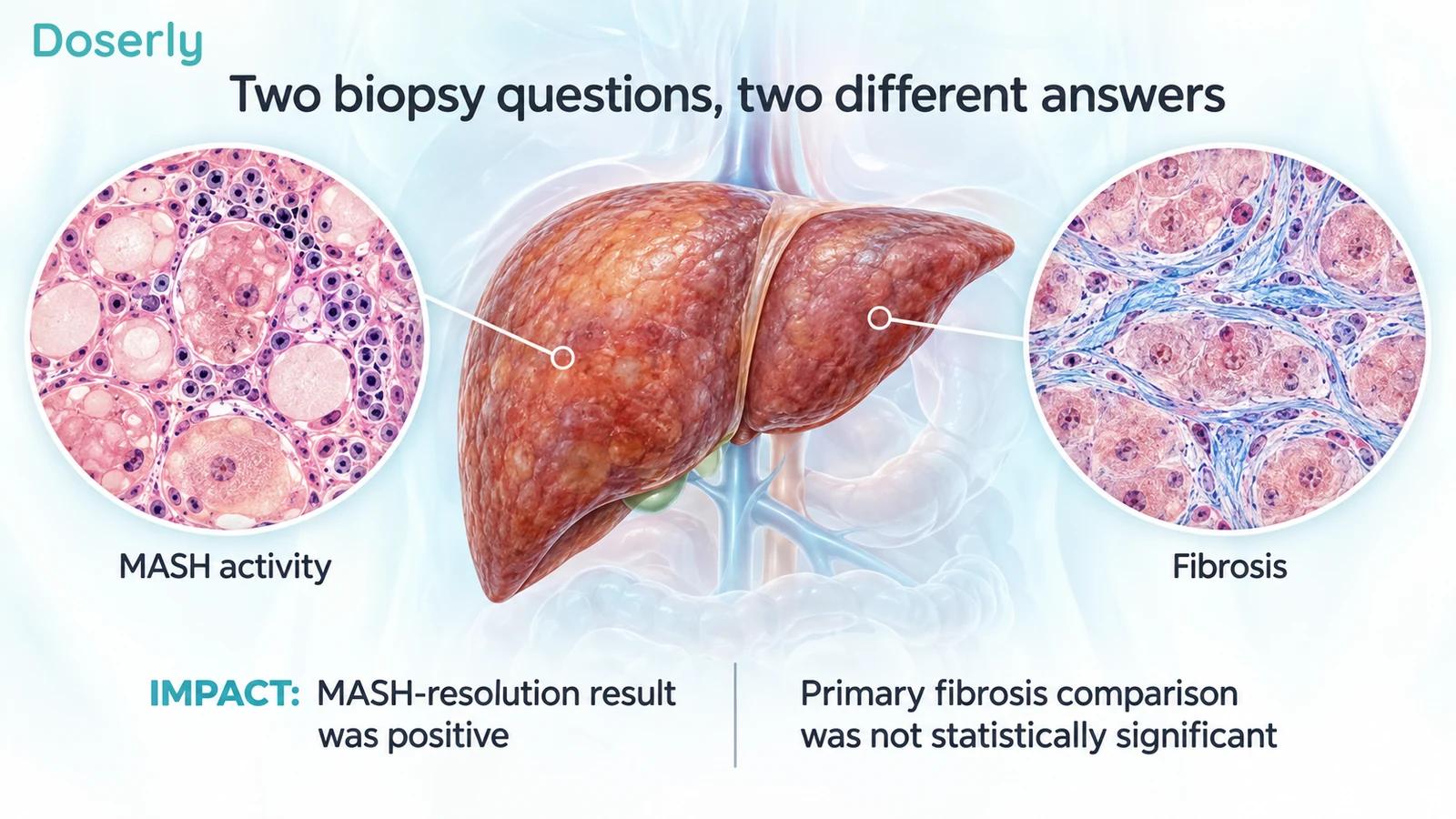
The June 2025 sponsor release reported MASH resolution without worsening fibrosis in up to 59.1% of participants receiving pemvidutide, compared with 19.1% on placebo. It also reported fibrosis improvement without worsening MASH, but explicitly stated that the differences on that outcome were not statistically significant. Initial IMPACT announcement
The phrases in bold are essential. “Without worsening fibrosis” does not say that fibrosis improved. It says that a participant could count as a MASH-resolution responder only if the scarring assessment had not worsened. The separate fibrosis endpoint asks whether scarring improved while the MASH assessment did not worsen.
An invented example makes the distinction clearer. A participant whose inflammatory disease pattern resolves while their fibrosis stage stays unchanged could satisfy the first endpoint. They would not satisfy an endpoint requiring at least a one-stage improvement in fibrosis. The two endpoints can therefore produce different response rates without contradicting one another.
For a patient especially concerned about scarring, that difference is more useful than a single overall label such as “successful trial.” It identifies what the experiment established and what remained unresolved.
Prefer the full publication for the current numerical account
The later peer-reviewed paper reported rounded, model-based MASH-resolution percentages of 58%, 52% and 20% for the lower dose, higher dose and placebo groups. Its corresponding fibrosis-improvement figures were 33%, 36% and 28%. Both fibrosis comparisons remained statistically nonsignificant. These are the paper's reported estimates, not percentages recalculated from the raw responder counts. Original IMPACT report
The preliminary and published numbers are close but not identical. The initial release listed group sizes of 42, 85 and 85; the publication reports randomized groups of 41, 85 and 86. The paper explains that one person assigned to placebo received lower-dose pemvidutide but remained in the placebo group for the intention-to-treat analysis. That documented detail is relevant, but it should not be treated as a complete explanation of every numerical difference between reports without further analysis documentation. Initial announcement, full original paper
A careful reader should use one coherent version of the results. Combining a preliminary active-treatment percentage with a later placebo percentage, or changing denominators while keeping the original estimate, produces a comparison the study did not report.
This is also why a rounded estimate may not exactly equal a raw count divided by the group size. Model-based percentages and simple proportions are related but different quantities. When an article uses the published model estimate, it should preserve that description rather than “correcting” the figure through informal arithmetic.
A positive p value needs its testing context
A p value is not the probability that a medicine works for a particular patient. It assesses how compatible the observed comparison is with a statistical null model under the analysis assumptions. It belongs beside the effect size, uncertainty and study design.
The full IMPACT paper describes sequential testing: the higher-dose MASH endpoint came before its fibrosis endpoint, followed by the lower-dose tests. Once a required step failed, later small p values did not automatically retain the same confirmatory status. This is why the testing plan matters even when the press release lists several apparently impressive results. Full original paper
Multiple outcomes can be clinically informative without all being independently confirmatory. Treating every favorable secondary or exploratory comparison as a separate proof overstates what one study can show. Conversely, a nonsignificant result does not prove that no individual benefited or that the true treatment effect is exactly zero. It tells us that the specified comparison did not meet its statistical test.
For the primary fibrosis question, the practical conclusion is straightforward: the study did not establish the claimed improvement with the required evidence at 24 weeks. A later or larger trial can revisit that question; optimistic expectations cannot substitute for its result.
Missing biopsies affect the meaning of a response rate
The published primary analysis treated missing outcomes due to absent biopsies or treatment discontinuation as nonresponse. This makes the reported response percentage different from a calculation restricted to people with an available final specimen. It also means that the percentage answers a treatment-strategy question, rather than simply describing the tissue of everyone who completed both biopsies. Full original paper
Consider an invented group of 100 people in which 80 provide a final biopsy and 40 meet a response definition. The response rate among available biopsies would be 50%. If all 20 missing outcomes were counted as nonresponses in the randomized group, it would be 40%. Those figures describe the same observed responders with different denominator rules. Neither should be substituted for a published estimate without identifying the analysis.
Missingness is not just a statistical inconvenience. Someone might decline another biopsy, stop treatment because of an adverse event or leave for reasons unrelated to response. Those circumstances can have different implications. A full account should show participant flow and explain assumptions rather than presenting the most favorable available percentage.
For IMPACT, the practical reading rule is to retain the published analysis description and avoid relabeling a completer-only result as the result for everyone randomized. The same care should apply when comparing the main biopsy analysis with a digital subset that may include a different set of usable specimens.
Digital tissue analysis asks a related but different question
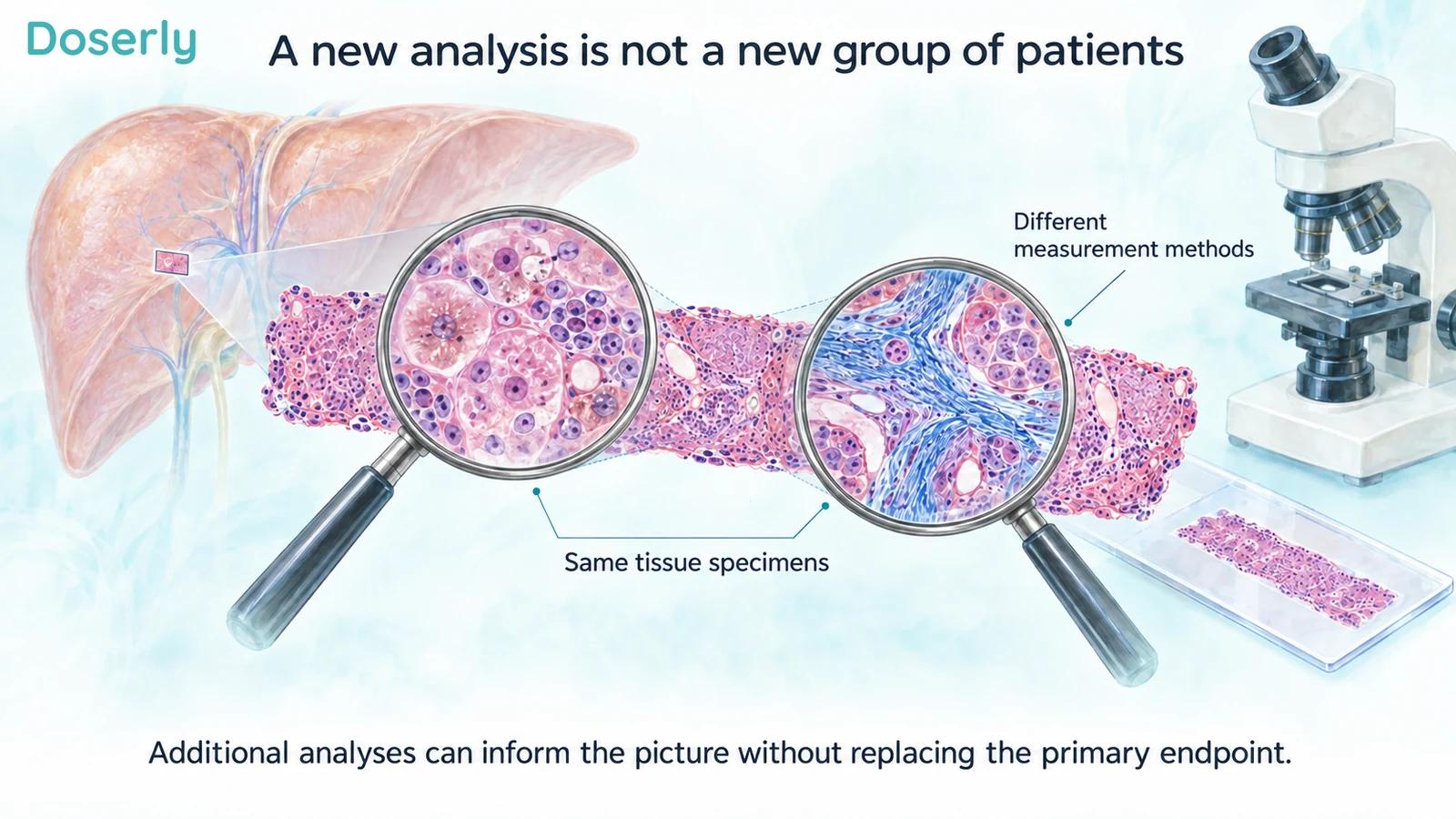
The initial release highlighted an additional AI-based fibrosis analysis. The subsequent paper describes a post-hoc analysis of the proportionate fibrotic area using Liver Explore. A later EASL announcement described qFibrosis analysis using a different imaging approach. These are not interchangeable names for one prespecified endpoint. Full original paper, EASL analysis announcement
A digital method may detect changes that a categorical fibrosis stage does not capture. That can be scientifically valuable. It also creates a need to understand the measurement: what was quantified, when the analysis was planned, which specimens were included, and how the result relates to later health outcomes.
An exploratory favorable finding does not retroactively turn a statistically unsuccessful primary comparison into a successful one. The additional analysis can strengthen a hypothesis or help design another trial. It needs to keep its own label and limitations.
Nor does a new conference presentation necessarily mean new patients. Reanalyzing the same specimens provides another view of the original experiment. It does not carry the same replication value as a separate randomized trial in a new group of people.
Check the time point before assuming a second biopsy
The primary biopsy comparison was at 24 weeks. The December 2025 sponsor report added 48-week findings for noninvasive measures, including liver stiffness, blood-based fibrosis markers, liver fat and weight. It did not provide a new 48-week biopsy endpoint. 48-week IMPACT announcement
This matters because a phrase such as “continued liver improvement at 48 weeks” can sound like direct confirmation that scarring continued to regress under the microscope. If the measurement was a blood test or elastography, the wording should identify it.
Noninvasive measures are useful precisely because they can be repeated without another biopsy. Their convenience does not make them the same measurement as histology. A coherent pattern across tests may support further investigation while leaving the original biopsy question unanswered at the later time point.
The calendar also prevents accidental double-counting. A 24-week paper, a 48-week press release and a subsequent conference presentation can all come from one trial. Three announcements do not mean three independent experiments.
Keep tolerability claims within the comparison actually performed
The initial announcement emphasized low treatment discontinuation due to adverse events and used comparative promotional language. IMPACT's randomized comparator was placebo. It was not designed to rank pemvidutide's tolerability against every other drug in development for MASH. Initial IMPACT announcement
Discontinuation is an important outcome because it reflects whether people could remain on treatment. It is not the only safety outcome. Readers also need the frequency and severity of events, serious events, follow-up duration and reasons people left the study.
Cross-trial comparisons are especially difficult when dose schedules, populations and event-collection methods differ. A low percentage in one study can be encouraging without establishing superiority. A useful account says what was observed in that trial and leaves the comparative claim for an appropriate experiment.
Separate a development milestone from a treatment result
In August 2026, the sponsor announced that enrollment had begun in PERFORMA, its phase 3 MASH program. The plan includes a 52-week biopsy assessment and longer-term follow-up for clinical outcomes. Starting that study is a development milestone; it is not evidence that the planned endpoints have been achieved. PERFORMA initiation announcement
The distinction between biopsy response and long-term health is not unique to pemvidutide. The FDA's Rezdiffra trial snapshot explains an accelerated approval based on liver-biopsy changes and the need for continued assessment of clinical benefit. That is an example involving another medicine, not an approval or prediction for pemvidutide. FDA trial snapshot
For someone reading news because of their own liver condition, the useful questions are concrete: which outcome improved, how large was the difference, who was studied, how long were they followed, and what remains unproven? Keep the exact endpoint and time point attached to the claim. That habit preserves both the promise of new research and the clinical meaning needed to discuss it with a care team.
Explore the research
- Initial IMPACT announcement — preliminary sponsor estimates.
- IMPACT full publication — peer-reviewed paper, with the detailed methods and analysis.
- 48-week report — later noninvasive follow-up.
- EASL additional-analysis announcement — another analysis of the same program.
- PERFORMA initiation — planned phase 3 assessments.
- FDA Rezdiffra trial snapshot — regulatory context for biopsy-based endpoints in a different medicine.