
HRT
October 16, 2026
Gabapentin for night sweats: why off-label does not mean evidence-free
On this page
Gabapentin can sound like an odd choice for menopause symptoms. A prescription associated with nerve pain or seizures appears in a conversation about waking drenched at 3 a.m., and the clinician explains that the use is “off-label.” It is reasonable to want more than reassurance that other people take it.
For menopausal hot flashes and night sweats, gabapentin has randomized trial evidence and a place in professional nonhormonal treatment guidance. It is not FDA-approved for this indication, and the evidence does not make every dose, schedule, or promise equally credible. The useful question is whether a particular treatment plan has a reasonable chance of reducing your symptoms without creating an unacceptable burden of dizziness, sleepiness, or other adverse effects.
That distinction is especially important at night. Fewer sweaty awakenings, better perceived sleep, and feeling sedated are different experiences. A good review asks about all three.
What off-label means here
An approved drug has a label describing the uses, populations, doses, and other conditions the FDA has reviewed. Prescribing outside those conditions is called off-label use. The FDA explains that clinicians may prescribe an approved medicine for an unapproved use when they consider it medically appropriate, but the agency has not determined its safety and effectiveness for that unapproved use. The FDA’s explanation separates this regulatory status from the existence of research.
The current US Neurontin label lists postherpetic neuralgia in adults and adjunctive treatment of certain seizures; it does not list menopausal vasomotor symptoms. Nevertheless, placebo-controlled trials have specifically tested gabapentin for hot flashes. The Menopause Society’s 2023 nonhormone therapy position statement classified gabapentin among recommended treatments supported by Level I evidence.
Neither fact cancels the other. Calling it off-label should prompt an explanation of the evidence and the plan, rather than a conclusion that it is experimental in every sense. Conversely, a guideline recommendation does not turn it into an approved menopause medicine or guarantee that it is appropriate for a particular person.
The gabapentin menopause guide provides a broader reference alongside this closer look at what the trials can actually tell you.
What the trials measured
Three trials help explain why clinicians consider gabapentin, and why percentages need careful reading.
In a 2003 randomized trial, 59 postmenopausal women experiencing at least seven hot flashes a day received gabapentin or placebo for 12 weeks. At the studied total daily dose of 900 mg, hot-flash frequency fell by 45%, compared with 29% on placebo. The composite score, which incorporated frequency and severity, fell by 54% and 31%, respectively.
The placebo response is part of the result. Quoting a 45% reduction without the 29% comparison overstates what can reasonably be attributed to the treatment. The study also had relatively few participants, limiting how precisely it could estimate benefits and uncommon harms.
A larger 2005 trial involving 420 women with breast cancer compared placebo with 300 mg or 900 mg daily, administered in three divided doses, over eight weeks. At week eight, the hot-flash severity score had decreased by 15% with placebo, 31% with the lower dose, and 46% with the higher dose. Only the higher-dose group showed statistically significant reductions in both frequency and severity compared with placebo.
This was a symptom trial in a particular clinical population. It did not establish that gabapentin prevents cancer recurrence, that every breast cancer survivor should take it, or that oncology review is unnecessary. It did establish evidence relevant to a group for whom hormone treatment decisions can be complicated.
A 2008 trial in natural menopause enrolled 197 participants, with 193 completing four weeks. Participants were aged 45–65 and had at least 14 hot flashes per week. With 300 mg three times daily, hot-flash scores declined by 51%, compared with 26% on placebo.
These are average changes in scores or frequency within treatment groups. “The score fell by about half” does not mean “half the women became symptom-free,” and it does not identify the chance that one particular reader will achieve a personally worthwhile improvement. Different starting symptom burdens, study durations, and endpoints also make it inappropriate to line these percentages up as if they were identical measurements.
What gabapentin does—and what remains uncertain
Gabapentin is not estrogen, progesterone, or a medicine that replaces ovarian hormone production. Its name can also be misleading: although structurally related to the neurotransmitter GABA, the prescribing information does not describe it as simply increasing GABA activity.
The current prescribing information describes high-affinity binding to the α2δ subunit associated with voltage-activated calcium channels. It also states that the relationship between this binding and therapeutic effects is not fully established. A molecular binding target is not a complete explanation of why a woman has fewer hot flashes.
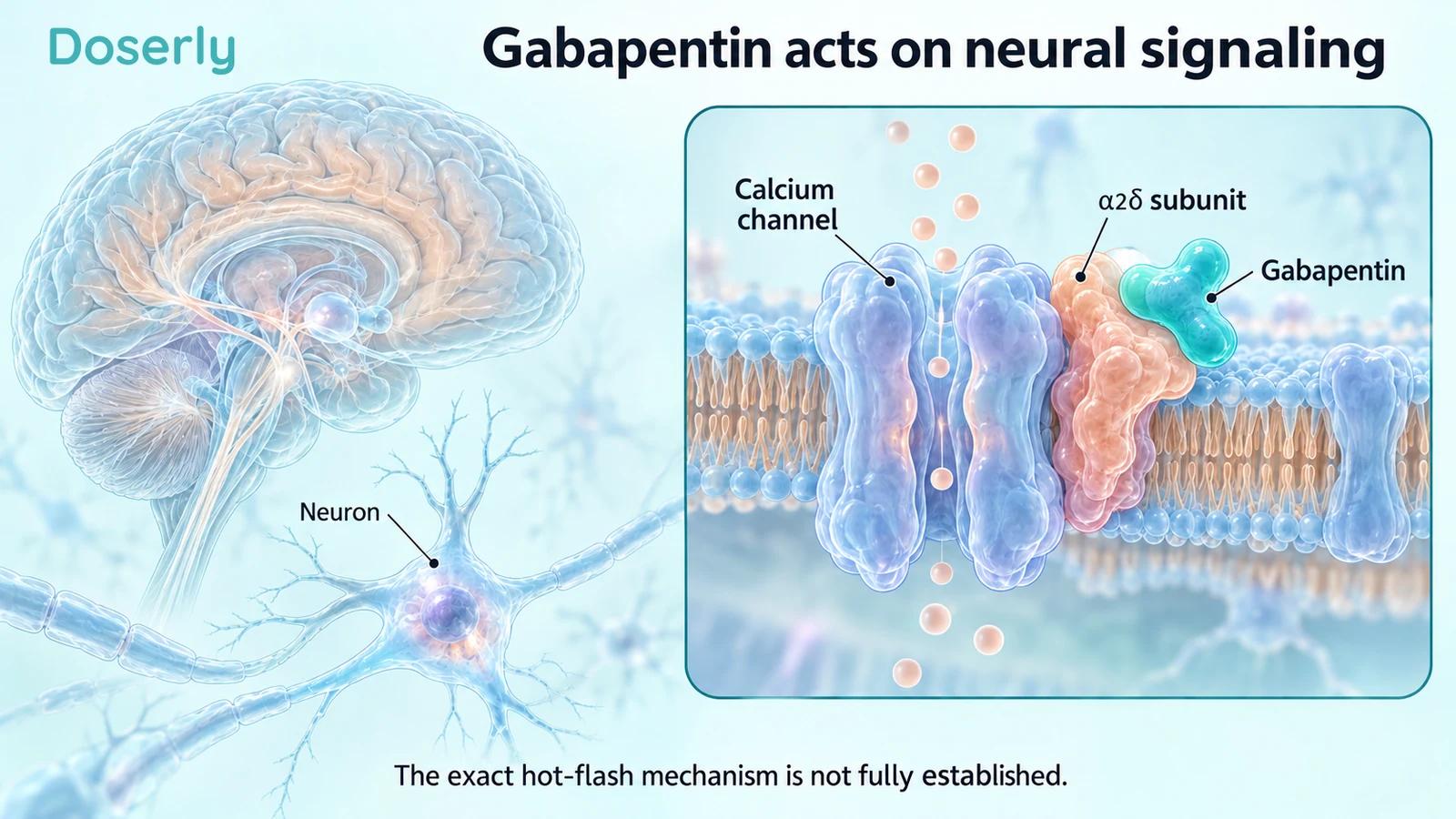
For readers, the practical consequence is modest but useful: clinical benefit is judged from trials and treatment experience, not from how persuasive a brain diagram looks. Becoming sleepy after a dose does not prove that thermoregulation has normalized. Having fewer hot flashes does not prove that a hormone deficiency has been corrected.
This also sets realistic boundaries around the prescription. Evidence about vasomotor symptoms should not be expanded into claims that gabapentin treats vaginal dryness, protects bone, improves cardiovascular health, or addresses every symptom attributed to menopause.
Why night sweats make the dosing question important
A person whose symptoms are concentrated overnight may reasonably ask about a night-focused plan. Sleepiness is a recognized effect of gabapentin, and reducing disruptive night sweats could itself improve sleep. Those observations make timing clinically relevant, but they do not establish a universal bedtime regimen.
The larger trials described above tested a total daily dose divided across the day. Their results cannot automatically be transferred to taking that entire amount at bedtime, to a much smaller single dose, or to using a different formulation. The doses are reported here to explain the evidence, not to suggest a starting dose or a self-directed titration schedule.
A useful prescribing conversation therefore includes two separate questions: what schedule is being proposed for your symptom pattern, and how closely does that schedule match the evidence being cited? A clinician may individualize treatment, but the rationale should remain clear when the plan differs from a trial protocol.
The same applies when someone says gabapentin “works immediately.” Early sedation may be noticeable before there is enough consistent symptom information to judge benefit. The trials evaluated symptoms over weeks; a single better or worse night cannot reproduce that comparison.
Better sleep needs its own definition
A secondary analysis of a randomized hot-flash trial examined Pittsburgh Sleep Quality Index outcomes with gabapentin 300 mg three times daily. It found improvements in the sleep-quality factor at four and 12 weeks and in global sleep quality and sleep efficiency at four weeks. It did not find an effect on the daily-disturbance factor.
That is useful evidence, but it has boundaries. It was a secondary analysis using reported sleep outcomes, rather than proof of a particular effect on sleep architecture or a dedicated test of a single bedtime dose. It also illustrates why one improved sleep measure should not be described as improvement in every aspect of sleep or daytime function.
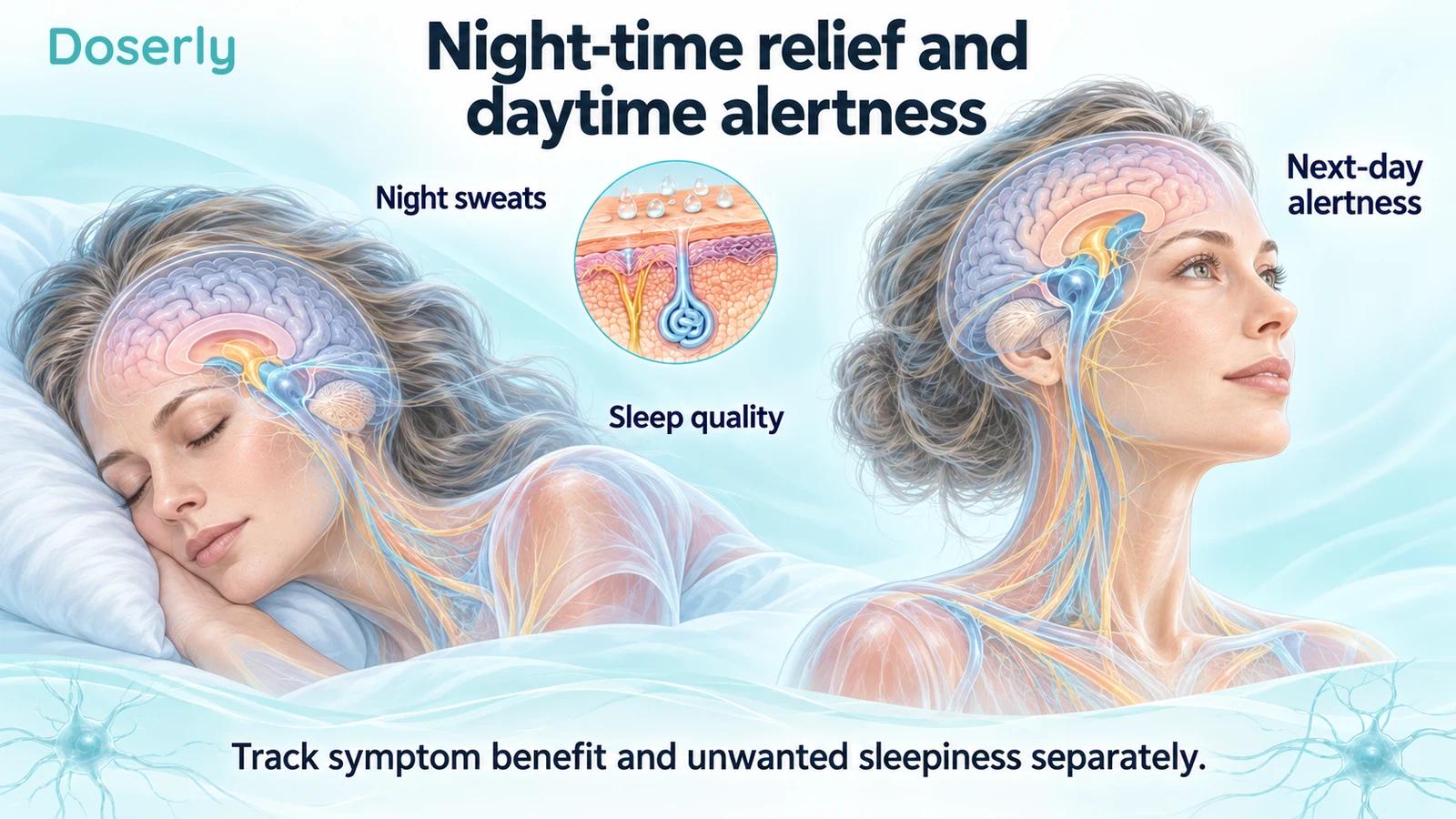
For example, someone might report fewer awakenings but feel too groggy for the morning commute. Another person might remain awake for long periods despite a reduction in sweating. These are hypothetical patterns, not estimates of how often they occur. They show why “helped me sleep” needs a little more detail before it can guide the next decision.
The broader menopause guide can help frame symptoms that deserve their own assessment rather than being assumed to have one cause.
Tolerability is part of effectiveness
Dizziness, unsteadiness, and drowsiness matter when deciding whether a symptom improvement is worthwhile. In the 2008 trial, these were reported more often in the gabapentin group during the first week and improved over subsequent visits. That pattern is reassuring at a group level, but it is not a promise that everyone should wait through troublesome symptoms or that adverse effects always disappear.
The smaller 2003 trial also recorded withdrawals due to adverse events: four participants receiving gabapentin and one receiving placebo. A benefit estimate that ignores people who cannot tolerate treatment leaves out part of the decision.
Discuss work demands, driving, overnight caregiving, and activities requiring balance or alertness before starting. The product label cautions against driving until a person has enough experience to judge impairment. A medicine taken in the evening can still matter the following morning.
Kidney function is another prescribing consideration because gabapentin is cleared through the kidneys. An existing prescription for a different condition should not be increased, moved, or repurposed for night sweats without review. Other medicines and formulations can change the context of what appears to be the same treatment.
Safety questions that deserve a direct answer
Gabapentin is nonhormonal, but that does not mean it is free of serious risks. The FDA’s respiratory safety communication highlights breathing problems in people with risk factors, including opioids or other central nervous system depressants, underlying respiratory impairment, and older age. A medication review should include sleep medicines and other sedating substances, not just menopause treatments.
Severe difficulty breathing, extreme sleepiness, or inability to wake normally requires urgent medical attention. The prescribing information also includes serious allergic reactions and warnings about suicidal thoughts or behavior. These are reasons to have a clear contact and escalation plan, without implying that such events are common in the short menopause trials.
Stopping deserves planning too. Current labeling warns about withdrawal symptoms after both short-term and long-term treatment and about risks associated with abrupt or rapid discontinuation. Do not independently stop suddenly, escalate the dose, or repeatedly skip and restart it as an experiment. Ask the prescriber how any change or discontinuation should be managed.
Make the follow-up answer a useful question
Before treatment, identify what you most want to change: repeated sweaty awakenings, disruptive daytime flashes, the time needed to return to sleep, or the impact on next-day life. Choose a simple, consistent way to record that experience. A brief diary can separately note episodes, their interference, sleep quality, and unwanted dizziness or sleepiness.
Keep the prescribed schedule and any changes visible in that record. This is particularly helpful when other treatments change at the same time; improvement then cannot confidently be assigned to one medicine from memory alone. The diary is a conversation aid, not a substitute for clinical assessment or a personal randomized trial.
At review, ask whether the benefit is large enough to matter to you, whether adverse effects are acceptable, and whether the original treatment goal is still the right one. Persistent poor sleep despite fewer sweats calls for a different discussion from persistent sweats with no benefit. An agreed review point and a plan for adjusting or stopping treatment make the initial decision more informative.
The nonhormonal menopause treatments guide offers context for alternatives. The choice should reflect individual risks, preferences, symptom patterns, and the evidence for each option; results from separate trials cannot establish that one medicine is universally best.
Gabapentin’s off-label status is a reason to explain the prescription carefully. Its randomized evidence is a reason to take the option seriously. The treatment earns its place in an individual plan when meaningful symptom relief and acceptable day-to-day function occur together.
Explore the research
- FDA: Understanding unapproved use of approved drugs.
- Neurontin prescribing information, current DailyMed record.
- Guttuso and colleagues: randomized gabapentin hot-flash trial, 2003.
- Pandya and colleagues: randomized trial in 420 women with breast cancer, 2005.
- Butt and colleagues: randomized trial in natural menopause, 2008.
- Gabapentin and sleep quality: secondary randomized-trial analysis.
- The Menopause Society: 2023 nonhormone therapy position statement.
- FDA: Gabapentin and pregabalin respiratory safety communication.