
HRT
October 16, 2026
Fezolinetant versus elinzanetant: why cross-trial rankings can mislead
On this page
Two medicines, two sets of hot-flash results, one obvious question: which works better? It is reasonable to ask. It is much harder to answer by placing the biggest numbers from separate trial reports next to each other.
Fezolinetant and elinzanetant both have evidence of benefit for menopausal vasomotor symptoms. Their pivotal studies compared each medicine with placebo, not with one another. A newer matching-adjusted analysis offers a more careful indirect comparison, but it does not turn those separate trials into a randomized head-to-head experiment. Understanding that distinction helps people make a choice without accepting a stronger claim than the evidence supports.
Start with what the medicines target
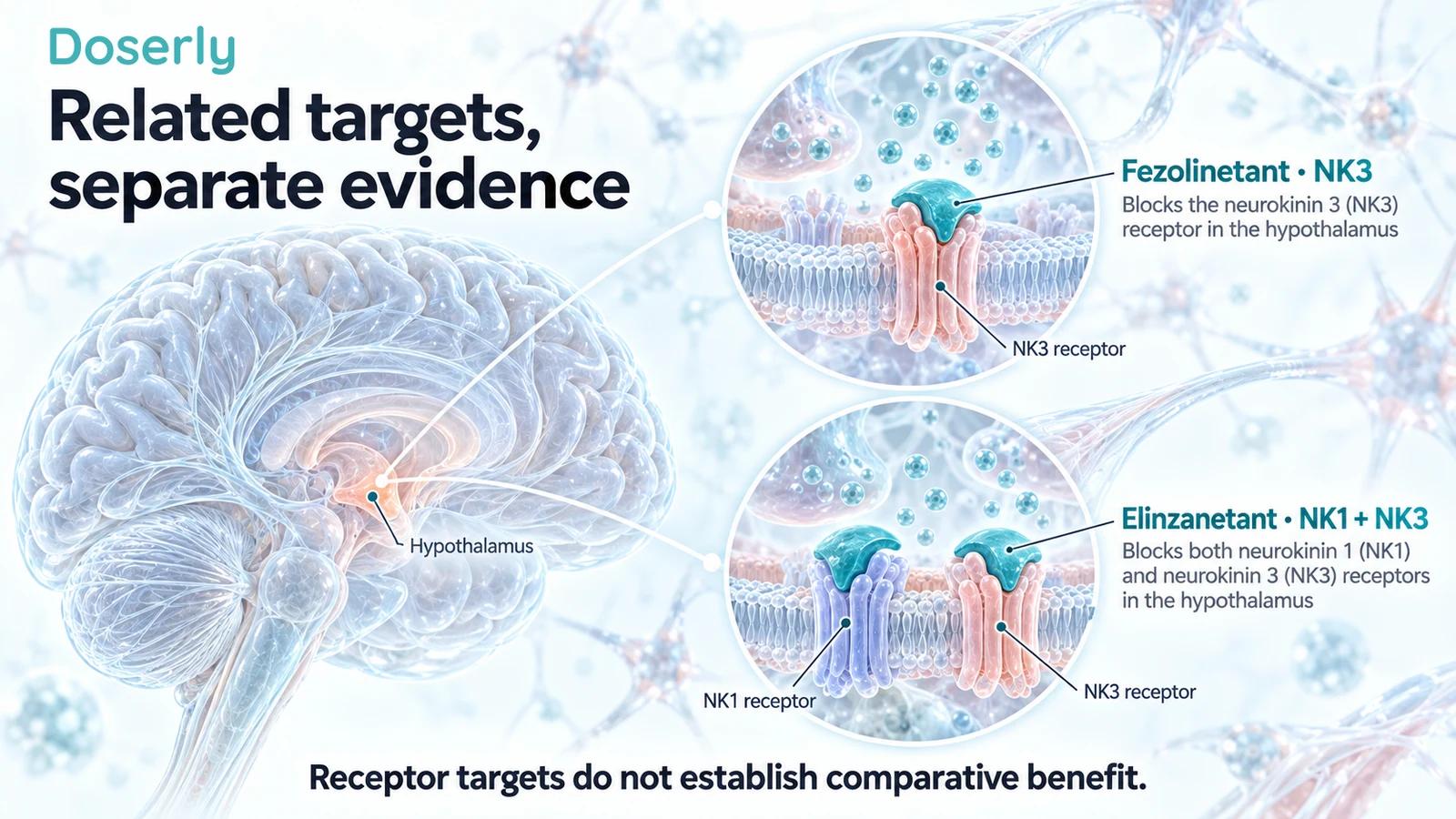
Fezolinetant, sold as Veozah in the United States, blocks neurokinin 3 receptors. Elinzanetant, sold as Lynkuet, blocks neurokinin 1 and neurokinin 3 receptors. Both are nonhormonal treatments directed at vasomotor symptoms due to menopause. Neither mechanism means that every menopause symptom will respond. Veozah prescribing information, Lynkuet prescribing information.
A dual receptor target is a biological difference, not a built-in ranking system. The additional target may motivate a hypothesis about sleep or other outcomes, but the hypothesis still needs clinical testing. “Two receptors” cannot be translated into twice the benefit, broader protection or greater safety.
The drug names also should not obscure the treatment goal. Someone seeking relief from night sweats may have a different priority from someone primarily troubled by daytime episodes. Vaginal symptoms, bone health and contraception are separate concerns. The Doserly nonhormonal treatment guide can help place these medicines within that wider discussion.
What the pivotal results actually compare
SKYLIGHT 1 enrolled women aged 40 to 65 with at least seven moderate to severe hot flashes daily. At week 12, fezolinetant 45 mg reduced daily frequency by an estimated 2.55 episodes more than placebo. That is a placebo-adjusted difference in change, not the total decline within the active-treatment group. SKYLIGHT 1 primary report.
OASIS 1 and 2 enrolled postmenopausal women aged 40 to 65 with at least 50 moderate to severe vasomotor episodes weekly. At week 12, the corresponding placebo-adjusted frequency difference was approximately 3.2 daily episodes in each trial. The baseline averages across those groups were approximately 13 to 16 episodes daily. OASIS 1 and 2 primary report.
It is tempting to subtract 2.55 from 3.2 and call the answer elinzanetant’s advantage. That calculation does not represent a randomized comparison. The people, baseline symptom distribution, trial conduct and analytical details were not held constant between the research programs. A numerical gap between published estimates contains both possible treatment differences and possible differences between studies.
This does not mean the estimates are useless or that the medicines must be identical. It means that the comparison requires additional assumptions and analysis. The honest conclusion from the pivotal trials is that each outperformed its own placebo group for the specified outcomes under the study conditions.
A percentage can hide the starting point
Consider two hypothetical people, unrelated to either trial. One starts with 12 episodes daily and improves to six; the other starts with eight and improves to four. Both have a 50% reduction, but one has six fewer episodes and the other four fewer. If you compare only the absolute reductions, the first looks larger; if you compare only percentages, they look the same.
Now imagine that each person belongs to a different trial with a different placebo response. The amount of change attributable to treatment cannot be read from their individual before-and-after counts. You need the randomized group comparison, the outcome definition and the uncertainty around the estimate.
The example is deliberately simple. Real trials analyze repeated observations, missing records and variation among participants. But it exposes a common problem with promotional graphics: a percentage can look self-explanatory while omitting the baseline, comparator and time point needed to interpret it.
A responder percentage asks another question again: how many people crossed a chosen threshold, such as a certain percentage reduction? That may be useful, but a 50% responder analysis should not be compared directly with a mean episode-count change. Neither is automatically the more patient-centered measure. The measure has to fit the question being asked.
The 2026 indirect comparison adds useful information
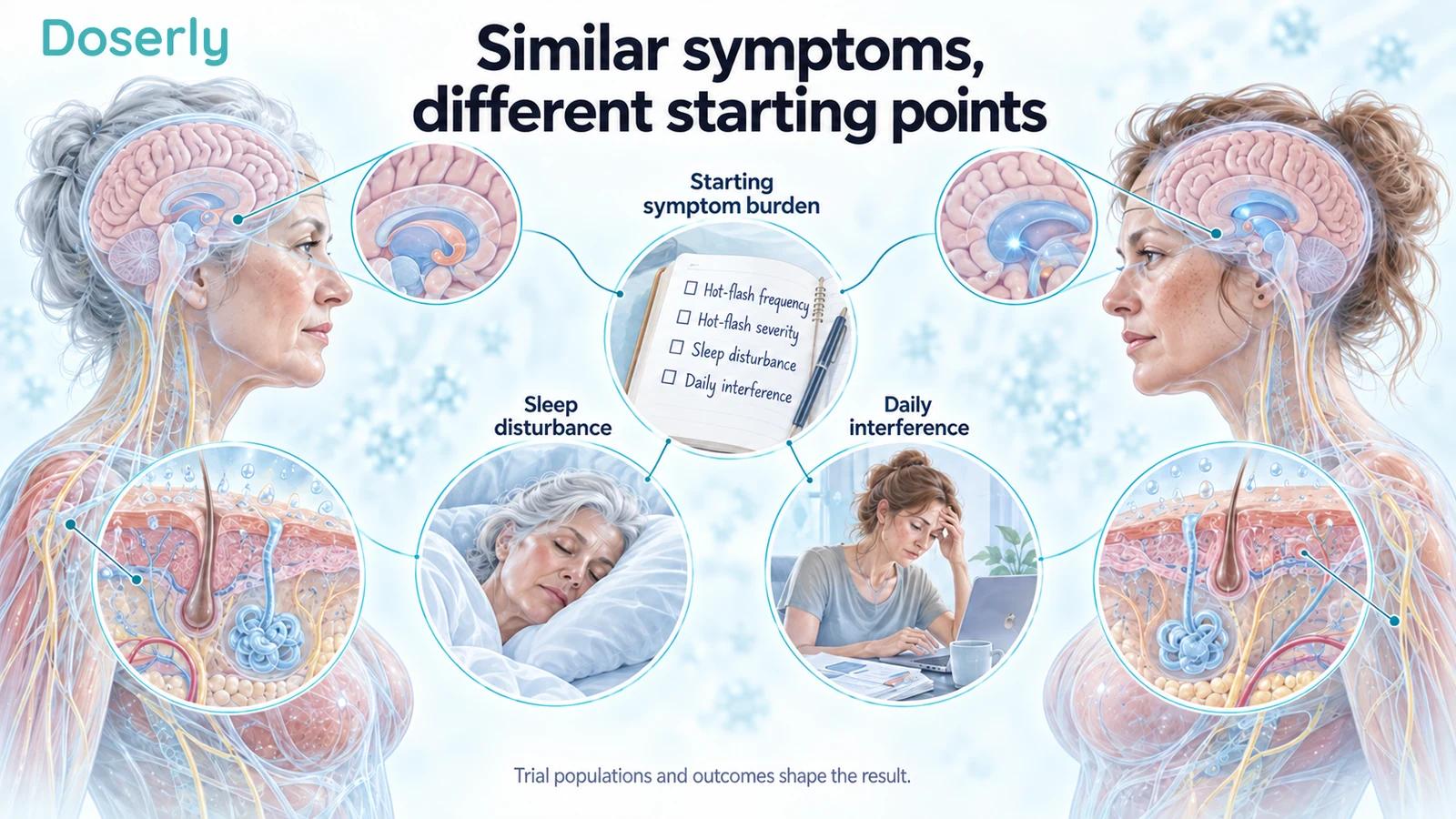
A matching-adjusted indirect comparison published in Maturitas used individual participant data from SKYLIGHT 1 and 2 to better match the population and design of OASIS 1 and 2. The authors identified potential treatment-effect modifiers and adjusted the comparison. They reported that the OASIS populations had higher baseline frequency, severity and sleep disturbance. Matching-adjusted comparison.
After adjustment, the analysis found comparable efficacy for vasomotor symptom frequency and severity. Reported sleep disturbance improved more with elinzanetant, while the overall menopause-specific quality-of-life comparison did not show a significant difference. The author list includes Astellas employees; the study is an industry-associated comparative analysis, not a new independently randomized treatment trial.
This result deserves attention precisely because it goes beyond lining up unadjusted headlines. It attempts to address some of the differences that make a naïve comparison unreliable. It also shows why the outcome must be named: a sleep difference and no clear overall quality-of-life difference can coexist in the same analysis.
Adjustment cannot ensure that every relevant difference between trials has been measured or adequately balanced. “Comparable” in an indirect analysis also should not be rewritten as formal proof of equivalence for every patient. The practical message is narrower: these data do not support declaring a universal winner on the basis of the unadjusted vasomotor results alone.
Indirect evidence is useful when its assumptions are visible
Formal indirect comparisons and network meta-analyses are established methods. Their validity depends on whether the studies are sufficiently similar in factors that can modify relative treatment effects. Cochrane calls that requirement transitivity. If those factors differ materially, connecting trials through a common placebo does not automatically solve the problem. Cochrane methods handbook.
For a reader, the useful questions are concrete. Were the same doses studied? Were the participants comparable? Was the same outcome measured at the same time? Did the analysis account for baseline symptom burden? How much uncertainty remained after adjustment? A treatment ranking without those details gives less information than its tidy ordering suggests.
An analysis can also be informative for one outcome and weak for another. A network assembled around short-term hot-flash frequency may have little to say about uncommon liver injury, long-term persistence or an individual’s ability to tolerate daytime drowsiness. The evidence does not become universally comparative simply because several treatments appear in one paper.
Sleep findings need especially careful wording
OASIS 1 and 2 found improvements in patient-reported sleep disturbance with elinzanetant compared with placebo. That is a meaningful outcome. It is not the same as proving superiority over fezolinetant for chronic insomnia, or showing that the additional NK1 blockade is solely responsible for the improvement. OASIS trial report.
Newer objective sleep research adds detail. NIRVANA randomized 110 postmenopausal women with vasomotor symptoms and documented sleep disturbance. The week-4 polysomnography estimate favored elinzanetant by 22.5 minutes of wakefulness after sleep onset; at week 12, the corresponding estimate was 0.9 minutes, with an interval spanning no difference. This was an exploratory placebo-controlled trial, not a comparison with fezolinetant. NIRVANA primary report.
Those findings should neither be ignored nor flattened into a blanket sleep promise. The timing and measurement matter. A person can have fewer sweat-related awakenings, persistent independent insomnia and unwanted daytime sleepiness at the same time. Those experiences require separate assessment, even if an overall questionnaire score improves.
For someone whose chief complaint is sleep disruption, the treatment conversation should specify what success means. Is it fewer soaked sheets, less time awake, more refreshing sleep or better daytime function? A trial headline about “sleep” cannot tell you which of these changed unless you look at the actual instrument and result.
Safety differences are real, but label comparison has limits too
Current US labels provide concrete differences that may be more relevant than a small numerical gap between trial averages. Veozah carries a boxed warning for hepatotoxicity. Its liver-testing schedule is baseline, monthly for the first three months, and at months 6 and 9. It is contraindicated with CYP1A2 inhibitors, known cirrhosis, and severe renal impairment or end-stage renal disease. Current Veozah label.
Lynkuet requires baseline liver tests and follow-up transaminases at three months. Its label highlights daytime impairment and CNS effects, pregnancy risk, and CYP3A4 interactions. The August 2026 revision warns about seizures and recommends counseling patients about that risk, with extra caution for a history of seizures or conditions lowering the threshold. Current Lynkuet label.
Different monitoring requirements are legitimate practical differences. They are not proof that a medicine with fewer scheduled tests is safer in every respect. Equally, a boxed warning for one product should not be automatically copied onto another because the receptor targets overlap. The current product-specific instructions matter.
Adverse-event percentages from separate studies also need care. Different follow-up, patient selection and event collection can affect them. Rare harms may become clearer only after broader use; the fezolinetant warning itself developed after approval. FDA’s communication documents why the treatment plan changed. FDA fezolinetant safety update.
A decision can be informed without a universal winner
The first step is to define the symptom target and establish whether the proposed medicine is appropriate for the person’s medical history. The second is to review the full medication list, including nonprescription products, for interactions. The third is to make follow-up practical: laboratory access, result review, adverse-effect instructions and a date to assess benefit.
Cost and access may also determine whether a theoretical option is a realistic one. Those details change by country, insurer and pharmacy, so a clinician or pharmacist should check the current local situation. A comparison that ignores whether someone can obtain the treatment or complete monitoring is incomplete even if its trial arithmetic is careful.
When treatment begins, use a small set of consistent observations. Count or describe the target episodes, record how much they interfere with life, and note unwanted effects separately. If a clinician later changes treatment, keep track of timing and other changes rather than assuming every difference reflects the new drug. An individual treatment experience can guide care without becoming proof of comparative efficacy for everyone.
The Doserly fezolinetant guide and elinzanetant guide provide product-specific context. The best use of the comparative evidence is to sharpen the questions: which outcomes matter, how directly were they compared, what uncertainty remains, and what makes a treatment workable for this person? Those questions support a more useful choice than declaring a winner from two separate trial headlines.
Explore the research
- SKYLIGHT 1 randomized trial.
- OASIS 1 and 2 randomized trials.
- Matching-adjusted indirect comparison, Maturitas, 2026.
- Cochrane: network meta-analysis methods.
- NIRVANA sleep trial, 2026.
- Veozah current US prescribing information.
- Lynkuet US prescribing information, August 2026.
- FDA fezolinetant liver-safety update.