
Peptides
October 16, 2026
Does CagriSema evidence support adding cagrilintide to tirzepatide?
On this page
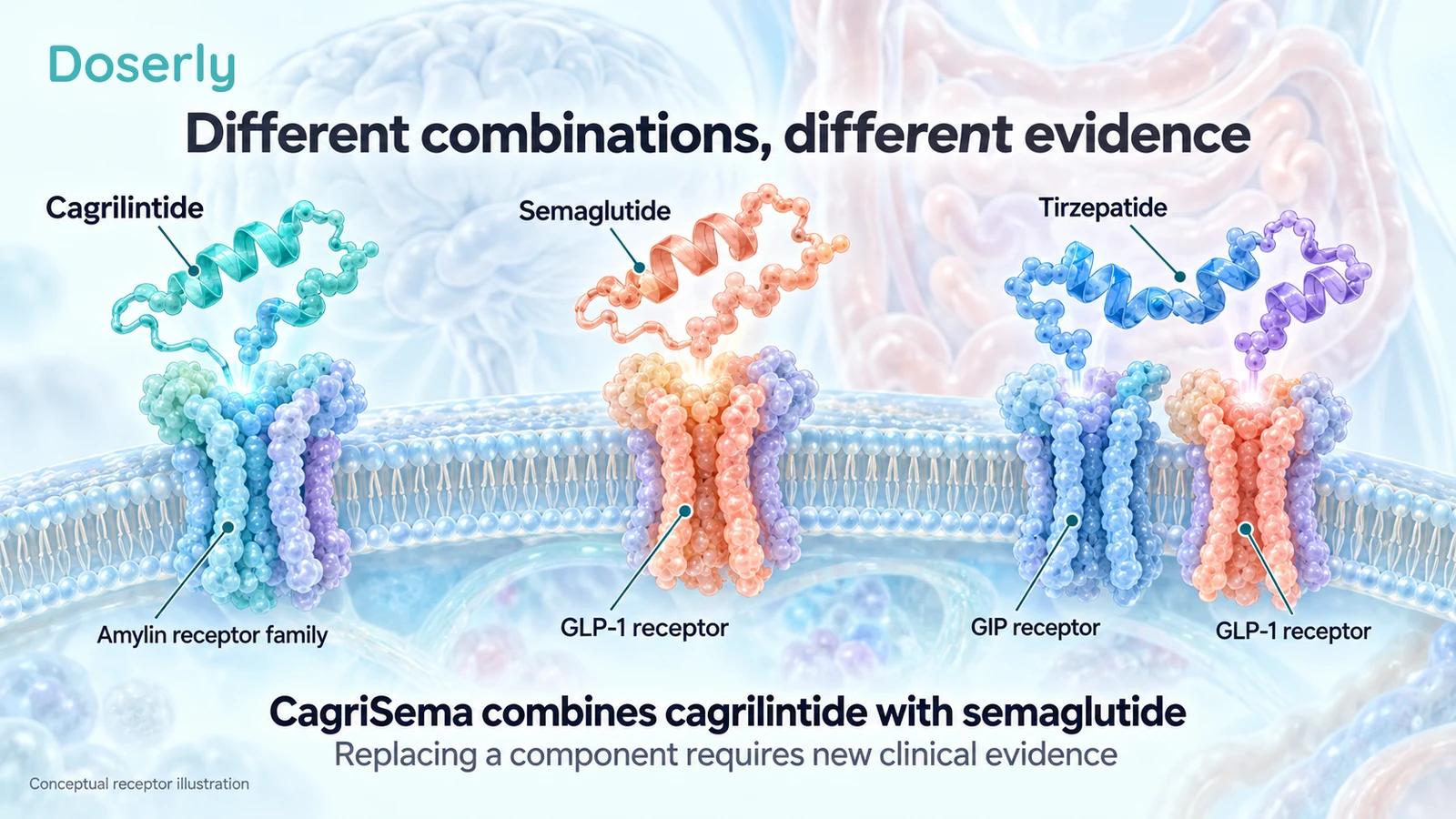
CagriSema provides evidence for cagrilintide combined with semaglutide. It does not, by itself, establish the benefit or safety of adding cagrilintide to tirzepatide. That distinction remains important even though both semaglutide and tirzepatide act at the GLP-1 receptor.
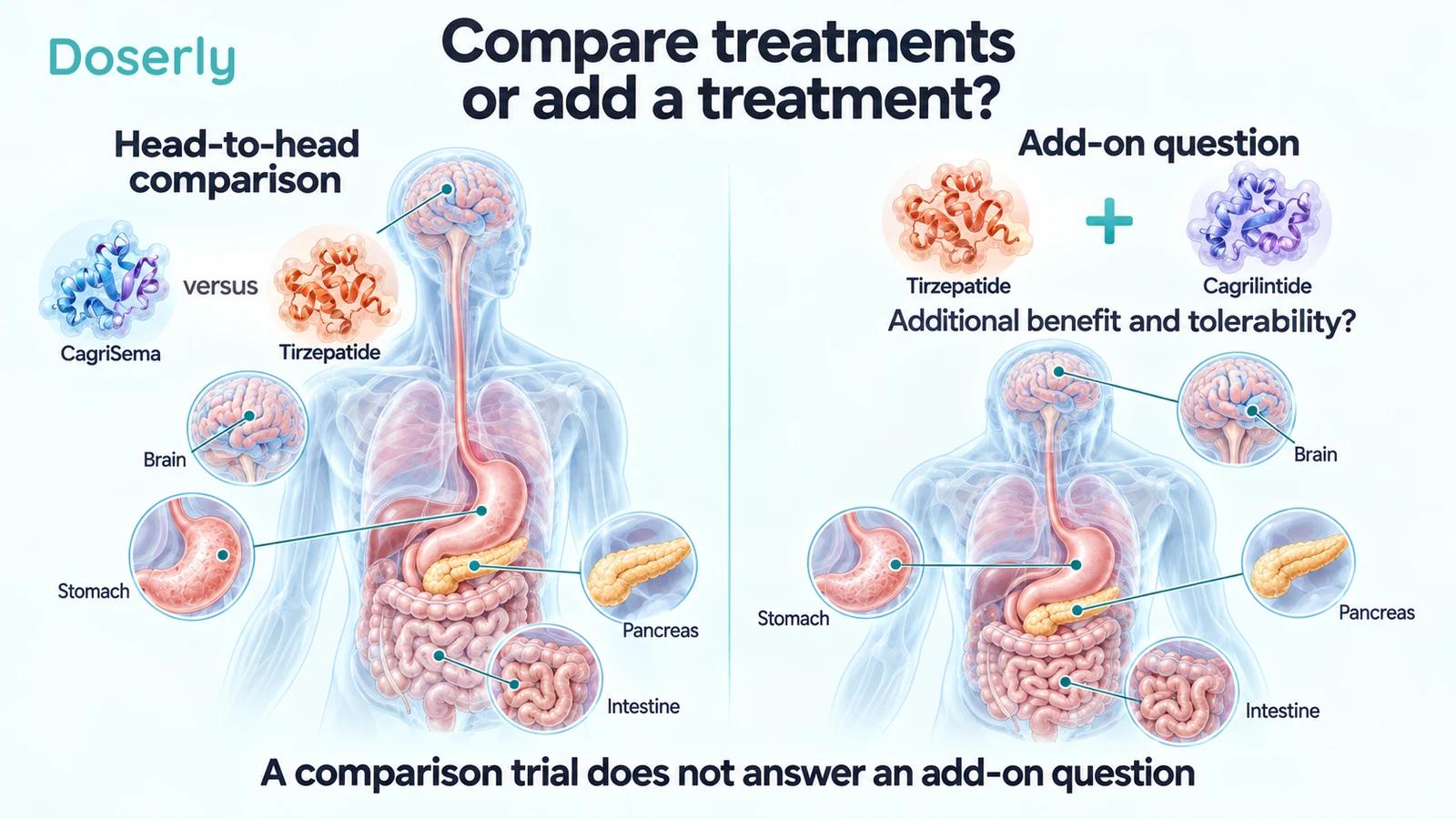
The idea is biologically plausible enough to investigate. It is not a validated substitution rule. A different background medicine changes the intervention, the possible incremental benefit and the tolerability question. A trial comparing CagriSema against tirzepatide also does not answer what happens when cagrilintide and tirzepatide are used together.
There is a timely qualification: a current Health Canada record names a cagrilintide add-on study involving GLP-1 or GIP/GLP-1 treatment. The record is sparse and supplies no efficacy results. The accurate conclusion is that add-on research has entered the public record—not that a supported personal regimen can be inferred from CagriSema.
Why the proposed substitution sounds convincing
The reasoning often starts with something true: amylin-related signaling and GLP-1 signaling are not identical. Cagrilintide is a long-acting amylin analogue with activity across calcitonin-family receptors. Semaglutide is a GLP-1 receptor agonist. Combining distinct pharmacology can be a sensible development strategy. Laboratory receptor studies help explain the rationale. Primary cagrilintide receptor research
The unsupported step comes next: because tirzepatide also activates the GLP-1 receptor, perhaps it can simply replace semaglutide while preserving or improving the combination’s benefits. Receptor overlap does not make two medicines interchangeable. Tirzepatide also activates the GIP receptor, and its complete pharmacology is not reproduced by attaching a GLP-1 label to its name. Zepbound prescribing information
Counting receptor targets is not a clinical prediction model. Three named targets do not automatically mean more benefit than two, just as a larger number of ingredients does not establish a better balance of effects. The dose-exposure relationship, duration of action, existing response and ability to tolerate treatment all belong to the actual intervention being tested.
The appropriate inference is therefore a research question: could amylin-related activity add useful benefit on top of this particular background treatment? Answering it requires observations in people receiving that combination.
What CagriSema trials actually establish
REDEFINE 1 randomized adults without diabetes to CagriSema, semaglutide alone, cagrilintide alone or placebo. At 68 weeks, its treatment-policy estimate of mean weight reduction was 20.4% with the combination, compared with 14.9% for semaglutide, 11.5% for cagrilintide and 3.0% for placebo. REDEFINE 1 primary report
That is strong evidence that the tested combination outperformed its individual components on the trial’s weight endpoint. It is not evidence that cagrilintide adds the same percentage-point benefit to any other medicine. There was no tirzepatide-plus-cagrilintide arm in this study.
It is also worth distinguishing a combination assigned within a trial from an add-on after a person has already spent substantial time on another treatment. The latter question includes treatment history. Someone considering an add-on because of a plateau, adverse effects or inadequate response may differ from participants entering a combination trial under its enrollment rules.
Subtracting two study averages cannot bridge that gap. It produces a comparison between groups under the original trial conditions. It does not identify what an individual’s counterfactual result would have been if a new medicine were added later.
Head-to-head evidence is often mistaken for combination evidence
REDEFINE 4 directly compared CagriSema with tirzepatide. The registry lists separate treatment arms, rather than a group receiving cagrilintide plus tirzepatide. Its primary question concerned noninferiority in weight change over 84 weeks. REDEFINE 4 registration
In a February 2026 announcement, the sponsor reported that the noninferiority endpoint was not met. It reported 23.0% versus 25.5% weight reduction under an adherence-assuming analysis, and 20.2% versus 23.6% under the treatment-regimen analysis, for CagriSema and tirzepatide respectively. These are sponsor-reported headline findings from an open-label comparison. Novo Nordisk REDEFINE 4 announcement
Whether the result favors one intervention, the other or neither, the logical boundary stays the same. A comparison between A and B does not reveal the effect of adding part of A to B. Nor does an unsuccessful noninferiority test establish that combining the treatments would rescue a result.
SURMOUNT-5 offers another example. It compared tirzepatide with semaglutide in adults with obesity without diabetes and found greater mean weight reduction with tirzepatide under the tested regimens. Cagrilintide was not the add-on being tested. Its findings inform that head-to-head comparison; they do not complete the missing combination experiment. SURMOUNT-5 primary report
What the newer add-on record does—and does not—show
The Health Canada portal lists protocol NN9833-8245 under a title describing cagrilintide as an add-on to GLP-1 or GIP/GLP-1 treatment for obesity. At the October 15, 2026 check, it displayed a closed status, a May 2026 authorization date and no matched international registry. The page did not provide treatment results or a detailed tirzepatide regimen. Health Canada trial record
This matters in two directions. It makes an absolute statement that “no add-on study exists” too strong. But it does not establish that the study completed successfully, that tirzepatide was a specified background medicine, or that adding cagrilintide produced a favorable benefit-risk balance. The portal explains that “closed” can include studies that ended normally or stopped early.
Trial authorization is permission to conduct research under regulatory requirements. It is not marketing authorization for a medicine or approval of a consumer treatment combination. A registry entry is evidence of a study record, not evidence of a successful clinical outcome.
For future updates, the meaningful additions would be an accessible protocol, clearly identified background treatments, actual enrollment and follow-up, and results that separate benefit from treatment burden. A press release or study title alone cannot supply those missing details.
What a useful add-on trial would need to measure
A persuasive study would compare an appropriate background treatment plus cagrilintide with the same background treatment plus a suitable control. Randomization would help prevent differences in motivation, prior response or clinical care from masquerading as an add-on effect.
The population would need careful description. Were participants just beginning treatment, already stable on it, or selected because they had reached a plateau? How long had they used the background medicine? Were people with diabetes included? A result in one of these settings cannot automatically be transferred to the others.
The analysis must also define what happens when people cannot remain on the assigned intervention. An estimate assuming continued treatment answers a different question from one incorporating discontinuation and other treatment changes. Both are potentially informative, but the distinction is especially relevant when adding another treatment could affect tolerability. ICH estimand guidance
Weight reduction alone would be incomplete. A clinically useful assessment would include adverse effects, discontinuation, nutritional intake, relevant glucose outcomes, patient-reported functioning and enough follow-up to assess durability. A person may reasonably value a smaller sustained benefit more than a larger result that is difficult to live with.
These are requirements for interpreting evidence, not a protocol for self-experimentation. A personal log can describe what happened. Without an adequate comparator, it cannot establish what would have happened without the added intervention.
Switching treatment is a third question
A comparison, an add-on and a switch are three different treatment strategies. In a switch, one intervention replaces another. In an add-on, the existing intervention continues while another is introduced. Results from people starting randomized treatment do not automatically describe either transition after prolonged prior treatment.
A meaningful switch study would need to explain what participants had already received, why the change was being considered and how follow-up handled the transition. An add-on study would need to preserve a suitable background-treatment comparison. These distinctions matter because the apparent change after a transition includes the history that came before it.
Consider a hypothetical person whose weight has been stable for several months. A later reduction after a change does not reveal whether the new ingredient, the altered background treatment or another concurrent change produced it. Nor does the original trial's mean tell us what would have happened if the person had continued the previous plan. That is why outcome definitions and treatment changes are specified in clinical-trial estimands rather than left implicit. ICH guidance
Why tolerability cannot be borrowed either
The same transfer problem applies to safety. If a combination has gastrointestinal effects in a semaglutide-based trial, that does not quantify the effects of substituting tirzepatide. The background medicine and resulting exposure pattern have changed.
Tirzepatide’s prescribing information includes gastrointestinal adverse reactions and a warning about acute kidney injury due to volume depletion. Such information identifies clinically relevant issues that an add-on study would need to monitor. It does not predict the frequency of those events with cagrilintide added.
The label also says coadministration with other tirzepatide-containing products or a GLP-1 receptor agonist is not recommended. That is relevant to combining tirzepatide with CagriSema, because CagriSema includes semaglutide. Cagrilintide alone is not a GLP-1 receptor agonist, so this wording should not be misquoted as a specific studied prohibition or endorsement of cagrilintide-plus-tirzepatide. Current Zepbound label
Precision helps more than either extreme. A missing explicit label statement does not establish safety. Conversely, a restriction concerning one drug class should not be silently rewritten to describe another. The unanswered combination question remains unanswered until relevant evidence resolves it.
A plateau is a reason to review the situation, not proof of a missing receptor target
An anecdote about renewed weight loss after adding a product can be compelling. It can also combine several changes: renewed attention to food intake, altered activity, different measurement timing, changes in the original treatment, or selection of the most successful experiences for public sharing.
None of those possibilities proves the reported experience was unreal. They explain why the experience does not isolate the added product’s causal effect. The same problem applies when symptoms improve or worsen: sequence alone is not a controlled comparison.
For someone already receiving treatment, a useful clinical review starts with the actual pattern. That includes the time course, the clinician-directed regimen, missed treatments, symptoms, intake, relevant laboratory results and the goal that remains unmet. A plateau on the scale is not a laboratory test showing that amylin signaling is deficient.
Product identity is a separate unanswered question
Even a future positive trial would test a defined investigational product and clinical protocol. It would not validate every product sold online under the same molecule’s name. The FDA currently identifies cagrilintide among unapproved products and states that it is not a component of an FDA-approved drug. FDA statement
The strongest current conclusion is therefore specific: CagriSema supports the tested cagrilintide–semaglutide combination, and current records show interest in broader add-on research. Neither a shared receptor nor a head-to-head result supplies a reliable benefit estimate, safety estimate or use regimen for adding cagrilintide to tirzepatide.
Our cagrilintide guide, tirzepatide guide and semaglutide guide can help keep the molecules and their evidence separate when preparing questions for a clinician.
Sources
- Coadministered Cagrilintide and Semaglutide in Adults with Overweight or Obesity, 2025.
- AM833 Is a Novel Agonist of Calcitonin Family G Protein-Coupled Receptors: Pharmacological Comparison with Six Selective and Nonselective Agonists, 2021.
- Zepbound US Prescribing Information, 2026.
- Tirzepatide as Compared with Semaglutide for the Treatment of Obesity, 2025.
- REDEFINE 4 study registration, 2026.
- REDEFINE 4 headline results announcement, 2026.
- Health Canada trial portal: NN9833-8245 cagrilintide add-on study, 2026.
- E9(R1) Statistical Principles for Clinical Trials: Addendum: Estimands and Sensitivity Analysis in Clinical Trials, 2021.
- FDA’s Concerns with Unapproved GLP-1 Drugs Used for Weight Loss, 2026.