
Peptides
October 16, 2026
MOTS-c and CB4211: two names that should not share one evidence column
On this page
Someone looking into MOTS-c may encounter an encouraging human study: four weeks of treatment, changes in liver enzymes and glucose, and no reported serious adverse events. The study is real, but the name of the treatment matters. Participants received CB4211, an investigational analogue of MOTS-c, rather than native MOTS-c.
An analogue is a related molecule developed from an original biological structure. That relationship can help explain why scientists chose to study it. It does not make the two substances clinically interchangeable. The CB4211 findings belong to the actual investigational product, formulation and participants in its trial.
Reading the evidence under the correct name reveals a more interesting story than a borrowed safety claim. There were exploratory metabolic signals, similar liver-fat reductions in both groups, a very small final analysis and formulation problems that remained important after the positive announcement.
Native MOTS-c is the starting point, not another name for CB4211
The original MOTS-c research identified a 16-amino-acid peptide encoded within a region of mitochondrial DNA. Cell and mouse experiments connected it with metabolic regulation, including insulin sensitivity. These findings established a biological reason to investigate the peptide family, not a demonstrated treatment for human fatty liver disease. MOTS-c discovery study
CohBar described CB4211 as a modified analogue of naturally occurring MOTS-c. Its 2021 announcement concerned that company's investigational drug. When a summary changes the drug name to MOTS-c, it removes a distinction the source itself made. CohBar's CB4211 announcement
This does not mean an analogue must be better, worse or unrelated in every effect. It means those comparisons require evidence. Chemical changes and formulation decisions can alter how a peptide behaves, and a shared biological origin does not tell us which findings transfer.
The distinction also works in the other direction. An adverse effect observed with a CB4211 formulation cannot automatically be assigned the same frequency to native MOTS-c. Preserving the product name protects against exaggerating both benefit and harm.
What the human CB4211 program was designed to learn
The registered phase 1a/1b study had three parts. Single-dose and short repeated-dose stages involved healthy, non-obese participants. The later stage evaluated repeated treatment over 28 days in people with nonalcoholic fatty liver disease, using the disease terminology of the original protocol. The registry lists 88 participants across the whole program. CB4211 trial registry
The primary focus was safety and tolerability. Pharmacokinetics—how drug concentrations change after administration—was also a central objective. Liver fat, body weight and metabolic biomarkers were exploratory outcomes. Those categories matter because the study was an early development experiment, not a large confirmatory test of clinical liver benefit.
The registry was marked completed when checked on October 15, 2026, but it had no posted results dataset. The publicly available findings discussed here come from the sponsor's announcement and presentation filed with the SEC. A completed registry entry and a published results table are different things.
Why “20 participants” does not describe everyone randomized
The sponsor's presentation reports 23 people with obesity and fatty liver disease randomized in the phase 1b stage. Three discontinued before the final assessment: two because of COVID-19 and one who withdrew consent. Twenty completed the end-of-treatment pharmacodynamic assessments, with 11 in the CB4211 group and nine in the placebo group. CohBar participant-disposition slides
That explains why the headline report often describes a 20-person analysis while the full program's registry reports 88. These are different denominators for different parts of the research, not necessarily contradictory counts.
The participants stayed in the clinical unit and received a standardized diet during the four-week stage. This was a closely controlled setting. It cannot simply be treated as evidence about people using a different peptide at home while changing their diet, training and other treatments.
A small final sample is not worthless. It can reveal an early signal and help plan the next study. But a few participants can substantially influence the averages, and missing final assessments deserve attention. The reported result should be described as coming from the analyzed group rather than quietly assigned to everyone randomized.
The enzyme findings were encouraging but exploratory
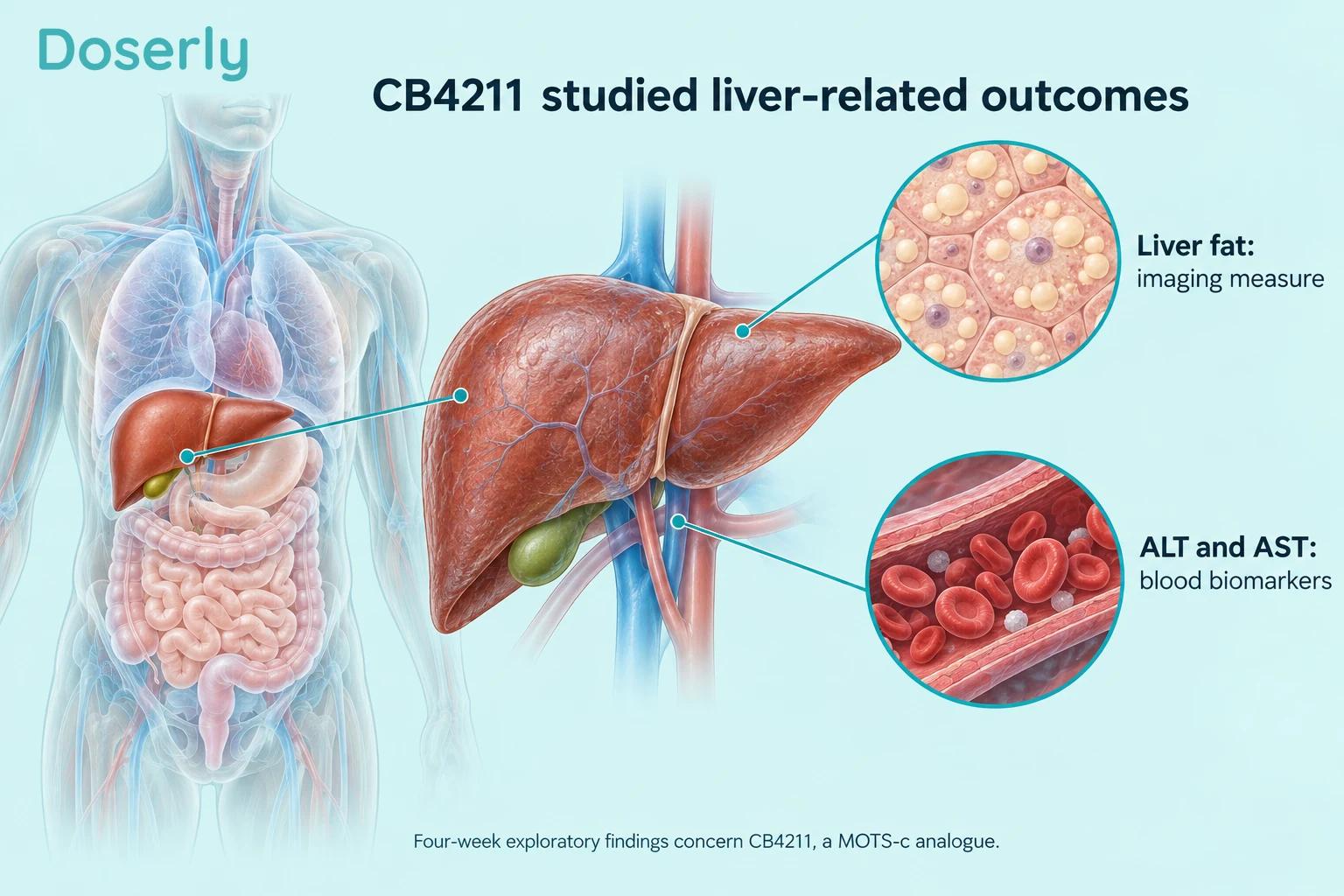
The sponsor reported a 21% reduction from baseline in ALT with CB4211, compared with a 4% increase with placebo. AST and glucose also showed favorable changes in the announcement. ALT and AST are enzymes measured in blood that can provide information about liver injury; they are not direct measurements of scar tissue or proof that a person's liver disease has resolved. Sponsor topline biomarker results
The most defensible interpretation is that these short-term findings supported further investigation of the analogue. They did not establish prevention of cirrhosis, fewer liver-related complications or long-term weight benefit.
A reader should also distinguish “the primary endpoint was met” from “every proposed benefit was proven.” Here, the primary objective concerned safety and tolerability; the metabolic measurements were exploratory. A favorable exploratory comparison remains interesting, but its role in the study does not change because it is more appealing in a headline.
The public materials did not provide the same level of methods, individual outcomes and statistical detail that a full clinical report would ordinarily allow readers to assess. We should therefore retain the sponsor's reported findings without adding certainty about longer-term efficacy or the robustness of every analysis.
Liver fat fell in both groups
The liver-fat finding is an essential part of the same story. The sponsor reported absolute liver-fat reductions of approximately five percentage points in each group: 5.03 with CB4211 and 4.88 with placebo, measured by MRI-derived proton density fat fraction. Sponsor liver-fat results
MRI-PDFF estimates the proportion of fat in liver tissue. A percentage-point change in that measurement is not the same as a relative percentage reduction. For example, a hypothetical change from 20% to 15% liver fat is a five-percentage-point decline and a 25% relative decline. Mixing those descriptions can make the same measurement sound dramatically different.
In this study, both groups improved from their own starting values. That observation does not demonstrate that CB4211 added a liver-fat benefit beyond the comparison condition. The sponsor suggested that the controlled study environment and diet might have contributed to the placebo response, but the study did not separately randomize participants to prove that explanation.
The enzyme signal and the similar liver-fat changes can coexist. Different measurements describe different features of the condition. A useful summary reports both instead of selecting whichever result makes the treatment appear most impressive.
A positive announcement did not solve the formulation problem
Drug development is about the preparation that can actually be administered, not only the underlying molecule. CB4211's history illustrates that point.
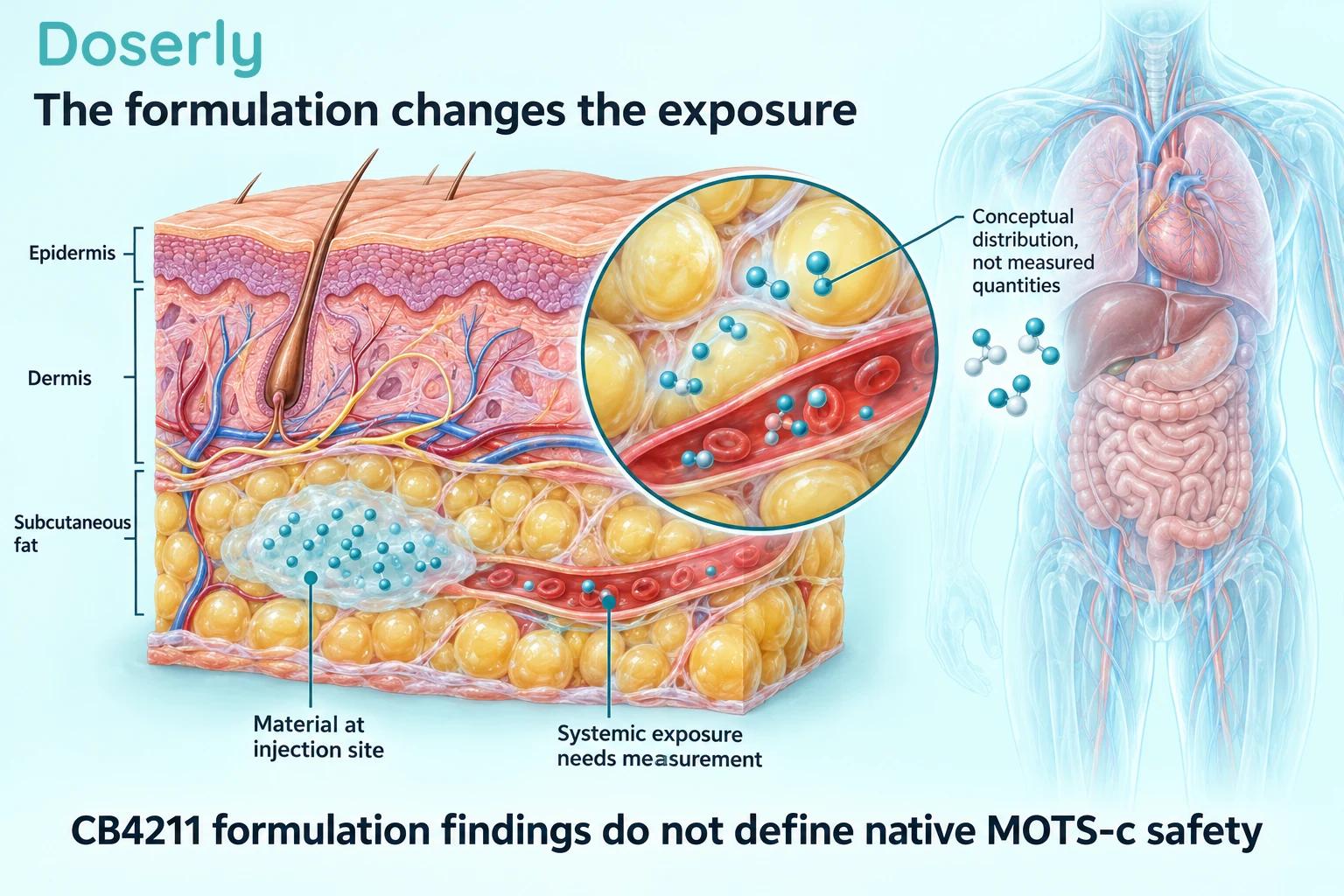
In an earlier filing, CohBar described a temporary suspension of the trial in November 2018 because of mild but persistent injection-site reactions. The company thought some drug remained at the injection site, producing palpable bumps. That was its working explanation, not a proven mechanism for every peptide injection. CohBar's 2019 formulation disclosure
The trial subsequently continued with a modified formulation. Even after the 2021 results, the issue did not disappear from the development record. In its 2022 annual-report disclosure, CohBar said it did not consider the phase 1b formulation suitable for further development and that attempts to improve it had not succeeded at that time. CohBar's 2022 annual-report note
These are historical statements about that development program. They should not be transformed into a universal claim that every MOTS-c-related molecule will behave the same way. They do show why a favorable laboratory marker and a practical, usable medicine are separate milestones.
What “no serious adverse events” can reasonably mean
The sponsor reported no serious adverse events in the early CB4211 study. That is useful information about the observed participants and exposure. It does not establish that the drug was free of adverse effects, that repeated use over much longer periods is safe or that a different preparation has the same risk profile. CB4211 safety announcement
An event can be clinically troublesome without meeting the regulatory definition of serious. Persistent injection-site effects can interfere with repeated treatment and product development even when they do not cause hospitalization or another serious outcome. The formulation history supplies context that a single reassuring sentence omits.
The same caution applies to product comparisons. One cannot use CB4211's short-term safety observations to calculate the risk of native MOTS-c, just as one cannot use its injection-site history to assign native MOTS-c a measured adverse-event rate. The missing comparison is not filled by assuming sameness.
A patient considering a proposed treatment needs evidence about the actual preparation they would receive: its identity, route, quality and intended duration. A paper about a related experimental compound can inform the conversation, but it cannot certify that preparation.
The native MOTS-c evidence remains its own question
The FDA's July 2026 briefing on MOTS-c-related bulk drug substances reported that its review had not identified clinical exposure or pharmacokinetic data adequate to evaluate native MOTS-c safety. It also discussed uncertainties about product characterization and immune responses. This was a staff briefing for an advisory process, not a final product approval. FDA MOTS-c evaluation
There is also newer registered research. As checked in October 2026, MOTS-MET was listed as recruiting, with 120 participants planned and no results posted. It proposes to test investigational MOTS-c in adults with prediabetes and overweight or obesity over 12 weeks. The latest posted registry update was April 1, 2026. Native MOTS-c trial registration
This should prevent two opposite errors. It would be outdated to say no native MOTS-c human trial has been registered. It would also be premature to treat that registration as a positive human result. A study can be planned or underway while the clinical evidence needed for treatment decisions remains unavailable.
Neither the older CB4211 study nor the newer registry establishes a general longevity protocol. Their intended populations and outcomes are metabolic, and their actual results—or absence of results—must remain visible.
Why the dose cannot be borrowed either
The same-name confusion often reaches dosing. A research amount used for CB4211 is sometimes presented as though it establishes an appropriate amount of native MOTS-c. That is an unsupported transfer between products.
Even if two substances have related biological effects, an amount expressed in milligrams does not show that they produce equivalent tissue exposure or duration of action. The formulation history makes this especially concrete: administration did not necessarily result in the distribution the developers wanted.
A useful clinical comparison would need data connecting identity, exposure and response. Without that connection, copying a trial amount provides the appearance of a scientific protocol while leaving its central assumption untested. Nothing in the sources reviewed here validates converting the CB4211 regimen into a native MOTS-c schedule.
Keep the evidence attached to the treatment
For someone evaluating a claim, the simplest first step is to read the intervention's exact name in the methods or registry. Then identify the formulation, population, duration and primary outcome. Check whether the claimed result comes from a completed trial report, a sponsor announcement or a registration without results.
For CB4211, that process leads to a small early human study with exploratory biomarker signals and meaningful formulation limitations. For native MOTS-c, it leads to a separate body of preclinical and endogenous-measurement research, unresolved treatment questions and a registered study awaiting results.
Doserly's MOTS-c guide keeps these distinctions together for reference. They are worth preserving in every article, chart and consultation: a related molecule can inspire a research program, but it cannot donate its clinical evidence to another product by name alone.
Sources
- MOTS-c discovery study, 2015
- CB4211 phase 1a/1b trial registry
- CohBar's August 2021 topline announcement
- CohBar's August 2021 results presentation
- CohBar's 2019 injection-site and formulation disclosure
- CohBar's 2022 annual-report note on formulation suitability
- FDA's July 2026 MOTS-c briefing
- MOTS-MET native-peptide trial registration