
Peptides
October 16, 2026
MOTS-c rises with exercise: why that does not prove injections mimic exercise
On this page
Exercise changes what happens inside muscle and what can be measured in the bloodstream. MOTS-c is one of the signals researchers have investigated in that response. It is a small peptide associated with the mitochondrial genome, and experiments suggest that it participates in how cells handle metabolic stress.
That makes it an interesting research subject. It also creates an easy misunderstanding: if the body produces more of something during exercise, perhaps injecting it reproduces the benefits of exercise. The human MOTS-c studies do not establish that conclusion.
Some studies measured people's own MOTS-c before and after activity. Other experiments administered MOTS-c to mice or cultured cells. Those are complementary ways to investigate biology, but they answer different questions. Understanding the difference helps explain both the promise of the research and why an “exercise mimetic” claim remains ahead of demonstrated human treatment benefit.
What MOTS-c is—and what its name does not tell us
MOTS-c is a peptide of 16 amino acids. Its coding sequence was identified within a region of mitochondrial DNA associated with the 12S ribosomal RNA gene. The discovery paper reported metabolic effects in cells and mice, including protection against certain forms of insulin resistance in mice. It did not demonstrate that giving MOTS-c to people substitutes for exercise. Original MOTS-c discovery study
Mitochondria are involved in energy conversion, but the phrase “mitochondrial peptide” does not mean that a product delivers extra mitochondria or directly adds usable energy to muscle. The research concerns signaling: how a molecule changes cellular responses, gene activity and metabolism.
A related word, endogenous, simply means produced within the body. Exogenous means supplied from outside. An endogenous blood measurement and an exogenous drug exposure are not interchangeable, even when the molecule is described with the same name. Location, amount, duration and the body's other simultaneous responses all matter.
The Doserly MOTS-c guide explains the peptide's background and distinguishes native MOTS-c from the related investigational drug CB4211. That identity check is useful before comparing any two studies.
What the often-cited cycling experiment actually did
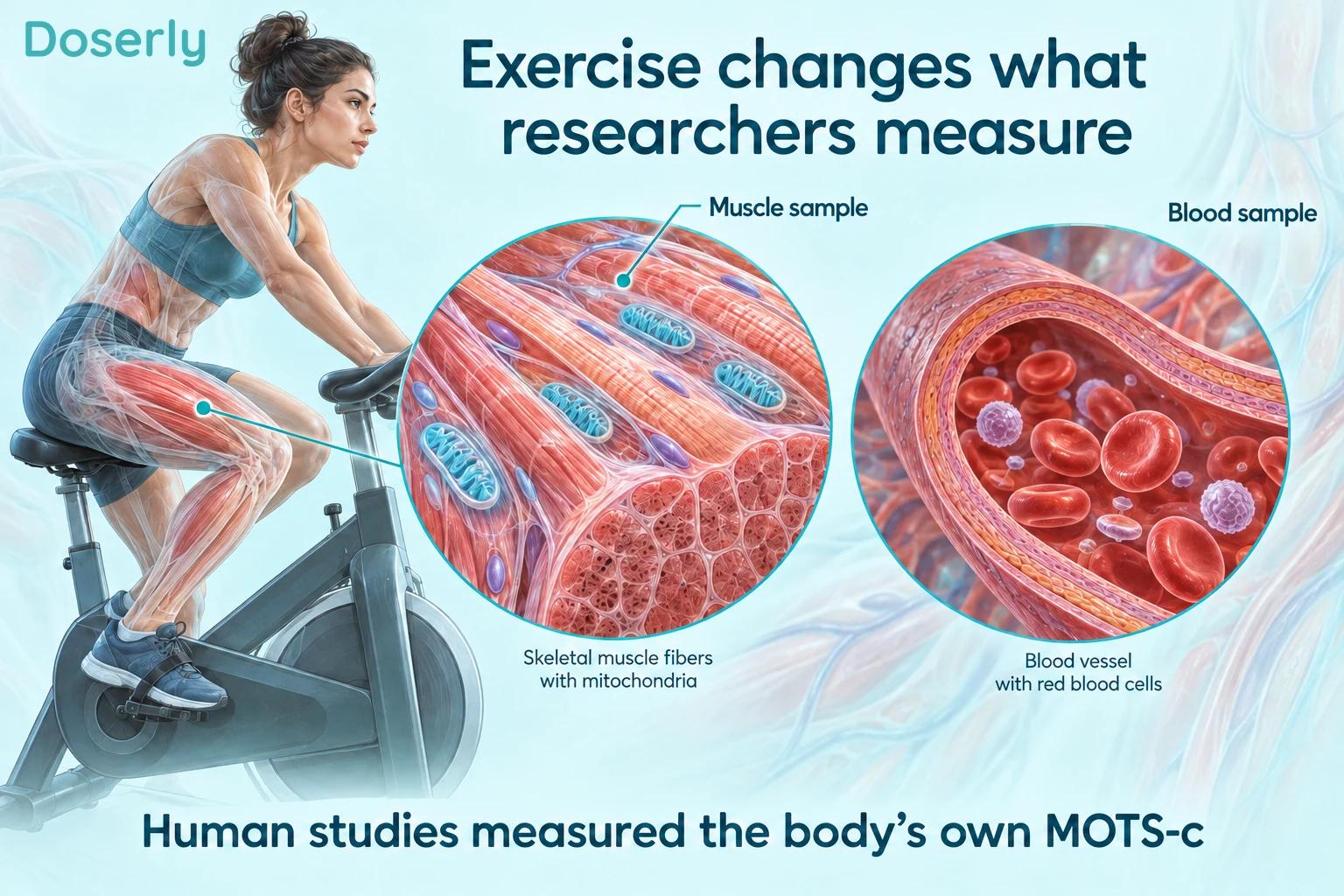
A 2021 paper included ten sedentary, healthy young men who performed a high-intensity interval session on a stationary bicycle. Researchers collected blood and muscle samples around the session and after four hours of recovery. The men were exercising; they were not receiving MOTS-c injections. Human and mouse exercise study
The researchers reported increased endogenous MOTS-c in muscle after exercise and increased circulating levels during and immediately after exercise. Circulating levels returned to baseline after four hours of rest, while muscle measurements remained elevated. The sample was small and deliberately specific: healthy young men studied during an acute exercise response.
The same paper also contained MOTS-c treatment experiments in mice, including physical-performance assessments at different ages. The human observation and the mouse intervention belong to different parts of the paper. A summary that combines them into “MOTS-c improved exercise performance in humans” changes the experiment into one that was not performed.
Another human study found a more qualified response
A separate 2021 study randomized 30 participants to endurance exercise, resistance exercise or a control condition, with ten assigned to each. The endurance group cycled for 45 minutes, while the resistance group performed leg exercises. Researchers collected blood and muscle samples before exercise and at 30 minutes and three hours afterward. Acute endurance and resistance exercise study
Its clearer circulating peptide finding concerned humanin, another mitochondrial-derived peptide. MOTS-c showed a trend toward an increase after endurance exercise. The authors also reported that circulating peptide concentrations were not associated with the fitness measures they examined, including aerobic capacity and leg strength.
This distinction matters because the paper's title refers to mitochondrial-derived peptides in the plural. It would be inaccurate to attribute every positive result to MOTS-c or describe a trend as a firmly demonstrated increase. Different molecules measured in the same experiment need their own results.
It also helps explain why a single post-exercise blood value is not a personal fitness score. Someone could have a relatively high or low measured concentration without that number telling us how far they can walk, how strong their legs are or how they will respond to training.
An acute response is not the same as long-term adaptation
The timing of sampling can change the question being answered. Blood taken immediately after exercise describes a different physiological moment from blood taken the next morning or after several weeks of training. If a signal rises briefly and then returns toward its usual level, a later sample can miss that response without proving the earlier result was false.
A 2019 human study adds useful context. Researchers measured MOTS-c during lipid and insulin infusions in women with polycystic ovary syndrome and healthy controls, then repeated assessments after eight weeks of exercise training. Lipid exposure increased circulating MOTS-c, and insulin altered that response. The authors did not find that training changed circulating MOTS-c levels in either group. Lipid, insulin and exercise study
That finding does not mean exercise failed to have other effects. It means a chronic exercise intervention and an acute peptide measurement should not be assumed to move together. It also shows that circulating MOTS-c can respond to metabolic conditions other than a workout.
For a reader, the practical question is whether a proposed marker has been shown to track the outcome they care about. A transient rise during exercise is interesting physiology. A reliable marker of training progress would need evidence that its measurement consistently provides useful information beyond the exercise itself.
Where does circulating MOTS-c come from?
A blood sample tells researchers that a substance is present in circulation. By itself, it does not identify the tissue that released it. Finding increased MOTS-c in muscle at the same time does not prove the muscle caused the blood increase.
A 2026 paper examined this issue alongside mechanistic experiments. Its human component measured MOTS-c around one-legged knee-extensor exercise. Although interstitial levels increased, the researchers did not observe a change in the arterial-to-venous difference across the exercising leg. They interpreted this as suggesting that skeletal muscle might not be the source of the circulating exercise response. MOTS-c bioenergetics and human sampling study
Interstitial fluid is the fluid around cells. Arterial and venous samples help investigators examine what changes as blood passes through a tissue. These measurements provide more information about a possible source than a peripheral blood sample alone, although a negative finding in one experimental setting does not rule out every form of release under all conditions.
The full methods of this newer paper were not available in the source checked here, so its abstract does not support detailed claims about the size or generalizability of the human experiment. Its contribution is the more careful question: tissue content, surrounding-fluid levels and net release into blood are distinct measurements.
What the mechanistic studies contribute
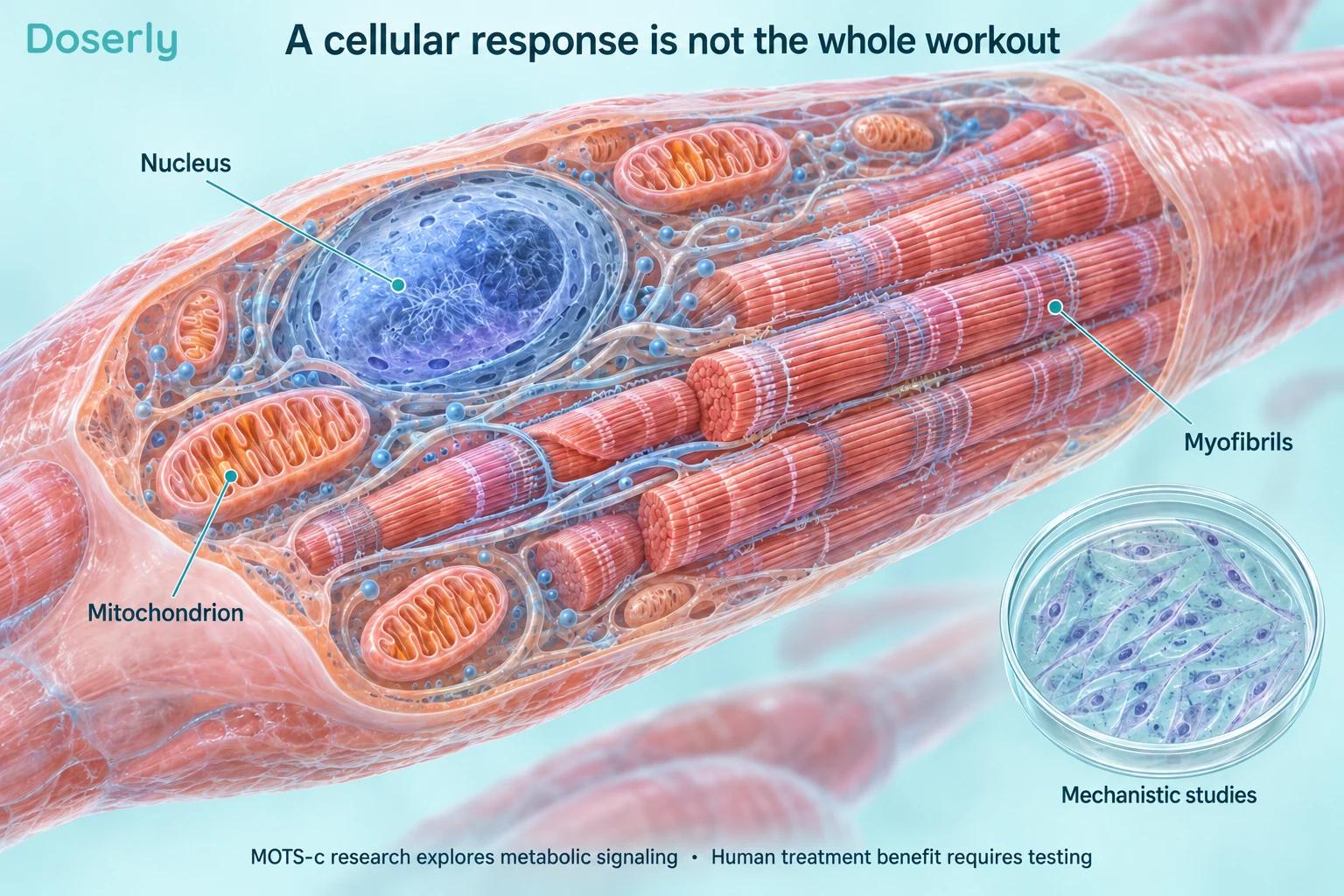
Laboratory experiments can test parts of the causal story more directly than a before-and-after human blood sample. Researchers can expose cells to a peptide, change a signaling pathway or compare animals with different genetic characteristics.
In a 2018 cell study, MOTS-c moved into the nucleus during metabolic stress and influenced gene regulation in an AMPK-dependent manner. AMPK is an enzyme involved in sensing cellular energy status. These experiments offered a possible mechanism for coordinating mitochondrial and nuclear responses; they did not demonstrate improved endurance from MOTS-c treatment in people. Cellular stress-signaling study
The 2026 bioenergetics paper used transgenic mice to investigate the roles of AMPK and PGC-1α, a regulator associated with cellular energy metabolism. The authors reported improved muscle mitochondrial performance dependent on those pathways. These were mechanistic treatment findings in mice, separate from the paper's human exercise sampling. 2026 mechanistic study
Such work can justify developing a drug. It can identify outcomes worth testing and reveal reasons that a candidate might fail in a different biological setting. But a pathway name is not a clinical outcome. Showing that a molecule affects AMPK does not tell us the size of a person's performance benefit, the appropriate exposure or the consequences of repeated use.
Why an injection is a new experiment
To claim that injected MOTS-c mimics exercise, researchers would need to define what “mimics” means. Improved glucose handling, increased endurance, greater strength and better daily function are different outcomes. A positive result for one would not automatically establish the others.
They would also need to show what exposure the injection creates. How much intact peptide reaches relevant tissues? For how long? Does repeated administration change the response? An injection schedule inferred from a temporary rise in an endogenous marker does not answer those questions.
A useful hypothetical trial might compare a specified product with placebo while keeping exercise and other care comparable between groups. It would measure a prespecified functional outcome, not only the peptide concentration, and follow safety long enough to address the intended use. If the claim were specifically that treatment replaces some benefit of training, the comparison would have to test that claim rather than merely include the word exercise in the introduction.
This is why the distinction is more than terminology. A person buying a vial wants to know what administration will do to them. A study of what their body already does during cycling provides a biological rationale, but not that treatment answer.
What current human research can and cannot settle
As checked on October 15, 2026, ClinicalTrials.gov listed MOTS-MET, a planned 120-person randomized study of investigational MOTS-c in adults with prediabetes and overweight or obesity, as recruiting. Its record describes a 12-week treatment period and assessment of insulin sensitivity and safety. No results were posted. The record was last updated in April 2026, so its recruitment label should be understood as the latest posted status. MOTS-MET registry
This is relevant human research activity, but it is not evidence that the treatment already improves metabolism or exercise performance. A registry describes what investigators intend to evaluate. It should not be counted as a completed positive trial, nor does its existence validate a different commercially offered preparation.
The FDA's July 2026 advisory-committee briefing reported that its review had not identified clinical exposure or pharmacokinetic data sufficient to evaluate native MOTS-c safety. That document is a staff evaluation for an advisory process, not a final approval or a statement that an ongoing registration cannot exist. Its safety-data gap and a trial with no posted results can both be true. FDA MOTS-c briefing
How to read the next MOTS-c headline
Start by identifying what actually happened to the participants. Did people exercise while researchers measured their own peptide? Did mice receive treatment? Were human cells studied in a dish? Or did people receive a defined investigational product in a controlled trial? The word human can appear in several of these settings without describing a human treatment experiment.
Then look for the outcome. A change in blood concentration, a cellular signaling response and a meaningful improvement in walking or endurance occupy different places in the research process. A strong explanation should make that distinction easy to see.
MOTS-c research offers a plausible connection between metabolic stress, mitochondrial signaling and physical activity. The evidence currently discussed here does not show that injecting native MOTS-c reproduces the benefits of exercise in people. The next useful step is a clear treatment result in a defined human population, with a comparison group and enough safety information to interpret the benefit.
Sources
- Lee and colleagues: MOTS-c discovery and metabolic experiments, 2015
- Reynolds and colleagues: exercise response and mouse treatment experiments, 2021
- Von Walden and colleagues: acute endurance and resistance exercise, 2021
- Ramanjaneya and colleagues: lipids, insulin and exercise, 2019
- MOTS-c, PGC-1α/AMPK and muscle bioenergetics, 2026
- Kim and colleagues: nuclear signaling under metabolic stress, 2018
- MOTS-MET: registered human trial, no posted results
- FDA: MOTS-c-related bulk drug substances, July 2026 briefing