
Peptides
October 16, 2026
Amylin plus GLP-1: when two hormone pathways improve treatment
On this page
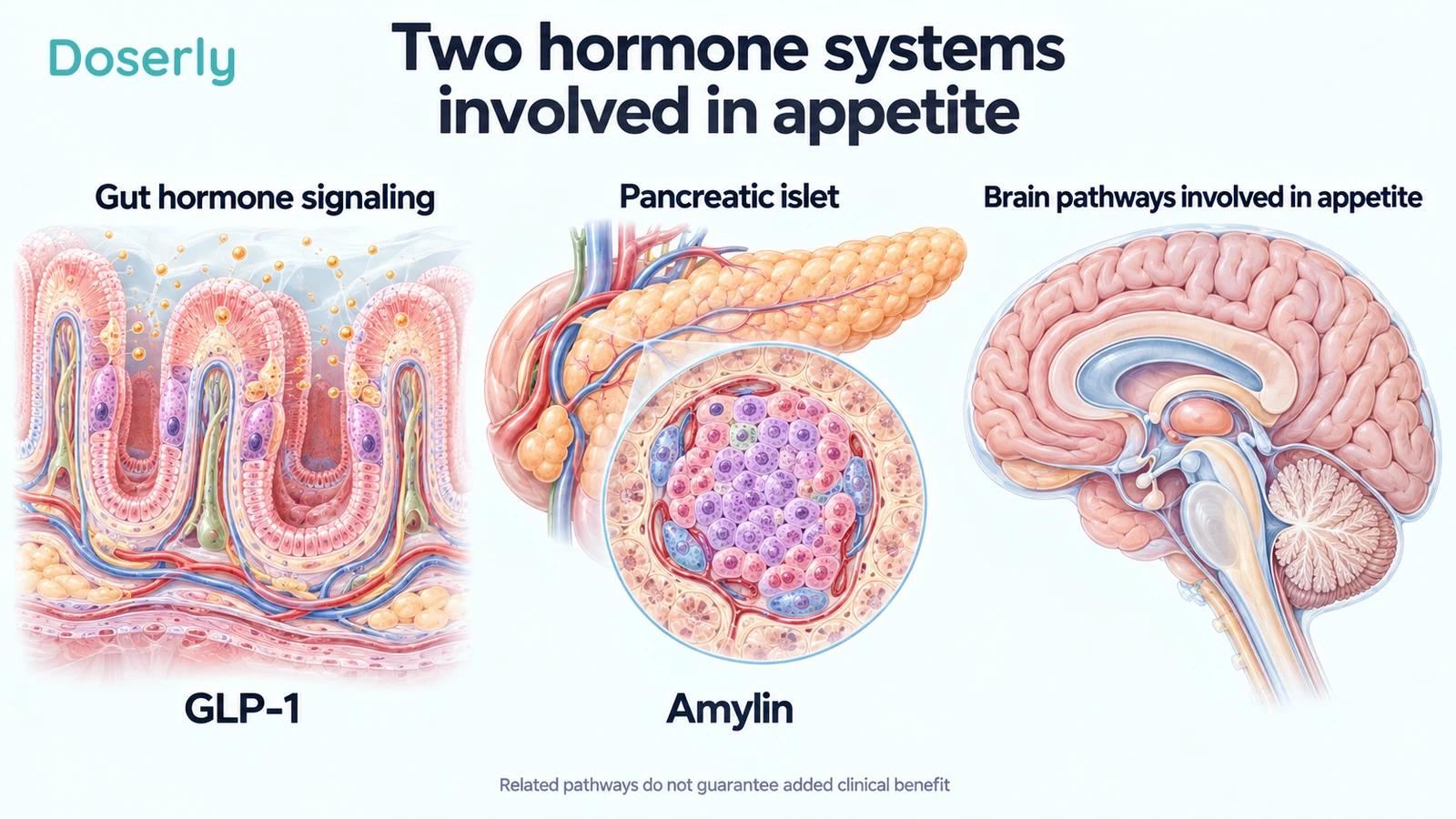
Appetite and blood sugar are regulated by several interacting signals. That is one reason researchers are interested in medicines acting on both GLP-1 and amylin pathways. These hormone systems help coordinate responses to eating, and combining their effects may offer benefits that a single approach does not.
There is now human trial evidence that one particular amylin–GLP-1 combination can produce greater weight reduction than its individual components. But that conclusion comes from testing the medicines, not from counting the receptors they activate. It also does not mean every outcome improves by the same amount, or that every medicine targeting the two pathways is interchangeable. REDEFINE 1 primary report
This distinction is especially useful when reading about zenagamtide, formerly amycretin, and CagriSema, the combination of cagrilintide and semaglutide. They share a broad scientific rationale but use different molecules and have different clinical evidence. Understanding the biology first makes their trial results easier to interpret.
What amylin adds to the conversation
Amylin is released from pancreatic beta cells alongside insulin. It is involved in the body's response to a meal, including signals that influence how much people eat. An analogue is a modified molecule developed to reproduce aspects of a naturally occurring hormone's activity.
Researchers have directly tested an amylin analogue's effect on eating in people. In a small randomized crossover study, 11 men with insulin-treated type 2 diabetes and 15 men with obesity without diabetes received pramlintide or placebo before standardized meal testing. Energy intake at a subsequent buffet was lower after pramlintide in both groups. This supports a human effect on food intake under the tested conditions. It is not evidence that every amylin-based medicine produces the same long-term weight loss. Chapman and colleagues, 2005
The study is also a reminder that mechanisms can be measured at different levels. Eating less at one meal is a behavioral outcome. Feeling fuller is a reported experience. Losing weight over months is a longer-term clinical outcome. Those observations can fit together, but one does not make the others unnecessary to study.
Why combine amylin with GLP-1 activity?
GLP-1 is a hormone involved in responses to food, including glucose regulation and appetite. Medicines that activate its receptor can influence both blood sugar and body weight. Adding activity through an amylin-related pathway offers a plausible way to modify appetite and metabolism further.
The word complementary describes the hypothesis: the two activities may contribute differently to a useful combined effect. It does not imply that their benefits simply add together. Biological responses can overlap, saturate or depend on exposure. An additional activity can also add adverse effects, limiting how much of a medicine someone can tolerate.
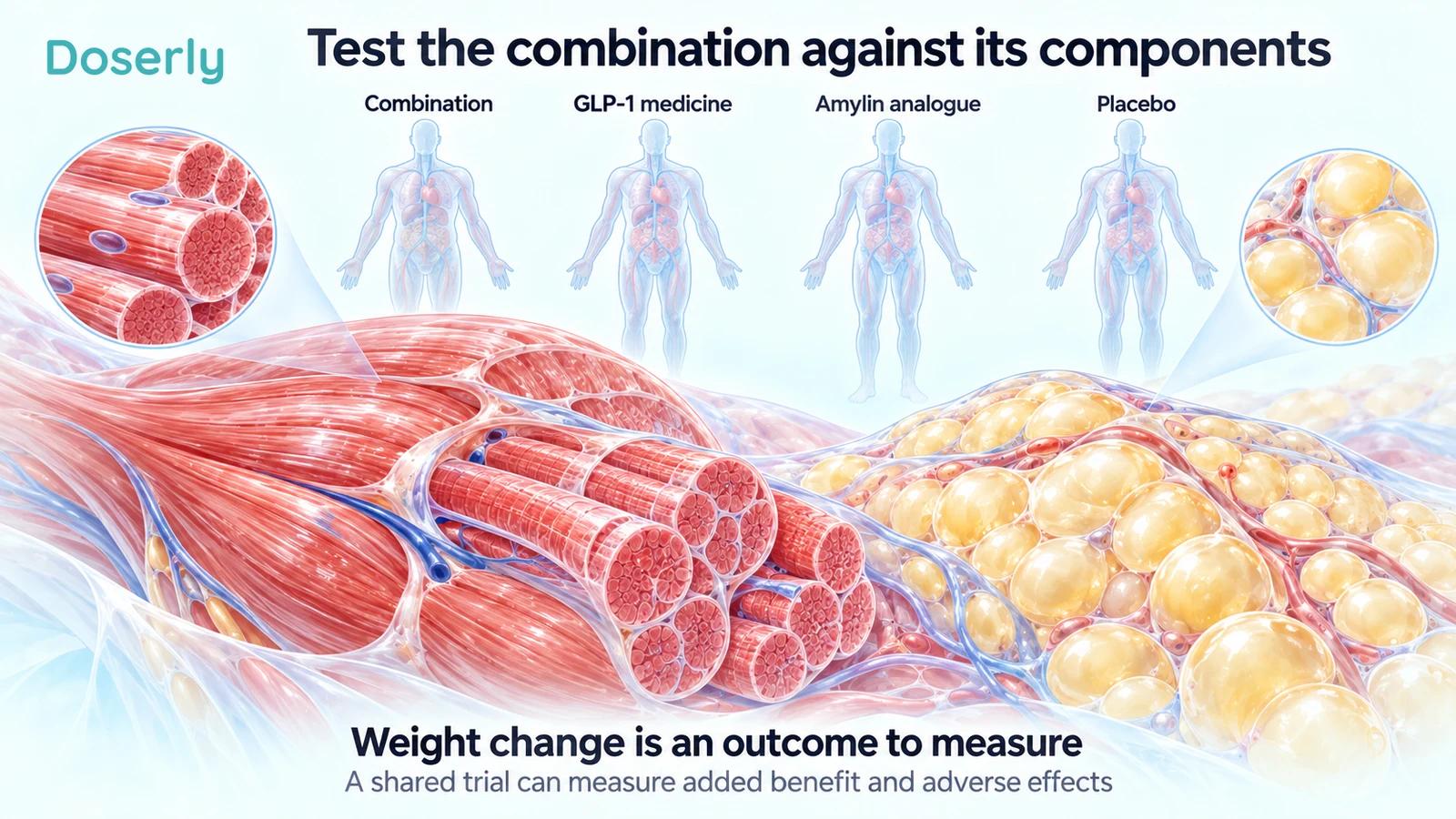
A rigorous test therefore needs more than a picture of two pathways pointing toward a smaller body. Researchers need to measure the outcome, compare it with an appropriate control and describe the tradeoffs. If the aim is better glucose control, the study should test glucose control. If the aim is greater weight reduction, weight change needs to be assessed directly.
Zenagamtide and CagriSema use different approaches
Zenagamtide combines receptor activities within one molecule, often described as a unimolecular agonist. An agonist activates a receptor. Its preclinical characterization examined GLP-1, amylin and calcitonin receptor activity in cell systems and studied metabolic effects in mice and rats. The newer diabetes reports also describe this broader receptor activity. Primary preclinical investigation
CagriSema uses two medicines together: semaglutide, which activates the GLP-1 receptor, and cagrilintide, an amylin analogue. Its results concern those medicines and the regimens tested. They cannot be transferred to zenagamtide simply because both approaches engage related pathways. REDEFINE 1
One molecule is not inherently superior to two. A combined molecule has its own receptor activity and exposure profile. Two components have their own formulation and dosing constraints. Either approach could be clinically useful, but convenience, effectiveness and tolerability must be demonstrated rather than inferred from the design.
Our cagrilintide guide and semaglutide guide explain the component medicines. The zenagamtide guide covers the separate single-molecule program.
A diabetes trial showed why the outcome matters
A 32-week phase 2 trial randomized 92 adults with type 2 diabetes to CagriSema, semaglutide or cagrilintide. Participants were receiving metformin, with or without an SGLT2 inhibitor. The main outcome was HbA1c, a measure of blood glucose over the preceding months.
Mean HbA1c reductions were 2.2 percentage points with CagriSema, 1.8 with semaglutide and 0.9 with cagrilintide. The combination's difference from semaglutide was −0.4 percentage points, with a confidence interval extending from −0.8 to 0.0 and p=0.075. This did not establish a statistically clear HbA1c advantage over semaglutide in that study. Weight reduction, a secondary outcome, was greater with the combination than with either component. Primary phase 2 report
This is a useful example because the biology did not change between endpoints. The same treatment could show a clearer advantage for weight than for HbA1c. “The combination worked better” needs an object: better for which outcome, in which people, over what period?
The small sample also matters. An uncertain difference is not proof that two treatments have identical effects. It means this study did not resolve that comparison with sufficient clarity for that endpoint. A larger trial could produce a more precise estimate, but its answer must be observed rather than assumed.
The larger obesity trial tested added weight benefit directly
REDEFINE 1 randomized 3,417 adults with overweight or obesity without diabetes and followed treatment for 68 weeks. It included the combination, each component and placebo within the same trial. Under its treatment-policy analysis, mean weight changes were −20.4% with CagriSema, −14.9% with semaglutide, −11.5% with cagrilintide and −3.0% with placebo. REDEFINE 1 primary publication
That common study framework is important. The component comparison is more informative than placing unrelated trials beside one another because eligibility, follow-up and outcome collection were shared. It provides evidence of added weight benefit for this specific combination under these conditions.
The result still does not establish synergy in the strict pharmacological sense. Synergy means more than “better than either alone”; it concerns whether the combined effect exceeds an appropriately defined expected interaction. The scale of measurement, doses and model used to define that expectation matter. For a patient, the directly observed additional benefit may be useful without making a stronger claim about the nature of the interaction.
Nor is it appropriate to add the two component percentages and call their sum the expected combination result. Body-weight responses are not independent quantities that can be combined by ordinary addition. The actual combination arm provides the clinically relevant observation.
Added benefit must be considered alongside adverse effects
The same obesity trial reported gastrointestinal adverse events in 79.6% of combination participants, compared with 73.8% on semaglutide, 54.0% on cagrilintide and 39.9% on placebo. Most were mild to moderate. Adverse events led to permanent trial-product discontinuation in 5.9%, 3.6%, 2.6% and 3.5%, respectively. These are different measures: experiencing an event is not the same as stopping because of one. REDEFINE 1 safety results
These figures do not mean every additional symptom outweighs the weight benefit. They mean the added effect comes with a treatment experience that also needs to be discussed. A person may value additional weight reduction highly, yet still need to know the likelihood of symptoms and how often participants could continue.
The absence of an adverse event in a particular person also cannot be guaranteed from group averages. Treatment decisions involve the expected benefit, known risks, other health conditions and the goal being pursued. A mechanistic description alone cannot weigh those factors.
What zenagamtide has demonstrated so far
The early injectable zenagamtide trial showed substantial estimated weight reduction in adults with overweight or obesity. It was a relatively small, multipart study with substantial withdrawal, rather than a direct comparison with CagriSema or semaglutide. Its results support further study of the molecule; they do not identify which receptor activity produced which portion of the benefit. Early human injection trial
The later oral diabetes trial provides a different form of evidence: 186 participants, 36 weeks of treatment and a primary focus on HbA1c. All three oral dose groups improved HbA1c compared with placebo. The trial did not compare an otherwise identical molecule with and without amylin activity. It therefore establishes an effect of the tested product, not the precise contribution of each receptor. Oral zenagamtide phase 2 trial
That distinction applies to many multiactivity medicines. A clinical trial can show that a product helps without fully resolving its mechanism. Conversely, a detailed mechanism can be demonstrated in a laboratory without establishing that the product delivers a worthwhile clinical benefit in people.
Animal findings help explain possibilities, not human guarantees
Zenagamtide's preclinical study measured energy intake, energy expenditure, insulin sensitivity and liver-related outcomes in mice and rats. It also examined access to appetite-related brain regions in mice. These experiments can help researchers choose mechanisms and endpoints for human trials. Kuhre and colleagues, 2025
A rodent finding about energy expenditure should not become a promise that a person will lose fat without losing muscle or experiencing metabolic adaptation. Those are separate human questions. Body composition, strength and function require their own measurements; a scale alone does not distinguish fat, lean tissue and fluid changes.
Likewise, an improvement in an animal liver model is not equivalent to preventing liver complications in people. It is scientifically useful without carrying the same clinical weight. Keeping species and outcome attached to the finding preserves the reason for interest and the limits of what it establishes.
What “better” should mean for the reader
There is a sound reason to investigate amylin–GLP-1 approaches, and the human combination trials show that added weight benefit is possible. The most useful conclusion is specific: certain tested regimens improved certain outcomes in defined populations. Receptor activity alone cannot determine how much benefit an individual will experience or whether a different combination will behave similarly.
Before comparing options, identify the goal. Is it improved glucose control, sustained weight reduction, less interference from symptoms or better everyday function? Then look for the trial that measured that goal with the relevant product and comparator.
The evidence also does not validate assembling an independent peptide “stack” to imitate a clinical product. Formulation, exposure, escalation and monitoring were part of the tested treatment. The useful lesson from these trials is to measure the intended added benefit and its costs, not to assume that more pathways always mean a better outcome.
Sources
- REDEFINE 1 full primary report, 2025
- Pramlintide meal-testing crossover study, 2005
- Amycretin receptor and rodent research, 2025
- CagriSema phase 2 diabetes trial, 2023
- Early injectable amycretin trial, 2025
- Oral zenagamtide diabetes trial, 2026