
In this guide
What is Strontium Citrate?
Strontium citrate has no standalone fracture-prevention trial. Strontium in bone can also make DXA density readings look higher. No U.S. RDA, AI or established routine supplement regimen exists for strontium. Prescription strontium ranelate evidence and risks must not be transferred to citrate.
Typical Strontium Citrate Protocols
| Source and population | Form and amount each time | Frequency | Total exposure | Duration or boundary |
|---|---|---|---|---|
| MOTS · postmenopausal women with osteopenia | Combination nightly: strontium citrate 450 mg + melatonin 5 mg + vitamin D3 2,000 IU + K2 MK-7 60 mcg | Once nightly | Multi-ingredient regimen; isolated strontium effect unknown | 1 year; BMD and bone-turnover markers |
| DXA phantom study | Strontium substituted into bone-mineral phantom | Laboratory exposures; no oral schedule | Not a supplement regimen | Measured X-ray attenuation and BMD inflation |
| Standalone citrate fracture evidence | No qualifying standalone human fracture protocol recovered | Not established | Not established | Evidence gap |
These rows reproduce sources. Do not average them into one universal regimen.
From source to outcome
Standalone citrate trial absent.
Cannot isolate strontium.
Disclose before scans.
Which forms and label details matter?
Record the salt, elemental strontium declared, citrate mass if separately stated, co-ingredients, calcium exposure, kidney function and product licence. Salt mass and elemental strontium are not interchangeable without a verified conversion.
How should it be stored?
Follow the label, close the container and protect it from heat, light and moisture.
Read the label before the claim
Keep form and outcome linked.
Not a universal regimen.
Track a chosen outcome.
What is it commonly used for?
It is marketed for bone density. The direct citrate clinical signal comes mainly from a multi-ingredient regimen, while fracture prevention remains unestablished and DXA interpretation is confounded.
What does human research show?
MOTS tested a nightly combination of strontium citrate 450 mg, melatonin 5 mg, vitamin D3 2,000 IU and vitamin K2 MK-7 60 mcg for one year in postmenopausal women with osteopenia. Lumbar-spine and femoral-neck BMD rose relative to placebo, but the trial cannot assign the result to strontium citrate alone and did not establish standalone fracture prevention. [1] A phantom study showed that strontium changes X-ray attenuation and can overestimate DXA-derived BMD; apparent scan gains are therefore not a one-to-one measure of stronger bone. [2] Health Canada’s safety review found insufficient information to determine whether cardiovascular risk seen with ranelate applies to non-ranelate salts and required cautionary product measures; uncertainty is not proof of safety. [3] A broader review describes plausible bone-remodelling mechanisms but confirms that the strongest clinical outcome evidence concerns other strontium salts, not standalone citrate. [4]
How might it act?
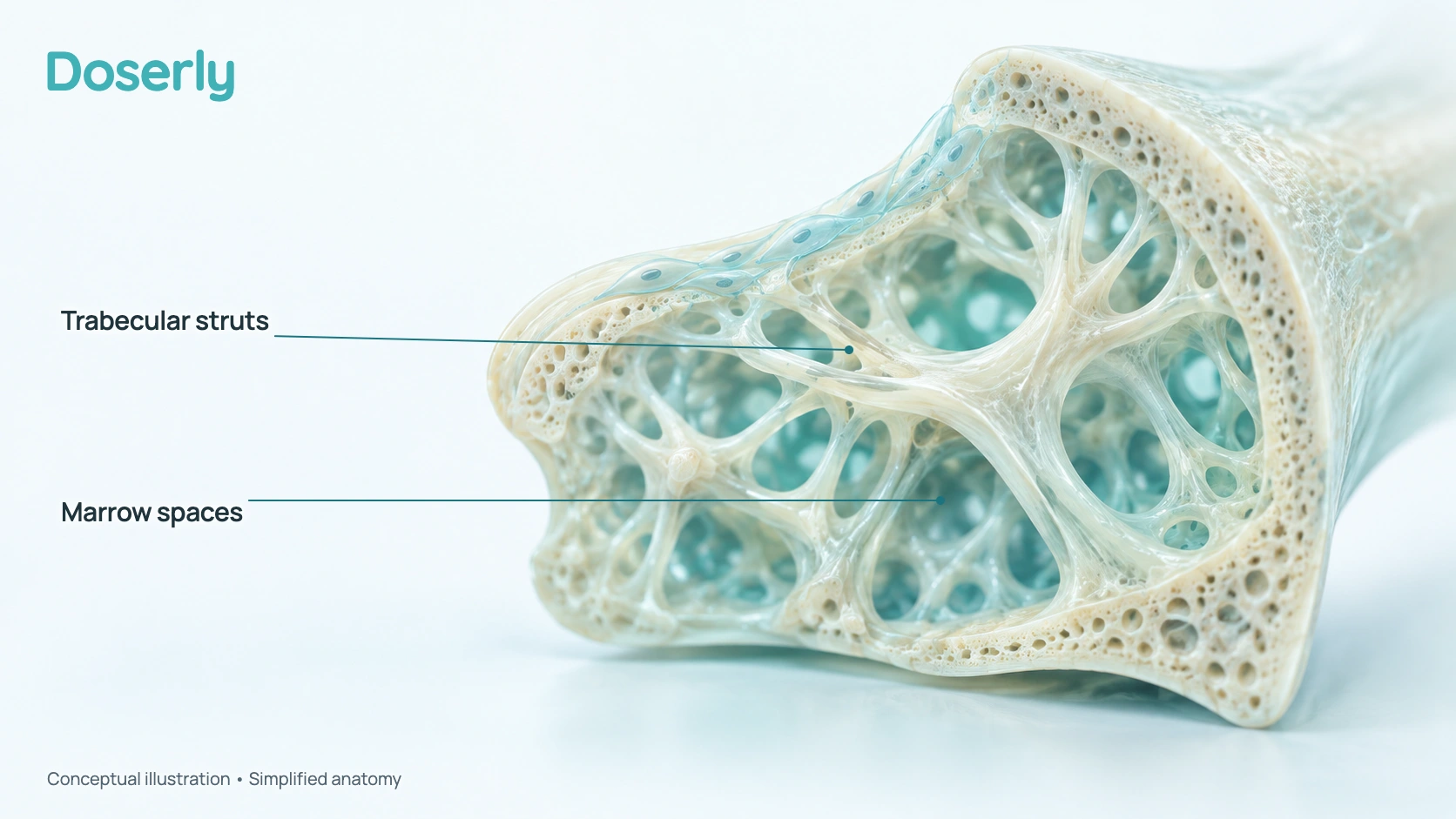
Biological plausibility does not establish a clinical outcome. The guide therefore keeps preparation, population and endpoint attached to each result.
How does it compare with related products?
| Product | Identity to preserve | Evidence boundary |
|---|---|---|
| Glucosamine | Sulfate or hydrochloride; active amount | Form-specific osteoarthritis evidence |
| Chondroitin | Chondroitin sulfate and product quality | Symptom and structure outcomes differ |
| UC-II collagen | Undenatured type II collagen | Milligram-dose proprietary trials |
| Collagen | Hydrolyzed peptides, source and grams | Peptide trials do not transfer to UC-II |
What are the risks and interactions?
Avoid self-treatment of osteoporosis. Review cardiovascular or thromboembolic disease, uncontrolled hypertension, kidney impairment, pregnancy, breastfeeding and all bone medicines. Tell the imaging clinician before DXA interpretation. Calcium and strontium share absorption pathways, but no universal separation schedule is established for citrate.
Which medicines require review?
Have the product reviewed with medicines, before surgery, and during pregnancy or breastfeeding. No universal separation interval is established.
Regulatory status: In the United States, supplements generally lack premarket efficacy approval. In Canada, verify the finished product’s NPN or DIN-HM and licensed conditions. [5], [6]
What should be monitored?
Record product, lot, form, amount per administration, frequency, daily total, co-ingredients, meals, symptoms, medicines, chosen outcome and review date.
What happens when it is stopped?
No ingredient-specific withdrawal syndrome is established. Record the stop date, symptoms and chosen outcome; seek care for a persistent serious symptom.
Seek prompt care for a serious allergic reaction, unusual bleeding, persistent palpitations, chest pain or another severe symptom.
What do public communities report?
Public reports can suggest questions to track, but they do not verify the product, dose or causality. This update did not newly quantify a community sample.
Common questions about Strontium Citrate
Does strontium citrate prevent fractures?
No standalone human fracture-prevention evidence establishes that claim.
Can I use ranelate trials to judge citrate?
No. Salt, prescription status, formulation and safety context differ.
Why can DXA look better?
Strontium attenuates X-rays more strongly than calcium, inflating the derived density.
What did MOTS test?
A four-ingredient nightly regimen, not isolated strontium citrate.
Should calcium be separated?
Competition is plausible, but the exact product and clinical context should determine timing; no universal citrate interval is established.
What should I track?
Elemental strontium, salt, co-ingredients, kidney and cardiovascular context, calcium, DXA disclosure and fracture outcomes.
Glossary
Terms for reading the evidence.
- Formulation
- The chemical form, source and finished delivery system used in a study.
- Daily total
- The sum across administrations; it does not reveal amount each time.
- WOMAC
- A questionnaire for osteoarthritis pain, stiffness and physical function.
- DXA
- Dual-energy X-ray absorptiometry; some materials can alter the reading itself.
- Subgroup
- A subset analysis that usually carries more uncertainty than the primary result.
- Clinical outcome
- A change in symptoms, function or events rather than only a laboratory marker.
How this guide was researched
Accessible official sources and human reports were read on October 9, 2026. Titles, authors, journals, DOI, PMID and visible corrections were checked. An unreported frequency was not guessed.
How this guide was made
Research and drafting were AI-assisted. This draft awaits Doserly editorial review and independent clinical review. See the editorial policy.
Explore the sources
Sources preserve form, amount, frequency, population, duration and outcome.
Showing 6 sources
- 01
Melatonin-micronutrients Osteopenia Treatment Study (MOTS): a translational study assessing melatonin, strontium (citrate), vitamin D3 and vitamin K2 (MK7) on bone density, bone marker turnover and health related quality of life in postmenopausal osteopenic women following a one-year double-blind RCT and on osteoblast-osteoclast co-cultures. ↗
Multi-ingredient randomized trial
Current page or report reviewed; scope and limits retained.
Detail: One-year nightly MSDK combination in postmenopausal osteopenia; cannot isolate citrate.
- 02
Assessment of the effect of strontium, lead, and aluminum in bone on dual-energy x-ray absorptiometry and quantitative ultrasound measurements: A phantom study. ↗
Bone-phantom measurement study
Current page or report reviewed; scope and limits retained.
Detail: Direct demonstration that strontium content alters DXA-derived BMD.
- 03
Summary Safety Review - Strontium - Risk of Heart and Circulatory Side Effects ↗
Official safety review
Current page or report reviewed; scope and limits retained.
Detail: Non-ranelate cardiovascular uncertainty and Canadian risk-management context.
- 04
The Influence of Strontium on Bone Tissue Metabolism and Its Application in Osteoporosis Treatment. ↗
Mechanistic and clinical review
Current page or report reviewed; scope and limits retained.
Detail: Separates salts, mechanisms and the stronger ranelate evidence base.
- 05
Questions and Answers on Dietary Supplements ↗
U.S. regulatory overview
Current page or report reviewed; scope and limits retained.
Detail: Supplements generally lack efficacy preapproval.
- 06
Product Licensing ↗
Canadian licensing overview
Current page or report reviewed; scope and limits retained.
Detail: Finished natural health products require licensing and authorized labels.
No matching sources
Try a different term or show the full list.