
Mitochondrial Research: The Complete Collection Guide
Explore compounds studied in mitochondrial biology and cellular metabolism, including the limits of combination claims.
On this page
Carte de référence rapide
Attribut
Rôle de la page
- Référence de recherche
- Couche de comparaison pour les peptides dérivés de la mitochondrie, les peptides ciblant la mitochondrie et la biologie redox ou NAD non peptidique. La page sépare les étiquettes de produits, les échecs d’essais humains, les registres actifs et les protocoles publics de mieux-être.
Attribut
Statut peptidique
Attribut
Ancrage d’étiquette actuel
- Référence de recherche
- SS-31 possède un produit d’ordonnance américain actuel, FORZINITY, approuvé sous approbation accélérée pour améliorer la force musculaire chez les patients atteints du syndrome de Barth pesant au moins 30 kg. Cette étiquette n’est pas une approbation générale pour longévité, fatigue ou mieux-être. [1][2]
Attribut
Prudence d’essai
- Référence de recherche
- L’elamiprétide à 40 mg par jour n’a pas amélioré les critères primaires de marche ou de fatigue dans MMPOWER-3 chez la myopathie mitochondriale primaire. L’existence d’une étiquette et l’intérêt mécanistique mitochondrial n’effacent pas les essais négatifs dans d’autres populations. [3]
Attribut
Limite de collection
- Référence de recherche
- Les thèmes mitochondriaux mécanistiques ne forment pas un stack d’optimisation validé. Cellules, souris, registres, étiquettes et cliniques publiques demeurent des catégories distinctes.
Chaque ligne résume la dose et la fréquence rapportées pour un composé. Les sources ci-dessous expliquent les données disponibles et leurs limites. Ces références distinctes n’établissent pas un protocole pour combiner les composés.
Doses en bref
Chaque ligne résume les sources posologiques d’un composé distinct. Les preuves et les usages approuvés diffèrent; ces lignes n’établissent pas de protocole combiné. Tout protocole posologique devrait être examiné avec un professionnel de la santé qualifié.
SS-31
Injection sous la peau (sous-cutanée)
D’après la monographie du produit
Étiquette FORZINITY : syndrome de Barth ≥30 kg
- Dose de la monographie
- 40 mg
- Fréquence
- Une fois par jour
- Durée
- Usage indiqué pour le syndrome de Barth
- Ajustement de la dose
- Adultes avec DFGe <30, non dialysés : 20 mg/jour
- Plage rapportée et limites
- L’étiquette Forzinity définit 40 mg/jour pour les patients atteints du syndrome de Barth ≥30 kg et 20 mg/jour pour certains cas d’insuffisance rénale sévère chez l’adulte. Ne pas extrapoler des limites de sécurité plus larges.
Données et contexte des dosesConsultez les références complètes ci-dessous.
SS-31 · Étiquette FORZINITY : syndrome de Barth ≥30 kg
Retenue comme repère approuvé actuel : syndrome de Barth, poids d’au moins 30 kg; chez l’adulte atteint d’insuffisance rénale sévère non dialysé, la dose est de 20 mg par jour. La monographie ne fournit pas de schéma pour les adultes dialysés ou les enfants atteints d’insuffisance rénale.
La ligne de 40 mg par jour s’applique aux patients atteints du syndrome de Barth ≥30 kg. Le contexte rénal à 20 mg par jour est propre à l’étiquette et ne doit pas être traité comme une option de titration.
Tous les scénarios de ce composéNAD+
Perfusion intraveineuse de NAD+ (dans une veine)
D’après les données d’une étude clinique
Étude pilote cinétique intraveineuse à 750 mg
- Dose étudiée
- 750 mg
- Fréquence
- Environ 2 mg/min
- Durée
- 6 heures
- Ajustement de la dose
- Aucune
- Plage rapportée et limites
- Cette étude a utilisé 750 mg perfusés sur 6 heures. Elle n’établit ni dose efficace plus basse, ni limite supérieure sûre, ni bénéfice de bien-être.
Données et contexte des dosesConsultez les références complètes ci-dessous.
NAD+ · Étude pilote cinétique intraveineuse à 750 mg
Retenu parce qu’il s’agit d’une quantité humaine directe de NAD+ en perfusion avec critères métaboliques, pas d’un essai de résultats bien-être.
Ne pas la traiter comme preuve de bénéfice antivieillissement, fatigue ou dépendance.
Tous les scénarios de ce composéMOTS-C
Injection sous la peau (sous-cutanée)
Doses rapportées dans des guides en ligne
- Dose rapportée
- 5 à 10 mg
- Fréquence
- 1 à 3 fois par semaine
- Durée
- Non précisée
- Ajustement de la dose
- Aucune précisée
- Plage rapportée et limites
- Les lignes publiques de fioles MOTS-c natives rapportent 5 à 10 mg, 1 à 3 fois par semaine, avec des horaires plus élevés ailleurs. Aucun minimum efficace ni limite supérieure sûre n’est établi.
Données et contexte des dosesConsultez les références complètes ci-dessous.
MOTS-C · Calendrier public de fiole MOTS-c native
Choisie comme ligne publique de fiole du même composé la plus claire, puisque la dose de l’essai humain natif reste non divulguée.
Peptide Tables indique 5 à 10 mg 1 à 3 fois par semaine. Peptide Schedule indique des variantes plus fréquentes; cette ligne conserve donc la plage publique plus basse et commune.
Tous les scénarios de ce composéToutes les sources de référence posologiqueÉtudes cliniques, études enregistrées et sources en ligne, avec leur contexte et leurs limites.
Les quantités de composés différents ne se comparent pas sur une même échelle. Les fiches individuelles expliquent les autres scénarios et les écarts entre les sources.
SS-31 / FORZINITY
40 mg sous-cutané une fois par jour pour les patients pesant au moins 30 kg; 20 mg une fois par jour pour les adultes avec insuffisance rénale grave non dialysés.
- Voie / population
- Produit elamiprétide étiqueté par la FDA pour la force musculaire dans le syndrome de Barth.
SS-31 dans MMPOWER-3
40 mg par jour pendant vingt-quatre semaines.
- Voie / population
- Elamiprétide expérimental sous-cutané chez des adultes atteints de myopathie mitochondriale primaire.
- Limites et source liée
- Les critères primaires de distance de marche et de fatigue n’ont pas été améliorés par rapport au placebo. [3]
MOTS-c peptide natif
Le registre indique du MOTS-c sous-cutané une fois par jour pendant douze semaines; la quantité fixe n’était pas publiée.
- Voie / population
- Essai MOTS-MET phase 2a en recrutement chez adultes avec prédiabète et surpoids/obésité.
- Limites et source liée
- Registre actif sans résultats affichés lors du rafraîchissement; ne valide pas les protocoles en ligne de fioles MOTS-c. [4]
MOTS-c préclinique
Les expériences murines ont utilisé 5 mg/kg/jour ou 15 mg/kg/jour selon le protocole.
- Voie / population
- Études murines intrapéritonéales et travaux cellulaires.
- Limites et source liée
- Espèce et voie restent liées aux chiffres; aucune conversion animal-humain n’est faite. [5]
Epithalon / epitalon
Les documents examinés par la FDA incluaient des produits par voie sous-cutanée proposés à 10 mg/mL et 3000 mcg/mL; des rapports plus anciens incluent 5 mcg par injection parabulbaire et des concentrations cellulaires.
- Voie / population
- Injection composée proposée, rapport ophtalmique historique ou culture cellulaire.
NAD+ par voie intraveineuse direct
Les données directes incluent 750 mg sur six heures, 10 mg/jour par voie intraveineuse pendant sept jours dans l’insuffisance cardiaque ischémique, une prépublication 2024 NAD+/NR malgré l’absence de résultats affichés pour NCT06382688, et une prépublication 2026 sur la sécurité injectable.
- Voie / population
- Contextes par voie intraveineuse NAD+ ou NR, pas un protocole de mieux-être unifié.
Précurseurs du NAD
Les essais oraux NR ont utilisé 100 mg, 300 mg et 1 000 mg en doses uniques; les études NMN ont utilisé 300-900 mg/jour ou 2 000 mg/jour selon le produit.
- Voie / population
- Essais de précurseurs oraux, pas des injections directes de NAD+.
- Limites et source liée
- La pharmacologie des précurseurs ne prouve pas les protocoles par voie intraveineuse ou par voie sous-cutanée de NAD+. [9]
Methylene blue étiquette
1 mg/kg par voie intraveineuse sur cinq à trente minutes; répétition jusqu’à 1 mg/kg après une heure selon les conditions de l’étiquette.
- Voie / population
- Médicament approuvé par la FDA pour méthémoglobinémie acquise.
- Limites et source liée
- Indication de soins aigus seulement; avertissement encadré sur le syndrome sérotoninergique et contre-indication G6PD sont centraux. [10]
Methylene blue recherche et usage en ligne
Les données humaines incluent un essai fMRI oral à 280 mg, des résultats de registre MB2 à 282 mg/jour avec évaluations à 2 et 12 semaines, LUCIDITY 2026 HMTM sans séparation démontrée sur les critères cliniques coprimaires à 52 semaines, et des pages nootropiques publiques listant souvent 0,5-4 mg/kg/jour.
- Voie / population
- Essai oral, programme Alzheimer HMTM ou allégations nootropiques/mieux-être en ligne.
- Limites et source liée
- Les allégations hors indication et publiques ne remplacent pas l’étiquette; une étude humaine par voie intraveineuse aiguë a trouvé une diminution du débit sanguin cérébral et du métabolisme global à 0,5 et 1 mg/kg, et les programmes cognitifs cliniques restent mixtes. [11][12][16]
Ces sources proviennent des examens des composés de cette collection. Les données sur chaque composé ne prouvent pas l’efficacité ni la sécurité de leur association. Les documents portant sur une même étude ne sont pas des confirmations indépendantes.
Les monographies applicables et les études humaines ont le plus de poids. Les registres ne prouvent pas qu’un essai a produit des résultats. Les études animales, les guides publics et les forums apportent du contexte; ils n’établissent pas une limite de sécurité chez l’humain.
Sources officielles sur les produits et la réglementation
- CohBar CB4211 Phase 1a/1b topline materials for NASH and obesity
SEC filing / CohBar sponsor report · 2021 · Contexte
Rapport officiel promoteur/SEC décrivant des résultats sommaires non publiés de phase 1a/1b de l’analogue CB4211; contexte de confiance moindre, non revu par les pairs, et pas une dose de MOTS-c natif.
- July 23-24, 2026 Meeting of the Pharmacy Compounding Advisory Committee
U.S. Food and Drug Administration · 2026-07-23 · Contexte
La page PCAC de la FDA montre qu’Epitalon a été examiné pour les questions de substances en vrac en préparation magistrale, et non approuvé comme médicament général de longévité.
- FDA briefing document for MOTS-c-related bulk drug substances
FDA · 2026-07
Le document de la FDA proposait de ne pas ajouter MOTS-c base libre/acétate à la liste 503A et discutait l’incertitude de sécurité.
- Certain Bulk Drug Substances for Use in Compounding that May Present Significant Safety Risks
U.S. Food and Drug Administration · updated 2026
La page FDA fournit le contexte de nomination retirée/catégorie; elle ne fournit pas de dose ni de voie approuvée.
- DailyMed FORZINITY label
DailyMed · 2025
L’étiquette indique 40 mg une fois par jour par injection sous la peau chez les patients atteints du syndrome de Barth d’au moins 30 kg, avec 20 mg/jour pour certains cas d’insuffisance rénale sévère chez l’adulte.
- Drug Trials Snapshot: Forzinity
FDA · 2025
L’instantané FDA confirme l’usage sous-cutané quotidien et une base de preuves limitée dans le syndrome de Barth avec contexte d’approbation accélérée.
- FORZINITY NDA 215244 integrated review
FDA · 2025
L’évaluation FDA comprend des groupes de volontaires sains SPISC-101 recevant 6, 20 ou 40 mg sous la peau par jour pendant sept jours (tableau 104, page 188), l’exposition rénale, l’hypersensibilité et les limites des données sur le syndrome de Barth. L’exposition brève ne prouve pas un bénéfice prolongé.
- Epitalon briefing document for Pharmacy Compounding Advisory Committee
U.S. Food and Drug Administration · 2026-07
Le document FDA distingue l’épitalon base libre/acétate de l’épithalamine et documente l’examen des informations de sécurité réglementaires plutôt qu’une dose humaine étiquetée.
- Correction: Epitalon increases telomere length in human cell lines through telomerase upregulation or ALT activity.
Biogerontology · 2025-11-15 · Résumé consulté · Contexte
La correction remplace des figures de l’article cellulaire Biogerontology 2025; elle renforce l’usage prudent des données cellulaires et ne crée pas de dose humaine.
- Submitted 75-day premarket notifications for new dietary ingredients
FDA · 2026 · Contexte
La page NDI de la FDA a été revue pour le contexte du statut des suppléments autour des précurseurs, pas pour une approbation d’indication du NAD+ direct.
- Questions and Answers on Dietary Supplements
FDA · 2026 · Contexte
La FAQ FDA sur les suppléments soutient le cadrage réglementaire général; elle ne valide pas la posologie anti-âge.
- DailyMed PROVAYBLUE label
DailyMed · 2025-05-28
L’étiquette DailyMed actuelle, concordante avec le PDF corrigé de la FDA, donne 1 mg/kg par voie intraveineuse sur 5 à 30 minutes, une répétition possible après 1 heure, des limites rénales à dose unique, la contre-indication G6PD et l’avertissement de syndrome sérotoninergique.
- Methylthioninium chloride Proveblue — Summary of Product Characteristics
European Medicines Agency
La monographie européenne diffère de PROVAYBLUE américain : 1–2 mg/kg intraveineux chez l’adulte, répétition conditionnelle après une heure, plafond cumulatif de 7 mg/kg; des limites plus basses concernent certaines intoxications et l’insuffisance rénale. Aucun plafond oral quotidien n’en découle.
Recherche clinique chez l’humain
- Lipids and insulin regulate mitochondrial-derived peptide (MOTS-c) in PCOS and healthy subjects.
Clinical endocrinology · 2019-Aug · Résumé consulté · Contexte
Source examinée; contexte pertinent pour MOTS-c, sans protocole humain validé.
- Acute endurance exercise stimulates circulating levels of mitochondrial-derived peptides in humans.
Journal of applied physiology (Bethesda, Md. : 1985) · 2021-Sep-01 · Résumé consulté · Contexte
Source examinée; contexte pertinent pour MOTS-c, sans protocole humain validé.
- The Effect of Chronic Endurance Exercise on Serum Levels of MOTS-c and Humanin in Professional Athletes.
Reviews in cardiovascular medicine · 2022-May · Résumé consulté · Contexte
Source examinée; contexte pertinent pour MOTS-c, sans protocole humain validé.
- Efficacy and Safety of Elamipretide in Individuals With Primary Mitochondrial Myopathy: The MMPOWER-3 Randomized Clinical Trial.
Neurology · 2023 · Résumé consulté
L’essai de phase 3 a utilisé 40 mg/jour d’élamiprétide sous-cutané pendant 24 semaines et n’a pas atteint les critères fonctionnels/fatigue primaires.
- Effects of Elamipretide on Left Ventricular Function in Patients With Heart Failure With Reduced Ejection Fraction: The PROGRESS-HF Phase 2 Trial.
Journal of Cardiac Failure · 2020 · Résumé consulté
PROGRESS-HF a randomisé 71 patients atteints d’insuffisance cardiaque à fraction d’éjection réduite à 4 ou 40 mg sous la peau par jour pendant 28 jours ou au placebo; aucune dose n’améliorait le volume ventriculaire principal.
- Novel Mitochondria-Targeting Peptide in Heart Failure Treatment: A Randomized, Placebo-Controlled Trial of Elamipretide.
Circulation: Heart Failure · 2017 · Résumé consulté
Une étude d’insuffisance cardiaque de 36 personnes évaluait une perfusion intraveineuse unique de quatre heures à 0,005, 0,05 ou 0,25 mg/kg/heure. Le groupe le plus élevé présentait des changements ventriculaires aigus; ce n’était ni un essai sur le syndrome de Barth ni un protocole quotidien.
- ReCLAIM-2: A Randomized Phase II Clinical Trial Evaluating Elamipretide in Age-related Macular Degeneration, Geographic Atrophy Growth, Visual Function, and Ellipsoid Zone Preservation.
Ophthalmology Retina · 2024 · Résumé consulté
ReCLAIM-2 évaluait 40 mg sous la peau par jour pendant 48 semaines chez 176 personnes atteintes de dégénérescence maculaire sèche liée à l’âge. Les critères principaux de vision et d’atrophie étaient négatifs; les signaux rétiniens secondaires n’établissaient pas l’efficacité.
- A phase 2/3 randomized clinical trial followed by an open-label extension to evaluate the effectiveness of elamipretide in Barth syndrome, a genetic disorder of mitochondrial cardiolipin metabolism.
Genetics in Medicine · 2021 · Résumé consulté
TAZPOWER utilisait 40 mg sous la peau par jour dans deux périodes croisées de 12 semaines séparées par quatre semaines d’arrêt. L’essai contrôlé de 12 participants n’atteignait pas ses critères principaux; les signaux de prolongation n’étaient pas contrôlés.
- Long-term efficacy and safety of elamipretide in patients with Barth syndrome: 168-week open-label extension results of TAZPOWER.
Genetics in Medicine · 2024 · Résumé consulté
Dix participants TAZPOWER ont rejoint la prolongation ouverte à 40 mg/jour; huit atteignaient la semaine 168. Des améliorations fonctionnelles et réactions au point d’injection étaient rapportées, sans comparaison placebo simultanée.
- Natural history comparison study to assess the efficacy of elamipretide in patients with Barth syndrome.
Orphanet Journal of Rare Diseases · 2022 · Résumé consulté · Contexte
Compare huit participants traités de la prolongation TAZPOWER à 19 témoins non traités d’histoire naturelle. Cette analyse de témoins externes réutilise des participants; elle ne constitue pas une recherche posologique randomisée indépendante.
- A randomized crossover trial of elamipretide in adults with primary mitochondrial myopathy.
Journal of Cachexia, Sarcopenia and Muscle · 2020 · Résumé consulté
Trente participants atteints de myopathie mitochondriale primaire recevaient 40 mg/jour sous la peau ou un placebo par périodes croisées de quatre semaines. Le résultat principal de marche n’était pas statistiquement significatif; des signaux secondaires de fatigue et réactions locales fréquentes étaient rapportés.
- Randomized dose-escalation trial of elamipretide in adults with primary mitochondrial myopathy.
Neurology · 2018 · Résumé consulté
Trente-six adultes atteints de myopathie mitochondriale recevaient 0,01, 0,1 ou 0,25 mg/kg/heure par perfusion intraveineuse de deux heures par jour durant cinq jours. Des signaux exploratoires de marche ont motivé des essais plus grands; les débits ne sont pas des quantités d’injection quotidienne.
- Phase 1 Clinical Trial of Elamipretide in Intermediate Age-Related Macular Degeneration and High-Risk Drusen: ReCLAIM High-Risk Drusen Study.
Ophthalmology Science · Résumé consulté
Une étude ouverte de 21 personnes avec drusen à haut risque utilisait 40 mg sous la peau par jour pendant 24 semaines; 18 terminaient. Les signaux visuels n’avaient pas de témoin placebo et les réactions locales étaient fréquentes.
- In vivo mitochondrial ATP production is improved in older adult skeletal muscle after a single dose of elamipretide in a randomized trial.
PLOS ONE · 2021
Trente-neuf adultes âgés sélectionnés recevaient une perfusion intraveineuse unique de deux heures à 0,25 mg/kg/heure ou un placebo. Un signal énergétique musculaire immédiat ne persistait pas au septième jour et n’améliorait pas la résistance à la fatigue; il ne valide pas des injections chroniques de bien-être.
- EMBRACE STEMI study: a Phase 2a trial to evaluate the safety, tolerability, and efficacy of intravenous MTP-131 on reperfusion injury in patients undergoing primary percutaneous coronary intervention.
European Heart Journal · Résumé consulté
EMBRACE STEMI évaluait une perfusion intraveineuse périopératoire à 0,05 mg/kg/heure lors d’une intervention coronarienne. La taille de l’infarctus et les résultats cliniques n’étaient pas significativement améliorés; ce contexte aigu ne définit pas de calendrier général.
- Phase 2a Clinical Trial of Mitochondrial Protection (Elamipretide) During Stent Revascularization in Patients With Atherosclerotic Renal Artery Stenosis.
Circulation: Cardiovascular Interventions · 2017 · Résumé consulté
Six participants traités et huit sous placebo subissaient une pose d’endoprothèse rénale avec une perfusion intraveineuse de 0,05 mg/kg/heure avant et pendant l’intervention. Les signaux rénaux de ce petit essai pilote ne définissent pas de dose ambulatoire ou chronique.
- Pineal-regulating tetrapeptide epitalon improves eye retina condition in retinitis pigmentosa.
Neuro Endocrinology Letters · 2002-08 · Résumé consulté
Le résumé PubMed confirme le rapport chez des patients atteints de rétinite pigmentaire; les relevés secondaires examinés indiquent que la dose historique propre à cette voie était de 5 microgrammes par œil par injection parabulbaire pendant 10 jours.
- Peptide geroprotector from the pituitary gland inhibits rapid aging of elderly people: results of 15-year follow-up.
Bulletin of Experimental Biology and Medicine · 2011-07 · Résumé consulté · Contexte
Cures humaines d’extrait d’épithalamine chez des patients coronariens; formulation distincte de l’AEDG/Epithalon synthétique et non utilisée pour définir la dose rapide d’Epithalon.
- Geroprotective effect of epithalamine (pineal gland peptide preparation) in elderly subjects with accelerated aging.
Advances in Gerontology · 2006 · Résumé consulté · Contexte
Étude clinique randomisée portant sur l’épithalamine/extrait mixte plutôt que sur l’épithalon synthétique pur; pertinente comme avertissement de séparation, pas comme ligne de dose du même composé.
- A Pilot Study Investigating Changes in the Human Plasma and Urine NAD+ Metabolome During a 6 Hour Intravenous Infusion of NAD+
Frontiers in Aging Neuroscience · 2019
L’étude pilote directe de NAD+ a perfusé 750 mg sur 6 heures chez des hommes en santé et mesuré la cinétique/métabolites, pas des résultats de bien-être.
- Nicotinamide riboside is uniquely and orally bioavailable in mice and humans
Nature Communications · 2016 · Contexte
L’essai sur le précurseur NR utilisait des doses orales uniques de 100, 300 et 1 000 mg; il reste séparé de la posologie du NAD+ direct.
- The efficacy and safety of beta-nicotinamide mononucleotide supplementation in healthy middle-aged adults
GeroScience · 2023 · Résumé consulté · Contexte
L’étude NMN renseigne le contexte des précurseurs et n’a pas servi à modifier les lignes rapides NAD+.
- MIB-626 increases blood NAD levels in middle-aged and older adults
Journal of Clinical Endocrinology & Metabolism · 2023 · Résumé consulté · Contexte
La source MIB-626/NMN soutient seulement la comparaison des doses de précurseur.
- Randomized pilot study evaluating acute Niagen+ par voie intraveineuse and NAD+ par voie intraveineuse
medRxiv · 2024 · Résumé consulté · Contexte
La prépublication a été revue comme contexte comparateur préliminaire et gardée sous les preuves évaluées par les pairs.
- Preliminary Safety Analysis of Two Pilot Clinical Trials Involving Injections of Niagen
medRxiv · 2026 · Résumé consulté
La prépublication contribue au contexte de sécurité du NR/Niagen injecté, pas à la posologie du NAD+ direct.
- Effect of Nicotinamide Adenine Dinucleotide on Heart Failure Caused by Ischemic Cardiomyopathy
PMC / clinical journal · 2025
L’essai randomisé en insuffisance cardiaque a utilisé 10 mg/jour de NAD+ intraveineux pendant 7 jours; contexte propre à la maladie, non interchangeable avec les paliers bien-être.
- Intravenous infusion of nicotinamide adenine dinucleotide (NAD+) versus nicotinamide riboside (NR): a retrospective tolerability pilot study in a real-world setting.
Frontiers in aging · 2026 · Résumé consulté
Pilote rétrospectif réel de tolérance comparant NAD+ par voie intraveineuse et NR par voie intraveineuse; utile, mais pas preuve d’efficacité randomisée.
- Treatment of Parkinson's disease with NADH.
Acta neurologica Scandinavica · 1994-Nov · Résumé consulté · Contexte
Étude Parkinson en double aveugle utilisant NADH réduit, pas perfusion NAD+; contexte historique.
- Nicotinamide adenine dinucleotide (NADH)--a new therapeutic approach to Parkinson's disease. Comparison of oral and parenteral application.
Acta neurologica Scandinavica. Supplementum · 1993 · Résumé consulté · Contexte
Dossier ouvert NADH oral/parentéral Parkinson; distinct des perfusions NAD+ bien-être.
- Nicotinamide Mononucleotide Is Safely Metabolized and Significantly Reduces Blood Triglyceride Levels in Healthy Individuals.
Cureus · 2022-Sep · Résumé consulté · Contexte
Étude humaine sécurité/métabolisme NMN; contexte précurseur seulement.
- Multimodal Randomized Functional MR Imaging of the Effects of Methylene Blue in the Human Brain
Radiology · 2016
L’étude IRMf randomisée soutient seulement la ligne cognitive orale unique de 280 mg; ce n’est pas un protocole chronique.
- The effects of acute Methylene Blue administration on cerebral blood flow and metabolism in humans and rats
Journal of Cerebral Blood Flow & Metabolism · 2023 · Résumé consulté
L’imagerie humaine a utilisé 0,5 et 1 mg/kg de bleu de méthylène intraveineux et a trouvé une baisse du débit sanguin/métabolisme cérébral, contestant les allégations simples d’amélioration.
- Efficacy and safety of tau-aggregation inhibitor therapy in mild or moderate Alzheimer’s disease
Lancet · 2016 · Résumé consulté · Contexte
Le contexte d’essai Alzheimer LMTM a été gardé hors des lignes rapides, car la formulation et la population diffèrent.
- Clinical, imaging and blood biomarker outcomes in a Phase 3 trial of hydromethylthionine mesylate
Journal of Prevention of Alzheimer’s Disease · 2026 · Contexte
L’essai de phase 3 HMTM a utilisé des doses de développement de 8 et 16 mg/jour; cela reste séparé des lignes de bleu de méthylène consommateur.
- Design, Progress and Basis for Selection of the 16 mg/day Dose in a Phase 3 HMTM trial
Journal of Prevention of Alzheimer’s Disease · 2022 · Résumé consulté · Contexte
L’article de sélection de dose HMTM explique une formulation différente d’inhibiteur d’agrégation tau et ne doit pas être transposée aux doses de colorant consommateur.
- Pharmacokinetics and organ distribution of intravenous and oral methylene blue
European Journal of Clinical Pharmacology · 2000 · Résumé consulté
Étude pharmacocinétique chez sept volontaires comparant 100 mg de bleu de méthylène par voie intraveineuse et orale; l’exposition orale était beaucoup plus faible, ce qui soutient la séparation stricte des voies dans les lignes posologiques.
- High absolute bioavailability of methylene blue given as an aqueous oral formulation
European Journal of Clinical Pharmacology · 2009 · Résumé consulté
Étude de phase 1 croisée chez 16 adultes en santé utilisant 50 mg par voie intraveineuse et 500 mg par voie orale aqueuse, pertinente pour la biodisponibilité plutôt que pour une dose quotidienne consommateur.
- A controlled trial of methylene blue in severe depressive illness
Biological Psychiatry · 1987 · Résumé consulté
Petit essai contrôlé en dépression comparant 15 mg/jour de bleu de méthylène oral au placebo pendant 3 semaines; le contexte psychiatrique le garde hors de la ligne consommateur rapide.
- A two-year double-blind crossover trial of the prophylactic effect of methylene blue in manic-depressive psychosis
Biological Psychiatry · 1986 · Résumé consulté
Essai prophylactique bipolaire de deux ans comparant 300 mg/jour à 15 mg/jour pendant que les patients restaient sous lithium; contexte de dose humaine utile, pas une posologie bien-être.
- Methylene blue treatment for residual symptoms of bipolar disorder: randomised crossover study
British Journal of Psychiatry · 2017 · Résumé consulté
Étude bipolaire croisée randomisée utilisant 195 mg comme dose active contre 15 mg comme comparateur chez des patients sous lamotrigine, ce qui confirme que les doses d’essais psychiatriques sont un contexte séparé.
- Effects of post-session administration of methylene blue on fear extinction and contextual memory in adults with claustrophobia
American Journal of Psychiatry · 2014 · Résumé consulté
Étude randomisée sur la phobie donnant une dose orale unique de 260 mg après entraînement d’extinction; l’effet dépendait de la réponse à la séance et ne crée pas de protocole cognitif chronique.
- Methylene blue and serotonin toxicity: inhibition of monoamine oxidase A confirms a theoretical prediction
British Journal of Pharmacology · 2007 · Résumé consulté
Étude mécanistique sur enzyme humaine montrant une inhibition réversible puissante de la MAO-A, soutenant une séparation stricte des médicaments sérotoninergiques dans tous les scénarios posologiques.
- Ifosfamide induced encephalopathy: 15 observations
Bulletin du Cancer · 2005 · Résumé consulté
Le résumé de série de cas recommande 50 mg par voie intraveineuse toutes les 4 heures jusqu’à régression des symptômes et 50 mg toutes les 6 heures en prophylaxie lors d’une reprise d’ifosfamide.
- Preoperative methylene blue administration in patients at high risk for vasoplegic syndrome during cardiac surgery
Annals of Thoracic Surgery · 2005 · Résumé consulté
Étude randomisée en chirurgie cardiaque administrant 2 mg/kg de bleu de méthylène par voie intraveineuse pendant plus de 30 minutes avant la chirurgie chez des patients à risque élevé de vasoplégie.
- Methylene blue administration in septic shock: a clinical trial
Critical Care Medicine · 1995 · Résumé consulté
Essai clinique en choc septique perfusant 2 mg/kg de bleu de méthylène par voie intraveineuse, répété chez certains patients après une réponse hémodynamique transitoire; contexte de choc hospitalier seulement.
- Efficacy and safety of primaquine and methylene blue for prevention of Plasmodium falciparum transmission in Mali
Lancet Infectious Diseases · 2018 · Résumé consulté
Essai de phase 2 sur la transmission du paludisme utilisant 15 mg/kg/jour de bleu de méthylène pendant 3 jours avec traitement antipaludique chez des participants G6PD normaux, un schéma propre à cette maladie.
Essais cliniques enregistrés
- MOTS-c for Improving Insulin Sensitivity in Adults With Prediabetes and Overweight/Obesity
ClinicalTrials.gov · 2026-04-01
Le registre nomme explicitement le MOTS-c natif avec dose fixe sous-cutanée quotidienne pendant 12 semaines, mais sans quantité divulguée.
- NCT03323749: A Trial to Evaluate Safety and Efficacy of Elamipretide Primary Mitochondrial Myopathy Followed by Open-Label Extension
ClinicalTrials.gov · 2022-01-24
Le registre confirme le plan randomisé à 40 mg sous-cutané une fois par jour et le statut terminé après échec des critères primaires.
- NCT06373731: ReNEW:Phase 3 Study of Efficacy, Safety & Pharmacokinetics of Subcutaneous Injections of Elamipretide in Subjects With Dry Age-Related Macular Degeneration (Dry AMD)
ClinicalTrials.gov · 2026-05-20
ReNEW est un essai de phase 3 dans la dégénérescence maculaire sèche à 40 mg sous la peau par jour pendant 96 semaines. Actif, sans recrutement ni résultats affichés lors de la revue; ce n’est pas un essai confirmatoire sur le syndrome de Barth.
- NCT03098797: A Trial to Evaluate Safety, Tolerability and Efficacy of Elamipretide in Subjects With Barth Syndrome
ClinicalTrials.gov · 2024-04-16
Périodes croisées enregistrées de 12 semaines à 40 mg sous la peau par jour et prolongation ouverte jusqu’à 168 semaines. Étude achevée avec résultats affichés; mêmes participants que les publications TAZPOWER.
- NCT02388464: A Study Investigating the Safety, Tolerability, and Pharmacokinetics of MTP-131 in Subjects With Congestive Heart Failure
ClinicalTrials.gov · 2015-09-17
Essai précoce achevé d’insuffisance cardiaque avec perfusion intraveineuse unique de quatre heures; le registre décrit trois groupes sans dose numérique. Les débits exacts viennent de la publication, sans inférence du registre.
- NCT03891875: ReCLAIM-2 Study to Evaluate Safety,Efficacy & Pharmacokinetics of Elamipretide in Subjects With AMD With Non-central GA
ClinicalTrials.gov · 2024-07-12
Protocole ReCLAIM-2 achevé : 40 mg sous la peau par jour pendant 48 semaines, puis quatre semaines de suivi. Résultats affichés; publication et registre décrivent le même essai.
- NCT01755858: Effects of Intravenous Bendavia™ on Reperfusion Injury in Patients Undergoing Angioplasty of the Renal Artery
ClinicalTrials.gov · 2020-08-11
Le protocole d’angioplastie rénale précisait 0,05 mg/kg/heure par voie intraveineuse jusqu’à quatre heures. Registre interrompu avec résultats affichés; cette exposition procédurale diffère de l’usage sous-cutané quotidien.
- NCT01572909: Evaluation of Myocardial Effects of MTP-131 for Reducing Reperfusion Injury in Patients With Acute Coronary Events
ClinicalTrials.gov · 2020-06-11
Le protocole EMBRACE précisait 0,05 mg/kg/heure par voie intraveineuse dès 15–60 minutes avant l’intervention coronarienne et durant une heure après rétablissement du débit. Achevé avec résultats affichés; perfusion procédurale, non quotidienne.
- NCT06382688 par voie intraveineuse Niagen compared to NAD+
ClinicalTrials.gov · 2026
Le registre liste un comparateur NAD+ intraveineux de 500 mg contre le nicotinamide riboside intraveineux/oral et saline; les résultats n’ont pas été traités comme preuve d’efficacité publiée.
- NCT02191462 Nicotinamide Riboside Pharmacokinetics
ClinicalTrials.gov · 2016 · Contexte
Ancrage de registre pour la pharmacocinétique du NR; les preuves de précurseur n’ont pas été fusionnées avec les scénarios de perfusion NAD+.
- NCT04823260 Uthever NMN trial
ClinicalTrials.gov · 2022 · Contexte
Source de registre pour le contexte d’essai du précurseur NMN; ce n’est pas un protocole de NAD+ direct.
- A Clinical Trial to Assess the Absorption, Safety, and Efficacy of an Oral Nicotinamide Adenine Dinucleotide (NAD+) Supplement in Healthy Adults
ClinicalTrials.gov · 2026-08-11 · Contexte
Registre supplément oral NAD+ biodisponibilité/sécurité; pas dose par voie intraveineuse.
- Effects of Nicotinamide Riboside on Bioenergetics and Oxidative Stress in Mild Cognitive Impairment/Alzheimer's Dementia
ClinicalTrials.gov · 2026-06-30 · Contexte
Registre NR oral 1000 mg/jour pendant 12 semaines en MCI/Alzheimer; précurseur seulement.
- NAD Supplementation to Prevent Progressive Neurological Disease in Ataxia Telangiectasia
ClinicalTrials.gov · 2022-08-17 · Contexte
Intervention nicotinamide riboside deux ans en ataxie télangiectasie; précurseur seulement.
- NAD+ and Exercise in FA
ClinicalTrials.gov · 2026-03-11 · Contexte
Registre capsules NR plus exercice dans l’ataxie de Friedreich; précurseur seulement.
- NR Supplementation and Exercise
ClinicalTrials.gov · 2023-02-10 · Contexte
Registre supplément Niagen NR avec exercice; pas NAD+ direct.
- ACEs, SIRT1, and Premature Vascular Aging in Humans
ClinicalTrials.gov · 2026-08-19 · Contexte
Registre NR 1 000 mg deux fois par jour dans la recherche sur vieillissement vasculaire; précurseur seulement.
- NCT01836094 Effects of USP Methylene Blue on Cognitive and fMRI Brain Activity
ClinicalTrials.gov · 2017
Le registre liste une intervention orale unique de 280 mg de bleu de méthylène USP chez des adultes en santé, avec exclusions IRM et dépistage des médicaments sérotoninergiques.
- NCT03446001 TRx0237 in Alzheimer’s disease
ClinicalTrials.gov · 2026 · Contexte
Le registre Alzheimer porte sur l’hydrométhylthionine mésylate/TRx0237, une formulation de développement distincte du bleu de méthylène consommateur.
- NCT02380573 Effects of Methylene Blue in Healthy Aging, MCI and Alzheimer’s Disease
ClinicalTrials.gov · 2024-09-19
Le registre de résultats rapporte 282 mg oral quotidien dans plusieurs bras avec collecte systématique des événements indésirables; ce n’est pas un protocole consommateur à faible dose.
Revues publiées des données probantes
- Mitochondrial-derived peptides in energy metabolism.
American journal of physiology. Endocrinology and metabolism · 2020-Oct-01 · Résumé consulté · Contexte
Revue plaçant le MOTS-c parmi les peptides mitochondriaux et le métabolisme énergétique; aucune dose établie.
- MOTS-c: A novel mitochondrial-derived peptide regulating muscle and fat metabolism.
Free radical biology & medicine · 2016-Nov · Résumé consulté · Contexte
Source examinée; contexte pertinent pour MOTS-c, sans protocole humain validé.
- MOTS-c, the Most Recent Mitochondrial Derived Peptide in Human Aging and Age-Related Diseases.
International journal of molecular sciences · 2022-Oct-09 · Résumé consulté · Contexte
Source examinée; contexte pertinent pour MOTS-c, sans protocole humain validé.
- Mitochondria-derived peptide MOTS-c: effects and mechanisms related to stress, metabolism and aging.
Journal of translational medicine · 2023-Jan-20 · Résumé consulté · Contexte
Source examinée; contexte pertinent pour MOTS-c, sans protocole humain validé.
- MOTS-c: A promising mitochondrial-derived peptide for therapeutic exploitation.
Frontiers in endocrinology · 2023 · Résumé consulté · Contexte
Source examinée; contexte pertinent pour MOTS-c, sans protocole humain validé.
- MOTS-c Functionally Prevents Metabolic Disorders.
Metabolites · 2023-Jan-13 · Résumé consulté · Contexte
Source examinée; contexte pertinent pour MOTS-c, sans protocole humain validé.
- Overview of Epitalon—Highly Bioactive Pineal Tetrapeptide with Promising Properties
International Journal of Molecular Sciences · 2025-03 · Contexte
Revue distinguant épitalon/AEDG de l’épithalamine, résumant les données in vitro, animales et cliniques limitées, et rapportant 5 microgrammes par œil en injection parabulbaire pendant 10 jours dans la série de rétinite.
- Peptides and aging: microgram-dose hypothesis for regulatory peptides
Aging Pathobiology and Therapeutics · 2025 · Contexte
Article d’hypothèse consulté pour le débat microgrammes contre milligrammes; il n’établit pas de protocole clinique d’Epithalon.
- NAD⁺ supplementation for anti-aging and wellness: A PRISMA-guided systematic review of preclinical and clinical evidence.
Ageing research reviews · 2026-Apr · Résumé consulté · Contexte
Revue PRISMA des preuves NAD+ anti-âge/bien-être; soutient la prudence sur les résultats.
- NAD⁺ biology and supplementation: From mechanisms to clinical perspectives.
Molecular biology reports · 2026-Jul-23 · Résumé consulté · Contexte
Revue biologie/supplémentation NAD; perspectives cliniques sans dose par voie intraveineuse bien-être établie.
- CNS toxicity involving methylene blue: the exemplar for understanding and predicting drug interactions that precipitate serotonin toxicity
Journal of Psychopharmacology · 2011 · Résumé consulté
Revue reliant des cas de toxicité sérotoninergique à des doses intraveineuses aussi faibles que 1 mg/kg avec médicaments sérotoninergiques, renforçant les avertissements d’interaction.
- Methemoglobinemia: etiology, pharmacology, and clinical management
Annals of Emergency Medicine · 1999 · Résumé consulté
Revue de médecine d’urgence fournissant le contexte diagnostique et thérapeutique de la méthémoglobinémie, y compris les complications liées au G6PD avec le bleu de méthylène.
Ressources de référence clinique
- What is the MOTS-c peptide?
USADA · 2026 · Contexte
USADA identifie le MOTS-c comme interdit en sport selon les règles WADA sur les modulateurs métaboliques.
- Epitalon
Vialog · 2026 · Contexte
Registre de preuve utilisé pour séparer registres et sources; il ne publie pas de protocole posologique clinique.
- Epitalon Dosing in Published Studies: Routes, Ranges, and Pharmacokinetic Notes
RxEpitalon · 2026
Registre secondaire soulignant la série oculaire à 5 microgrammes par œil en parabulbaire et la séparation des voies; il n’a pas été utilisé comme autorité autonome.
- Epithalon: What the Research Actually Shows
Peptide Health Lab · 2026 · Contexte
Page indépendante de preuves soulignant que les expositions cellulaires et animales ne se convertissent pas en dose humaine et que les chiffres humains publiés restent rares.
- Epitalon Evidence Summary
Peptides Media · 2026 · Contexte
Résumé des preuves consulté pour comparer les sources FDA et le contexte de recherche de registre; il n’établit pas de protocole clinique.
- Blue cures blue but be cautious
Journal of Anaesthesiology Clinical Pharmacology · 2011 · Résumé consulté
Référence clinique réaffirmant 1–2 mg/kg par voie intraveineuse lente pour la méthémoglobinémie et la prudence si un déficit en G6PD est connu ou soupçonné.
- Recommendations for diagnosis and treatment of methemoglobinemia
American Journal of Hematology / PMC · 2021
Revue de type consensus recommandant en première ligne 1–2 mg/kg par voie intraveineuse pour la méthémoglobinémie symptomatique, avec prudence pour les doses répétées et le G6PD.
Recherche animale et en laboratoire
- The mitochondrial-derived peptide MOTS-c promotes metabolic homeostasis and reduces obesity and insulin resistance.
Cell metabolism · 2015-Mar-03 · Résumé consulté
Article métabolique fondateur chez la souris identifiant le MOTS-c et rapportant une dose animale administrée; ce n’est pas un protocole humain.
- The Mitochondrial-Encoded Peptide MOTS-c Translocates to the Nucleus to Regulate Nuclear Gene Expression in Response to Metabolic Stress.
Cell metabolism · 2018-Sep-04 · Résumé consulté · Contexte
Article de Cell Metabolism soutenant le mécanisme de translocation nucléaire et de réponse au stress, sans posologie clinique.
- MOTS-c is an exercise-induced mitochondrial-encoded regulator of age-dependent physical decline and muscle homeostasis.
Nature communications · 2021-Jan-20 · Résumé consulté
Étude souris exercice-vieillissement rapportant un traitement intermittent par MOTS-c et des critères de capacité physique; données animales seulement.
- MOTS-c modulates skeletal muscle function by directly binding and activating CK2.
iScience · 2024-Nov-15 · Résumé consulté · Contexte
Étude mécanistique montrant liaison/activation de CK2 et contextes musculaires de souris; aucune dose humaine.
- Mitochondrial-derived peptides MOTS-c and humanin attenuate dexamethasone-induced atrophy in human skeletal muscle cells.
PubMed-indexed literature · Résumé consulté · Contexte
Article sur cellules musculaires humaines étudiant MOTS-c et humanin contre l’atrophie induite par dexaméthasone; contexte cellulaire seulement.
- Humanin and MOTS-c Attenuate Atrial Fibrillation by Suppressing Fibrosis and Mitochondrial Dysfunction.
PubMed-indexed literature · Résumé consulté · Contexte
Article cardiaque MOTS-c/Humanin soutenant le contexte des peptides mitochondriaux; ce n’est pas un essai posologique humain MOTS-c natif.
- MOTS-c Serum Concentration Positively Correlates with Lower-Body Muscle Strength and Is Not Related to Maximal Oxygen Uptake-A Preliminary Study.
International journal of molecular sciences · 2023-Oct-06 · Résumé consulté · Contexte
Source examinée; contexte pertinent pour MOTS-c, sans protocole humain validé.
- The Mitochondrial-Derived Peptide MOTS-c May Refine Mortality and Cardiovascular Risk Prediction in Chronic Hemodialysis Patients: A Multicenter Cohort Study.
Blood purification · 2024 · Résumé consulté · Contexte
Source examinée; contexte pertinent pour MOTS-c, sans protocole humain validé.
- Mitochondrial-Derived Peptide MOTS-c Attenuates Vascular Calcification and Secondary Myocardial Remodeling via Adenosine Monophosphate-Activated Protein Kinase Signaling Pathway.
Cardiorenal medicine · 2020 · Résumé consulté · Contexte
Source examinée; contexte pertinent pour MOTS-c, sans protocole humain validé.
- MOTS-c interacts synergistically with exercise intervention to regulate PGC-1α expression, attenuate insulin resistance and enhance glucose metabolism in mice via AMPK signaling pathway.
Biochimica et biophysica acta. Molecular basis of disease · 2021-Jun-01 · Résumé consulté · Contexte
Source examinée; contexte pertinent pour MOTS-c, sans protocole humain validé.
- MOTS-c increases in skeletal muscle following long-term physical activity and improves acute exercise performance after a single dose.
Physiological reports · 2022-Jul · Résumé consulté · Contexte
Source examinée; contexte pertinent pour MOTS-c, sans protocole humain validé.
- The role of MOTS-c-mediated antioxidant defense in aerobic exercise alleviating diabetic myocardial injury.
Scientific reports · 2023-Nov-13 · Résumé consulté · Contexte
Source examinée; contexte pertinent pour MOTS-c, sans protocole humain validé.
- Mitochondrial-derived microprotein MOTS-c attenuates immobilization-induced skeletal muscle atrophy by suppressing lipid infiltration.
American journal of physiology. Endocrinology and metabolism · 2024-Mar-01 · Résumé consulté · Contexte
Source examinée; contexte pertinent pour MOTS-c, sans protocole humain validé.
- The mitochondrial-targeted compound SS-31 re-energizes ischemic mitochondria by interacting with cardiolipin.
PubMed-indexed journal · 2013 · Résumé consulté · Contexte
La source mécanistique soutient le cadrage cardiolipine/mitochondries, pas la posologie.
- Elamipretide Improves Mitochondrial Function in Mitochondrial Trifunctional Protein-Deficient Mice and Human Fibroblasts.
Journal of Inherited Metabolic Disease · 2026 · Résumé consulté · Contexte
Des expériences chez des souris déficientes et des fibroblastes de patients rapportaient des signaux fonctionnels mitochondriaux sans changements constants de cardiolipine. Des cellules humaines ne sont pas des participants traités et ne définissent pas de dose injectable.
- Epithalon peptide induces telomerase activity and telomere elongation in human somatic cells.
Bulletin of Experimental Biology and Medicine · 2003-06 · Résumé consulté · Contexte
Étude en culture de fibroblastes fœtaux humains rapportant activation de la télomérase et allongement des télomères; il s’agit d’une exposition cellulaire, pas d’un schéma posologique humain.
- Epitalon increases telomere length in human cell lines through telomerase upregulation or ALT activity.
Biogerontology · 2025-09-04 · Résumé consulté · Contexte
Étude sur lignées cellulaires humaines utilisant 0,1 à 1 microgramme/mL dans des lignées cancéreuses pendant quatre jours et 1 microgramme/mL dans des cellules normales pendant trois semaines; aucune dose clinique n’en découle.
- Effect of Epitalon on biomarkers of aging, life span and spontaneous tumor incidence in female Swiss-derived SHR mice.
Biogerontology / PubMed · 2003 · Résumé consulté · Contexte
Modèle murin de longévité/tumeurs fournissant seulement un contexte préclinique; l’exposition animale n’a pas été convertie en dose humaine anti-âge.
- [Effect of epitalon and melatonin on life span and spontaneous carcinogenesis in senescence accelerated mice (SAM)].
Voprosy Onkologii · 2005 · Résumé consulté · Contexte
Étude chez la souris SAM rapportant 1 microgramme d’épitalon par souris par voie sous-cutanée, cinq fois par semaine chaque mois; cela reste un contexte de dose animal seulement.
- The Antioxidant Tetrapeptide Epitalon Enhances Delayed Wound Healing in an in Vitro Model of Diabetic Retinopathy.
Stem Cell Reviews and Reports · 2025 · Résumé consulté · Contexte
Modèle in vitro récent de rétinopathie diabétique ajoutant un contexte mécanistique oculaire, sans modifier la ligne humaine parabulbaire.
- On the safety of reduced nicotinamide adenine dinucleotide (NADH).
Journal of environmental pathology, toxicology and oncology : official organ of the International Society for Environmental Toxicology and Cancer · 2004 · Résumé consulté
Article sécurité NADH réduit; contexte propre à la formulation, pas dose NAD+.
- Quantitative Analysis of NAD Synthesis-Breakdown Fluxes.
Cell metabolism · 2018-May-01 · Résumé consulté · Contexte
Article flux synthèse/dégradation NAD; soutient la séparation NAD/précurseurs.
- Nicotinamide riboside and nicotinamide mononucleotide facilitate NAD+ synthesis via enterohepatic circulation.
Science advances · 2025-Mar-21 · Résumé consulté · Contexte
Article circulation entérohépatique NR/NMN clarifiant le métabolisme des précurseurs, pas injection NAD+ directe.
- Intravenous nicotinamide riboside elevates mouse skeletal muscle NAD+ without impacting respiratory capacity or insulin sensitivity.
iScience · 2022-Feb-18 · Résumé consulté · Contexte
Étude NR par voie intraveineuse chez la souris; contexte précurseur/préclinique, pas preuve humaine NAD+ directe.
- Methylene blue as a cerebral metabolic and hemodynamic enhancer
PLOS One / PMC · 2012 · Contexte
L’article métabolique préclinique reste un contexte mécanistique et ne doit pas servir de dose consommateur.
Guides posologiques et calculateurs publics
- MOTS-c dosage calculator and community protocol table
Peptide Schedule · 2026-04
Calculateur public listant des schémas sous-cutanés comme 5 mg trois fois par semaine et variantes plus élevées; non validé chez l’humain.
- MOTS-c reconstitution calculator and dosage chart
Peptide Tables · 2026-09-12
Tableau public indiquant 5 à 10 mg une à trois fois par semaine; conservé seulement comme pratique rapportée.
- SS-31 Dosage Chart
PeptideDosage.org · 2026-05-21
Tableau standard : 5 mg/jour pendant deux semaines, puis 10 mg jusqu’à la huitième; tableau prolongé jusqu’à 20 mg/jour. Son texte distinct de 30 à 80 mg/jour contredit les tableaux et ne définit pas de maximum clinique.
- SS-31 Elamipretide Dosage Calculator
Peptide Schedule
Les niveaux du calculateur sont 4, 10 et 40 mg/jour, tandis qu’une FAQ décrit 1 à 10 mg dans la communauté. L’allégation d’un minimum efficace à 4 mg dans l’insuffisance cardiaque contredit le résultat principal négatif de PROGRESS-HF.
- SS-31 30 mg vial dosage protocol
Peptide Dosages
Rapporte le même tableau de 5 puis 10 mg/jour sur huit semaines et une prolongation facultative à 15–20 mg. Sa présentation de 10 mg comme dose courante d’essai et du suivi limité après 12 semaines contredit les essais à 40 mg et leurs suivis.
- PeptideFox SS-31
PeptideFox · 2026-02-13
Propose 6 mg sous la peau par jour pendant huit semaines, puis chaque jour ou deux à trois fois par semaine. Les dossiers FDA documentent sept jours d’exposition pharmacocinétique à 6 mg; ils ne valident pas ce traitement prolongé ni l’entretien.
- Guide to Peptide SS-31
Guide to Peptide
Propose 20 à 40 mg/jour sous la peau. Ses schémas allégués de myopathie sur 12 semaines et ses schémas pondéraux pour le syndrome de Barth ne correspondent pas à MMPOWER-3 ou TAZPOWER; ces erreurs d’attribution réduisent son poids.
- Epitalon Dosing Calculator
Peptide Protocol Wiki · 2026
Calculateur public listant un défaut à 1 mg/jour et 5 à 10 mg/jour pendant 10 à 20 jours, comme protocoles publics et non comme posologie clinique validée.
- Epitalon Dosage Guide
PeptideWiki · 2026
Guide public rapportant des cycles sous-cutanés de 5 à 10 mg/jour pendant 10 à 20 jours, répétés deux à trois fois par an; conservé seulement comme pratique rapportée.
- Epithalon
Peptide Tables · 2026
Page publique de calcul/source listant 5 à 10 mg par jour pendant 10 à 20 jours et un à deux cycles annuels; ce n’est pas une validation clinique.
- Epitalon Review
Peptides101 · 2026 · Contexte
Revue publique utilisée comme source de comparaison des allégations populaires; les sources plus fortes restent les documents FDA et les articles évalués par les pairs.
- Epitalon/Epithalon 10 mg vial dosage protocol
Peptide Dosages · 2026
Page publique rapportant 5 mg/jour par voie sous-cutanée pendant 20 jours et des exemples de reconstitution; utilisée seulement comme comparateur de pratique publique.
- NAD+ Dosage Guide: par voie intraveineuse, par voie sous-cutanée & Oral Protocols
PeptideWiki · not stated
Le guide public rapporte des séances intraveineuses de 250 à 1 000 mg et une pratique sous-cutanée de 50 à 200 mg; c’est traité comme pratique rapportée, pas comme efficacité d’essai.
- NAD+ 250mg vs 500mg vs 1000mg dose guide
AZ IV Medics · not stated · Contexte
La page de clinique fournit des allégations publiques de paliers intraveineux et a été pondérée sous les études humaines.
- NAD 500 mg Dosage Guide
FormBlends · not stated
Cette source publique nommée présente les paliers de charge 250 à 500 mg et d’entretien 100 à 500 mg utilisés dans la référence rapide.
- NAD+ Injection Protocol — par voie sous-cutanée Dosing, par voie intraveineuse & Longevity Stack
Biomogging · not stated · Contexte
La page de pratique publique a été revue seulement pour comparaison et ne remplace pas les repères d’essais.
- NooBlue Methylene Blue Dosage Guide
NooBlue · 2026-05-20
Le texte vendeur indique des départs à 2,5–5 mg et des exemples à 5–15 mg/jour, avec des tableaux pondéraux bien plus élevés allant jusqu’à 3 mg/kg. Ces plages ne valident pas une sécurité chronique.
- Eternal Elixir methylene blue drops
Eternal Elixir · not stated
La page produit fournit l’allégation cohérente de gouttes orales à 5 à 10 mg/jour utilisée comme pratique rapportée.
- Nootropics Expert: Methylene Blue
Nootropics Expert
L’article public indique 0,5–4 mg/kg/jour, mais l’auteur qualifie aussi l’exemple supérieur de trop élevé et reconnaît l’absence de dose établie. Ces allégations affiliées ne définissent pas un plafond sûr.
- Wholistic Research methylene blue dosage calculator
Wholistic Research
Le calculateur décrit 0,5–4 mg/kg pour des effets cognitifs, sans calendrier répété validé ni maximum quotidien sûr. Son résultat numérique demeure une estimation publique attribuée.
- MyHealthcare methylene blue dosing guide
MyHealthcare
Le guide indique 0,5–4 mg/kg/jour et un départ à 1 mg/kg/jour. Il assimile aussi une plage hospitalière de 1–2 mg/kg et un plafond de 7 mg/kg à l’étiquetage FDA; la monographie américaine actuelle diffère.
Voies de preuve
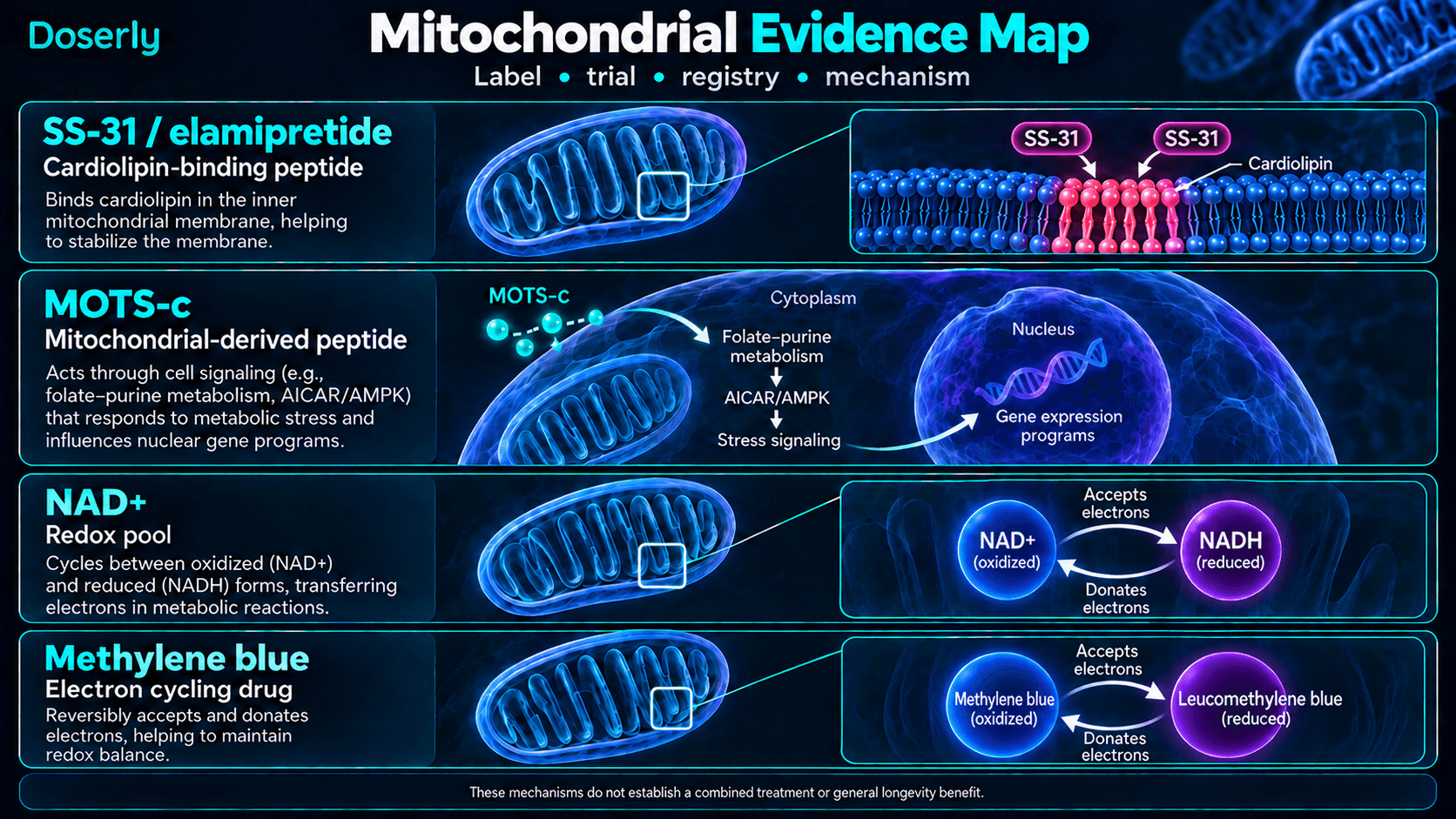
Les voies mécanistiques séparent l’étiquette, les essais négatifs, les registres actifs, les données de pool redox et les données de médicament à cyclage électronique. Le visuel ne prouve pas un bénéfice large de performance, de longévité ou de combinaison. [1][3][4][8][10][11][12][13][14][15][16]
SS-31 illustre le mieux un composé avec une étiquette actuelle et des données négatives importantes hors étiquette. FORZINITY crée un ancrage pour le syndrome de Barth, tandis que MMPOWER-3, PROGRESS-HF et ReCLAIM-2 empêchent d’en faire un optimisateur mitochondrial général.
MOTS-c demeure expérimental. Le registre MOTS-MET montre des essais humains actifs, mais le registre public n’a pas de résultats d’efficacité affichés. Les données murines et cellulaires soutiennent la discussion mécanistique et la justification des essais, pas la sélection de dose personnelle.
Epithalon appartient à une voie à fortes allégations et faibles résultats humains modernes. Les récits de télomérase, de pinéale et de vieillissement sont fréquents, mais l’epitalon synthétique, les extraits d’epithalamin et les protocoles publics de fioles SC ne sont pas interchangeables.
NAD+ et methylene blue nécessitent une étiquette spéciale parce qu’ils ne sont pas des peptides. NAD+ est une coenzyme du métabolisme redox avec des données humaines couvrant cinétique, usage IV propre à une maladie et prépublications IV/injectables préliminaires. Le bleu de méthylène est une petite molécule avec étiquette FDA pour méthémoglobinémie acquise, et sa recherche cognitive inclut des programmes cliniques aux critères mixtes ou non atteints. Leur présence dans un catalogue de peptides ne change pas leur classe moléculaire.
Risques et priorités de suivi
Le vocabulaire mitochondrial peut sembler assez large pour couvrir fatigue, longévité, santé cardiométabolique, cognition et exercice. Cette largeur est le risque principal. Les dossiers doivent garder identité moléculaire, voie, indication, population d’étude, cible de résultat, catégorie de source et moment des effets indésirables.
Dans les dossiers de stack Doserly, les entrées SS-31 peuvent indiquer si la ligne vient de l’étiquette ou d’un protocole public. Les entrées NAD+ et methylene blue bénéficient d’un suivi de la voie, de la durée de perfusion, de l’exposition aux médicaments sérotoninergiques ou opioïdes, du contexte G6PD pour le bleu de méthylène et du fait qu’une entrée vise un précurseur plutôt que NAD+ lui-même.
Doserly Academy soutient la littératie de recherche sur les différences entre étiquette, registre et mécanisme. La participation à l’Academy ne valide pas les protocoles d’optimisation mitochondriale, de longévité ou de performance.
Questions fréquentes
L’étiquette FORZINITY fait-elle de SS-31 un supplément mitochondrial général?
Non. L’étiquette vise les patients atteints du syndrome de Barth pesant au moins 30 kg et repose sur une approbation accélérée liée à un critère intermédiaire. Ce n’est pas une approbation générale de mieux-être ou de longévité. [1][2]
Un mécanisme mitochondrial justifie-t-il de combiner MOTS-c, SS-31, NAD+ et bleu de méthylène?
Non. Un thème mitochondrial partagé ne constitue pas une preuve de combinaison. Les composés diffèrent par classe moléculaire, voie, population étudiée et profil de risque.
NAD+ et bleu de méthylène sont-ils des peptides?
Non. NAD+ est une coenzyme nucléotidique. Le bleu de méthylène est une petite molécule colorante/médicament avec une étiquette FDA pour la méthémoglobinémie acquise.
Pourquoi inclure des essais SS-31 négatifs sur une page mitochondriale?
Les essais négatifs ou mixtes définissent la limite de preuve. Ils empêchent l’usage étiqueté dans le syndrome de Barth et le mécanisme de liaison à la cardiolipine de devenir une allégation générale non soutenue.
Références de routes vers les guides liés
Sources et références
Sources vérifiées le 12 septembre 2026.
[1] DailyMed. FORZINITY elamipretide prescribing information.
[2] FDA. Drug Trials Snapshot: Forzinity.
[3] MMPOWER-3 investigators. Efficacy and Safety of Elamipretide in Individuals With Primary Mitochondrial Myopathy. PMID: 37268435.
[4] ClinicalTrials.gov. MOTS-MET, NCT07505745.
[5] Lee et al. MOTS-c promotes metabolic homeostasis et Reynolds et al. MOTS-c and age-dependent physical decline.
[6] FDA. Epitalon-related bulk drug substances PCAC briefing.
[7] Khavinson et al. Epithalon peptide induces telomerase activity et retinitis pigmentosa report.
[8] Grant et al. Human plasma and urine NAD+ metabolome during a six-hour IV infusion.
[9] Trammell et al. Nicotinamide riboside bioavailability; Yi et al. NMN supplementation trial; Pencina et al. MIB-626 trial.
[10] DailyMed. PROVAYBLUE methylene blue label.
[11] Rodriguez et al. Methylene blue functional MRI trial et NCT01836094.
[12] Acute methylene blue cerebral blood-flow and metabolism study; contexte de protocoles publics nommés : NooBlue et Nootropics Expert.
[13] Yu et al., ischemic-heart-failure NAD+ randomized trial. Essai monocentrique IV NAD+ de 180 patients utilisant 10 mg/jour pendant sept jours.
[14] Hawkins et al., acute Niagen+ IV and NAD+ IV preprint. Prépublication 2024 malgré l’absence de résultats ClinicalTrials.gov affichés pour NCT06382688 au moment de la vérification.
[15] Nkrumah-Elie et al., injectable Niagen pilot preprint. Contexte préliminaire 2026 de sécurité injectable.
[16] ClinicalTrials.gov. MB2 methylene-blue results record, NCT02380573; Wischik et al. LUCIDITY HMTM clinical, imaging and biomarker outcomes. Contexte de programme cognitif bleu de méthylène et méthylthioninium.
Peptides in This Stack
Epithalon
Guide Epithalon actuel qui distingue l’epitalon synthétique de l’extrait epithalamin, les données cellulaires, les anciens rapports humains, les documents de la FDA de juillet 2026 et les propositions de dosage en ligne.
MOTS-C
Guide MOTS-c actuel qui distingue le MOTS-c natif de CB4211, les données cellulaires et animales, les documents de la FDA de juillet 2026, le statut WADA et les propositions de dosage en ligne.
Methylene Blue
Guide vérifié sur le bleu de méthylène distinguant l’étiquette FDA pour la méthémoglobinémie, les risques MAOI et G6PD, les données cognitives hors indication, les données animales et les pages publiques de dosage.
NAD+
Guide vérifié sur le NAD+ distinguant les données pilotes sur le NAD+ IV direct, les essais sur les précurseurs NR et NMN, les allégations anti-âge, le contexte réglementaire et les pages publiques de dosage.
SS-31
Guide SS-31 comparant Forzinity, doses étudiées, protocoles communautaires, mécanismes mitochondriaux et limites des preuves, avec le statut actuel de ReNEW.