
HRT
October 16, 2026
Why Progesterone Cream Is Not Automatically Equivalent to Prescribed Endometrial Protection
On this page
A progesterone cream may contain the same hormone molecule as an oral prescription. It may also produce measurable hormone exposure. Neither fact, by itself, establishes that it can replace the progestogen regimen prescribed to protect the uterine lining during systemic estrogen treatment.
That distinction is easy to lose when a product is described as natural, bioidentical or better absorbed. Those terms do not answer the central question: has this formulation, at this dose and schedule, been shown to oppose estrogen's effects on the endometrium?
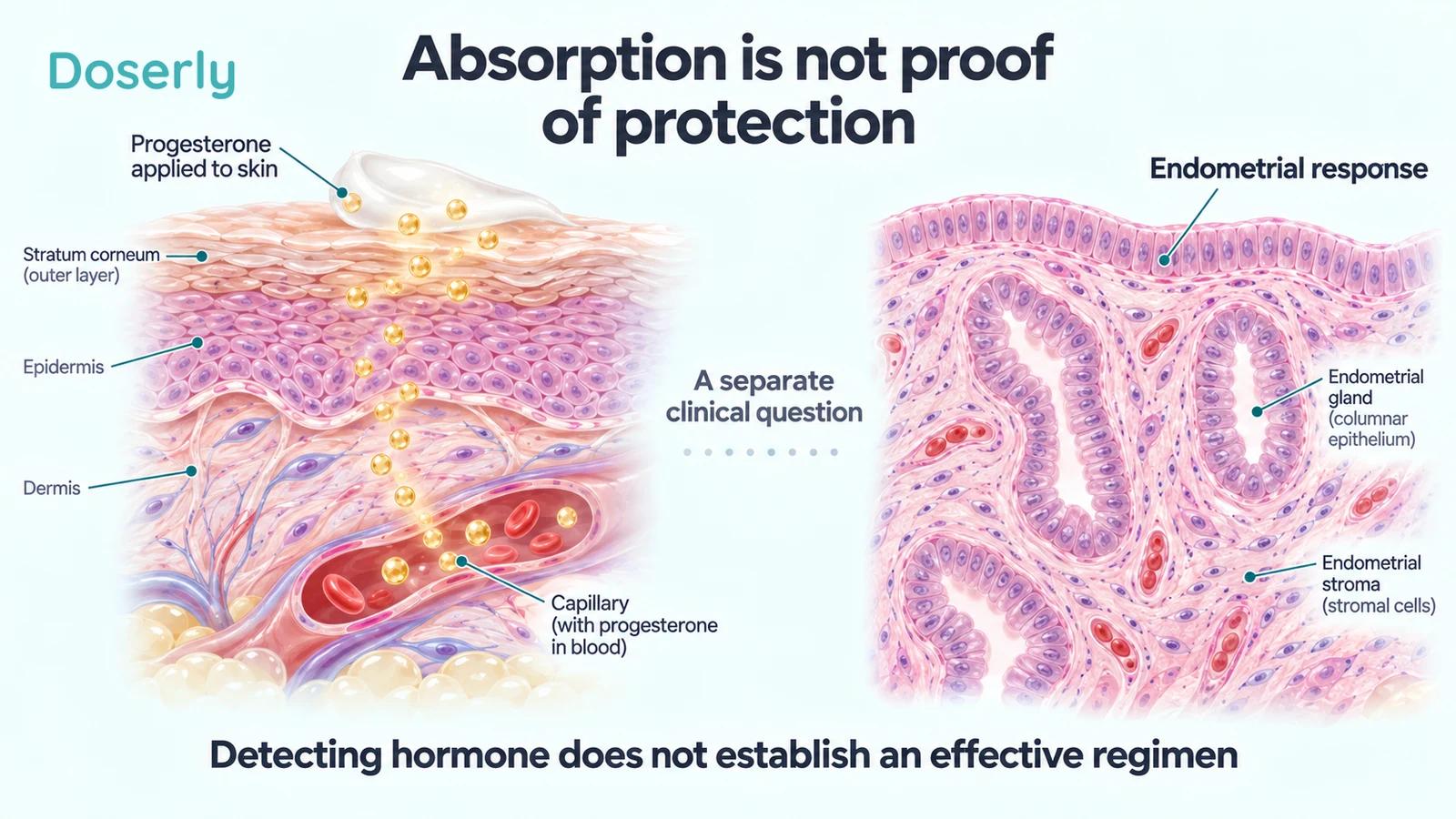
The evidence does not support treating skin-applied progesterone cream as an automatic substitute. At the same time, the explanation should be accurate. The problem is not that progesterone can never cross skin. It is that detecting absorption and demonstrating reliable endometrial protection are different scientific tasks.
What protection is trying to accomplish
The endometrium is the lining inside the uterus. Systemic estrogen can stimulate it to grow. In a person with a uterus, an appropriate progestogen regimen is generally used to oppose that stimulation and reduce the risk of hyperplasia and endometrial cancer associated with unopposed estrogen.
The British Menopause Society emphasizes that protection depends on dose and duration and that progestogen exposure should be proportionate to estrogen exposure. It specifically raises concerns about compounded progesterone creams and gels because absorption is variable and sufficient endometrial protection may not be provided. BMS endometrial-protection guidance
The clinical target is therefore a tissue response over time. Feeling calmer, sleeping differently or noticing breast tenderness does not measure that target. A product can have effects elsewhere without having established the particular protective effect required by the prescription.
This question usually arises when systemic estrogen is being used by someone with a uterus. It should not be confused with the separate discussion of low-dose local vaginal estrogen, or with a progesterone prescription for another indication.
Oral evidence does not transfer automatically to skin
The PEPI trial examined endometrial histology in 596 postmenopausal women over three years. One group received daily conjugated equine estrogen with oral micronized progesterone for twelve days of each cycle. Estrogen alone increased hyperplasia; the studied estrogen-plus-progestogen regimens had rates similar to placebo. PEPI trial, 1996
That is meaningful evidence for the tested regimens. The route, dose, estrogen exposure and schedule are all part of what was tested. Changing one or more of those features creates a different exposure that needs its own support.
An oral capsule and a cream also face different delivery barriers. The amount printed on a cream container describes the amount in the preparation, not necessarily the amount that reaches the endometrium in an effective pattern. A milligram-for-milligram comparison between routes is therefore not a valid conversion method.
The micronized progesterone guide can help identify the prescribed product. It should not be used to infer that every preparation containing the molecule has the same evidence.
The longer cream study found inadequate opposition
A 48-week open-label study tested daily transdermal estradiol with progesterone cream in women at least two years past menopause. Fifty-four women entered and 41 completed the study. The investigators used endometrial biopsies, ultrasound and bleeding diaries rather than relying only on hormone measurements. Endometrial cream study, 2005
At the end of follow-up, 32% had evidence of inadequate opposition, defined as proliferative or hyperplastic endometrium. The tested regimen was 40 mg progesterone cream with 1 mg transdermal estradiol daily. The investigators concluded that this combination did not adequately counter estrogen's endometrial effect.
There are two important limits to the interpretation. This was a small, uncontrolled study of a particular combination, so it cannot determine the outcome of every possible cream. And the 32% figure was not a cancer rate: it combined proliferative and hyperplastic findings.
Even with those limits, a tissue-based failure signal is directly relevant to a claim of uterine protection. It cannot be dismissed merely because the cream is chemically progesterone or because some users report feeling better.
A shorter study raised the same practical concern
Another study examined 27 postmenopausal women receiving continuous transdermal estrogen and sequential progesterone cream. The tested progesterone doses were 16, 32 or 64 mg daily during the latter half of each cycle. The investigators found no detectable endometrial change consistent with the intended secretory response. Sequential cream study, 2000
Only one participant experienced bleeding during the study. That finding is a useful reminder that the absence of bleeding does not establish adequate opposition. Bleeding is a symptom to interpret, not a substitute for evidence about what a regimen does to tissue.
Salivary progesterone levels were also highly variable and did not help the investigators manage treatment. The study was short and small, but it directly tested the assumption that the applied doses would reliably transform an estrogen-stimulated endometrium.
A result like this does not tell an individual user that harm has already occurred. It tells the prescriber that the regimen cannot be assumed equivalent to a better-established protective strategy.
There is a favorable pilot, and its limits matter
The literature is not uniformly negative. A small randomized crossover pilot compared oral conjugated estrogen plus medroxyprogesterone acetate with the same estrogen plus twice-daily progesterone cream. Twenty-six women completed both six-month treatment periods. Crossover pilot, 2005
No hyperplasia was found in 52 post-treatment biopsies. Forty showed atrophic endometrium and twelve showed proliferative endometrium, including five during the cream regimen. Participants also tended to prefer the cream-containing regimen.
Those findings deserve inclusion. They do not establish long-term equivalence: the study was small, each exposure period lasted six months, and a lack of observed hyperplasia in that sample cannot rule out a clinically important difference over longer use. Preference is also a different outcome from protective efficacy.
Taken together, these studies leave uncertainty rather than a validated interchangeable option. A favorable preliminary trial cannot cancel the tissue findings from another regimen, just as one unfavorable regimen cannot prove that all topical progesterone has no biological activity.
Absorption studies answer a different question
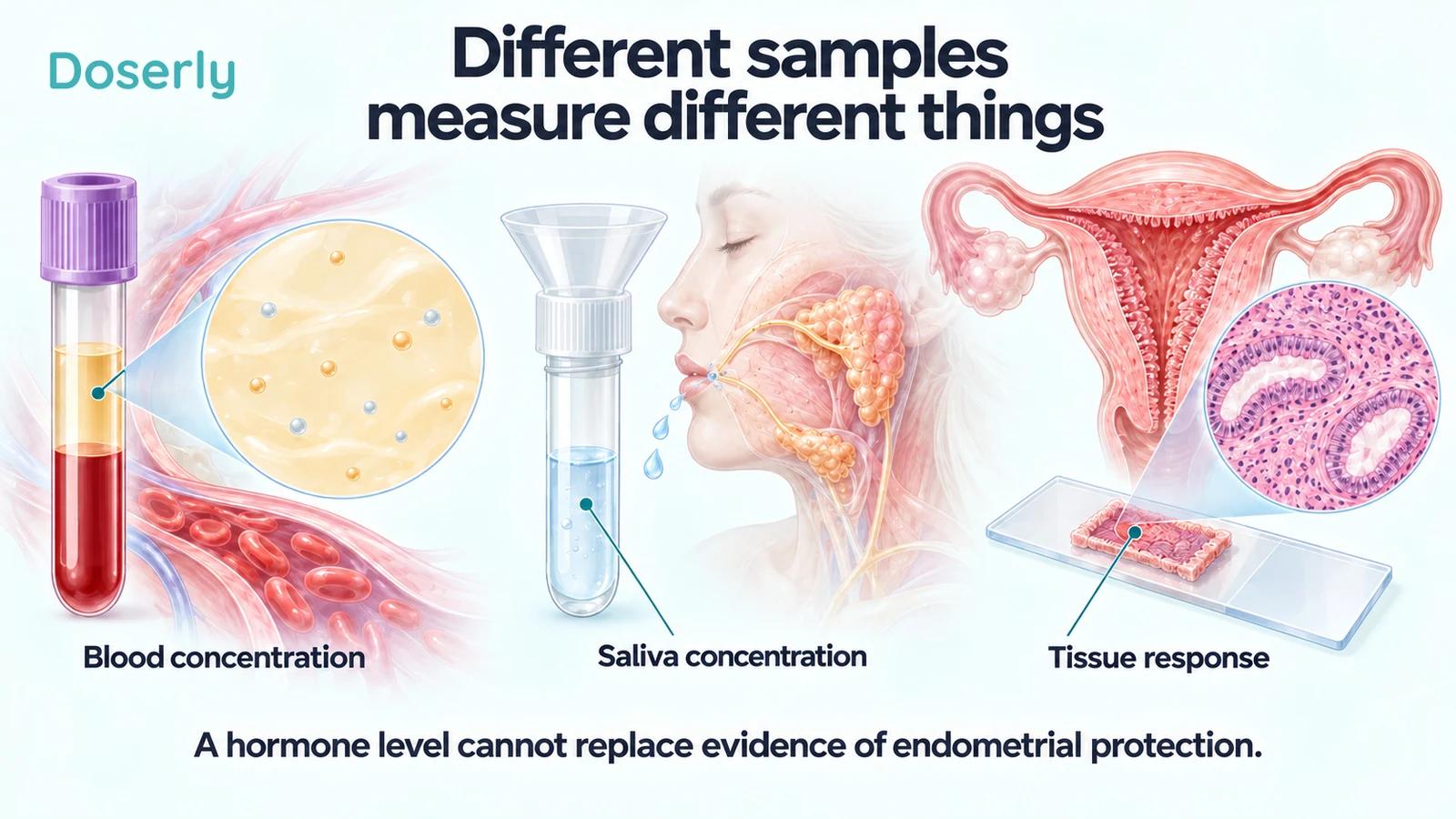
A randomized crossover study in ten postmenopausal women examined progesterone concentrations after cream or gel application. It collected venous serum, whole blood, fingertip capillary blood and saliva over time. Concentrations differed substantially between sample types, with saliva and capillary measurements much higher than venous measurements. Progesterone distribution study, 2013
This supports an important correction: a low venous level does not necessarily mean that no hormone was absorbed. The study's authors warned that relying on serum levels could underestimate exposure and encourage excessive dosing.
But the study did not establish endometrial protection. It was a pharmacokinetic experiment over short treatment periods, not a long-term comparison of uterine histology or cancer outcomes. High saliva or capillary values cannot be promoted into evidence that the endometrium is adequately opposed.
The two errors are mirror images. Saying “the blood level is low, so the cream does nothing” goes beyond what that measurement can show. Saying “the saliva level is high, so the uterus is protected” makes a different unsupported leap.
Saliva testing cannot validate a replacement regimen
ACOG does not support salivary testing as an accurate way to tailor compounded menopausal hormone treatment. Its consensus explains that measured circulating concentrations do not necessarily reflect tissue exposure and that salivary measurements are not sufficiently accurate or precise for the claims often made about them. ACOG clinical consensus, 2023
A laboratory report may look precise because it contains a number and a reference interval. Precision of display is not the same as validation for a clinical purpose. To establish protection, the test would need evidence connecting the measured value to the relevant endometrial outcome under that formulation and schedule.
This is why a plan based on adjusting cream until saliva enters a “balanced” range does not resolve the central uncertainty. The Endocrine Society likewise notes a lack of evidence supporting serial saliva or blood testing to monitor compounded hormone treatment in this way. Endocrine Society scientific statement
That does not mean laboratory testing never has a role in endocrinology. It means the test must be validated for the question being asked.
Product consistency adds another layer
A 2019 laboratory study sent prescriptions for combined estradiol and progesterone capsules and creams to fifteen compounding pharmacies; thirteen filled them. Measured hormone content varied. For cream prescribed to contain 100 mg progesterone per gram, measured concentrations ranged from 93 to 118 mg per gram. Compounded-content study, 2019
This was a product-analysis study, not a trial of clinical harm, and the sampled pharmacies do not represent every pharmacy or every batch. Its relevance is narrower: the label's nominal content and the measured content were not always identical.
Even perfect content consistency would not answer the absorption and tissue-response questions. Conversely, a well-designed efficacy study of one preparation would not automatically establish the quality of a different preparation. Manufacturing reliability and clinical effectiveness are related but distinct requirements.
The compounded HRT guide can help organize questions about the exact product and why it was selected. “Custom” describes how a medicine was prepared; it does not establish that its clinical effects were individually proven.
Skin cream and vaginal progesterone are not the same route
The words cream and gel can obscure an important distinction between application to skin and administration within the vagina. The BMS discusses vaginal progesterone separately, noting limited evidence for the optimal HRT regimen and circumstances in which off-license use may be considered. That discussion does not validate transdermal cream. BMS endometrial-protection guidance
A product used for fertility care also should not be assumed to have an established menopause regimen simply because it contains progesterone. The indication, estrogen exposure, duration and clinical endpoint differ.
For a reader comparing products, the useful habit is to write the route in full: oral, skin-applied or vaginal. Then identify the intended indication and schedule. That removes an ambiguity that can otherwise make two very different studies sound as though they tested the same treatment.
If you are already using a cream
The evidence is a reason to review the plan, not to assume that you have developed hyperplasia or cancer. Bring the actual product label, concentration, application instructions and estrogen prescription to the clinician who manages the regimen.
Ask which evidence supports this preparation for endometrial protection, whether an approved or better-established option would meet the same need, and how tolerability concerns could be addressed. If the cream replaced a medicine because of sedation or another adverse effect, explain that reason; it helps the clinician choose a workable alternative.
Report new or unexpected bleeding and any interruptions in treatment. Do not treat the absence of bleeding as proof that the regimen is protective, and do not attempt to solve the uncertainty by increasing the cream on your own. More applied hormone is not a validated conversion strategy. BMS endometrial-protection guidance
A treatment timeline can distinguish what was prescribed from what was actually used. Doserly can keep product changes, missed applications and bleeding dates together for review. The app cannot infer endometrial status from a hormone level or symptom pattern.
The central standard is straightforward: a protective claim needs evidence for the protective outcome. Progesterone's molecular identity, measurable absorption and user preference each provide useful information, but none makes a skin cream automatically equivalent to a prescribed endometrial-protection regimen.
Sources
- BMS progestogens and endometrial protection, current PDF
- PEPI endometrial histology trial (1996)
- 48-week progesterone cream and estradiol endometrial study (2005)
- Sequential progesterone cream endometrial study (2000)
- Progesterone cream crossover pilot (2005)
- Percutaneous progesterone distribution crossover study (2013)
- ACOG compounded bioidentical menopausal hormone therapy consensus (2023)
- Endocrine Society scientific statement (2016)
- Measured content of compounded capsules and creams (2019)