
Peptides
October 16, 2026
Why ipamorelin and CJC-1295 are paired, and what is still untested
On this page
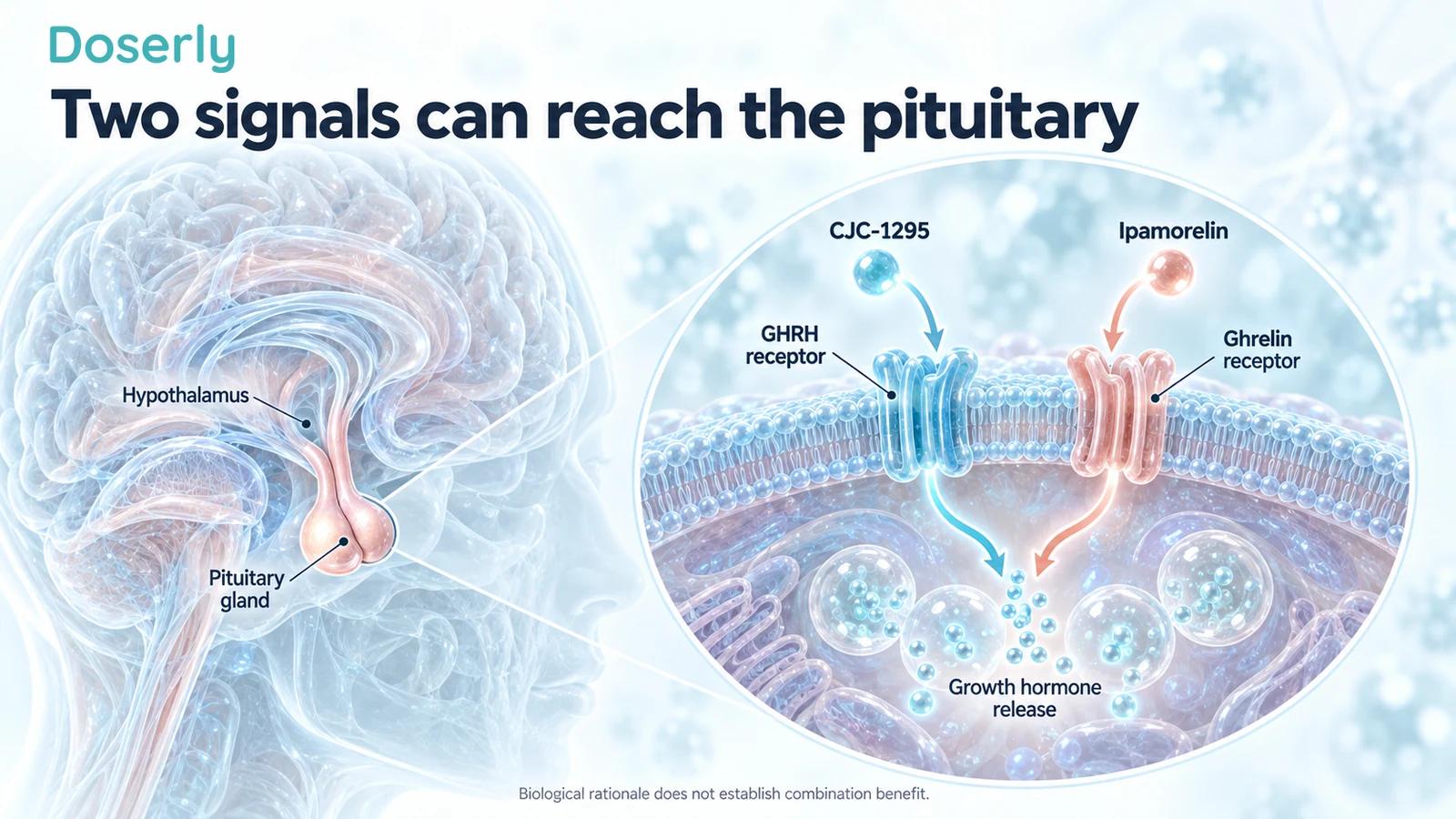
Ipamorelin and CJC-1295 are paired because they can stimulate the growth hormone system through different receptor pathways. The idea is that two signals reaching the pituitary might produce a larger hormonal response than either signal alone. That is a reasonable biological question.
It is also a different question from whether the combination improves muscle, sleep, recovery or quality of life. The human studies usually cited involve older combinations of related molecules or each compound separately. They do not establish a specific additional clinical benefit from pairing ipamorelin with CJC-1295. Human GHRP/GHRH experiment; CJC-1295 trials.
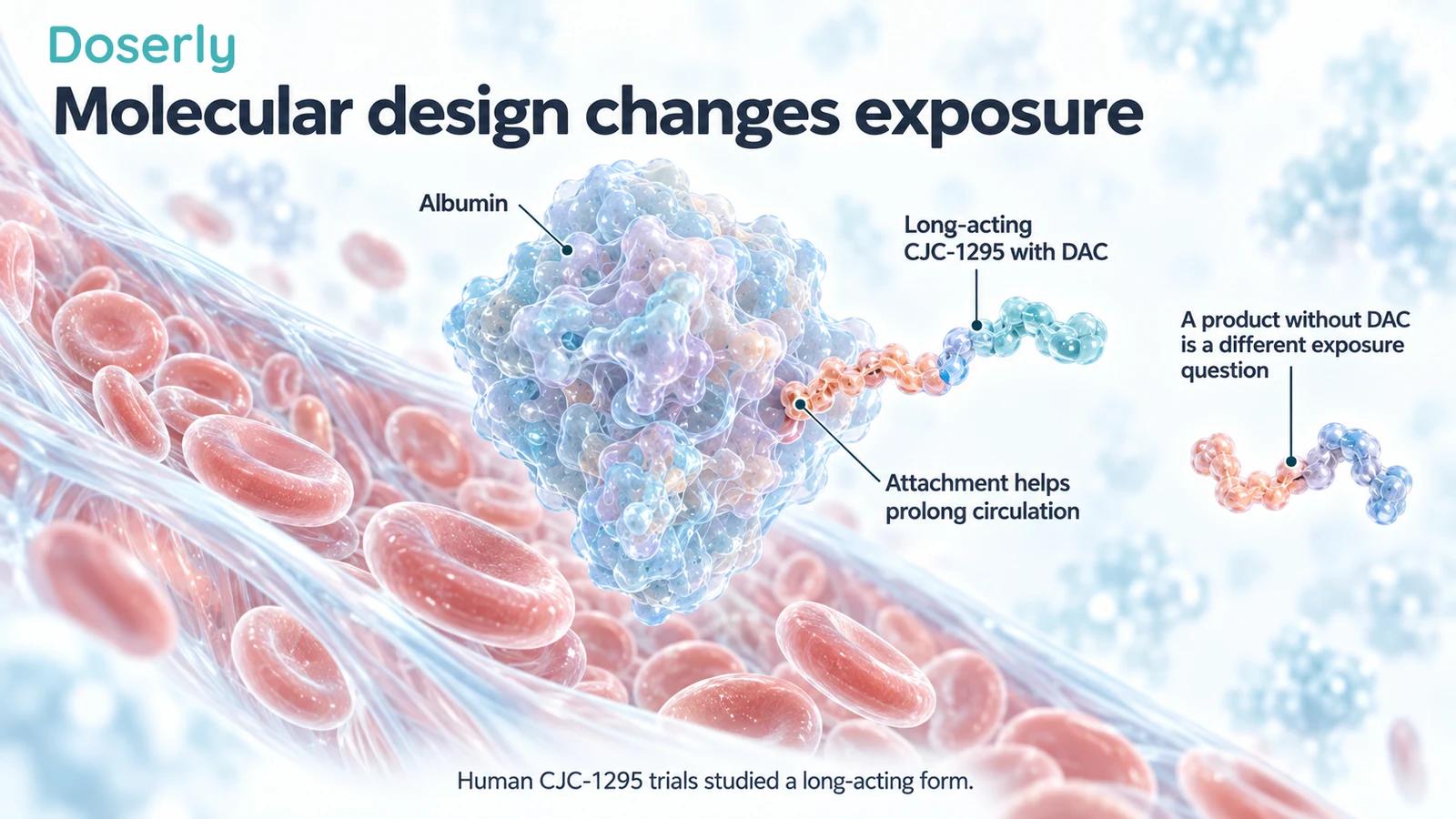
Before looking at the proposed synergy, one detail needs attention: “CJC-1295” is used inconsistently in commercial descriptions. Whether a product includes the drug affinity complex, or DAC, changes which evidence is relevant. Our CJC-1295 guide explains that naming issue in more detail.
Two pathways converge on GH release
The pituitary gland releases growth hormone, or GH, in response to signals from the brain and other parts of the body. Growth hormone–releasing hormone, GHRH, acts through its own receptor. CJC-1295 was developed as a modified GHRH analogue: a molecule designed to act through that signaling pathway.
Ipamorelin is a GH secretagogue acting through the ghrelin-receptor pathway. A secretagogue stimulates release of a substance; in this case, GH release is one of the measured effects. It is not the same molecule as GH and does not simply replace GH from outside the body. Ipamorelin pharmacology.
Because these pathways are different, researchers have investigated whether simultaneous stimulation can produce a larger response. Two receptor systems can interact inside an endocrine network rather than acting as independent, isolated switches.
That possibility explains the pairing. It does not yet tell us the best formulation, the appropriate clinical indication, or whether increasing the signal is desirable for a particular person.
What did the classic human synergy study actually use?
A 1990 experiment studied acute GH release in 18 healthy men. The investigators administered a synthetic GH-releasing peptide and GHRH-(1-44), separately and together. At some submaximal GHRP exposures, the combined response was described as synergistic. Original study.
Synergy here refers to the relationship between the measured hormone responses under the tested conditions. It does not mean that two compounds inevitably produce superior clinical outcomes whenever they share the same broad pathways.
Neither molecule was the modern ipamorelin–CJC-1295 combination. The study also measured an acute response, not changes in muscle size, sleep symptoms or health over months. It supports the general biological rationale for combining GHRH and secretagogue signaling.
This is a useful piece of evidence when kept at its proper level. The mistake occurs when the study is presented as though it established the benefits, dosing or safety of a different pair of drugs.
What did the CJC-1295 trials measure?
The 2006 CJC-1295 paper reported two randomized, blinded, placebo-controlled ascending-dose studies lasting 28 and 49 days. Participants were healthy adults aged 21–61. Researchers studied the long-acting compound through subcutaneous administration and measured GH, insulin-like growth factor 1 and drug exposure.
After a single administration, mean GH concentrations increased for at least six days, and IGF-1 increased for approximately nine to eleven days. The estimated half-life was 5.8–8.1 days. Repeated exposure produced sustained IGF-1 elevations, consistent with a cumulative effect. CJC-1295 human trials.
These are hormone and pharmacology findings. The study was not a comparison of CJC-1295 plus ipamorelin against either compound alone. Nor did the reported hormonal changes establish a particular improvement in strength, sleep or longevity.
The duration of exposure is central to interpretation. A long-acting molecule can continue influencing the system well after an injection. That is different from assuming that each injection creates an isolated brief pulse and then leaves no ongoing effect.
Why “with DAC” and “without DAC” cannot be collapsed together
The DAC design enables association with albumin, a major blood protein, helping prolong circulation. The long-acting CJC-1295 studied in the human trials belongs to this design. Products marketed without DAC cannot inherit its exposure profile merely because they use a similar name.
FDA's review explicitly treats CJC-1295 and CJC-1295 DAC as different active moieties. It also distinguishes free-base and salt forms. These distinctions matter because molecular identity, formulation and pharmacokinetics can affect both efficacy and safety. FDA CJC-1295 briefing.
A claim that cites a roughly week-long half-life while recommending a product described as “no DAC” is therefore mixing evidence from different identities. The naming problem must be resolved before discussing what a study means for the product.
This does not require the reader to become a medicinal chemist. It requires an exact answer to a practical question: which molecule was tested, and is it the same one being proposed?
What ipamorelin contributes to the evidence
Human ipamorelin pharmacology has demonstrated a GH response after intravenous administration. The 1999 study used five dose levels with eight healthy men at each level. Its estimated terminal half-life was about two hours. Ipamorelin study.
That supports the claim that ipamorelin can stimulate GH in people. It does not show how repeated subcutaneous ipamorelin interacts with long-acting CJC-1295, or with a different product sold as CJC without DAC.
The combination changes the exposure question. A response to ipamorelin alone may differ when the pituitary is already being stimulated through another pathway. Conversely, adding a short exposure to a sustained GHRH signal may not produce the pattern assumed from either single-agent study.
Those are questions for direct research. They cannot be settled by placing two published half-lives beside each other and designing a schedule from the arithmetic.
A larger hormone response is not automatically a larger benefit
A treatment's usefulness depends on the outcome and the person. If the goal is to correct an established endocrine deficiency, the clinical context differs from trying to increase an already adequate response in a healthy adult.
For muscle or healthy-aging claims, it is particularly important to separate the laboratory result from function. A randomized MK-677 trial in older adults increased fat-free mass but did not demonstrate improved strength or function. MK-677 is a different drug, but the result illustrates why GH-system activation is not a universal proxy for better physical performance. Related-drug trial.
For sleep, a hormone measurement does not record awakenings, sleep stages or daytime sleepiness. For recovery, the outcome might be time to resume activity, pain or a validated functional test. Each needs its own study.
A combination could increase a biomarker without improving the desired symptom. It could also add adverse effects. “More” is therefore not a clinical target until the relationship between the measured change and patient benefit is established.
What would establish that the pairing adds something?
The most informative comparison would include the combination and the individual components, using clearly identified formulations. A placebo or other appropriate control could help separate treatment effects from normal changes over time.
If the combination were compared only with placebo, a positive result would not reveal whether both ingredients were necessary. One component might account for the benefit. To show an added contribution, researchers need a comparison that can distinguish the pair from its parts.
The participants and outcome also need to be specific. A trial in adults with diagnosed GH deficiency would not settle healthy-aging claims. A study of muscle strength would not settle insomnia treatment. The same biological pathway can be relevant to several questions without answering all of them.
Safety follow-up would be essential. Combining compounds changes exposure and can complicate attribution of adverse events. A trial should report withdrawals, symptoms, laboratory changes and uncertainty alongside any favorable endpoint.
Does using the body's own GH guarantee safety?
No. Stimulating endogenous GH means the body releases the hormone, but the stimulus is still pharmacological. The presence of biological feedback does not establish that every exposure pattern or combination is harmless.
FDA's ipamorelin assessment describes limited safety information and gaps for proposed subcutaneous use. The CJC-1295 review addresses additional concerns about molecular identity, peptide impurities and immune responses. Those reviews do not demonstrate that the two substances protect against each other's risks. Ipamorelin briefing; CJC-1295 briefing.
A normal result on one laboratory test cannot resolve every concern. A hormone result tells us about a measured endocrine response; it does not verify product identity or exclude all delayed effects.
This is also why “selective” and “natural” are incomplete safety descriptions. They may refer to a particular mechanism or response pattern, but they do not replace clinical safety data for the actual combination.
Why a premixed vial creates another question
A blend may be convenient, but convenience is not evidence of pharmacological compatibility or superior outcomes. The actual amounts, identity of the CJC component, formulation and quality controls remain important.
A fixed mixture also links the exposure to both components. Adjusting the amount of the blend changes both at once, making it harder to distinguish which ingredient contributed to a response or adverse effect. That observation does not imply a better self-experiment; it explains why a combination needs deliberate clinical evaluation.
The existence of a branded or compounded mixture does not mean it is the product tested in a publication. The relevant comparison is the study's formulation and route, not whether the names on the vial resemble the paper's keywords.
Our ipamorelin guide and CJC-1295 guide can help you understand the individual compounds before discussing a proposed blend.
What should a clinician be able to explain?
Start with the intended benefit. “Support GH” describes a mechanism; it does not identify the symptom or outcome you want to improve. A useful discussion specifies the problem, the evidence in similar patients and how progress would be assessed.
Next, establish the exact CJC-1295 identity. Ask whether the cited human studies used that form and whether the proposed combination has been studied directly. A clear answer may be that the recommendation rests on mechanistic reasoning or clinical experience rather than a controlled combination trial.
Finally, discuss what uncertainty remains and what would trigger reassessment. It is reasonable to want a better-defined benefit before accepting the complexity of two experimental exposures.
The pairing has an understandable scientific rationale: two receptor pathways can influence GH release. The missing step is evidence that this particular pairing, in a specified formulation and population, produces a worthwhile clinical advantage over simpler alternatives. Until that comparison is available, the mechanism should remain a rationale for research rather than a promise of results.
Explore the research
- Growth hormone (GH)-releasing peptide stimulates GH release in normal men and acts synergistically with GH-releasing hormone (1990): Neither ipamorelin nor CJC-1295; acute hormone endpoint.
- Prolonged stimulation of growth hormone (GH) and insulin-like growth factor I secretion by CJC-1295, a long-acting analog of GH-releasing hormone, in healthy adults (2006): Not an ipamorelin combination trial; not evidence for products marketed as no-DAC.
- FDA Briefing Document: CJC-1295-Related Bulk Drug Substances, December 4, 2024 (2024): Advisory briefing, not final legal determination or direct combination trial.
- Ipamorelin, the first selective growth hormone secretagogue (1998): Abstract reviewed; animal responses do not establish human safety.
- Pharmacokinetic-pharmacodynamic modeling of ipamorelin, a growth hormone releasing peptide, in human volunteers (1999): Acute intravenous study; no chronic sleep or muscle efficacy endpoints.
- FDA Briefing Document: Ipamorelin-Related Bulk Drug Substances, October 29, 2024 (2024): Advisory briefing, not itself a final legal determination; safety events do not prove causality.
- Effects of an oral ghrelin mimetic on body composition and clinical outcomes in healthy older adults: a randomized trial (2008): MK-677, not ipamorelin; functional outcomes underpowered.