
Peptides
October 16, 2026
Thymosin beta-4 versus TB-500: why the actual molecule matters
On this page
Thymosin beta-4 and TB-500 are often discussed together because they share part of an amino-acid sequence and a connection to cell movement. If you're reading about recovery from an injury, you may encounter the names used as though they identify one treatment. That makes it surprisingly easy to attach a real scientific finding to a different substance.
Full-length thymosin beta-4 and the seven-amino-acid TB-500 fragment are not the same molecule. Commercial naming is also inconsistent, so the words “TB-500” alone do not reliably tell you what was studied or what a product contains. FDA highlighted this problem in its 2026 evaluation of TB-500-related substances. FDA briefing.
The difference is more than terminology. A fragment can share a biological activity with a larger peptide without having the same stability, distribution or clinical effects. Understanding the identity of the molecule helps you interpret the eye, wound and laboratory studies without turning them into evidence for an untested injury treatment.
What is full-length thymosin beta-4?
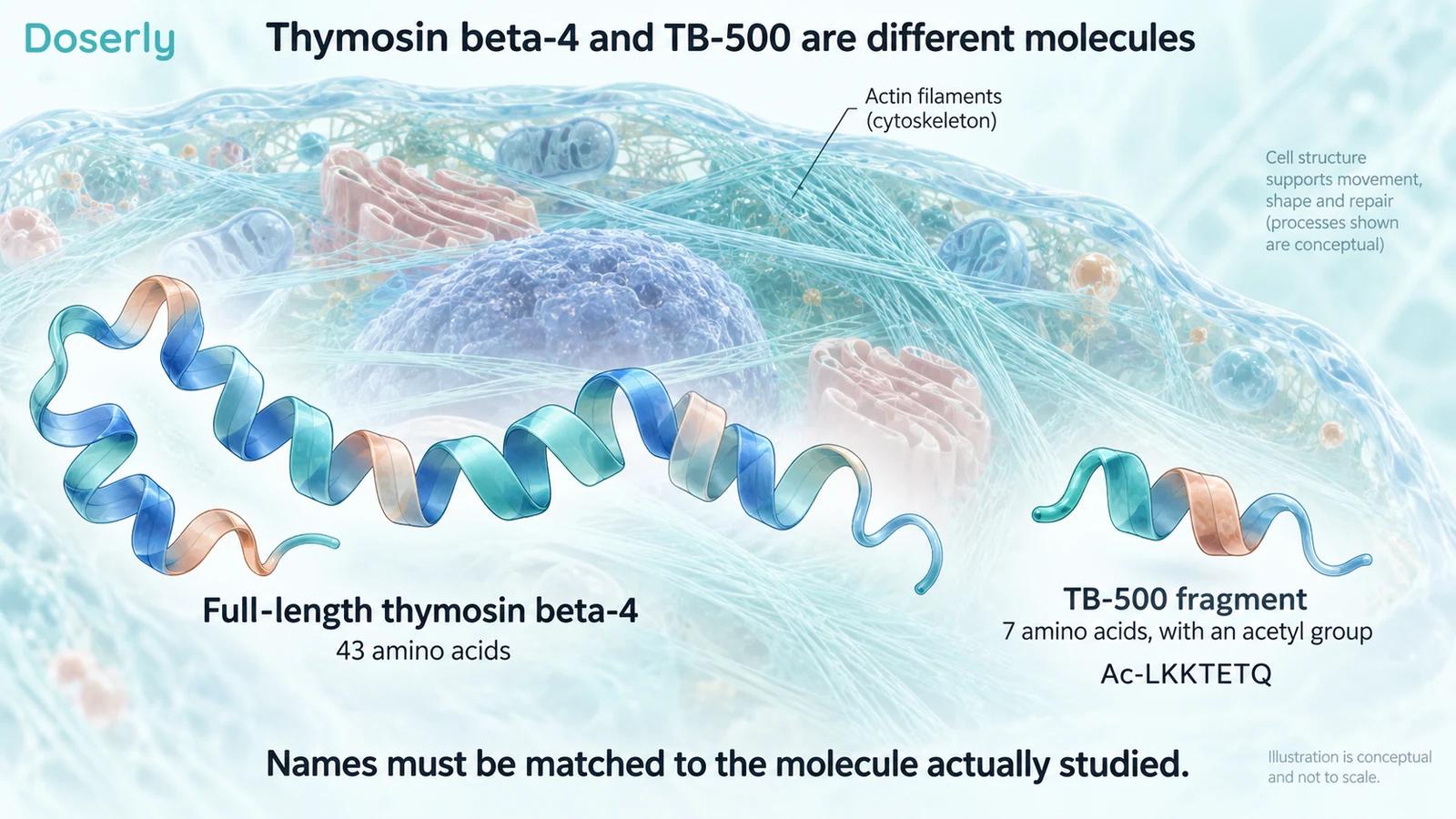
Thymosin beta-4 is a naturally occurring peptide involved in regulating actin, a protein that forms part of the cell's internal structure. Actin helps cells change shape and move. Thymosin beta-4 binds individual actin units, contributing to the balance between those units and assembled filaments.
The mature peptide contains 43 amino acids. The reviewed human protein record in UniProt identifies the protein and its processed chain; the sequence record includes an initiating methionine that is removed in the mature form. This is one reason a raw database sequence count may look different from a paper's mature-peptide description. UniProt thymosin beta-4 record.
Researchers have investigated whether supplying a synthetic or recombinant preparation could affect injured tissue. “Synthetic” describes chemical manufacture; “recombinant” describes production using genetic technology. Neither word turns the full-length peptide into the shorter fragment. The product's identity still depends on its sequence, chemical modifications and formulation.
Our thymosin beta-4 guide covers the full-length molecule. Its human studies include specific eye-drop, topical and intravenous preparations. Those route-specific results need their own interpretation even before TB-500 enters the discussion.
What does TB-500 refer to here?
FDA's briefing describes TB-500 free base as a synthetic fragment corresponding to positions 17–23 of thymosin beta-4, with an acetyl group attached at the amino-terminal end. The shorthand sequence is Ac-LKKTETQ. The letters represent seven amino acids; “Ac” represents the acetyl modification, not another amino acid.
The same briefing emphasizes that TB-500 is a common name and that different salts, derivatives and active substances have been sold under it. It therefore warns that inconsistent naming can cause a patient to receive a different substance from the one intended. FDA substance-identity discussion.
For clarity, this article uses “full-length thymosin beta-4” for the mature 43-amino-acid peptide and “TB-500 fragment” for the acetylated seven-amino-acid substance described above. A seller or older publication may use the name differently. In those cases, the methods and analytical identification matter more than the headline.
A fragment is not automatically weaker, safer or more potent than its parent molecule. Those are experimental questions. Removing most of a sequence can change several properties at once, and a chemical modification can affect how a peptide behaves. There is no reliable clinical conversion based simply on the relative chain lengths.
Why do the names get linked in wound-healing discussions?
One reason is research on a short actin-binding motif, a region of thymosin beta-4 involved in actin-related activity. In a 2003 laboratory study, researchers compared full-length thymosin beta-4 and peptide fragments in cell migration, adhesion and vessel-sprouting experiments.
The work included human umbilical-vein endothelial cells and chick aortic-arch assays. The full peptide and the seven-residue motif showed similar activity in selected assays at approximately 50 nanomolar. Peptides missing part of that motif were inactive in those experiments. Actin-binding-site study.
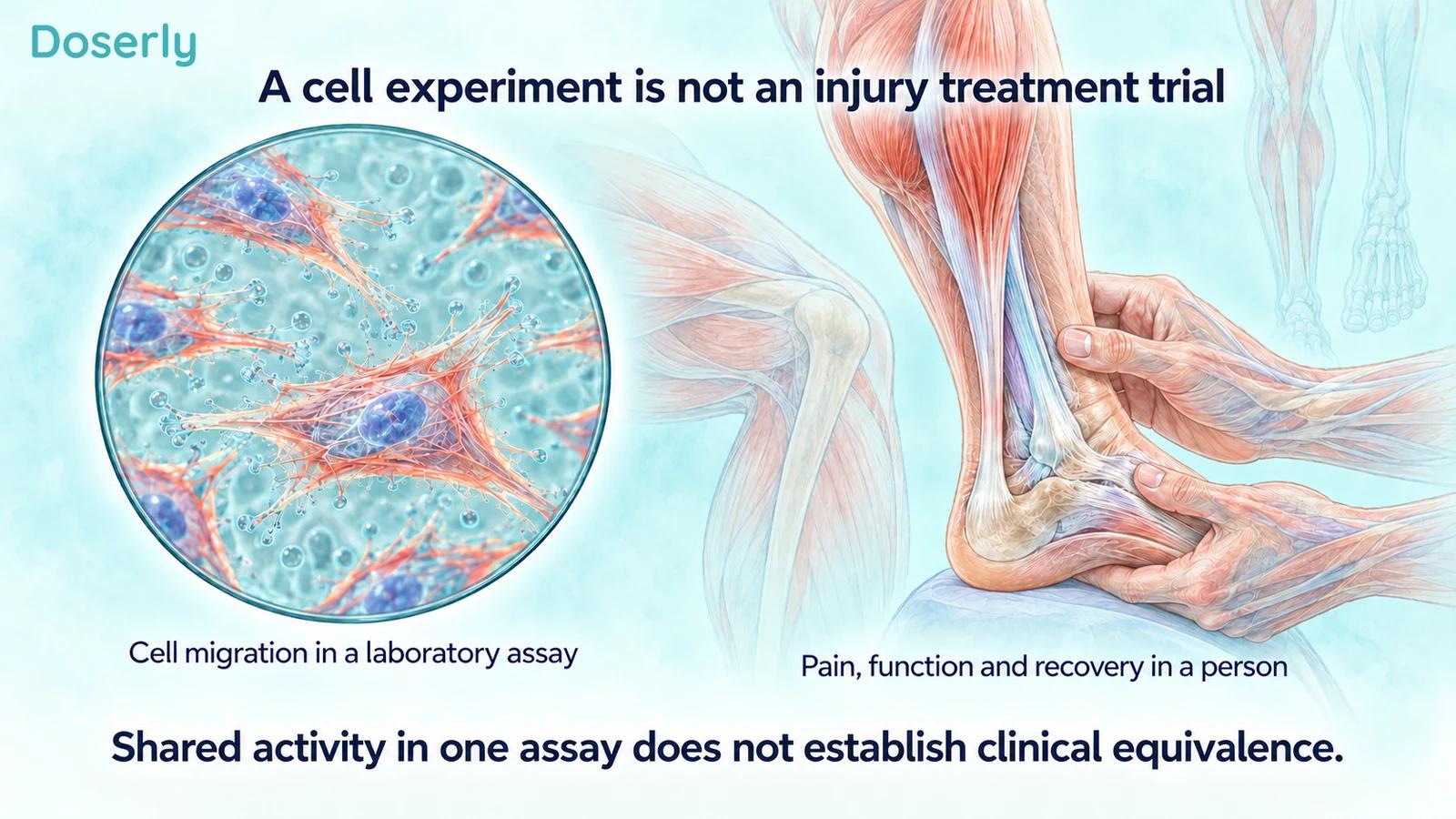
That is a useful biological observation: a short sequence can contribute to an activity of a larger molecule. But an assay concentration is not a human dose, and endothelial-cell movement is not a measurement of pain or return to sport. The experiment also does not establish that every commercial substance called TB-500 has the same chemical identity as the fragment tested.
Angiogenesis, the formation of new blood vessels, is another term in this literature. Vessel growth can be involved in healing, but it is a process rather than a clinical benefit in itself. Whether changing it is useful depends on the tissue and disease. A result showing vessel sprouting cannot establish that an injured human tendon becomes stronger.
What did the mouse wound study show?
Another 2003 study examined full-thickness skin wounds in diabetic and aged mice. Full-length thymosin beta-4 increased wound contraction and collagen deposition in diabetic mice. The investigators did not find a difference in keratinocyte migration in that diabetic model; almost complete surface coverage was present by day eight across groups.
In aged mice, the full-length peptide accelerated several repair measurements. A seven-amino-acid synthetic peptide containing the actin-binding sequence, LKKTETQ, also promoted repair in the aged animals, with activity described as comparable to the parent molecule. Mouse wound study.
The chemical notation matters here. The abstract identifies LKKTETQ; it does not by itself establish that the experiment tested the same acetylated preparation now described as TB-500. The animals also had deliberately created skin wounds, not the range of human injuries for which products are marketed.
The findings support further investigation of that region of the peptide. They do not identify a validated human injection schedule, prove that a fragment can replace the full-length peptide or establish safety after repeated use. Those additional questions remain separate from the observed wound measurements.
Which molecule did the human eye and IV trials use?
The 72-person dry-eye trial used RGN-259, an ophthalmic formulation containing full-length synthetic thymosin beta-4. Its two primary endpoints did not demonstrate a significant benefit, although additional analyses suggested possible effects. Describing this as a successful “TB-500 clinical trial” would introduce both an identity error and an outcome error. Dry-eye trial.
The recombinant IV study of NL005 enrolled 54 healthy volunteers in a single-dose portion and 30 in a multiple-dose portion. It examined tolerability, pharmacokinetics and anti-drug antibodies for a particular full-length product. It was not a seven-residue fragment trial or a trial of injury recovery. Recombinant phase 1 study.
These examples show why a citation needs a description of the tested intervention. A full-length eye drop, a recombinant intravenous product and a subcutaneous fragment are not one pooled treatment. You can learn from all three research areas while keeping their findings attached to the substances and routes actually examined.
Our TB-500 guide provides a separate starting point for the fragment. Keeping separate guide names is useful because a shared nickname can otherwise make a small collection of distinct experiments appear to be a large clinical evidence base for one product.
What does the horse research establish?
A 2024 equine doping-control paper measured endogenous thymosin beta-4 in racing-horse blood samples and investigated analytical detection of misuse. It found that sample handling mattered: concentrations increased when plasma was not separated from blood cells during refrigerated storage, consistent with release from cells.
The investigators also detected a non-natural synthesis impurity in equine plasma after administration of a thymosin-beta-4-containing product to a horse. That was an analytical detection finding. It did not demonstrate improved healing, better performance or safety in horses, and it provides no treatment result for humans. Equine analytical study.
The practical lesson is about measurement and identity. A laboratory signal can reflect sample processing or identify exposure without demonstrating a health effect. A study involving a horse is also not evidence for owners to administer a research peptide to an animal.
Why a purity percentage cannot settle the question
A product description may emphasize a high purity percentage. Even a genuine analytical result needs context: what substance was the test designed to identify, which impurities were assessed and was the tested sample representative of the product in question? Identity and purity are related but different properties.
FDA's briefing discusses injectable-product quality attributes including sterility, bacterial endotoxins and particulates. A peptide-identification or purity result alone cannot establish all of them. The briefing also distinguishes the substance's chemical characterization from evidence of clinical safety and effectiveness. FDA quality assessment.
This does not mean an online certificate can never provide information. It means that the information answers a limited analytical question. It cannot substitute for a matching clinical trial, establish an effective dose or confirm that the preparation is appropriate for a particular route.
The same applies to “acetate” on a label. A salt designation and an acetyl group attached to a peptide are different chemical descriptions. They should not be used to infer that two products are equivalent without examining their actual specifications. When the name is ambiguous, confidence in a treatment claim should not exceed confidence in the identity of the substance.
What to ask when someone cites a study
Ask for the paper's intervention description: full-length peptide or fragment, exact sequence or product, formulation, route and population. Then ask which result supports the proposed benefit. A laboratory wound experiment may justify interest, while a patient trial is needed to estimate whether people recover better.
If the answer is simply that TB-500 and thymosin beta-4 are “the same thing,” ask what that means chemically. Sometimes a person is using an informal nickname for the full-length molecule. At other times they mean the fragment. Making the distinction explicit is more helpful than arguing over a name without knowing what is being discussed.
For someone considering treatment for an injury, the central question remains practical: is there reliable evidence for this particular substance, delivered this way, in people with this problem? The thymosin beta-4 literature offers real biological findings and some human studies, but changing the molecule's name cannot fill gaps in that chain of evidence.
Sources
- FDA, 2026: TB-500 substance evaluation.
- UniProt: human thymosin beta-4, P62328.
- Actin-binding-site and angiogenesis study, 2003.
- Diabetic and aged mouse wound study, 2003.
- Full-length RGN-259 dry-eye trial, 2015.
- Recombinant NL005 phase 1 trial, 2021.
- Equine doping-control analytical study, 2024.