
TRT
October 16, 2026
Why Fertility Should Be Discussed Before the First TRT Prescription
On this page
A first testosterone prescription can feel like the end of a long search for answers. Someone has finally connected symptoms with a diagnosis and proposed a treatment. Fertility can seem like a separate conversation, especially when having a child is years away or still uncertain.
It belongs in that first conversation. Testosterone replacement can improve a blood testosterone result while suppressing the signals that support sperm production. A person can feel better, have normal erections and continue to ejaculate without knowing that their sperm count has fallen.
This does not mean every man who uses TRT becomes infertile, or that recovery is impossible. It means the opportunity to understand the starting point and preserve options is clearest before treatment changes it. The Endocrine Society advises against starting testosterone in men planning fertility in the near term. The AUA/ASRM male-infertility guideline also makes future reproductive intentions a central treatment consideration. Endocrine Society guideline, AUA/ASRM guideline
Why more testosterone in blood can mean less support for sperm
Testosterone replacement supplies a hormone from outside the body. The hypothalamus and pituitary respond to hormone feedback by reducing their own stimulation of the testes. Luteinizing hormone, or LH, normally supports testosterone production by Leydig cells; follicle-stimulating hormone, or FSH, contributes to the environment in which sperm develop.
That local environment matters. The concentration of testosterone within the testes is normally much higher than its concentration in the bloodstream. Raising the blood result with an injection or gel does not necessarily maintain the same concentration inside the testes.
A small controlled experiment makes the distinction visible. In 29 healthy men studied for three weeks, testosterone treatment with placebo suppressed intratesticular testosterone by 94%. Adding hCG produced a dose-related preservation of that local hormone concentration. This was a physiology experiment, not a demonstration that every participant remained fertile or could achieve a pregnancy. Coviello and colleagues
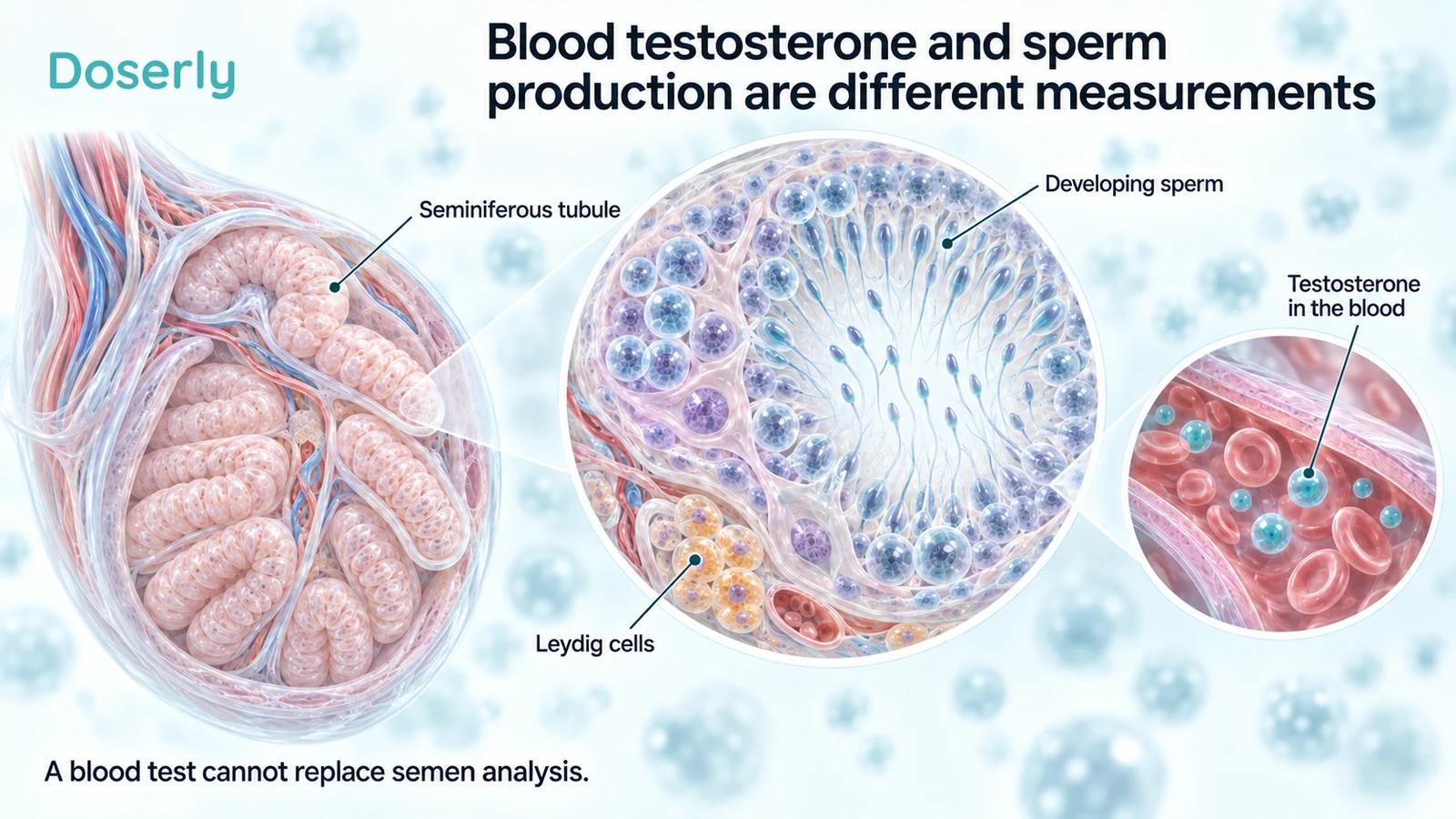
The practical implication is simple: the blood test used to monitor TRT and the semen analysis used to assess sperm answer different questions. Improvement in one cannot stand in for measurement of the other. Sexual desire and erection quality are also not substitutes for a sperm count.
“Maybe later” is a real reproductive plan
A useful discussion starts with intentions, not with a yes-or-no box marked “trying for a baby.” Are you hoping to conceive soon? Might you want children in several years? Have you completed your family? Are you undecided?
These answers can lead to different decisions. Someone trying now has little room for a treatment that may suppress sperm while a specialist later works to restore production. Someone considering children years from now has more time to discuss trade-offs, but also more opportunity for life plans to change.
The 2024 AUA/ASRM guideline's formal recommendation is to avoid prescribing exogenous testosterone to men interested in current or future fertility. Its discussion recognizes that treatment may still be considered for some people with more distant plans after counseling. That nuance does not turn fertility risk into a routine afterthought. It calls for an explicit decision about timing and uncertainty, particularly because recovery can take months and occasionally much longer. AUA/ASRM guideline
Write down the answer even if it is “I do not know yet.” Uncertainty is a reason to preserve a conversation, not evidence that fertility is unimportant.
Establish what is being treated
Low testosterone is a laboratory finding; hypogonadism is a clinical diagnosis that requires appropriate symptoms, consistently low measurements and investigation of the cause. Before selecting treatment, the clinician needs to understand whether the main problem is in the testes, in the signals reaching them, or related to potentially reversible circumstances.
LH and FSH help distinguish primary from secondary hypogonadism. That distinction matters for fertility as well as hormone treatment: stimulating the body's existing pathway requires enough function in the relevant organs to respond. Doserly's primary versus secondary hypogonadism guide explains the difference.
The evaluation may also uncover medication effects, systemic illness or another condition that changes the treatment discussion. A plan built around a single testosterone value risks missing both the diagnosis and the reproductive implications. Endocrine Society guideline
Bring previous test results and a complete medication history, including testosterone obtained elsewhere, anabolic steroids and supplements marketed for hormones. An accurate exposure history is useful clinical information. It should not be a test of whether someone has made perfect choices.
What a baseline semen analysis adds
A semen analysis examines the sample directly. It can describe sperm concentration, total number, movement and other characteristics. The WHO manual exists to standardize how laboratories perform and interpret this work, including monitoring during and after interventions that affect sperm production. WHO laboratory manual
Testing before TRT can reveal a problem that already exists. Without that baseline, a low count discovered later leaves two questions tangled together: what was present beforehand, and what changed with treatment?
A baseline is not a lifetime certificate of fertility. Semen measurements vary between samples, and an abnormal initial result often needs confirmation and specialist interpretation. Values above or below a reference limit do not by themselves guarantee conception or establish that conception is impossible. AUA/ASRM guideline
Ask whether testing would change the proposed plan, how to prepare for collection, and who will review the result. Follow the laboratory's collection instructions and report an incomplete collection or other problem. A test that is ordered but never reviewed does little to protect future choices.
Recovery estimates are not personal deadlines
One frequently cited analysis combined individual data from 30 hormonal male-contraception studies involving 1,549 healthy men with normal hormone function. The median time after treatment to recover a sperm concentration of 20 million per milliliter was 3.4 months. The modeled probability of reaching that threshold was 67% within six months and 90% within twelve months. Liu and colleagues
Those figures are reassuring about reversibility in the population studied. They are often stretched beyond what they establish.
The participants were healthy volunteers in contraception studies, not a representative group of older patients with underlying hypogonadism after many years of TRT. The outcome was a sperm concentration threshold, not a pregnancy or live birth. A median also means a substantial proportion took longer; it is not a date on which an individual can expect recovery.
A separate retrospective study followed 66 men with testosterone-associated infertility who stopped testosterone and received hCG plus a selective estrogen receptor modulator. Forty-six, about 70%, reached the study's total motile sperm-count threshold within twelve months. Older age and longer testosterone exposure were associated with slower recovery. This was a treated referral population, and its endpoint differed from the contraception analysis. Kohn and colleagues
Neither study supports promising “stop three months before trying and everything will be fine.” They support discussing lead time, the original diagnosis and a plan if recovery takes longer than hoped. They also explain why a low count after stopping should be assessed rather than interpreted as proof of permanent loss.
Sperm banking preserves a different option
Cryopreservation stores sperm collected now for possible future use. It does not keep the hormonal system functioning during TRT, but it may provide another route if later sperm production is inadequate or the timing of recovery is inconvenient.
The process involves collection, laboratory preparation and freezing with a protective medium. Samples can be divided into separate storage containers so that everything need not be thawed at once. Not every sperm survives freezing and thawing, and future use may require fertility treatment. HFEA sperm-freezing guidance
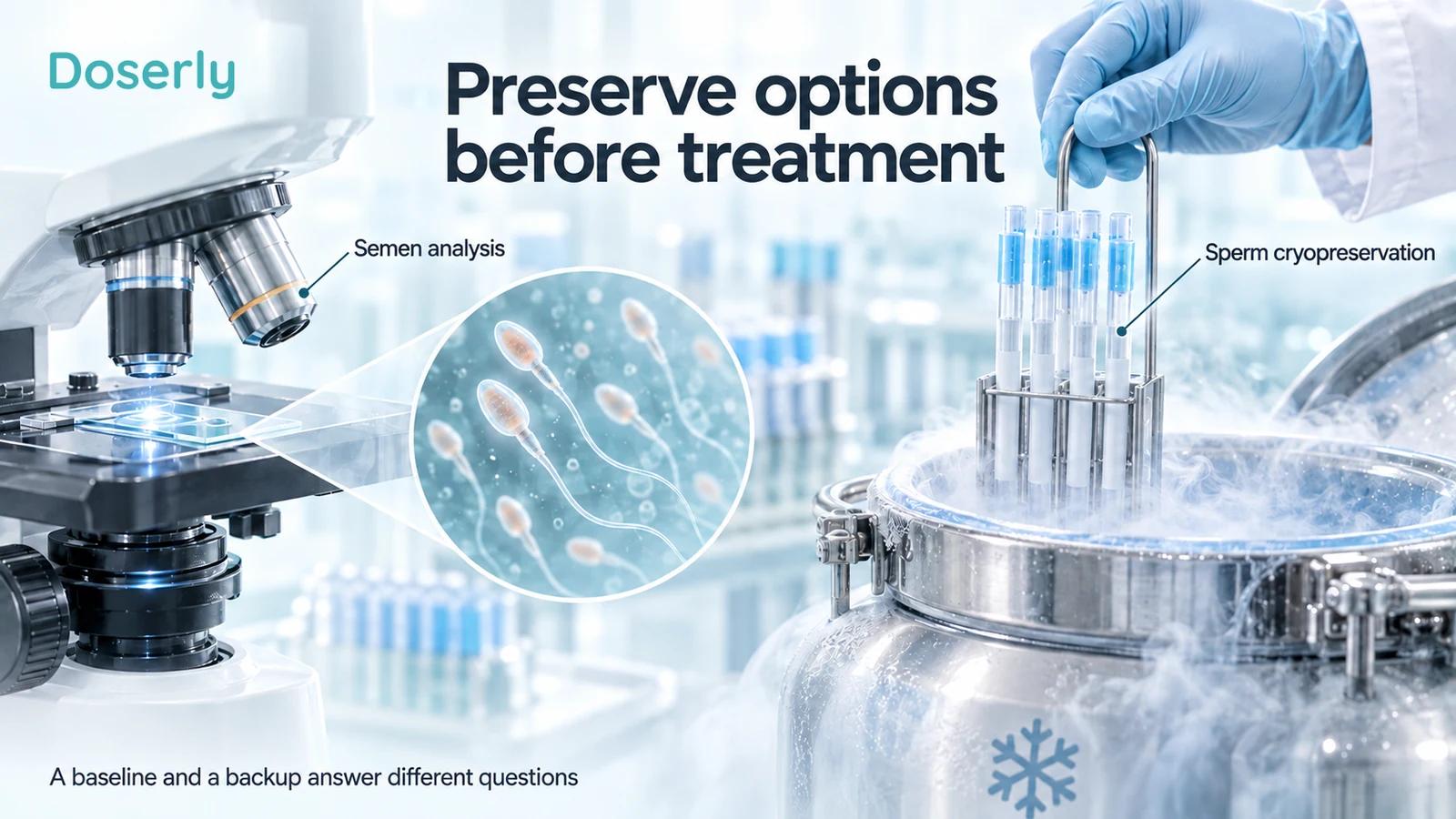
A clinic can explain whether more than one collection is sensible, what the stored sample might support, and what costs, consent and storage arrangements apply. These details vary by location and individual circumstances. Banking sperm is an option to discuss, not a universal requirement or a guarantee of a future child.
The question is whether preserving this option has enough value for you before a treatment that can change sperm production begins.
An add-on medication is not a fertility guarantee
hCG and other hormone treatments have legitimate roles in selected male-fertility problems. That does not mean adding a second prescription to TRT reliably solves the reproductive issue for everyone.
The AUA/ASRM guideline describes the evidence for preserving spermatogenesis with adjunctive medication during exogenous testosterone treatment as too limited to recommend the approach generally. It separately allows selected hormone-stimulating treatments for infertile men with low testosterone, with a conditional recommendation based on limited evidence. Those are different clinical situations. AUA/ASRM guideline
A meaningful plan needs an intended outcome and a way to measure it. Is the clinician trying to improve symptoms, increase blood testosterone, maintain sperm production, or help achieve pregnancy soon? Which test will show whether that goal is being met?
Doserly's TRT and fertility guide provides broader context. Medication selection and monitoring belong with a clinician who understands both hormone deficiency and reproductive medicine.
If treatment has already started
This conversation is still worth having. Gather the starting date, formulations, treatment changes, available hormone results and any previous semen analyses. Tell the prescriber how your reproductive plans have changed.
Do not assume that having started means all options are lost. Equally, do not assume that feeling well or continuing to ejaculate proves that sperm production is intact. A reproductive urologist can assess the current situation and coordinate a plan with the clinician managing testosterone.
Changing or stopping treatment can also bring back symptoms of the underlying condition. A fertility plan should account for that burden, rather than treating recovery as a purely numerical exercise. The stopping TRT guide explains why the original diagnosis and follow-up matter.
Keep a record that can travel with you
Fertility care may involve a primary-care clinician, endocrinologist, reproductive urologist and fertility laboratory. Keep copies of results with collection dates, laboratory names and the treatment being used at the time. A result labeled only “normal” loses information when another clinician needs to compare it with a later sample.
Record the agreed review point as well. “We will revisit this when you want children” can leave responsibility unclear. A specific follow-up plan makes it easier to reopen the conversation when a relationship, timeline or treatment changes. Tracking supports communication; it does not replace the laboratory or predict conception.
Make the first prescription part of a longer plan
Before treatment begins, aim to leave the appointment with clear answers to four practical questions:
- How does the proposed treatment fit my current or possible future plans for children?
- Would a semen analysis or reproductive-specialist consultation change the decision now?
- Is sperm cryopreservation worth considering in my circumstances?
- If my plans change, who will manage reassessment and what uncertainty should I expect?
If a partner is involved, their reproductive timeline belongs in the discussion too. Waiting for sperm recovery can affect another person's treatment choices and the time available for family building. The plan should reflect the people involved, not only the testosterone result.
You do not need to predict your entire future before accepting care. You do need enough information to understand which options a treatment may change. Bringing fertility into the first TRT conversation makes that choice more informed and leaves fewer surprises for later.
Sources
- Testosterone Therapy in Men With Hypogonadism: An Endocrine Society Clinical Practice Guideline
- AUA/ASRM Diagnosis and Treatment of Infertility in Men, amended 2024
- Liu et al. Recovery after hormonal male contraception
- Kohn et al. Age and duration of testosterone therapy predict sperm-count recovery
- Coviello et al. hCG and intratesticular testosterone during gonadotropin suppression
- WHO laboratory manual for human semen, sixth edition
- HFEA: Sperm freezing