
Peptides
October 16, 2026
CJC-1295 with ipamorelin: what the pairing theory actually shows
On this page
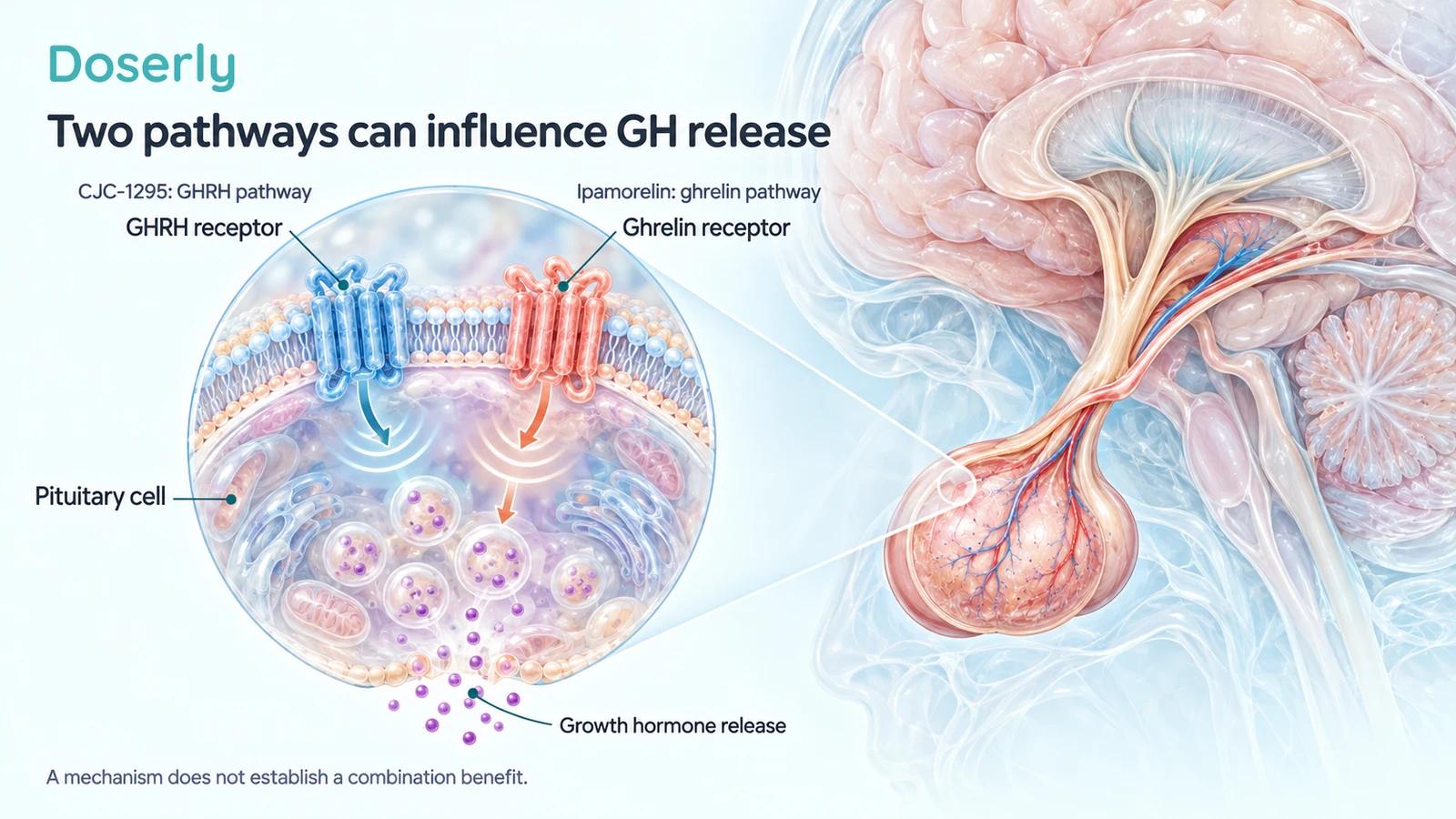
CJC-1295 and ipamorelin are often paired because they can influence growth hormone release through different receptor pathways. The idea is biologically plausible: stimulating two inputs to a hormone-producing system might produce a different response from stimulating either input alone.
For someone interested in sleep, recovery or body composition, however, the useful question is more demanding. Does the exact combination improve that outcome, and does its added benefit outweigh its added uncertainty? The primary studies reviewed here do not establish a clinical benefit for CJC-1295 plus ipamorelin.
There is genuine human research behind parts of the rationale. It includes studies of each compound separately and older experiments pairing other growth-hormone-releasing substances. The key is to keep those different interventions separate. Our CJC-1295 guide and ipamorelin guide explain each compound's development history.
Two receptor pathways, one hormone system
Growth-hormone-releasing hormone, or GHRH, normally helps signal the pituitary gland to release growth hormone, abbreviated GH. CJC-1295 is a synthetic GHRH analogue designed to act through this pathway. The original long-acting version includes an albumin-binding modification, commonly called DAC.
Ipamorelin belongs to a different family of GH secretagogues. A secretagogue stimulates secretion. Its development work identified activity through the GHRP-like pathway now associated with the ghrelin receptor. The original experiments used rat pituitary cells, rats and swine; they did not establish a human combination regimen. Raun and colleagues, 1998.
Different receptor inputs provide a reason to investigate an interaction. They do not guarantee that the interaction is large, useful, durable or safe. Both signals feed into a regulated biological system rather than two independent machines whose outputs can simply be added.
Where did the synergy idea come from?
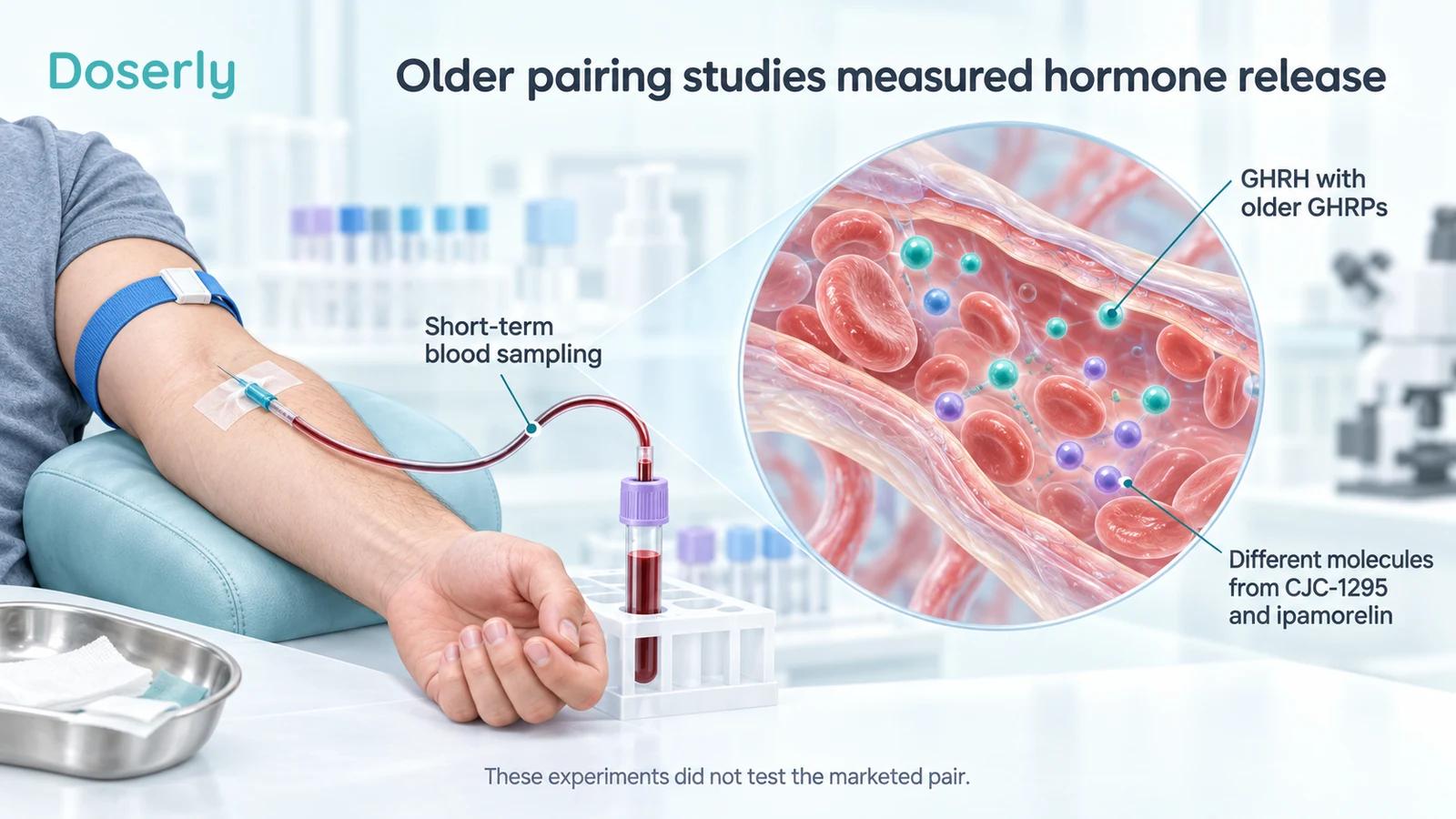
An early human experiment studied a synthetic GH-releasing hexapeptide, commonly identified as GHRP-6, and GHRH(1–44) in 18 healthy men. The compounds were given intravenously, separately and together, and researchers measured short-term hormone responses. At the tested submaximal GHRP exposures, combining the agents stimulated GH release synergistically. Original human pairing experiment, 1990.
That is evidence for an interaction under those experimental conditions. It helped show that GHRH and the other secretagogue could influence secretion through distinguishable mechanisms. It was not a trial of CJC-1295, ipamorelin, subcutaneous wellness use, or months of treatment.
The paper also measured other hormones. At the highest GHRP exposure, prolactin and cortisol increased, while some other hormone measurements did not. Those findings are another reason not to collapse all secretagogues into one category with identical effects. The specific substance and exposure matter.
A pathway concept can travel from one experiment to the next as a hypothesis. The actual efficacy and safety results remain attached to the intervention that generated them.
A larger response is not always synergy
A later study tested GHRH(1–29) and GHRP-2 in eight healthy, non-obese men aged 25–34. Each participant underwent the separate and combined intravenous challenges in randomized order. Researchers collected blood over two hours and compared GH responses. GHRH/GHRP-2 experiment, 1995.
The combined response exceeded the response to GHRP-2 alone on the reported area-under-the-curve measure, which summarizes hormone concentration over time. However, it was not significantly different from the sum of the individual responses. The authors therefore did not demonstrate synergy in that experiment.
That distinction is easy to lose in a summary. “More than either alone” is not necessarily “more than expected from the components.” A combination can produce an additive effect without a special interaction beyond that expectation.
The older experiments do not contradict one another merely because their conclusions differ. They tested different molecules, exposures and conditions. Together, they show why synergy is something to measure, not a property that can be assigned to every pair acting on these pathways.
What did CJC-1295 itself show in people?
Teichman and colleagues studied the long-acting molecule in two blinded, placebo-controlled pharmacology trials in healthy adults. Study periods were 28 and 49 days. The investigators measured drug exposure and GH and insulin-like growth factor 1, or IGF-1, responses. Teichman and colleagues, 2006.
After a single injection, mean GH increased approximately 2- to 10-fold for at least six days, while mean IGF-1 increased approximately 1.5- to 3-fold for nine to eleven days. The reported drug half-life was 5.8–8.1 days. These are findings about sustained biological activity.
They do not establish what adding ipamorelin would do. The combination might alter the hormone pattern, have little additional effect, or create unwanted effects without sufficient benefit. None of those possibilities can be settled by placing the CJC-1295 result next to a separate ipamorelin paper.
The original CJC-1295 trials also did not demonstrate the commonly discussed goals of improved sleep, strength or injury recovery. A larger response in a blood marker would still leave those goals to be tested directly.
What did ipamorelin itself show in people?
Gobburu and colleagues examined intravenous ipamorelin in healthy male volunteers, using five escalating infusion levels with eight participants at each level. The study measured the drug and GH over time. It found approximately dose-proportional exposure, a terminal drug half-life near two hours and a GH peak around 0.67 hours. Human ipamorelin pharmacology, 1999.
That provides useful information about a short intravenous exposure. It does not define a chronic subcutaneous schedule or show that timing it alongside another peptide improves a health outcome. The variability in hormone response was also greater than the variability in drug-exposure parameters, cautioning against assuming identical responses across people.
Ipamorelin later reached a clinical trial for postoperative ileus, a delay in return of bowel function after surgery. In the published randomized study, 117 patients were enrolled and 114 contributed to the safety and modified intention-to-treat populations. Intravenous ipamorelin did not significantly improve the key or secondary efficacy outcomes versus placebo. Beck and colleagues, 2014.
This was a real clinical test, but it concerned gastrointestinal recovery in surgical patients. It was not a test of body composition or the CJC-1295 pair. Its existence should neither be hidden nor repurposed as proof of an unrelated wellness benefit.
Which CJC-1295 is being paired?
The name adds another layer of uncertainty. A marketed combination may describe its CJC component as no DAC, often associated with the name modified GRF(1–29). The sustained human results above concern the DAC-containing investigational molecule.
FDA's review distinguishes the DAC and non-DAC active moieties and identifies incomplete chemical characterization in the literature and nomination material. It does not treat them as interchangeable. FDA CJC-1295 briefing.
Consequently, a claim about the pair needs to identify its actual CJC substance before anyone can compare it with a study. Merely writing “CJC-1295 and ipamorelin” does not resolve the formulation, route or exposure. A fixed-ratio blend also restricts the ability to vary one component independently of the other, which matters when studying contribution or tolerability.
Product naming is therefore part of the scientific question, not an administrative detail added after the biology has been settled.
What would a useful combination trial compare?
For the exact pair, researchers would need a defined population and a meaningful outcome. A study of patients with a diagnosed endocrine disorder would answer a different question from a study of healthy recreational athletes or people reporting nonspecific fatigue.
To identify each component's contribution, a trial could include CJC-1295 alone, ipamorelin alone, the combination and a suitable control, with otherwise comparable care. This is an illustrative research design, not a self-experiment or recommended schedule. FDA's combination-development guidance describes why individual contributions matter when new investigational drugs are developed together. FDA combination guidance.
The control arms also matter when interpreting a disappointing result. If the combination improves an outcome but performs no better than one component alone, the second ingredient has not demonstrated added benefit. If both components change together, their individual contributions remain difficult to identify even when the final result looks favorable.
The study would need to measure the promised benefit, not select whichever hormone feature looks most favorable afterward. Higher peak GH, more total GH exposure and longer elevation are different measurements. None automatically establishes better function.
For example, if the aim were improved physical recovery, investigators would need to define recovery in advance: return to a specified activity, symptom improvement or another relevant measure. Background rehabilitation, exercise and other treatment would need to be accounted for. A hormone result could help explain the response but would not replace the outcome.
Safety needs a combination answer too
Ipamorelin is often described as selective because of its early animal hormone comparisons. In the swine experiments, its ACTH and cortisol responses differed from some older secretagogues. That does not establish freedom from adverse effects in humans, especially during prolonged use or combination exposure. Original ipamorelin pharmacology.
FDA's current compounding-risk information raises characterization and immunogenicity concerns for these substances. It identifies increased heart rate and systemic vasodilatory reactions associated with CJC-1295. For ipamorelin, it cites serious events, including death, in intravenous gastric-motility research and insufficient information about certain other injectable routes. FDA risk information.
Those statements do not prove that the drugs caused every reported event or quantify the risk of a particular blend. They also do not support declaring a combination safe because its components act through different receptors. Different pathways can still converge on shared downstream effects.
A well-designed combination program would track adverse events, reasons for discontinuation, relevant clinical measurements and what happens after treatment ends. Tolerability during a brief single-compound study cannot supply all of that information.
What can a personal record contribute?
If a person starts both compounds and later notices better sleep or a change in training, the timing is worth documenting. It does not identify which component mattered, whether their interaction helped, or whether another change explains the result.
A useful record preserves dates, exact product descriptions, other medicines, symptoms and any relevant clinical measurements. It gives a clinician a more accurate history. It should not be used to retroactively prove synergy or to turn an untested schedule into a validated protocol.
The same principle applies when nothing seems to happen. A lack of perceived benefit does not reveal whether the issue was the proposed mechanism, actual exposure, product identity or the outcome being assessed. Controlled research is designed to separate these questions more reliably.
The question to ask about the pair
Rather than asking whether the mechanisms “work together,” ask what the exact combination has been shown to improve in people like you, compared with each component or appropriate care. Then ask what safety information exists for that formulation and duration.
The biology makes the pairing a research hypothesis. The older human experiments show that receptor-pathway interactions are real and context dependent. The separate drug studies show hormone responses and, for ipamorelin, a clinical trial in a different setting. None of these pieces establishes the marketed pair's benefit by itself.
A direct combination trial could change that conclusion. Until then, the distinction between a plausible interaction and a demonstrated patient benefit should remain visible in every claim about CJC-1295 with ipamorelin.
Explore the research
- Raun et al., 1998: ipamorelin's preclinical receptor and hormone-selectivity work.
- GHRH/GHRP human pairing study, 1990: synergy under specific acute conditions with different compounds.
- GHRH/GHRP-2 study, 1995: larger combined response without demonstrated synergy.
- Teichman et al., 2006: long-acting CJC-1295 alone.
- Gobburu et al., 1999: intravenous ipamorelin alone.
- Beck et al., 2014: postoperative gastrointestinal trial.
- FDA CJC-1295 briefing: molecule and formulation distinctions.
- FDA combination-development guidance: individual-component contribution.
- FDA risk information: safety signals and data gaps.