
Peptides
October 16, 2026
What cagrilintide-alone research adds to the combination story
On this page
CagriSema attracts attention because it combines cagrilintide with semaglutide. That attention can leave an important question unanswered: what does cagrilintide actually contribute? If a study only compares the combination with placebo, it cannot separate the ingredients. A substantial combination result does not establish that each component would have produced the same benefit alone.
The standalone evidence matters because it shows that cagrilintide has measurable activity without semaglutide. It also puts boundaries around what that activity means. Weight reduction, blood-glucose control, tolerability and cardiac electrical measurements are different outcomes. A favorable result in one does not settle the others.
The most useful reading follows the single-agent arms across trials, while keeping their populations, duration and analysis methods attached to the results. This is a guide to that evidence—not a plan for obtaining or using an investigational medicine.
The first question: does cagrilintide work without semaglutide?
The 2021 phase 2 dose-finding study directly addressed this. It randomized 706 adults with overweight or obesity, without diabetes, to several cagrilintide groups, liraglutide or placebo. Treatment lasted 26 weeks, followed by an off-treatment observation period. Across the cagrilintide groups, estimated mean weight reduction ranged from 6.0% to 10.8%, compared with 3.0% for placebo. These were trial-product estimates, using the trial’s specified assumptions about treatment adherence. Cagrilintide phase 2 trial
That finding answers a narrower and more defensible question than “how much weight will someone lose?” It shows that, in a randomized study under the tested conditions, cagrilintide could produce greater average weight reduction than placebo without a GLP-1 medicine alongside it. Randomization makes that comparison more informative than a collection of before-and-after experiences.
It does not establish that the largest tested group average is a universal expectation. The participants had eligibility criteria, follow-up and a defined intervention. Nor does a dose-finding study identify a suitable regimen for someone outside research. Its purpose is partly to help choose what to investigate next, balancing activity against tolerability.
There is also a common attribution error to avoid. A paper can report a total number of people who stopped treatment across every randomized group. That total should not be relabeled as the discontinuation rate of cagrilintide alone. The denominator and the treatment assignment belong with every safety percentage.
An active comparator answers a different question from placebo
The early study also included liraglutide, an established GLP-1 receptor agonist. Its highest cagrilintide group had a larger mean weight reduction than the liraglutide group under the tested conditions. That adds context beyond demonstrating a difference from placebo. It does not establish superiority to every GLP-1-based medicine, particularly medicines and regimens that were not compared.
The study's masking also deserves attention: participants and investigators were masked to active treatment versus placebo within the relevant groups, but not to the different active treatments. This does not erase the randomized result; it is a design feature to retain when interpreting an active-treatment comparison. The finding belongs to that study's duration, population and analysis rather than a permanent league table of medicines. Primary phase 2 trial
What the single-agent arms add to REDEFINE 1
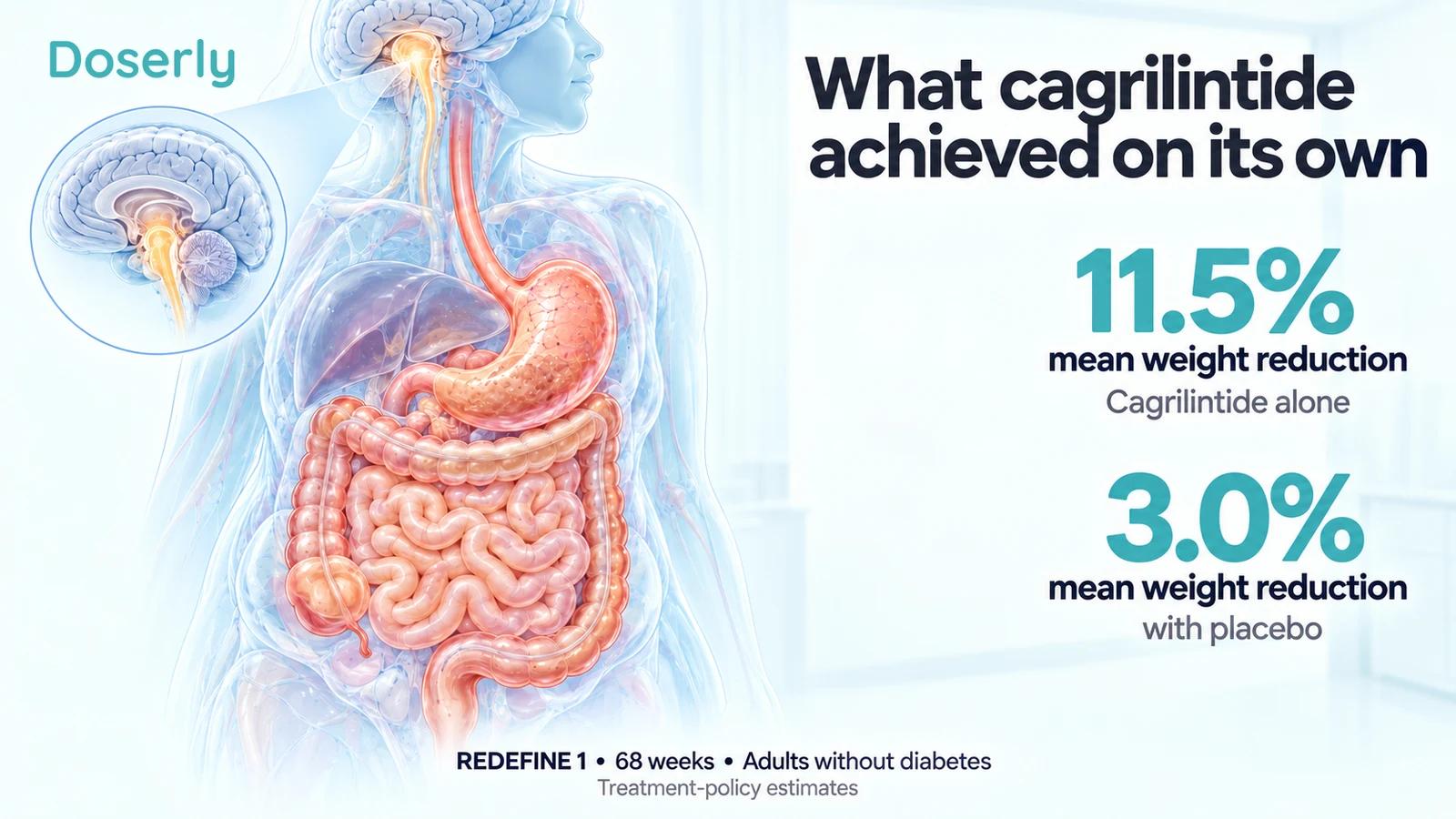
REDEFINE 1 included four randomized groups: the combination, semaglutide alone, cagrilintide alone and placebo. That design allows a more useful comparison than placing unrelated trial headlines side by side. At 68 weeks, treatment-policy estimates of mean weight reduction were 20.4%, 14.9%, 11.5% and 3.0%, respectively. The trial enrolled adults with overweight or obesity without diabetes. REDEFINE 1 primary report
The cagrilintide arm therefore contributes two pieces of information. It supports standalone activity, and it helps show how the combination performed relative to either ingredient within the same study. The combination’s result belongs to the combined intervention. It should not be described as “cagrilintide weight loss” with semaglutide quietly omitted.
The numbers are not ingredients in an addition problem. Adding 14.9% and 11.5% does not predict the combination’s result. Both interventions act within the same person, whose intake, body weight and physiological responses change over time. Shared downstream effects, tolerability and treatment exposure also matter. A randomized comparison of the actual combination is the relevant evidence.
Similarly, subtracting the two group means gives a descriptive difference, not a guaranteed personal bonus from adding a drug. A person who has already used a treatment for months is in a different situation from a participant assigned to an intervention at the start of a trial. The history of treatment and the reason for considering a change can affect how applicable the study is.
Why 11.5% and 11.8% can both describe the cagrilintide arm
A trial result depends on the question being estimated. REDEFINE 1 also reported a trial-product estimate of 11.8% weight reduction for cagrilintide alone. The treatment-policy figure was 11.5%. These are different analyses of the same randomized arm, not evidence of two separate populations receiving different versions of the medicine.
A treatment-policy question includes the consequences of treatment discontinuation and other specified events. A trial-product question estimates an outcome under assumptions about remaining on assigned treatment and avoiding specified additional interventions. Both can be useful, but they are not interchangeable. ICH E9(R1) estimand guidance
For a reader, the practical habit is simple: copy the analysis label along with the percentage. Do the same for the comparator, follow-up time and population. That small amount of context prevents a frequent mistake—using an adherence-assuming result from one treatment against a treatment-policy result from another and calling the difference a fair comparison.
The modest gap between two estimates in one arm also does not prove that adherence never matters for that medicine. It describes this dataset and these assumptions. Missing observations, treatment changes and statistical models need to be evaluated in the study in which they occurred.
Weight loss and glucose control are separate tests
A 2023 phase 2 study in 92 people with type 2 diabetes compared CagriSema with its individual components over 32 weeks. Mean weight reduction was 15.6% with the combination, 5.1% with semaglutide and 8.1% with cagrilintide. But the ordering for HbA1c change differed: reductions were 2.2, 1.8 and 0.9 percentage points, respectively. Type 2 diabetes phase 2 trial
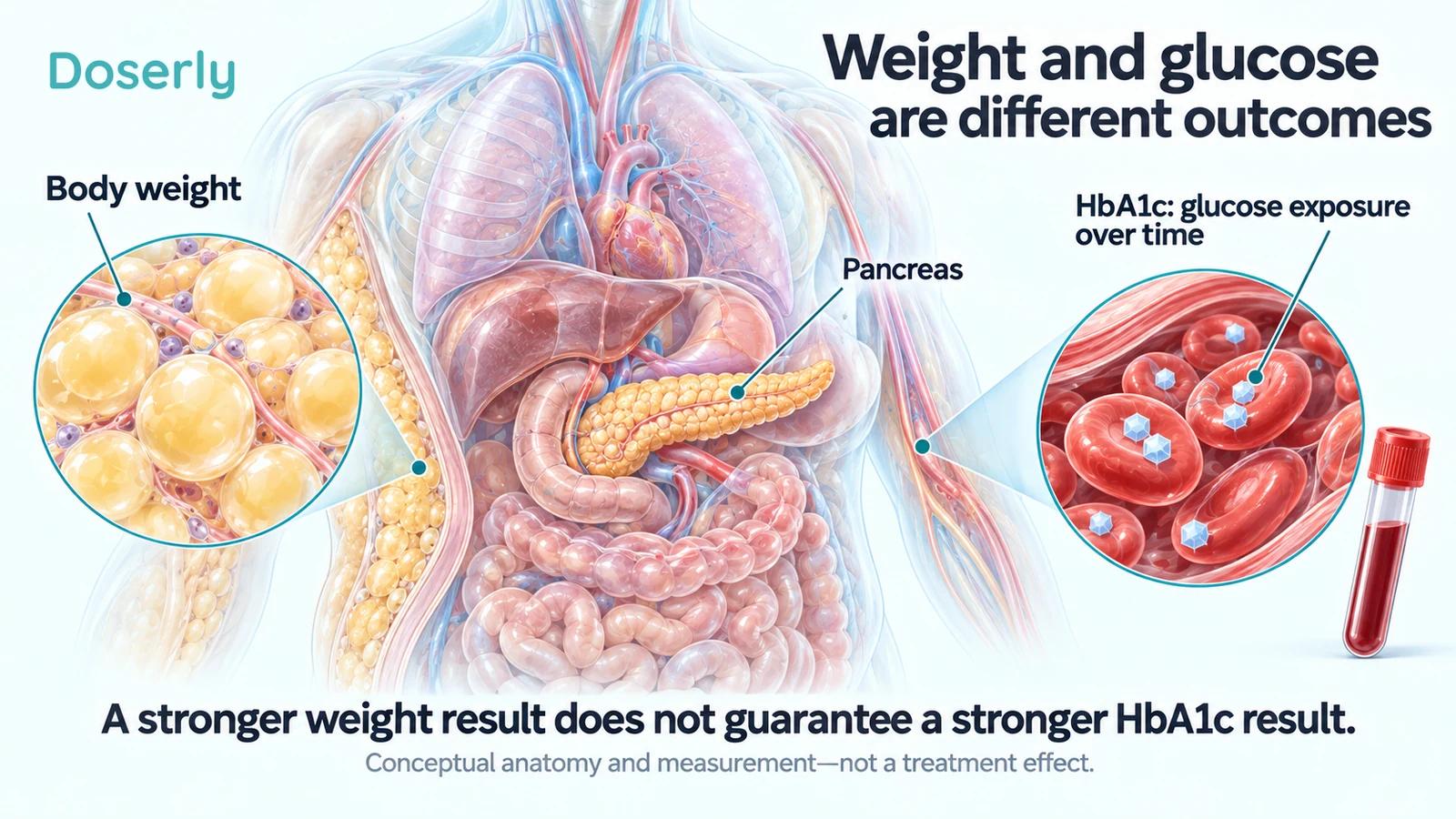
That contrast is valuable. Cagrilintide’s larger mean weight reduction than semaglutide in this small study did not mean it produced the larger HbA1c reduction. A weight endpoint cannot substitute for a glucose endpoint.
HbA1c reflects glucose attached to hemoglobin in red blood cells and gives information about average glucose exposure over roughly three months. It is not a measure of appetite or body fat. Conditions affecting red blood cells or hemoglobin can also complicate its interpretation. NIDDK explanation of HbA1c
The combination-versus-semaglutide HbA1c comparison in the small phase 2 study was not statistically significant at the conventional 0.05 threshold: the reported p value was 0.075. That does not prove the two treatments have identical glucose effects. It means this experiment did not establish that particular difference with the chosen statistical standard. A small study can leave a clinically relevant question unresolved.
Larger and newer evidence can change the answer
The 2026 REIMAGINE 2 publication reported a much larger randomized trial in people with type 2 diabetes. It included 2,713 participants across several groups, including 152 assigned to cagrilintide alone. Its primary comparison concerned HbA1c change with CagriSema versus semaglutide at 68 weeks.
Under the efficacy estimand, HbA1c reductions were 1.91 and 1.75 percentage points, respectively; the estimated difference was 0.16 percentage points in favor of the combination and was statistically significant. REIMAGINE 2 primary abstract
This illustrates why “not significant in an early trial” should not become “proven to have no additional effect.” A later, larger study can estimate a difference more precisely. It also illustrates why statistical significance is only part of interpretation: the size of the difference, baseline glucose, other outcomes and treatment burden still matter.
The presence of a cagrilintide arm does not mean every result for that arm appears in an abstract. When a report foregrounds the primary combination comparison, the responsible response is to obtain the relevant component analysis—not infer its numerical result from the other arms. The published record also links a correction, another reason to use the current primary record rather than an old promotional summary.
Safety findings have their own scope
Standalone research can help separate safety observations that might otherwise be attributed to the combination as a whole. Gastrointestinal events were common in the early cagrilintide study, including nausea. This means semaglutide is not necessary for gastrointestinal symptoms to occur during cagrilintide treatment. It does not establish that every symptom in a combination trial came from cagrilintide.
A different standalone experiment examined cardiac repolarization: the electrical recovery phase measured through the corrected QT interval. In 105 healthy participants, the thorough-QT study did not find clinically relevant QTcF prolongation under its tested conditions. Cagrilintide thorough-QT study
That is useful, specific reassurance about a drug-development safety question. It is not a cardiovascular outcomes trial. It cannot establish prevention of heart attacks, strokes or cardiovascular death, and it should not be rewritten as proof that every possible heart-related risk has been excluded.
The distinction matters whenever a reassuring headline sounds broader than its measurement. “No concerning change in this electrical endpoint” and “improves long-term cardiovascular health” require different study designs, participants and follow-up.
What monotherapy research still cannot tell a particular person
Even a consistent standalone effect leaves several personal questions open. Will a person tolerate the intervention? How much benefit will persist? Will an improvement in one outcome translate into a meaningful improvement in daily function? Does their medical history resemble the population studied?
Averages cannot answer those questions individually. Nor can a person identify the active ingredient responsible for a change by adding or removing several things at once outside a controlled study. Symptoms, eating patterns, concurrent treatments and measurement variability can move together.
There is a second boundary between evidence for a manufactured trial product and evidence for something offered online under the same name. The FDA’s current discussion of unapproved GLP-1-related products specifically includes cagrilintide and states that it is not a component of an FDA-approved drug. Clinical trial results do not establish the identity, strength or quality of an independently purchased product. FDA statement on unapproved products
For a clinical discussion, it is more useful to name the outcome you care about than to chase the biggest percentage. Weight trajectory, glucose results, tolerability, nutrition and ability to remain on an appropriate treatment all describe different parts of the decision. A dated record of these observations can support that discussion; it cannot turn an untested intervention into a validated one.
Our cagrilintide guide provides broader context, while the semaglutide guide explains the other component of CagriSema. The standalone studies earn cagrilintide a place in the scientific story. They do not allow the combination’s results, or another person’s experience, to become a personalized promise.
Sources
- Once-weekly cagrilintide for weight management in people with overweight and obesity: a multicentre, randomised, double-blind, placebo-controlled and active-controlled, dose-finding phase 2 trial, 2021.
- Coadministered Cagrilintide and Semaglutide in Adults with Overweight or Obesity, 2025.
- Efficacy and safety of co-administered once-weekly cagrilintide 2·4 mg with once-weekly semaglutide 2·4 mg in type 2 diabetes: a multicentre, randomised, double-blind, active-controlled, phase 2 trial, 2023.
- Cagrilintide-semaglutide versus semaglutide or cagrilintide in people with type 2 diabetes: REIMAGINE 2, 2026.
- E9(R1) Statistical Principles for Clinical Trials: Addendum: Estimands and Sensitivity Analysis in Clinical Trials, 2021.
- The A1C Test & Diabetes, 2026.
- Cagrilintide is not associated with clinically relevant QTc prolongation: A thorough QT study in healthy participants, 2024.
- FDA’s Concerns with Unapproved GLP-1 Drugs Used for Weight Loss, 2026.