
TRT
October 16, 2026
Weight loss and testosterone: when a new baseline changes the conversation
On this page
Testosterone results can change when body weight changes. That is especially relevant for men whose low result was measured during a period of obesity, poor sleep or worsening metabolic health. After substantial weight loss, an old blood test may no longer describe the same situation.
This does not mean that every man with obesity has a reversible hormone problem, or that weight loss makes testosterone treatment unnecessary for everyone. The useful question is more specific: was the original low result partly related to a health condition that has changed, and how should that change be reassessed?
Human studies show that weight reduction can accompany increases in testosterone. They also show why a single number is an incomplete answer. Total testosterone, free testosterone, symptoms and fertility can move differently. Understanding those differences helps you discuss a new baseline without assuming that a better laboratory result proves complete recovery.
Why body weight can affect a testosterone result
Most testosterone in blood travels attached to proteins. One is sex hormone-binding globulin, or SHBG, which is produced by the liver. A smaller fraction circulates unbound, called free testosterone. A total testosterone test counts both the bound and unbound hormone.
Obesity and insulin resistance often occur with lower SHBG. This can lower total testosterone even when the free fraction is not equally reduced. In other people, particularly with more severe obesity, hormone production itself is also affected. A low total result therefore needs interpretation alongside symptoms and, when appropriate, SHBG and a reliable free-testosterone assessment. The European Society of Endocrinology specifically discusses this problem in its guideline on endocrine evaluation in obesity.
An increase in total testosterone after weight loss can consequently reflect more than one change. The body may be producing more testosterone, more hormone may be circulating bound to SHBG, or both may be happening. That is why two apparently conflicting statements can both be true: the total level improved substantially, and the change in free testosterone was smaller.
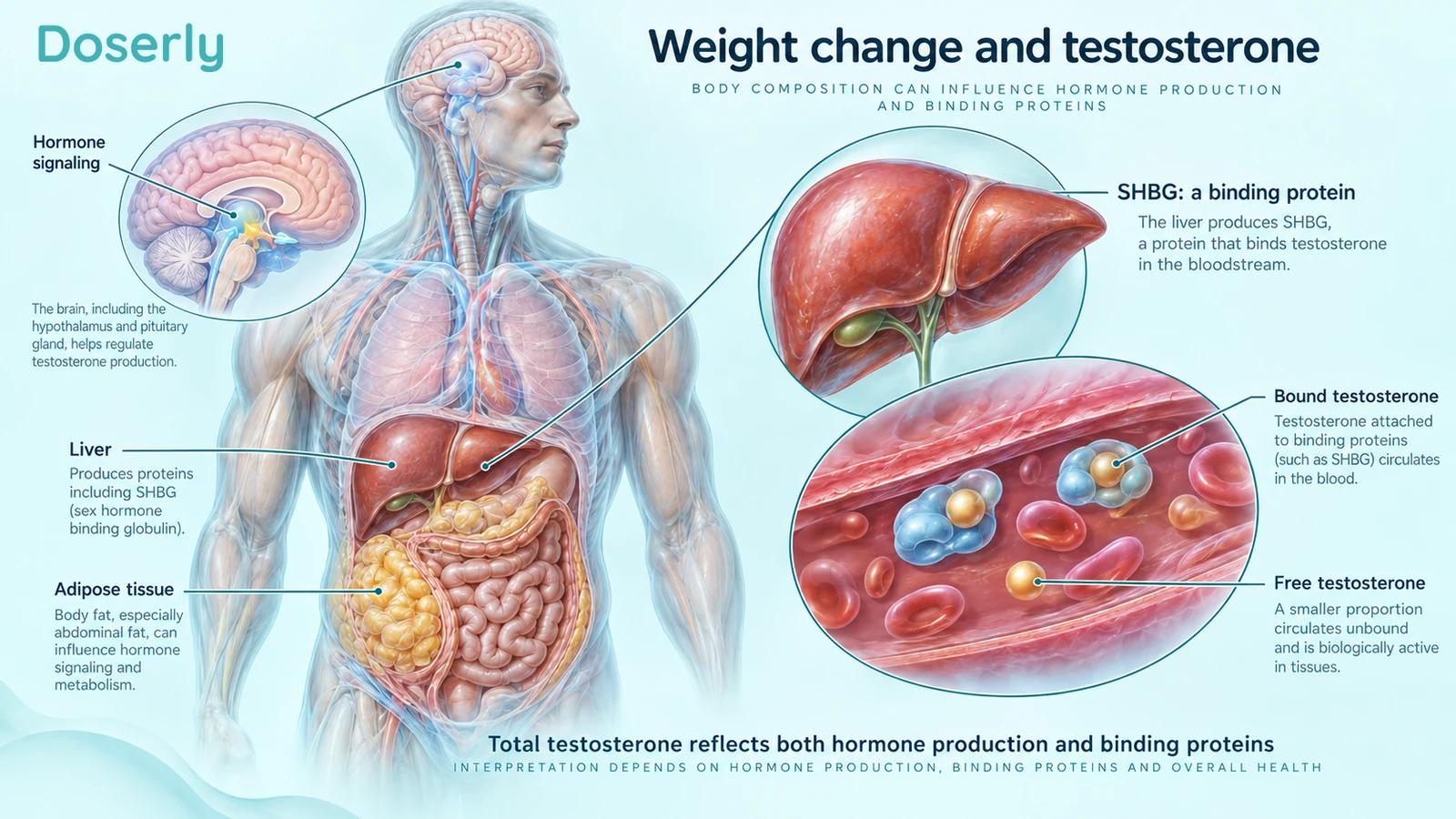
Conceptual anatomy explains why total testosterone depends on binding proteins as well as hormone production. The enlarged shapes represent bound and free hormone; they are not molecular structures or measured concentrations.
What does long-term observational research show?
The European Male Ageing Study followed community-dwelling men aged 40–79 across eight European centres. Paired testosterone results were available for 2,395 participants, with follow-up about 4.4 years later. Weight loss was associated with increases in testosterone and SHBG; weight gain was associated with decreases. Camacho and colleagues, 2013.
This is useful evidence that adult hormone levels are not fixed independently of changing health. It is also observational evidence. Participants were not randomly assigned to lose a specified amount of weight while every other aspect of life stayed the same. Illness, activity, medicines and other changes can accompany a changing waistline.
For an individual, the study supports reassessment rather than a numerical promise. It cannot tell you that losing a particular number of kilograms will raise your testosterone by a particular amount. Nor does it establish that everyone whose level rises will experience better sexual function or energy. Those are separate outcomes that need to be assessed in their own right.
Can lifestyle treatment change hormones without TRT?
A smaller study followed 58 men with abdominal obesity and metabolic syndrome through rapid weight loss and a period of weight maintenance. It measured testosterone and binding proteins rather than assuming that the scale alone captured the hormonal response. Its design matters because measurements during active restriction and after maintenance address different phases of treatment. Niskanen and colleagues, 2004.
The practical lesson is to describe the context of each blood draw. A result taken while weight is changing quickly is not necessarily the same baseline as a result after a sustained change in health and routine. Your clinician can decide when repeat testing would be informative, taking account of symptoms, the pace of weight change and any intercurrent illness.
Lifestyle care also has goals beyond testosterone. Someone may want better stamina, easier movement, improved glucose management or more restful sleep. Those changes are worth recording directly. If walking becomes easier while testosterone barely changes, the improvement is still meaningful. If testosterone increases but fatigue persists, that is a reason to investigate the fatigue rather than dismiss it because one laboratory number improved.
The Doserly guide to natural testosterone optimization provides broader background on potentially modifiable contributors. It is best used to prepare questions about your circumstances, rather than to build a supplement regimen around a target testosterone number.
What has a weight-loss medicine study found?
A 2019 trial compared liraglutide with testosterone gel in 30 men with obesity-associated functional hypogonadism who had responded poorly to lifestyle measures. It lasted 16 weeks and was randomized but open-label: participants and clinicians knew which treatment was being used. Mean baseline age was approximately 46.5 years and mean BMI approximately 41.2 kg/m². Jensterle and colleagues.
Average weight loss was 7.9 kg with liraglutide and 0.9 kg with testosterone. Total testosterone increased in both groups, by approximately 2.6 nmol/L and 5.9 nmol/L, respectively. LH and FSH, the pituitary hormones involved in reproductive signaling, increased with liraglutide. The study also reported improved sexual function.
This offers a human example of treating obesity while observing a hormonal change. It does not prove that every GLP-1 medicine has the same effect, that the effect is independent of weight loss, or that liraglutide replaces TRT in men with permanent testicular disease. Thirty participants and four months of observation cannot establish long-term reproductive or cardiovascular outcomes.
It is also important to separate the question being studied from a prescribing recommendation. The trial compared two interventions in a selected group; it did not test a general rule that anyone with a low testosterone result should receive a weight-loss medicine. Treatment selection depends on the person's obesity-related needs and the cause of the hormone finding.
Why surgery studies help explain the binding-protein issue
A prospective study followed 29 men with severe obesity after gastric bypass or sleeve gastrectomy. Their average BMI was about 56.8 kg/m². Total testosterone and SHBG increased at one month, while calculated free testosterone showed improvement at six months. At six months, 22 participants had testosterone measurements classified as normalized by the investigators. Boonchaya-anant and colleagues, 2016.
The differing timing is informative: an early total-testosterone change need not mean that every part of reproductive physiology has already recovered. The study was small and did not randomly compare surgery with another approach. Its population also had much more severe obesity than many readers.
Surgery changes food intake, weight and metabolic physiology together. These findings cannot isolate one mechanism, and they do not establish surgery as treatment for an isolated low testosterone result. They show why a clinician may interpret serial total and free measurements differently as a person's health changes.
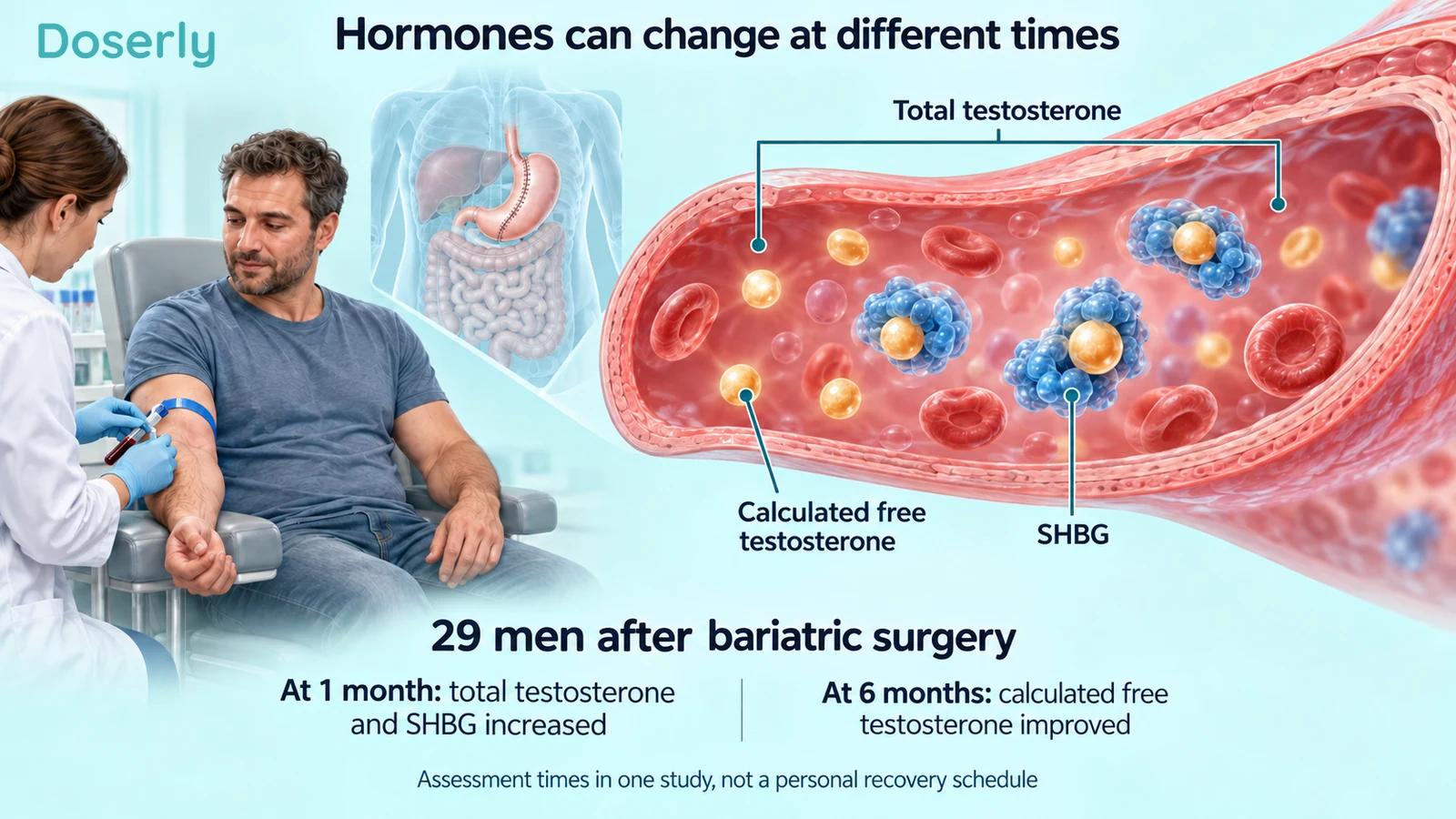
In the 29-person surgery cohort, total testosterone and SHBG increased at one month; improvement in calculated free testosterone was observed at six months. These are study assessment times, not a promised recovery schedule. Study source.
A better testosterone result is not a fertility test
Testosterone production and sperm production are related but distinct functions. If pregnancy is a goal, a reassuring testosterone result does not establish that sperm concentration, movement or other semen parameters have recovered.
A prospective bariatric-surgery study examined both androgen measurements and semen. It reported increasing testosterone over time without corresponding improvement across semen measurements. The small study illustrates why reproductive outcomes should be measured directly rather than inferred from blood testosterone. Legro and colleagues.
That distinction matters even more for someone already using testosterone treatment. Exogenous testosterone can suppress the pituitary signals supporting sperm production. Weight loss does not remove that treatment effect automatically. Tell the clinician about reproductive plans before changing a hormone prescription; a fertility assessment asks questions that a routine TRT laboratory panel does not answer.
What if the original diagnosis was permanent hypogonadism?
Weight loss cannot be assumed to reverse a testicular injury, genetic condition or structural pituitary problem. A man can have obesity and a separate endocrine disease at the same time. Improvement in one does not erase the other.
Primary hypogonadism means the main limitation is in the testes. Secondary hypogonadism involves inadequate hypothalamic or pituitary signaling. LH and FSH help distinguish those patterns, although medicines and existing testosterone treatment can alter their interpretation. A diagnosis of functional hypogonadism requires considering and excluding relevant organic causes. European Academy of Andrology guidance.
This is why the original records are so valuable. Two low morning measurements obtained before treatment, the associated symptoms, LH and FSH, and the clinical explanation are more informative than remembering that a result was “low.” If those records are missing, a clinician may need to reconstruct the history rather than assume that weight was the entire cause.
Our guide to secondary hypogonadism explains the diagnostic distinction in more detail. Reassessment is particularly useful when the original explanation was potentially reversible, but it should remain sensitive to findings that point elsewhere.
How reassessment differs if you already take TRT
For someone who has not started hormone treatment, repeat testing can assess their current untreated physiology. For someone taking testosterone, a blood result reflects the medication as well as the body. A normal value on treatment does not establish what the untreated level would be after weight loss.
Do not interpret a missed injection or a few days without gel as a clean diagnostic experiment. Different products persist for different lengths of time, and suppression of hormone signaling can outlast the most obvious drug exposure. Whether a supervised reassessment is appropriate depends on why treatment began and what question the clinician needs to answer.
The Endocrine Society recommends diagnosing hypogonadism from compatible symptoms together with consistently low testosterone, confirming a low morning result and investigating the cause. That principle is equally helpful when reviewing an old diagnosis after a substantial health change. Diagnostic guideline.
What to bring to the next appointment
Bring dated information that helps the clinician compare like with like. Include your earlier laboratory reports, changes in weight, current medicines, sleep changes and the symptoms that originally led to testing. Note whether a blood sample was taken while taking testosterone and, if so, the formulation and timing relative to treatment.
Choose a few outcomes that matter to you. For example, describe whether sexual desire changed, whether morning erections returned, whether fatigue is better and whether exercise tolerance improved. These observations are more useful than simply writing that you feel “optimized.” They can also reveal a mismatch between the laboratory trend and the problem you hoped treatment would solve.
The questions can stay straightforward: What did we think caused the low result originally? Has enough changed to justify reassessment? Which measurements would clarify production versus binding? If results remain low, what other explanations need attention? If they improve, what symptoms still need their own evaluation?
Substantial weight loss can create a meaningful new baseline. The benefit of recognizing it is a more accurate picture of your current health and a treatment discussion grounded in that picture. It does not require treating every low result as permanent or every improvement as proof that endocrine care is finished.
Sources
- Camacho et al., European Male Ageing Study, 2013: longitudinal weight and hormone associations.
- Niskanen et al., 2004: weight loss, maintenance and hormone measurements.
- Jensterle et al., 2019: small randomized open-label liraglutide versus testosterone study.
- Boonchaya-anant et al., 2016: prospective bariatric-surgery hormone measurements.
- Legro et al., 2015: androgen and semen outcomes after surgery.
- European Society of Endocrinology, 2020: endocrine evaluation in obesity.
- European Academy of Andrology, 2020: functional hypogonadism evaluation.
- Endocrine Society, 2018: diagnosis and treatment principles.