
Supplements
October 16, 2026
Vitamin D2 versus D3: the blood test is only part of the choice
On this page
Vitamin D3 generally raises and maintains the usual blood marker of vitamin D status more effectively than vitamin D2. That is a useful difference. It does not mean D2 is inactive, that every D2 prescription should be replaced, or that a larger laboratory increase automatically produces better health. NIH vitamin D fact sheet
The comparison becomes especially confusing when a study measures only the D3-derived portion of that blood marker. A fall in one portion is not necessarily a fall in the total. Understanding what the laboratory measured is therefore part of understanding what the study found.
A practical choice needs four pieces of information: the reason for supplementation, the form, the amount and schedule, and the outcome being followed. The strongest product claim is not always the one that answers those questions.
D2 and D3 feed into the same broad vitamin D system
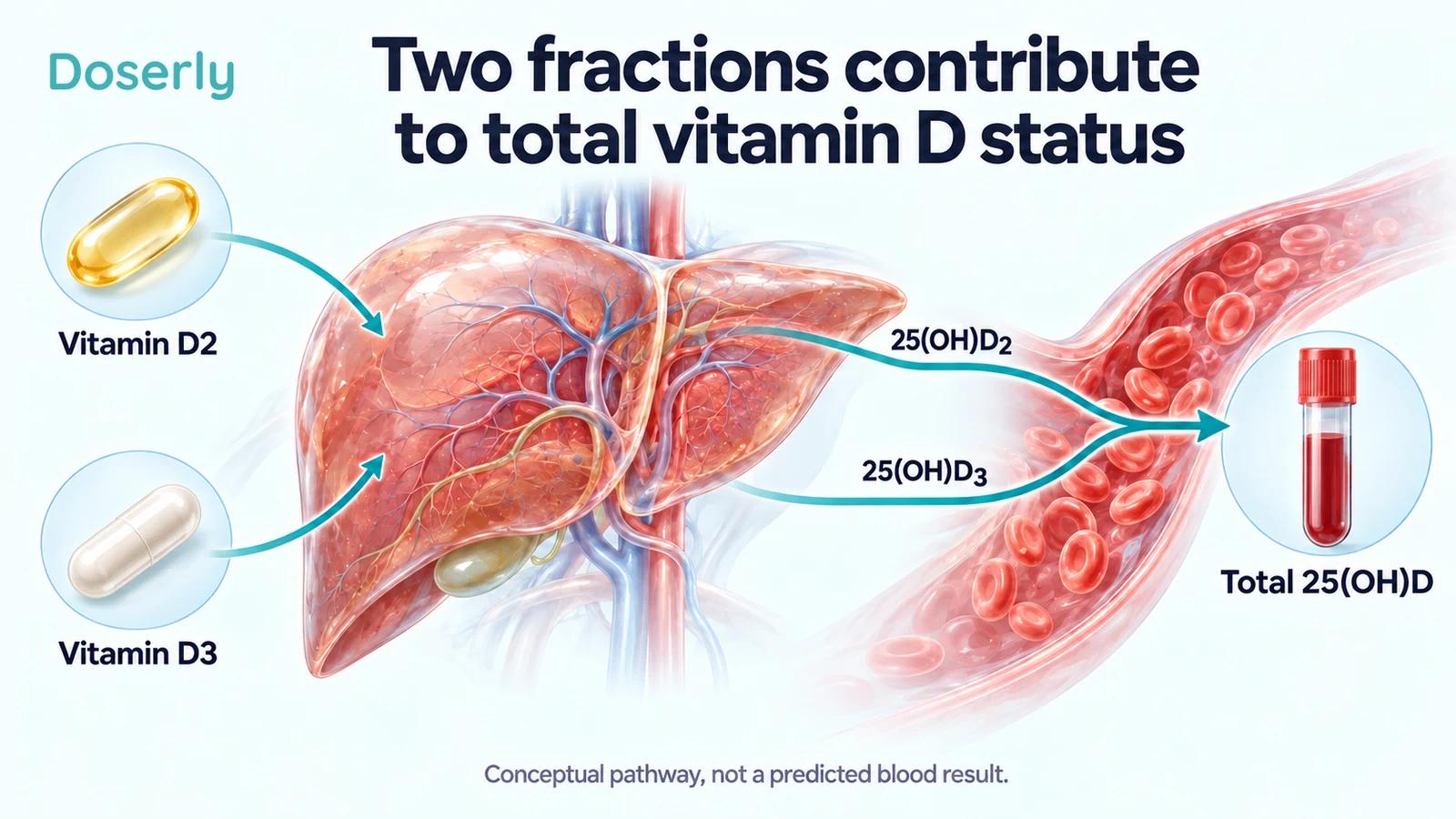
Vitamin D2 is ergocalciferol; vitamin D3 is cholecalciferol. After absorption, the liver converts them to their corresponding 25-hydroxyvitamin D forms. Further conversion, mainly in the kidneys, produces active hormone forms. Both D2 and D3 can increase circulating 25-hydroxyvitamin D, usually shortened to 25(OH)D. NIH vitamin D metabolism
The routine status measurement is generally total 25(OH)D, which includes the D2-derived and D3-derived fractions. The active hormone measurement, 1,25-dihydroxyvitamin D, is a different test and is not usually the preferred general indicator of vitamin D status.
These names are similar enough to cause real confusion. A supplement labeled D3 is not the same thing as a laboratory result labeled 25(OH)D3, and neither should be casually substituted for the active hormone result.
Our vitamin D2 guide and vitamin D3 guide explain each form more broadly. For comparing products or papers, first identify whether the reported outcome is total 25(OH)D, one fraction, or something else.
What the 2025 D2 review measured
A 2025 systematic review examined the effect of D2 supplementation on serum 25(OH)D3, the D3-derived fraction. It included 20 reports in the review, with 11 suitable for meta-analysis. The search covered publications through February 2023, so the publication year should not be mistaken for the final search date. D2 and the D3-derived fraction review
Across the pooled comparisons, D2 supplementation was associated with lower 25(OH)D3 than control. The review discussed possible changes in vitamin D metabolism and called for further work on their clinical implications.
That is a narrower result than “D2 lowers your vitamin D.” D2 can raise 25(OH)D2 while 25(OH)D3 falls. To understand overall status, the total and the context still matter. The review did not establish that this fractional shift caused more fractures, worse symptoms or other clinical harm.
This distinction is useful when reading a laboratory report after starting D2. A changed D3 fraction may be biologically interesting without meaning that the treatment failed. The appropriate interpretation depends on what the clinician intended to correct and what happened to the relevant total measurement.
A simple example explains the fraction problem
Imagine a purely illustrative blood result with a total of 40 units, made up of 35 units from the D3-derived fraction and 5 from the D2-derived fraction. At a later test, suppose the D3-derived fraction is 25 and the D2-derived fraction is 30. The first fraction fell, while the total rose to 55.
Those invented numbers are not a trial result or a proposed target. They show why tracking one component can give a different impression from tracking the sum.
The reverse is also possible: a rising D2-derived fraction does not by itself guarantee an adequate total. The point is not to favor one fraction. It is to avoid treating a part as the whole.
When comparing reports from different laboratories, check the test name and units before comparing numbers. One ng/mL of 25(OH)D equals 2.5 nmol/L, so numerically different results may represent the same concentration. NIH measurement units
Direct comparisons generally favor D3 for raising total 25(OH)D
A 2017 food-fortification trial enrolled 335 South Asian and white European women in the United Kingdom. Over 12 winter weeks, participants received placebo or foods supplying 15 micrograms daily of D2 or D3, delivered through juice or biscuits. D3 was more effective at increasing total 25(OH)D. Tripkovic food-fortification trial
This is valuable because the study directly compared the forms at the same relatively modest daily amount. It also tested them in food, rather than assuming that all evidence must come from high-dose capsules.
However, the study measured biochemical status over a season. It did not demonstrate that D3 prevented more fractures or improved symptoms more than D2. Its participants were women aged 20–64, so it does not automatically settle the best regimen for every age group or medical condition.
The result supports a practical preference for D3 when the aim is to raise the status marker efficiently. It should not be inflated into a universal claim that D2 cannot work.
Smaller trials show why the schedule and population still matter
A 2011 study assigned 64 community-dwelling adults aged at least 65 to D2 or D3, taken either daily at 1,600 IU or monthly at 50,000 IU, for one year. D3 was slightly but significantly more effective overall at increasing total 25(OH)D. Individual responses varied substantially. Binkley dosing comparison
The investigators also observed that D2 increased its own 25(OH)D2 fraction while reducing 25(OH)D3. That finding connects the direct comparison with the later review, but still leaves total status and clinical purpose central to interpretation.
An earlier 11-week trial reached a different conclusion for its tested regimen. In 68 adults, daily 1,000 IU D2, 1,000 IU D3 or a combination of 500 IU of each produced similar increases in total 25(OH)D. It was a small, short study and does not outweigh all later evidence, but it demonstrates why “D2 never raises levels effectively” is inaccurate. Holick daily-dose trial
These results should not be converted into an unsupervised dose-switching formula. The studies used different participants, schedules, follow-up periods and measurements. A product's form is one variable among several.
The dose frequency is part of the intervention
A daily dose and an intermittent high dose are not interchangeable instructions simply because their average daily amounts can be calculated. The timing of doses and blood sampling can affect what a comparison shows, and practical adherence can differ between schedules. The one-year dosing study explicitly compared daily and monthly regimens rather than treating them as identical. Binkley dosing study
For a prescribed regimen, record the frequency in words: daily, weekly or monthly. “Vitamin D, 50,000 IU” without a schedule is an incomplete medication history. It can conceal a much larger difference than the one between D2 and D3.
If a clinician changes the form, confirm whether the dose and frequency are also changing. A new bottle can look like a simple substitution while actually creating a new regimen. The old product should not remain silently active in the routine unless that overlap is intentional.
This is a practical reason to keep the treatment instructions beside the product name, rather than relying on memory or a photograph of the front label.
A better blood-level response does not prove better fracture prevention
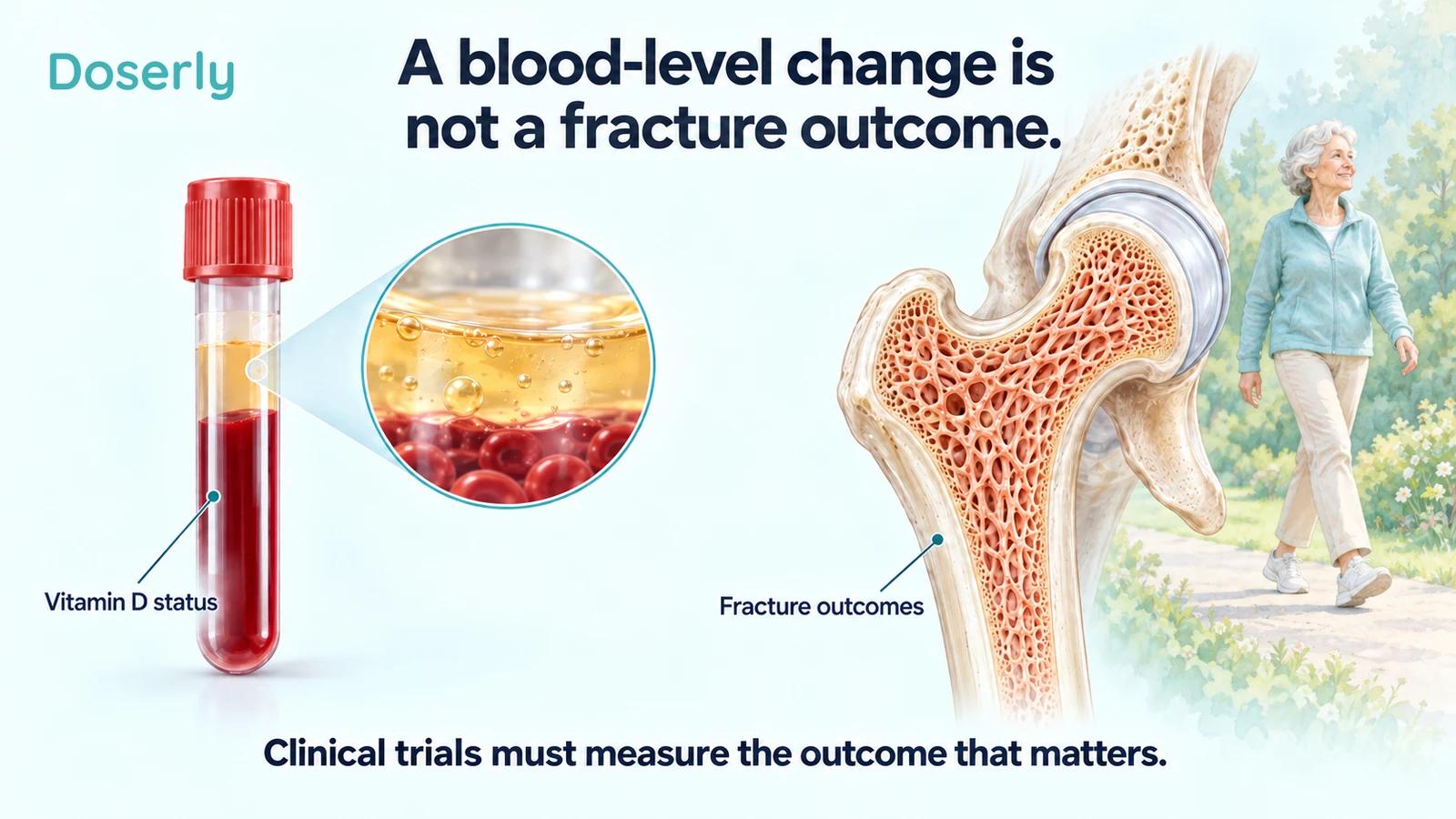
The VITAL fracture study helps explain the gap between a plausible nutrient benefit and a clinical outcome. It tested 2,000 IU of D3 daily against placebo in 25,871 midlife and older adults who were not recruited because of vitamin D deficiency, osteoporosis or low bone mass. VITAL fracture trial
Over a median 5.3 years, D3 did not significantly reduce total, nonvertebral or hip fractures. The hazard ratio for total fractures was 0.98, with a 95% confidence interval of 0.89–1.08.
This was not a D2-versus-D3 trial. It cannot establish that the forms are equivalent for fractures, and it does not answer how to treat a person with established deficiency or a specific bone disorder. Its relevance is different: choosing a form that raises the biomarker well does not guarantee an additional fracture benefit in a broadly recruited population.
The appropriate response is to keep the indication clear. Preventing or correcting deficiency, managing a diagnosed condition and adding a supplement to an already adequate routine are different decisions.
Testing and targets should follow the clinical reason
The Endocrine Society's 2024 guideline focuses on disease prevention in people without established indications for vitamin D testing or treatment. It advises against routine testing in generally healthy adults and against supplementation above reference intakes for most healthy adults younger than 75. It makes different recommendations for selected groups and does not cover every clinical deficiency scenario. Endocrine Society guideline
That scope matters. “Routine testing is not recommended” does not mean an already ordered test is irrelevant, or that malabsorption, low calcium or another specific clinical problem should be ignored. It means repeated testing to chase a higher number is not automatically a proven health strategy.
Likewise, a threshold used in an older trial should not be presented as the universal target for every reader today. Ask what the test is intended to guide and what result would actually change management.
If follow-up testing is appropriate, keeping the form, schedule, recent adherence and test date together makes the result easier to interpret. A laboratory change without that history can invite the wrong conclusion about the product.
Dietary preferences do not reduce the choice to D2 alone
D2 is commonly produced from irradiated yeast. D3 is often made from lanolin, but animal-free D3 derived from lichen is also available. Someone avoiding animal ingredients therefore has more to check than the D2 or D3 name alone. NIH supplement sources
The capsule shell and other ingredients may matter too. Verify the current product's sourcing or vegan certification rather than assuming all products containing a particular form share the same manufacturing process.
Availability, affordability and a regimen the person can reliably follow are legitimate practical considerations. A theoretically preferred form that is never taken is not equivalent to an effective prescribed routine. Those considerations should be discussed alongside the biochemical evidence, without pretending that convenience proves clinical superiority.
For someone already responding appropriately to prescribed D2, a general comparison article is a reason to ask an informed question, not an instruction to abandon the treatment.
More is not the purpose of the comparison
D3's tendency to raise 25(OH)D more effectively is not a reason to maximize the dose. Excess supplemental vitamin D can cause high calcium levels and other serious effects. The U.S. adult tolerable upper intake level is 4,000 IU, or 100 micrograms, daily; medical treatment may use different regimens under supervision. The upper limit is not a recommended target. NIH vitamin D safety
Count combination products, including multivitamins and calcium-with-D supplements, when reviewing exposure. Read whether a liquid amount is per drop or per measured volume. These product details can matter more immediately than a small average difference between forms.
Doserly can help keep the form, dose, frequency and reason for use together with the rest of a routine. A record can support the conversation; it cannot determine the right target or infer a health benefit from a blood-level change.
D3 is often the more efficient choice for raising total 25(OH)D. The complete decision still depends on why vitamin D is being used, how the regimen is delivered and what outcome actually matters.
Sources
- NIH Office of Dietary Supplements: Vitamin D
- Brown and colleagues: D2 and 25(OH)D3 systematic review, 2025
- Tripkovic and colleagues: D2/D3 food-fortification trial, 2017
- Binkley and colleagues: Daily and monthly D2/D3 comparison, 2011
- Holick and colleagues: Daily D2/D3 trial, 2008
- LeBoff and colleagues: VITAL fracture trial, 2022
- Endocrine Society: Vitamin D for the Prevention of Disease, 2024