
HRT
October 16, 2026
Vaginal Estrogen and Systemic HRT: Why the Distinction Changes the Discussion
On this page
Someone can be comfortable on systemic HRT, with fewer hot flashes and better nights, yet still have vaginal dryness or pain. Someone else may have troublesome vaginal symptoms without needing treatment for hot flashes at all. Both situations make more sense once estrogen treatment is separated by its intended target and exposure.
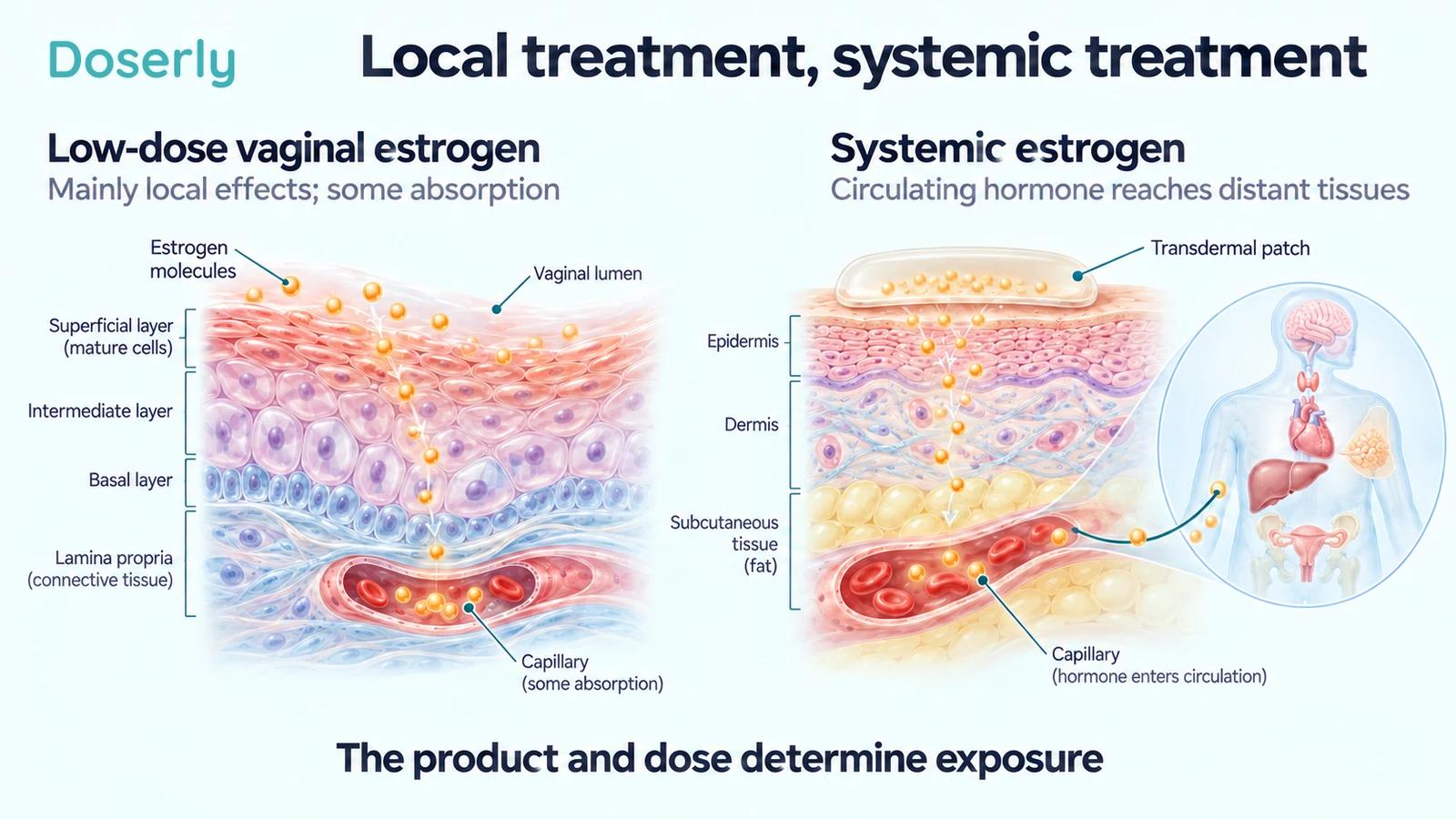
Low-dose vaginal estrogen is used mainly for local genitourinary symptoms. Systemic HRT delivers hormone into the circulation to treat symptoms such as hot flashes. They share a hormone family, but they are not interchangeable prescriptions, and evidence about one cannot simply be assigned to the other.
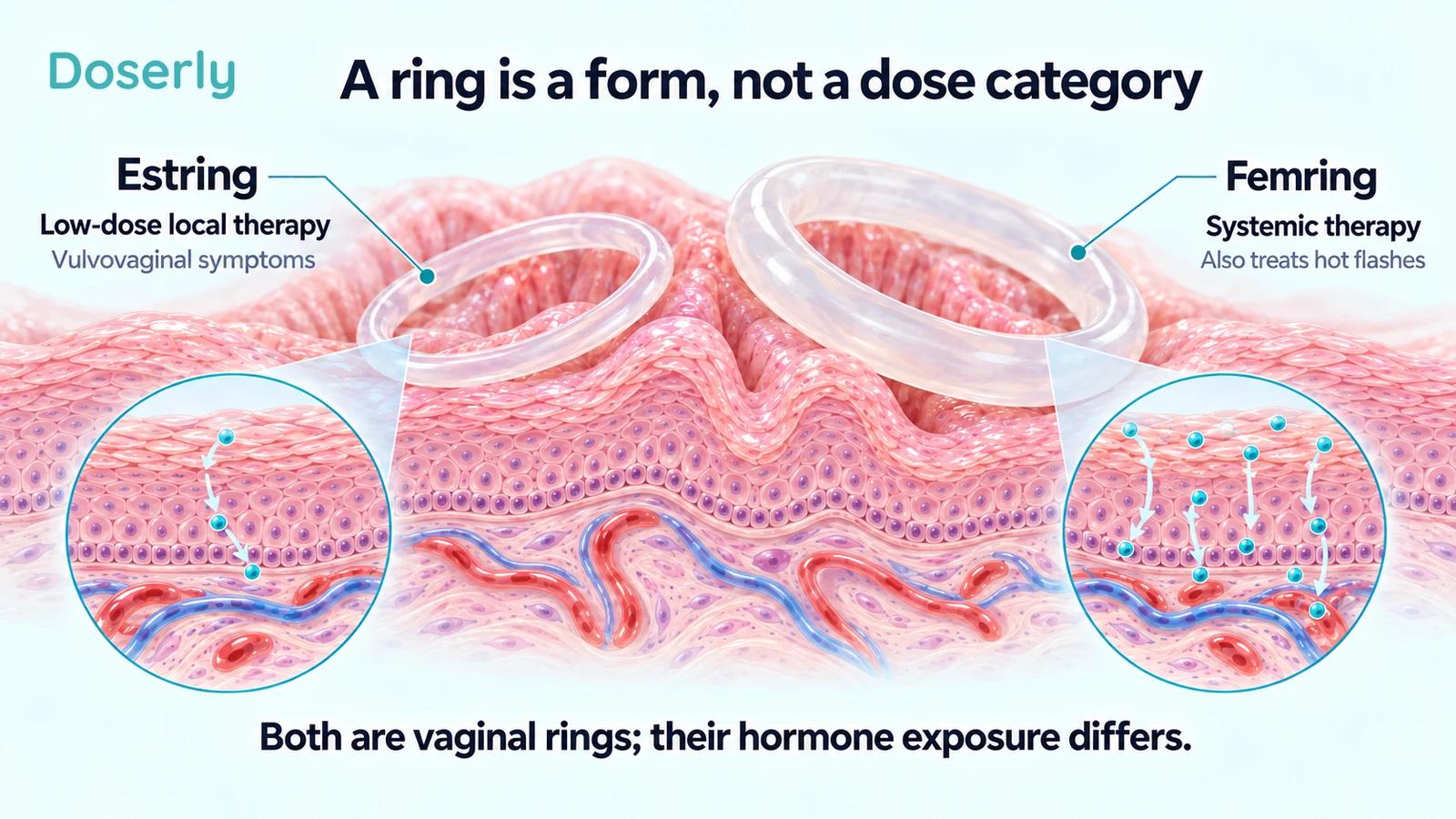
There is also an important exception to the vocabulary: not every product placed in the vagina is low-dose local therapy. Some vaginal rings deliver systemic estrogen. The product name and dose matter more than the word “vaginal” on its own.
Begin with the symptoms being treated
Genitourinary syndrome of menopause, often shortened to GSM, describes symptoms and tissue changes associated with declining sex-hormone exposure around menopause. These may include dryness, irritation, discomfort with penetration and urinary symptoms. The term is useful because the vagina and lower urinary tract are connected clinically, but it does not mean that every symptom in those areas is hormonal.
The 2025 AUA/SUFU/AUGS guideline emphasizes clinical assessment and exclusion of other causes. An infection, a skin condition, pelvic-floor problems or overactive bladder can coexist with GSM and may need its own treatment. A person should not have to keep increasing estrogen simply because the original diagnosis was incomplete. AUA/SUFU/AUGS guideline, 2025
The first useful distinction at an appointment is therefore between the treatment goal and the treatment route. Is the main problem dryness during everyday activities, pain with penetration, recurrent confirmed urinary infections, hot flashes, or several of these? Describing the actual problem helps avoid choosing a medicine merely because it sits within the broad category of HRT.
The existing GSM guide provides background on the symptom group. It can help prepare a discussion, but a symptom checklist does not establish a diagnosis.
Local treatment does not mean zero absorption
Low-dose vaginal estrogen acts mainly on local tissues. A small amount can enter the bloodstream. NICE explicitly describes this exposure as minimal compared with systemic HRT and unlikely to produce a significant effect throughout the body. That distinction supports its use for local symptoms without pretending the vagina is sealed off from the circulation. NICE recommendations
The Estring prescribing information offers a concrete example. The low-dose ring releases about 7.5 micrograms of estradiol per day. Its pharmacokinetic studies show an initial blood-level rise after insertion, followed by substantially lower steady exposure. Mean steady-state estradiol estimates in a longer study were within the range observed in untreated postmenopausal women. Estring prescribing information, 2026
Those findings belong to that product and its studied use. They do not establish identical exposure for every cream quantity, every compounded product or every vaginal ring. Absorption can depend on formulation and dose, which is why a broad statement such as “vaginal estrogen never reaches the blood” is inaccurate.
Two vaginal rings can have different treatment roles
Estring and Femring illustrate why the product name matters. Estring is a low-dose vaginal estradiol system used for postmenopausal vulvovaginal symptoms. Femring contains estradiol acetate and delivers systemic estrogen; its indications include moderate-to-severe vasomotor symptoms as well as vulvar and vaginal atrophy. Estring prescribing information, 2026 · Femring prescribing information
The Femring label reports average serum estradiol concentrations of 40.6 pg/mL and 76 pg/mL with its two delivery strengths. These values are not targets for self-adjusting treatment. They demonstrate that placement in the vagina does not automatically mean exposure remains local.
A prescription review should therefore identify the exact medicine, its intended dose and what it is expected to treat. A person saying “I use an estrogen ring” has not yet supplied enough information to determine whether the discussion should follow a low-dose local or systemic framework.
The distinction also matters when a prescription is changed. Two rings that look broadly similar should not be substituted on the assumption that they have the same hormone exposure or uterine-protection requirements.
Symptom trials support treatment without promising universal relief
Randomized trials do not all produce the same result. In a 576-participant trial, very-low-dose estradiol cream improved vaginal dryness and several tissue measures compared with placebo over 12 weeks. Some other symptoms, including irritation or itching and painful urination, improved similarly in both groups. The trial supports a specific product and symptom outcome rather than a promise that every genitourinary complaint will respond. Estradiol cream trial
A separate 302-participant trial compared a 10-microgram estradiol vaginal tablet, a moisturizer and dual placebo. The main outcome was improvement in the participant's most bothersome vulvovaginal symptom. All three groups improved, and neither active treatment showed a statistically significant advantage over placebo for that primary outcome at 12 weeks. Vaginal tablet and moisturizer trial, 2018
These results are not a reason to dismiss symptoms or assume that all treatment is ineffective. They show why formulation, enrolled population, comparator and outcome matter. Improvement in vaginal pH or cell maturation is also not identical to a meaningful improvement in pain or daily comfort.
For an individual, follow-up should ask whether the original problem improved enough to matter. A technically correct regimen that remains uncomfortable, difficult to use or ineffective deserves reassessment.
Systemic HRT and local treatment can be used together
NICE recommends offering vaginal estrogen for menopause-associated genitourinary symptoms, including to people already using systemic HRT. That is a useful corrective to the assumption that a patch or tablet must address every estrogen-related symptom. Local treatment can have a distinct purpose within a broader plan. NICE recommendations
Conversely, low-dose local therapy should not be expected to replace systemic treatment for hot flashes. The Estring and Femring indications make that difference visible in the product labels. A change in one symptom domain does not establish that every other symptom has been treated.
The practical benefit of separating the goals is a clearer review. If dryness improves but night sweats continue, the local medicine may be doing its intended job. If hot flashes improve but pain persists, the next step may be local assessment and treatment rather than an automatic increase in systemic dose.
Uterine protection follows exposure, not packaging
For systemic estrogen in someone with a uterus, an appropriate endometrial-protection strategy is generally needed. Low-dose vaginal estrogen used for GSM is treated differently. The Endocrine Society guideline advises against routinely adding a progestogen solely for low-dose vaginal estrogen. That advice must not be transferred to a systemic vaginal ring or to an unstudied higher-dose preparation. Endocrine Society guideline, recommendation 5.2d
There is a second distinction between routine surveillance and investigation of a symptom. The AUA/SUFU/AUGS guideline does not recommend endometrial surveillance solely because a person uses local low-dose vaginal estrogen. It also emphasizes that postmenopausal vaginal bleeding should be evaluated. The absence of a routine screening requirement does not make new bleeding irrelevant. AUA/SUFU/AUGS guideline, 2025
This is particularly important for someone using both local and systemic treatment. A clinician needs the full medication list to determine what protection is already prescribed and whether bleeding fits an expected regimen pattern. Do not stop a prescribed progestogen just because a low-dose vaginal product has been added.
Longer-term safety evidence is reassuring but observational
The Nurses' Health Study examined vaginal estrogen use among postmenopausal participants who were not current systemic hormone users. Over 18 years of follow-up, it found no statistically significant increase in cardiovascular disease, cancer or hip-fracture risk among vaginal estrogen users after adjustment for measured factors. Nurses' Health Study
That is useful reassurance. It is not the same as an 18-year randomized trial of one standardized product. Vaginal estrogen use was self-reported, and people choosing treatment could differ from nonusers in ways the analysis could not fully measure. Nor does the lack of a detected increase prove protection against those diseases.
Long-term safety discussions should preserve that difference in evidence strength. A local treatment can be a reasonable choice for a symptom without also being advertised as a way to prevent cardiovascular disease, cancer or aging.
Breast-cancer history requires a more specific conversation
A large study of 49,237 women with breast cancer in Scotland and Wales found no evidence of higher early breast-cancer-specific mortality among vaginal estrogen users. Its adjusted hazard ratio was 0.77. Because this was an observational comparison, that lower estimate should not be interpreted as proof that vaginal estrogen improves cancer survival. The outcome was mortality, not a direct assessment of every recurrence risk. Breast-cancer survival study
A Danish study of 8,461 women with early estrogen-receptor-positive breast cancer found no overall increase in recurrence associated with vaginal estrogen. However, the subgroup using aromatase inhibitors had a higher recurrence estimate: relative risk 1.39, with a confidence interval of 1.04–1.85. That signal was not accompanied by increased mortality in the subgroup. Danish breast-cancer cohort, 2022
The studies therefore answer different questions. Reassurance about mortality does not erase a recurrence signal, and a subgroup association does not establish causation for every survivor. NICE advises trying nonhormonal options and involving a breast-cancer specialist when persistent symptoms occur during aromatase-inhibitor treatment. NICE recommendations
Build follow-up around the problem you want to improve
Before starting or reviewing treatment, write down the main symptom and its effect on daily life. Examples include discomfort while sitting, dryness despite a moisturizer, or pain that makes penetration impossible. Then record the exact product and schedule, how consistently it was used, and any irritation or bleeding.
That information helps distinguish lack of effect from difficulty using the formulation. A ring, cream or tablet may fit a person's routine differently. Cost, dexterity, comfort with insertion and preference can all affect whether the intended treatment is actually used.
The vaginal estrogen therapy guide can help organize product-specific questions. Doserly can keep local and systemic prescriptions in separate entries while bringing their dates and symptom changes together for review. Tracking supports the conversation; it cannot determine whether bleeding, infection or persistent pain is benign.
The central distinction is practical: match the treatment's exposure to its purpose. Low-dose local estrogen and systemic HRT can both have a role, but the right expectations, uterine-protection discussion and cancer-history review depend on knowing which product is actually being used.
Sources
- AUA/SUFU/AUGS guideline on genitourinary syndrome of menopause (2025)
- NICE menopause recommendations
- FDA Estring prescribing information (2026)
- DailyMed Femring prescribing information
- Randomized trial of low-dose estradiol cream
- Randomized trial of vaginal estradiol or moisturizer versus placebo (2018)
- Endocrine Society clinical practice guideline, accepted manuscript (2015)
- Vaginal estrogen and chronic disease in the Nurses' Health Study
- Vaginal estrogen therapy and survival after breast cancer
- Danish observational cohort after early breast cancer (2022)