
Peptides
October 16, 2026
Two hormone receptors, one medicine: how tirzepatide differs from GLP-1 alone
On this page
Tirzepatide helps regulate blood sugar and appetite by activating two hormone receptors: the receptors for GIP and GLP-1. It is sometimes described as a stronger version of a GLP-1 medicine. That shorthand misses something useful. Tirzepatide is one molecule with its own pattern of receptor activity, and a larger clinical effect doesn't necessarily mean stronger stimulation of the GLP-1 receptor.
For someone considering treatment, there are two questions worth separating. What makes the medicine biologically different? And does that difference produce an advantage for the outcome you care about? Laboratory studies help with the first question. Trials measuring glucose control, weight or health events are needed for the second.
Our tirzepatide guide covers practical treatment background. Here we'll connect receptor research with human findings, without turning a mechanism into a promise that one medicine is always best.
What are GIP and GLP-1?
GIP stands for glucose-dependent insulinotropic polypeptide; GLP-1 is glucagon-like peptide-1. Both are incretin hormones, involved in coordinating insulin responses with nutrient intake. A receptor is a protein through which a cell responds to a signal. An agonist activates a receptor; a dual agonist activates two receptor types.
Pancreatic beta cells, which release insulin, express both incretin receptors. This helps explain why researchers would investigate a medicine acting on both. The pancreas is not the whole treatment story, however: blood-glucose regulation and appetite are outcomes of interactions across the body. Human-islet research
The names can also cause confusion. GLP-1 and GIP are different hormones. “Dual” does not mean GLP-2, and tirzepatide isn't a mixture of two ordinary GLP-1 medicines. It is a distinct drug whose pharmacology must be studied on its own terms.
A practical consequence is that the milligram number on one product cannot be interpreted as a strength ranking against the milligram number on another. Equal mass doesn't imply equal receptor exposure, duration of action or clinical effect.
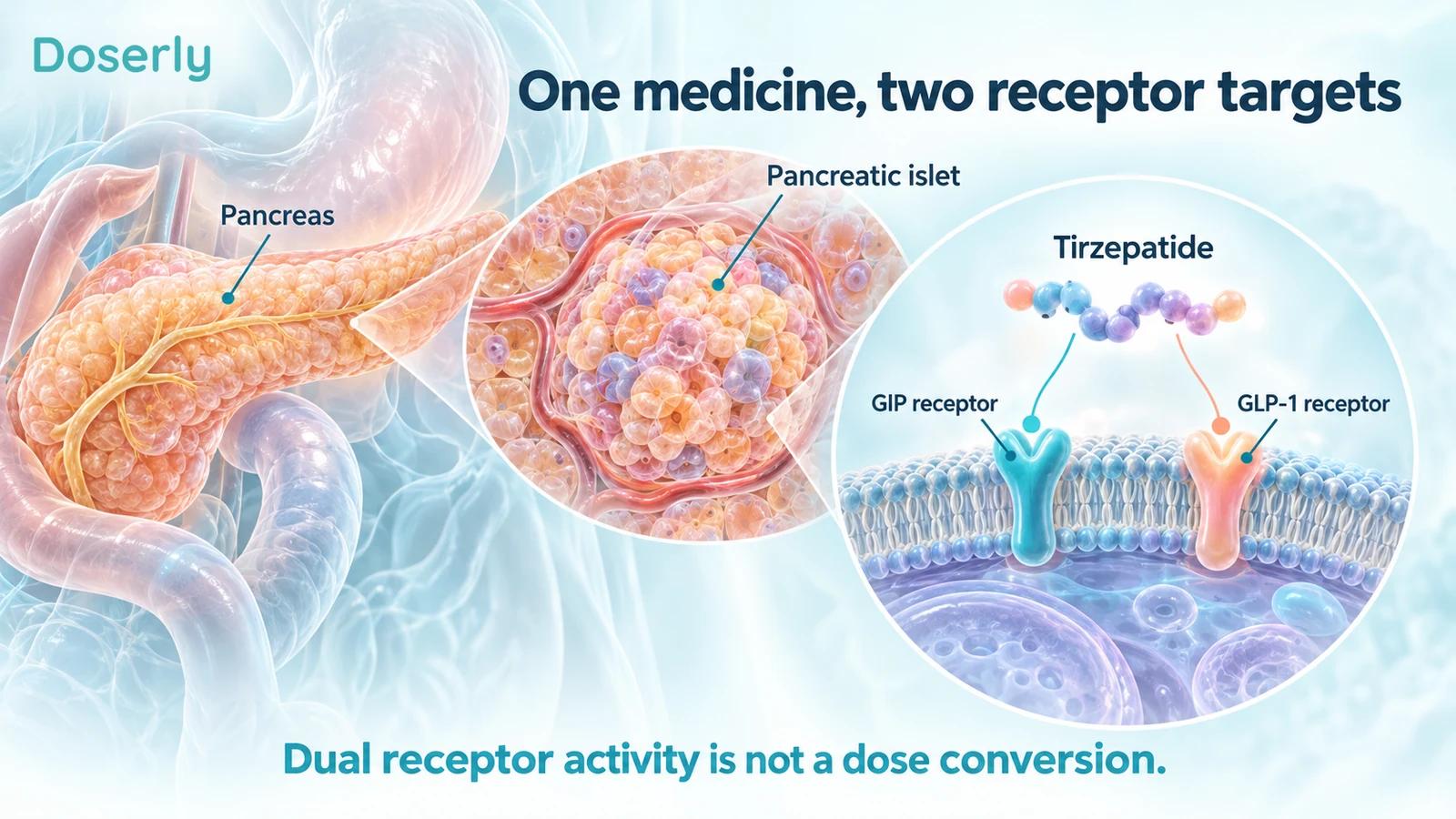
Tirzepatide activates two receptor types. The peptide motif and receptors are conceptual symbols, not an amino-acid sequence or molecular structure, and do not imply equal activity at both targets.
Why “dual” doesn't mean equal activity
A 2020 pharmacology study described tirzepatide as an imbalanced agonist. In its experimental systems, activity at the GIP receptor resembled that of native GIP, while the profile at the GLP-1 receptor differed from native GLP-1. The researchers also described biased signaling: relative preference for one downstream cellular response over another. Willard and colleagues
“Biased” here isn't a criticism of the study. It is a pharmacology term. Activating a receptor can trigger several processes inside a cell; a drug can favor some responses over others. In this work, tirzepatide favored cAMP signaling over recruitment of beta-arrestin at the GLP-1 receptor and produced less receptor internalization than GLP-1.
You don't need to remember those names to understand the implication. A receptor isn't simply on or off, and two drugs acting at the same receptor need not produce identical cellular behavior. That makes “more GLP-1 stimulation” an incomplete explanation of tirzepatide.
These experiments characterize the molecule. They don't provide a personal dose-conversion formula or establish what fraction of someone's weight loss is due to a particular cellular pathway.
What can structural research explain?
A 2022 study used cryogenic electron microscopy and molecular simulations to examine how tirzepatide interacts with the two receptors. It investigated how the molecule's amino-acid sequence and fatty-acid modification influence binding and signaling. The findings help explain why its behavior at GIP receptors resembles native GIP more closely than its behavior at GLP-1 receptors resembles native GLP-1. Structural determinants study
That is valuable drug-development evidence. Researchers can connect a molecular feature with a measured receptor response and use it to develop better questions or future compounds. It still isn't a measurement of hunger, nausea or a clinical outcome in a person.
Consider the difference between knowing how a medicine interacts with a protein and knowing whether someone can tolerate it for a year. Both questions matter, but one experiment cannot answer both. Structural detail makes the mechanism more concrete; it doesn't remove the need for trials.
This is also why diagrams should remain modest. A colorful receptor illustration can show two targets. It cannot honestly show that a particular pathway accounts for a fixed share of clinical benefit unless that contribution has been established.
Does the GIP component actually do anything in human tissue?
Human pancreatic-islet experiments offer a more direct answer than receptor diagrams alone. In a 2023 study, blocking GIP-receptor activity consistently reduced the insulin response to tirzepatide in isolated human islets. The investigators also examined secretion of other islet hormones. These findings support a functional contribution from GIP receptors in that preparation. El and colleagues
The same paper found a different pattern in mouse islets, where tirzepatide stimulated insulin secretion predominantly through GLP-1 receptors because of lower potency at mouse GIP receptors. That species difference is a reason to identify the tissue in a mechanism claim.
Human tissue is still not the same as a human treatment trial. Isolated islets don't reproduce appetite, digestion, drug distribution or every feedback signal present in a person. The experiment answers whether a receptor contributes to hormone secretion under its conditions; it doesn't measure long-term weight loss.
A useful reading of the study is therefore specific: the GIP component isn't merely a name attached to the molecule. It has demonstrable activity in human islet experiments. How that activity combines with the rest of the medicine's effects is a broader question.
What happens when whole people receive treatment?
A mechanistic phase 1 trial enrolled 117 adults with type 2 diabetes and compared tirzepatide, semaglutide and placebo. Unlike isolated-tissue experiments, it examined pancreatic-islet function and insulin sensitivity in treated participants. It is a useful example of moving from a receptor question to an integrated physiological question. Heise and colleagues, 2022
Insulin sensitivity describes how responsive tissues are to insulin. Insulin secretion describes how much insulin pancreatic cells release. These are related but distinct: better glucose control can involve changes in either, and looking only at a glucose reading doesn't explain the full mechanism.
Specialized physiological testing can help separate these processes. For everyday care, however, the immediate question is usually whether glucose control improves enough, with acceptable adverse effects and treatment burden. A mechanism study and a routine blood test serve different purposes.
The small trial should also not be confused with the larger head-to-head trials below. Different research designs address different questions, even when the same medicines appear in the title.
What did a direct diabetes comparison find?
SURPASS-2 randomly assigned 1,879 adults with type 2 diabetes to tirzepatide at 5, 10 or 15 mg, or semaglutide at 1 mg weekly, over 40 weeks. Participants were receiving metformin. The open-label trial's main outcome was change in HbA1c, a measure used to assess longer-term blood-glucose control.
Average HbA1c reductions were 2.01, 2.24 and 2.30 percentage points with tirzepatide, versus 1.86 with semaglutide. All three tirzepatide doses met the trial's criteria for superiority on this endpoint. SURPASS-2 primary report
This is more informative than saying that two receptors must be better than one. It demonstrates a clinical difference under defined conditions. It doesn't compare tirzepatide against every semaglutide dose, formulation, population or possible outcome.
The dose detail matters particularly here: semaglutide 1 mg is the comparator studied. A headline omitting that detail can make the result sound broader than the experiment.
What about weight loss without diabetes?
SURMOUNT-5 addressed another question. It compared maximum tolerated tirzepatide doses of 10 or 15 mg with semaglutide doses of 1.7 or 2.4 mg in adults with obesity without diabetes. At 72 weeks, average weight change was −20.2% with tirzepatide and −13.7% with semaglutide. SURMOUNT-5 primary report
These are percentages of starting body weight, not kilograms and not the proportion of people who responded. The difference between the averages is 6.5 percentage points. It doesn't predict the difference that any individual would experience after switching.
The open-label design means participants knew which medicine they received. It was also a comparison of complete treatment regimens, not a study selectively turning GIP activity on and off while holding every other molecular feature constant. The result establishes comparative weight efficacy in this setting; it doesn't calculate the isolated contribution of the GIP receptor.
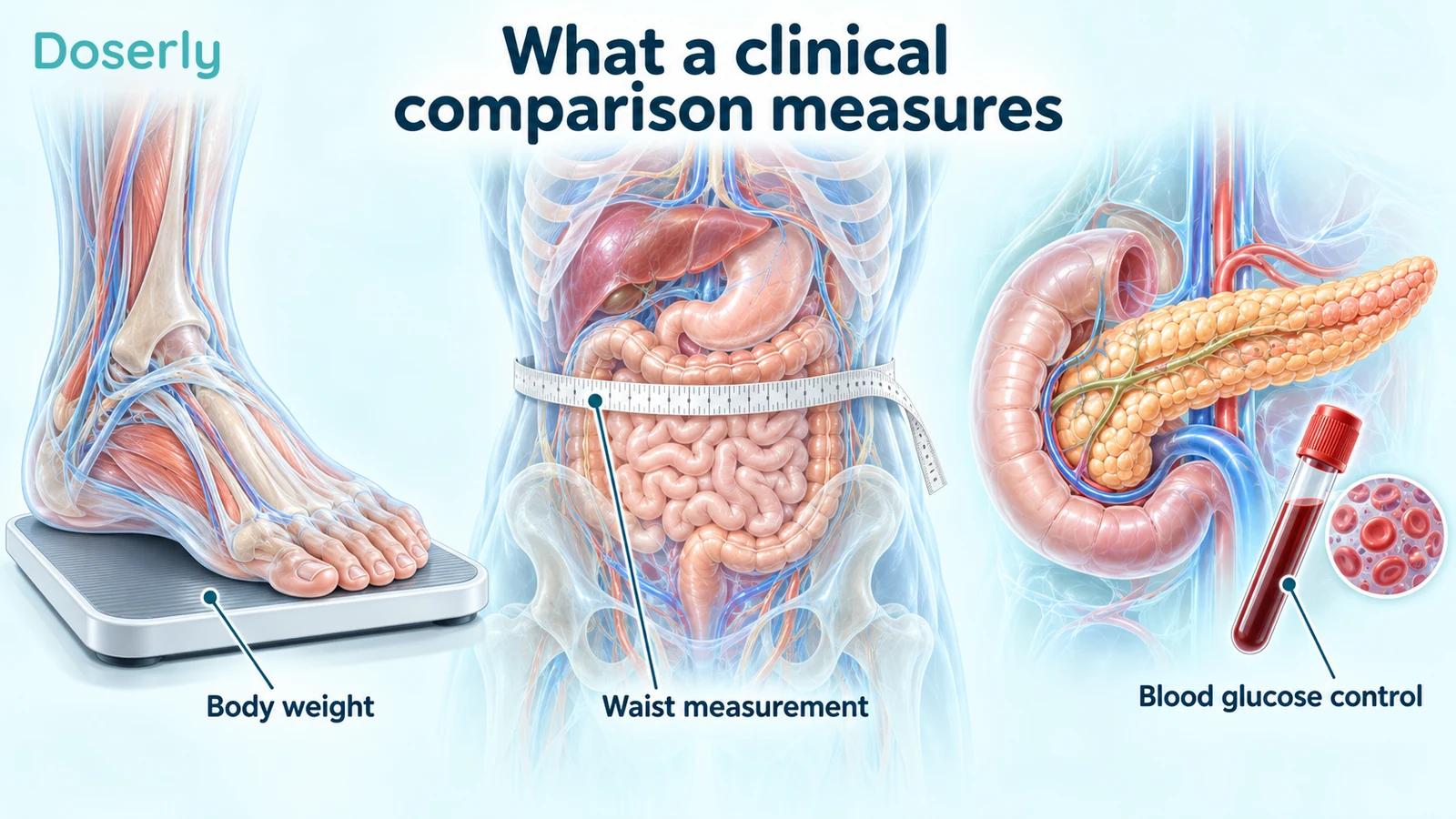
Human trials measure outcomes such as glucose control and body weight. The scenes are conceptual and do not depict actual participants or a treatment response.
Does greater weight loss mean better results for every condition?
No. Outcomes need their own comparisons. In SURPASS-CVOT, tirzepatide was compared with dulaglutide in people with type 2 diabetes and cardiovascular disease. The primary cardiovascular outcome occurred in 12.2% versus 13.1%; the hazard ratio was 0.92, with a confidence interval of 0.83–1.01. The trial established noninferiority, but not superiority, for that endpoint. Cardiovascular outcomes trial
Noninferiority means the comparison met a prespecified standard for not being unacceptably worse. It isn't another word for being better. This example shows why a weight-loss ranking shouldn't be carried automatically into heart-event claims.
It also helps frame treatment goals. If the main concern is glucose control, discuss glucose evidence. If it is weight, discuss weight outcomes and tolerability. If it is a particular complication, look for research measuring that complication in a relevant population.
Our semaglutide guide offers background on the other molecule. The useful comparison is between actual treatment options for a defined need, rather than between receptor counts.
What does this mean for side effects and switching?
Dual-receptor activity doesn't guarantee freedom from gastrointestinal symptoms. Tirzepatide's prescribing information includes nausea, vomiting and diarrhea among adverse reactions, and warns about dehydration-related kidney injury and other important risks. When used with insulin or an insulin secretagogue, the risk of hypoglycemia requires attention. Zepbound prescribing information
The same label advises against coadministration with other tirzepatide-containing products or GLP-1 receptor agonists. Adding another drug is not a validated way to adjust the receptor balance shown in a diagram. The person prescribing treatment needs to consider actual products, exposure and tolerability.
Likewise, an apparent milligram ratio between tirzepatide and semaglutide isn't a conversion schedule. Their pharmacology and labeled regimens differ. If a switch is being considered, discuss the reason, current adverse effects, other glucose-lowering medicines and how response will be reviewed.
A good treatment discussion ends with measurable goals rather than a claim about the most powerful molecule. What improvement matters? How will it be assessed? What side effects would change the plan? Tirzepatide's dual activity helps explain why it is scientifically interesting. Human outcomes and your clinical circumstances determine how useful it may be.
Sources
- Willard et al., 2020: receptor pharmacology and signaling.
- Sun et al., 2022: structural experiments.
- El et al., 2023: human and mouse islet experiments.
- Heise et al., 2022: human mechanistic trial.
- SURPASS-2, 2021: diabetes comparison.
- SURMOUNT-5, 2025: obesity comparison.
- SURPASS-CVOT, 2025: cardiovascular comparison.
- Zepbound prescribing information: pharmacology, adverse effects and coadministration.