
TRT
October 16, 2026
TRT, telehealth and the missing follow-up question
On this page
Telehealth can make testosterone care easier to reach. It can reduce travel, fit around work and make a sensitive conversation more comfortable. Those benefits matter, especially when specialist appointments are difficult to obtain.
But a prescription is only the beginning of testosterone replacement therapy, or TRT. The question that often receives less attention is what happens afterward: who reviews the results, responds to adverse effects and decides whether the treatment is helping? A convenient first appointment does not answer those questions by itself.
Good remote care can include careful diagnosis and reliable follow-up. The challenge is to identify the actual service being offered rather than infer it from an efficient website, subscription or delivery schedule. Here is what the research shows, and how to turn “monitoring included” into a concrete care plan.
Why TRT requires a continuing relationship
Testosterone treatment can change blood hormone levels, red-cell production and other aspects of health. The clinician needs to assess whether the intended symptoms improve, whether exposure is appropriate for the formulation and whether adverse effects appear. A refill process alone does not provide that assessment.
The Endocrine Society recommends evaluating response, adverse effects and treatment use after initiation. Monitoring is therefore part of treatment, not an optional service added after the prescription. Testosterone guideline.
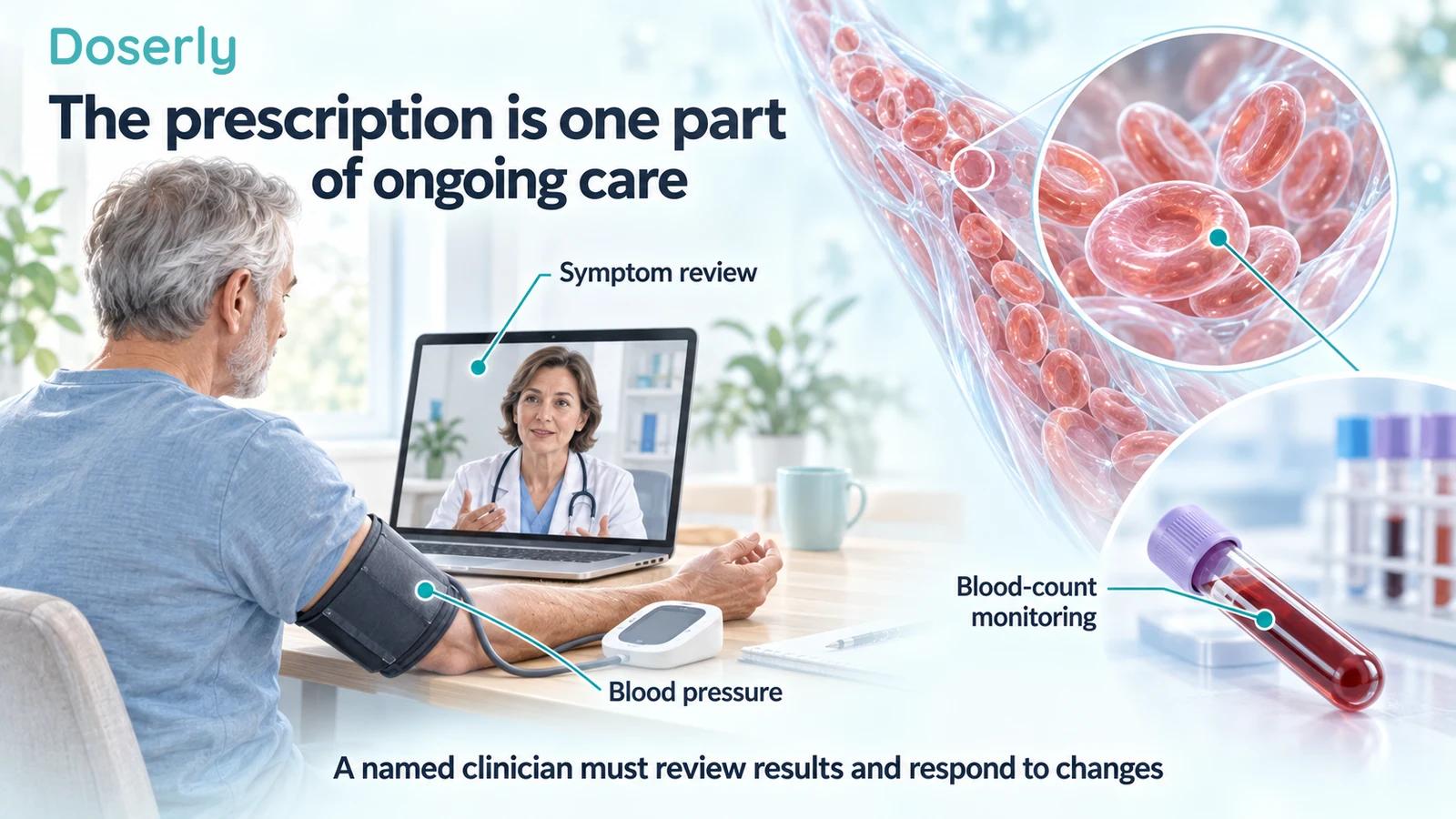
For a patient, the distinction is practical. An automatic reminder to obtain blood tests is useful, but someone must receive the report, interpret it alongside symptoms and explain what happens next. A result uploaded to a portal is not necessarily a result reviewed by the responsible clinician.
Before starting, ask who holds that responsibility. The answer should identify a clinical role and a way to contact that person or team, including when the usual prescriber is unavailable. This does not require continuous access to one individual; it requires a clear system for continuity.
What a secret-shopper study found
A 2022 study examined seven US direct-to-consumer testosterone platforms using a scripted patient scenario. The shopper presented as a 34-year-old man with low energy, low libido and interest in future fertility. His measured total and free testosterone were within the laboratory reference ranges. Six of the seven platforms nevertheless offered testosterone. Dubin and colleagues.
The study documented gaps in diagnostic practice and counseling. It also found that platforms offered follow-up, illustrating that the existence of a follow-up schedule does not establish that the initial treatment decision was appropriate. The investigation assessed the intake process and proposed care; it did not track long-term patient outcomes.
This was a small snapshot from 2022, not a current rating of every telehealth clinic. Its importance is the type of question it raises. If symptoms are nonspecific and testosterone is not consistently low, a service should be able to explain why treatment is appropriate rather than treating a patient's interest in TRT as the indication.
Why the evidence should not become a blanket verdict
Another 2022 study compared the practices and costs of direct-to-consumer telemedicine platforms with guideline recommendations and a tertiary centre. Its authors reported that the evaluated platforms were largely following guidelines, while ongoing treatment costs were substantial. Practice comparison and cost analysis.
These studies used different approaches and do not support one universal judgment about remote care. What a clinic says it does and what happens in a specific consultation are related but distinct observations. Neither study establishes that all online care is unsafe or that all office-based care is better.
The useful response is to ask for observable details. How is the diagnosis confirmed? What information is collected about fertility, sleep, other medicines and prior treatment? What happens if the results do not support TRT? A service that offers a genuine evaluation should have a pathway that does not necessarily end in a testosterone prescription.
Start with a clear treatment goal
The initial record should identify the symptom or condition treatment is intended to improve. “Optimize hormones” is difficult to evaluate. A goal such as improving persistent low sexual desire in a person with confirmed deficiency is more specific and can be revisited.
The American College of Physicians' guideline for age-related low testosterone recommends reassessing sexual symptoms within twelve months and periodically afterward, and discontinuing treatment if sexual function does not improve. This recommendation applies to that particular clinical context, not every form of pathological hypogonadism. ACP guideline.
The broader lesson is to agree on what benefit would justify continuing. A rising testosterone result is evidence of drug exposure; it is not proof that the original problem improved. If fatigue persists, for example, the clinician may need to investigate sleep, mood, anemia or another cause rather than assume that the dose must increase.
Ask how symptoms will be recorded and compared. A brief consistent description at each visit can be more useful than a long questionnaire completed once and never revisited. The method should help both you and the clinician recognize a meaningful change.
Laboratory follow-up needs timing and interpretation
The same testosterone result can mean different things depending on the product and the timing of the sample. A value collected soon after an injection may not be comparable with a value collected near the next dose. Gels and other formulations have their own sampling considerations.
A remote service should give instructions that fit the actual medicine. If a product or schedule changes, ask whether the blood-draw instructions change too. Record the last administration time with the test so the reviewer can interpret it correctly.
Blood counts matter because testosterone can increase red-cell production. Hematocrit is the proportion of blood volume occupied by red cells. An abnormal value needs a clinician's interpretation and a plan, rather than an automated instruction detached from the rest of the history. The Doserly blood-work guide explains common tests and why they are used.
It is reasonable to ask how quickly routine results are reviewed and how urgent abnormalities are handled. Also ask what happens when the laboratory sends a result to the ordering service but you do not hear back. A clear answer reduces the chance that each party assumes someone else has acted.
Blood pressure remains relevant despite changing headlines
In February 2025, FDA announced testosterone labeling changes after reviewing the TRAVERSE cardiovascular trial and ambulatory blood-pressure studies. The action removed the boxed-warning language concerning increased major cardiovascular outcomes and required blood-pressure warnings based on the newer evidence. FDA announcement.
Those are different findings. A change to one warning does not mean cardiovascular assessment or blood-pressure monitoring has become unnecessary. It also does not make every formulation or patient population interchangeable with the treatment studied in TRAVERSE.
For remote care, the practical issue is how blood pressure will be measured and shared. If home monitoring is part of the plan, ask which device and technique the clinic recommends and what readings should prompt contact. The clinician should interpret trends in the context of symptoms and other medicines, rather than ask you to self-adjust testosterone from a single reading.
This article does not provide a universal monitoring schedule. Product labeling, baseline health and treatment changes can affect the plan. The important point is that the plan should exist and be understandable before a problem arises.
Remote care still needs local services
Blood collection, examination and urgent assessment may occur outside the telehealth company. A workable arrangement identifies how those services connect. If a local laboratory is used, establish where the order comes from and how the results reach the prescriber. If an examination is needed, establish who arranges it.
HHS guidance on preparing for telehealth emphasizes helping patients understand the visit process and what information or measurements may be needed. Preparation is more than testing the video connection: it includes making the appointment clinically useful. HHS preparation guidance.
Bring your medication list and recent reports to the visit, including information from clinicians outside the platform. If a primary-care clinician manages blood pressure or sleep apnea, ask how relevant changes will be communicated. A remote testosterone service should not become an isolated record that the rest of the care team never sees.

Know how to report a problem between appointments
A messaging portal is useful for routine questions, but patients need to know its limits. Ask whether messages are reviewed by clinical staff, the expected response time and which concerns should be handled by telephone, an urgent visit or emergency care.
HHS advises calling emergency services for a medical emergency rather than relying on a routine telehealth appointment. HHS emergency-care guidance. Chest pain, severe breathing difficulty or sudden neurological symptoms should not wait for a subscription-service reply.
For non-emergency problems, a dated description can help: when the symptom began, the product used, any recent change and other relevant medicines. Photographs may help with some local skin reactions if the clinic requests them through a secure channel. The record supports assessment; it does not replace it.
If the service routinely responds to every concern by adding another medicine, ask for the diagnosis and expected benefit of that addition. Each prescription deserves its own rationale and follow-up. A package of products is not inherently a more complete treatment plan.
What happens when care changes hands?
Continuity matters when you travel, move, change insurance, switch clinics or decide not to renew a subscription. Ask how to obtain your consultation notes, laboratory reports and treatment history. These should be usable by the next clinician, including the original reason treatment was started.
Also clarify whether prescription continuity depends on membership, scheduled visits or particular laboratories. These are questions about the service's actual policies, which can vary. Do not assume that an advertised monthly price guarantees uninterrupted care in every location or situation.
For US access questions, the Doserly US TRT guide offers additional context. Local prescribing requirements and coverage rules should be checked for the place where care is provided. This article focuses on clinical follow-up rather than promising that any remote service can prescribe across every jurisdiction.
The question to ask before you subscribe
Ask the service to describe what happens after an unexpected laboratory result or a new adverse effect. Who sees it? How will you be contacted? Who decides whether treatment should change? How is local assessment arranged if needed?
Then ask the same level of detail about lack of benefit. When will the original symptom be reassessed, and what happens if the hormone number improves but the symptom does not? These questions reveal whether follow-up is a clinical process or mainly a refill schedule.
Telehealth can be a useful way to receive testosterone care when diagnosis, monitoring and continuity are well organized. The missing follow-up question is therefore not a criticism of the medium. It is a way to evaluate the care you will actually receive once the first prescription has been filled.
Sources
- Endocrine Society testosterone guideline, 2018.
- Dubin et al., 2022: seven-platform secret-shopper study.
- Practice comparison and cost analysis, 2022.
- ACP age-related low-testosterone guideline, 2020.
- FDA testosterone labeling announcement, 2025.
- HHS: Preparing patients for telehealth.
- HHS: Telehealth and emergency care.