
TRT
October 16, 2026
TRT Evidence in Younger Men: Why Age Limits in Trials Matter
On this page
A 32-year-old reading a reassuring testosterone study may discover that every participant was at least 65. That does not make the study useless. It does mean the result needs a translation step before it can inform his own treatment.
Age changes the questions a patient brings to testosterone replacement therapy (TRT). A younger man may be planning children, investigating an underlying pituitary or testicular condition, or considering treatment that could continue for decades. A study designed around older men's sexual symptoms or cardiovascular events may answer only part of that decision.
The useful question is not simply whether testosterone has been studied. It is whether the participants, diagnosis, treatment and follow-up resemble the situation in front of you. Younger men can have genuine hypogonadism; limited evidence for a particular age group is neither proof that treatment is unnecessary nor permission to assume every benefit and risk is already known.
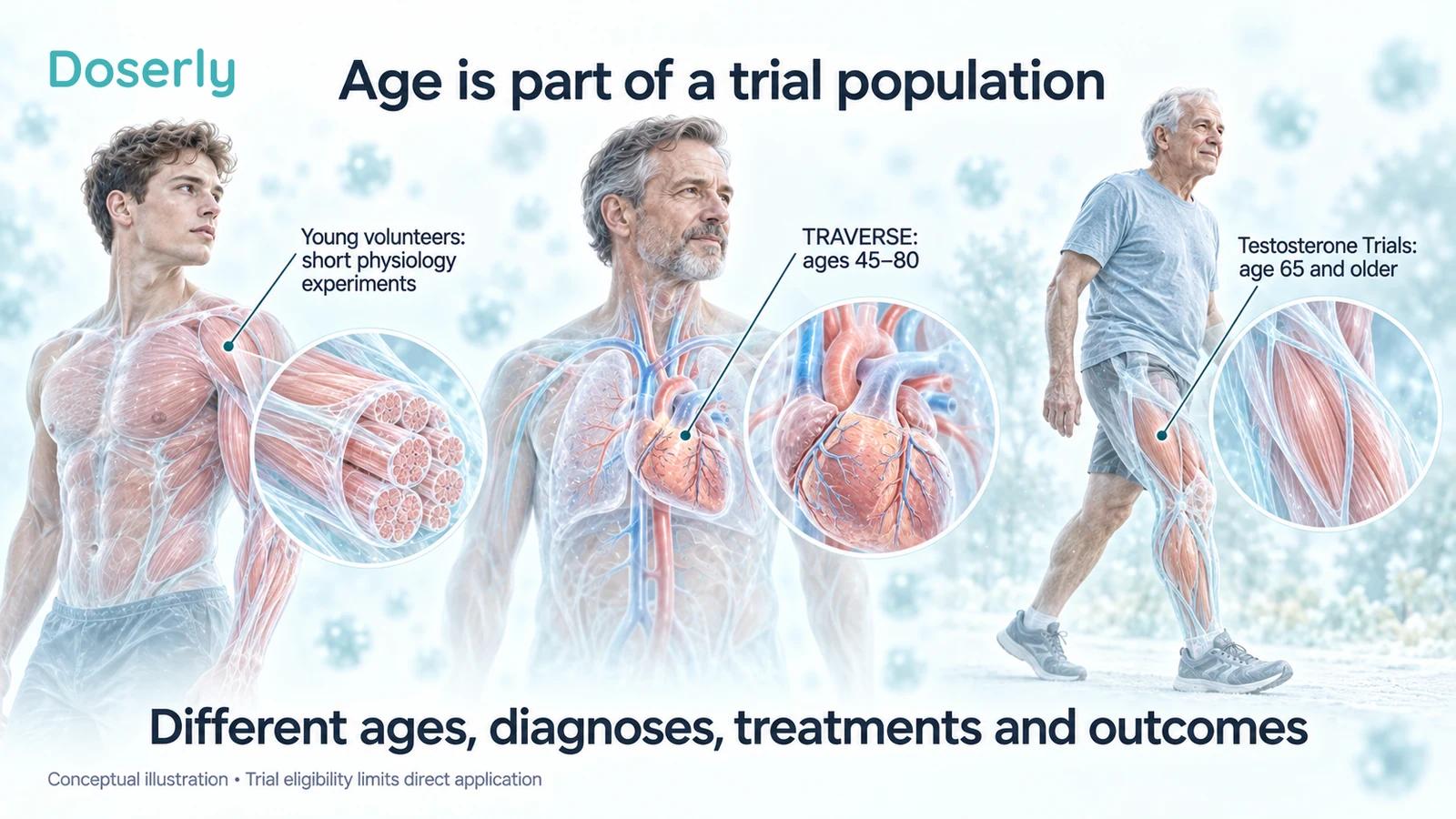
“Young men” does not describe one clinical population
A healthy volunteer with normal hormone production is different from a man whose testes cannot produce enough testosterone. Both differ from someone with a potentially reversible suppression of the hormonal signals to the testes.
The Endocrine Society guideline recommends diagnosing hypogonadism in men with relevant symptoms or signs and unequivocally, consistently low testosterone concentrations. It also recommends distinguishing primary testicular dysfunction from secondary hypothalamic or pituitary dysfunction and investigating the cause. Age alone does not make that evaluation unnecessary. Endocrine Society guideline
That distinction affects what a trial can tell you. In established testicular failure, replacing a deficient hormone addresses a defined physiological problem. In a man with nonspecific fatigue and one low measurement, the unanswered question may be whether he has persistent hypogonadism at all. A treatment study cannot complete that diagnostic work retrospectively.
For younger patients, the cause may also change fertility planning and whether a different treatment approach is appropriate. Our secondary hypogonadism guide explains the distinction between a problem in the testes and a problem in the signals controlling them.
What the large older-men trials actually studied
The Testosterone Trials enrolled 790 men aged 65 or older with low testosterone and relevant symptoms. Participants received testosterone gel or placebo for one year. Treatment improved some sexual-function outcomes, but the primary vitality outcome did not show a significant benefit. These were selected older men, not a representative sample of all adults with fatigue. Testosterone Trials
TRAVERSE studied a different question. It enrolled 5,246 men aged 45 to 80 with symptoms, two low testosterone measurements, and established cardiovascular disease or elevated cardiovascular risk. Testosterone gel was compared with placebo, with mean follow-up of 33 months. The trial found testosterone noninferior to placebo for its primary composite cardiovascular outcome under its prespecified analysis. It also observed higher incidences of atrial fibrillation, acute kidney injury and pulmonary embolism in the testosterone group. TRAVERSE
These studies are substantial evidence for their questions. Neither directly estimates the consequences of starting TRT at 28 and continuing until 70.
A younger patient's baseline likelihood of a cardiovascular event may differ from that of a TRAVERSE participant. Without suitable data, you cannot simply carry over the trial's event percentage as that patient's personal risk. Equally, being younger does not make an observed adverse effect biologically impossible.
Why experiments in healthy young men are not the missing answer
Some well-known testosterone studies did recruit young men. Their purpose was often to understand hormone physiology, rather than to evaluate ordinary replacement treatment in patients with a clinical diagnosis.
For example, a 2001 dose-response study enrolled 61 healthy men aged 18 to 35. Researchers suppressed their own testosterone production and assigned graded testosterone enanthate exposure over 20 weeks. Different physiological outcomes responded differently across the exposure range. Dose-response study
That design helps separate hormone effects from background variation. It does not establish an optimal lifelong regimen for a younger patient, a safe upper target, or a reason to pursue the largest possible muscle response. Experimental hormone suppression is also different from longstanding pituitary or testicular disease.
When a social-media explanation says “this was proven in young men,” look beyond the age range. Were those men hypogonadal before the experiment? Was the exposure intended to replace a deficiency? Was the endpoint a symptom, muscle measurement, blood marker or clinical event? A close age match can coexist with a poor clinical match.
There is some younger clinical evidence—but it remains specific
A randomized trial in 136 male cancer survivors aged 25 to 50 offers a useful example. Participants had borderline-low morning testosterone after previous cancer treatment; most were testicular-cancer survivors. Over 26 weeks, testosterone gel improved body composition compared with placebo, including increased lean mass and reduced fat mass. It did not improve the measured quality-of-life outcomes. Young male cancer-survivor trial
This matters because younger clinical populations are not entirely absent from the literature. It also shows why a headline such as “TRT works in younger men” is too broad.
These participants had a particular treatment history, eligibility criteria and testosterone range. Hormone-dependent cancers were excluded. The trial was not designed to establish recurrence safety or decades of treatment benefit. Someone without a cancer history should not assume the same body-composition response; a cancer survivor should not read it as clearance for every cancer type.
The result also separates a physical measurement from lived benefit. An increase in lean mass is not automatically an improvement in fatigue, mood, sexual function or daily life.
Fertility deserves its own evidence review
Testosterone in the bloodstream and sperm production are related but distinct. Exogenous testosterone can suppress the hormonal signals involved in maintaining sperm production. A normal or high blood testosterone result during treatment therefore does not establish that fertility has been preserved. The Endocrine Society recommends against starting testosterone therapy in men planning fertility in the near term. Endocrine Society guideline
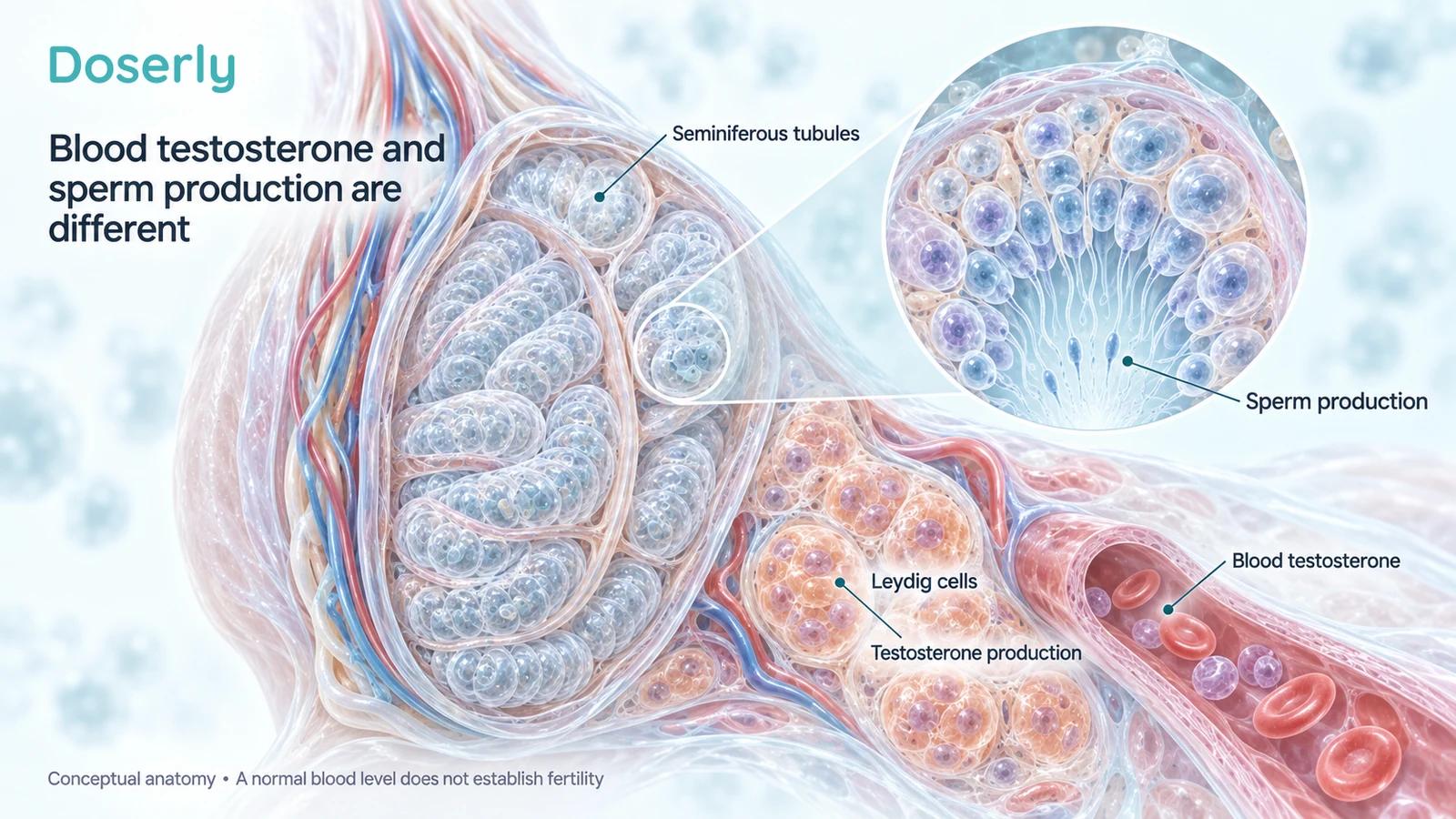
This issue can matter even when pregnancy is not an immediate goal. “Not this year” and “never” are different plans. Discussing future fertility before treatment allows a clinician to consider the diagnosis, whether semen assessment is useful, and whether reproductive-specialist input is appropriate. The fertility preservation guide provides context for that conversation.
Recovery data also require care. An integrated analysis of 1,549 healthy men in hormonal male-contraception studies described recovery of sperm concentration after treatment ended. Those participants were selected for contraceptive research, not long-term hypogonadism treatment. Their recovery estimates should not become a personal countdown for a man with underlying testicular disease or previous cancer treatment. Spermatogenic recovery analysis
Recovering to a sperm-concentration threshold is not the same endpoint as achieving a pregnancy. A reassuring average cannot guarantee an individual's timing or outcome.
Eligibility can matter more than the average age
Even within an eligible age range, researchers select participants. A study may exclude men with a particular cancer history, unstable illness, a raised hematocrit or a near-term fertility goal. Those exclusions improve safety or help isolate the research question, but they also create boundaries around the result.
Suppose a 46-year-old meets a trial's age criterion but has a medical condition the investigators excluded. His age does not restore the missing evidence. Conversely, a 40-year-old with a well-established diagnosis may share important physiological features with older participants even though a specific event-rate estimate cannot be transferred directly.
Look for the eligibility section rather than relying only on the average age reported in a news story. An average hides the youngest and oldest participants and says little about how many people resembled a particular patient. If an age-subgroup result is reported, ask whether the trial was designed to evaluate that subgroup or whether the analysis is exploratory. A small subgroup can provide a useful clue without a precise estimate.
Duration is a separate limitation from age
A study can include the right age group and still be too short for the decision being considered. Twenty weeks may reveal a change in body composition. It cannot directly measure a lifetime of cardiovascular events, reproductive consequences or treatment burden.
The reverse also matters: longer follow-up does not repair a mismatch in diagnosis or treatment. Three years of a monitored gel regimen in men with cardiovascular risk is not automatically equivalent to three years of a different formulation, exposure pattern or monitoring practice.
This is why “long-term safety has been proven” needs an actual duration attached. Ask how long participants were treated, how long they were followed, and which events investigators collected. Treatment duration and follow-up duration may differ; TRAVERSE's mean follow-up should not be described as if every participant received uninterrupted treatment throughout it.
Uncertainty about decades of exposure does not require ignoring shorter-term evidence. It means a decision may need periodic reassessment instead of a one-time promise that all future outcomes are settled.
Read the outcome before judging the result
A trial can show that testosterone concentrations increased without demonstrating that the symptom a patient cares about improved. It can show more lean mass without better quality of life. It can meet a cardiovascular noninferiority criterion without proving that every adverse event is equally likely.
For a younger patient, defining the treatment goal makes these distinctions practical. If the goal is improved sexual desire, a muscle study provides indirect support at best. If the concern is infertility, a normal serum testosterone result does not answer it. If fatigue is the concern, improvement in a laboratory measurement should not automatically end the search for another contributor.
These examples are evidence-reading principles, not a substitute for an individual assessment. The point is to make the desired benefit explicit enough that a clinician and patient can recognize whether it has occurred.
A useful appointment starts with the missing details
Bring a short account of symptoms, their timing, prior hormone results and the circumstances of those tests. Include medications or previous hormone use, relevant illnesses, cancer treatment if applicable, and fertility plans. These details help a clinician decide which evidence applies and which additional evaluation matters.
For a study you want to discuss, four questions usually get further than asking whether TRT is “safe” in the abstract:
- How closely do the participants match my diagnosis and health history?
- Did the study measure the benefit or risk that matters to this decision?
- Does its formulation and treatment exposure resemble the proposed treatment?
- What does its follow-up leave unresolved for someone my age?
If treatment is started, a simple record of the prescribed formulation, administration dates, symptoms and clinician-directed measurements can support follow-up. Doserly can help organize that record; tracking does not determine the diagnosis, preserve fertility or make a dose adjustment appropriate.
It is also worth agreeing on what would count as a meaningful response. A patient and clinician can otherwise reach different conclusions from the same visit: one sees a normalized blood result, while the other still sees the symptom that prompted treatment. A stated goal gives later evidence something concrete to inform.
Age limits are boundaries, not verdicts
The strongest reading of the evidence avoids both extremes. Older-men trials do not answer every question for younger men, and their age restrictions do not establish that younger men cannot benefit from treatment for confirmed hypogonadism.
For a younger patient, the most consequential gaps often concern diagnosis, fertility and duration—not simply the birth date of the average participant. Matching those features to the research produces a more useful conversation than borrowing a headline from the largest available trial.
Sources
- Endocrine Society clinical practice guideline
- TRAVERSE cardiovascular safety trial
- Effects of Testosterone Treatment in Older Men
- Testosterone dose-response relationships in healthy young men
- Randomized trial in young male cancer survivors
- Integrated analysis of spermatogenic recovery