
TRT
October 16, 2026
TRT and exercise recovery: what stronger lifts can—and cannot—show
On this page
Testosterone affects muscle tissue, so it is reasonable to ask whether treating a genuine deficiency might change how exercise feels. Someone who regains strength or finds training easier may experience a worthwhile improvement. The challenge is describing exactly what improved without turning it into evidence for something else.
A heavier lift measures performance on that occasion. It doesn't tell us whether a tendon has healed, whether next week's workload is appropriate or whether treatment is safe over years. Those questions require different observations.
For men receiving testosterone replacement therapy, the useful approach is to consider training changes alongside the original indication, symptoms and safety monitoring. Our TRT muscle and fat-loss guide explains body-composition research more broadly. Here we'll focus on the meaning of “recovery” and the limits of interpreting personal bests.
Recovery can mean several different things
In everyday conversation, recovery may mean feeling less sore, being ready for another session, restoring performance after strenuous activity, or healing an injured tissue. These are not interchangeable outcomes.
Someone may feel ready to train while a painful tendon still needs assessment. Another person may increase their one-repetition maximum through better technique without any meaningful change in soreness. A third may gain lean mass but remain limited by breathlessness or another health problem.
This matters when interpreting both anecdotes and studies. A trial measuring muscle size cannot directly answer how quickly a person returns to sport after injury. A questionnaire about energy cannot establish whether a repaired tendon can tolerate a specific load.
Before linking recovery to TRT, define the problem you want to understand. Is it persistent fatigue between sessions? A decline in strength? A diagnosed injury? That description determines which evidence is relevant and which clinician or rehabilitation professional may be best placed to help.
Testosterone can affect muscle, but the exposure matters
A well-known 1996 randomized trial assigned 43 healthy men to testosterone or placebo, with or without a standardized resistance-training program, for ten weeks. Testosterone increased muscle size and strength, particularly with training. The experimental exposure was supraphysiologic, meaning above normal physiological replacement. Bhasin and colleagues
That experiment established a biological and performance effect under controlled conditions. It wasn't a study of routine replacement in men with confirmed hypogonadism, and it wasn't an injury-rehabilitation trial.
The distinction is important when impressive training numbers appear in a discussion of ordinary TRT. Results from a high-exposure experiment in healthy volunteers cannot be treated as expected gains from correcting deficiency. They also cannot establish that pursuing a larger effect is a favorable health trade-off.
Duration matters as well. Ten weeks is enough to observe some muscle changes, but not to characterize uncommon harms over many years. An intervention can produce a visible performance effect long before the full range of risks becomes clear.
A rapid rise in testosterone is not an instant recovery treatment
A smaller 2020 randomized trial studied a different question: whether a single mixed-ester testosterone administration improved performance 24 hours later in healthy young men. Nineteen men were randomized and 18 completed post-treatment testing.
Despite a marked increase in blood testosterone, the study found no clear acute benefit on the tested jump, cycling or arm-strength outcomes. It did not examine delayed training adaptations or injury recovery. Acute mixed-ester study
This is a useful limit on a common assumption. A hormone concentration can change quickly without producing an immediate improvement in every task affected by that hormone. Tissue adaptation, learning and rehabilitation have their own time courses.
It also means that feeling particularly strong shortly after an administration doesn't establish a pharmacological cause. The experience may be real, but the timing alone doesn't show how much treatment contributed.
Replacement trials measure different outcomes
The Testosterone Trials studied 790 symptomatic men aged 65 or older with low testosterone, using gel or placebo for one year. Among participants specifically enrolled in the Physical Function Trial, the primary walking-response outcome was not significantly improved. Some analyses across the broader group were more favorable. Testosterone Trials report
Walking capacity in older adults and weightlifting performance in healthy young volunteers are different clinical questions. Neither result can simply replace the other because both involve muscle.
For someone receiving replacement, it helps to match expectations to the outcome actually studied. Gaining lean mass, improving a strength test, walking farther and returning to work after injury each describe something different. A treatment may affect one more reliably than another.
The most useful personal goal is similarly specific. Being able to complete an everyday activity with less limitation can matter more than a change in body composition. Conversely, a larger muscle measurement may be interesting without resolving the symptom that originally led to treatment.
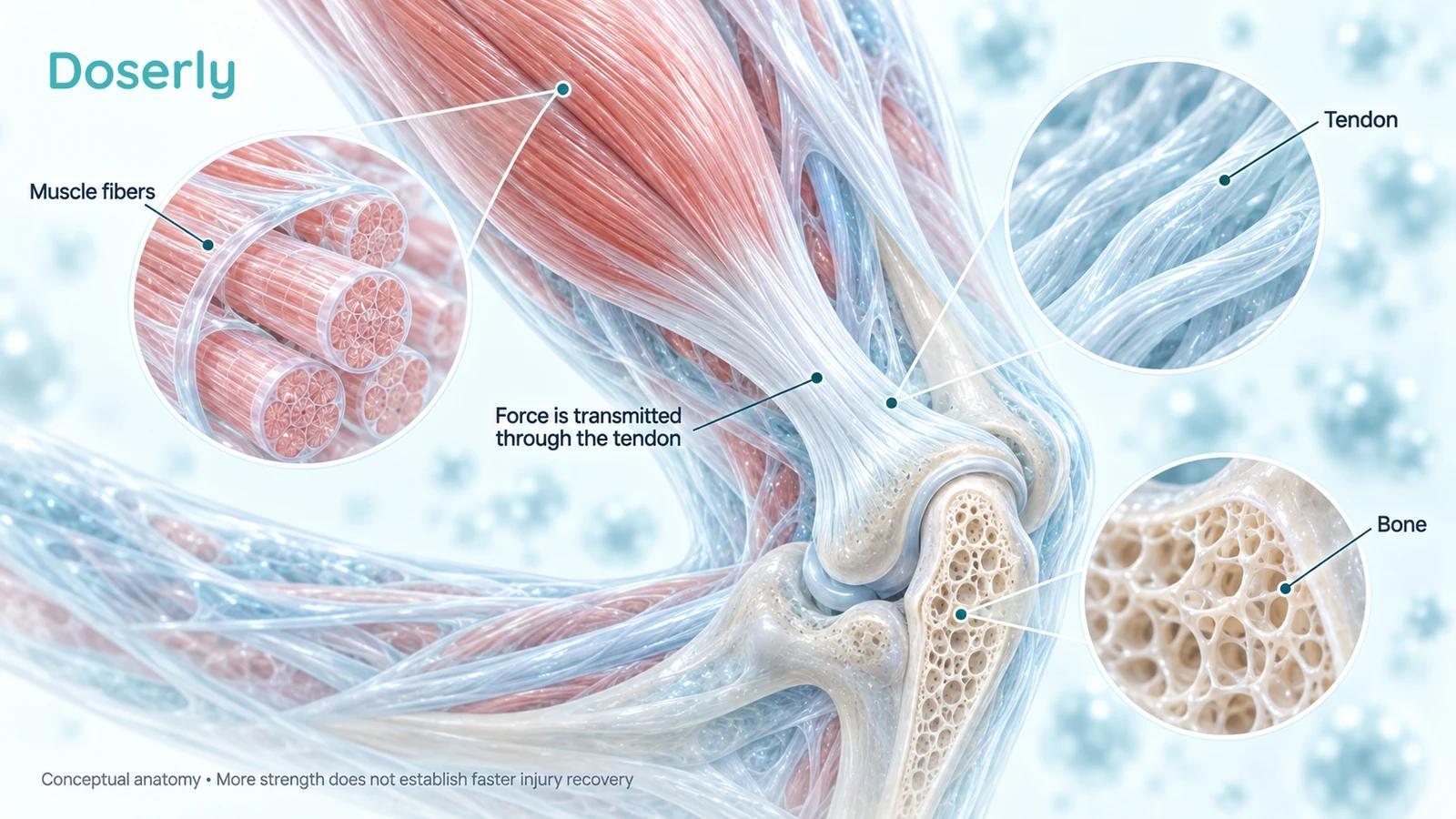
Muscle produces force, tendons transmit it and bones support movement. These tissues are illustrated conceptually. A change in muscle strength does not measure tendon healing, bone strength or readiness to return after an injury.
Bone findings show why one favorable measurement isn't enough
Testosterone research has reported favorable bone-density measurements in some settings. But a denser bone measurement and fewer clinical fractures are not the same endpoint.
In the TRAVERSE fracture study, clinical fractures occurred in 91 of 2,601 testosterone participants, or 3.50%, and 64 of 2,603 placebo participants, or 2.46%. The hazard ratio was 1.43, with a 95% confidence interval of 1.04–1.97. Testosterone did not reduce fracture incidence in this population. Fracture trial
That finding should not be converted into an unsupported claim that testosterone directly weakened bone or that a particular exercise caused the difference. The trial outcome identifies what happened, while the mechanism needs separate investigation.
It does undermine the simple inference that an anabolic effect guarantees protection from injury. The participants were middle-aged and older men with hypogonadism and cardiovascular disease or risk factors; the result is not a personalized fracture prediction for every person on TRT.
If you have an injury, its diagnosis and rehabilitation plan remain important even when training performance improves elsewhere. A stronger lift is not a substitute for an assessment of the injured structure.
What the major cardiovascular trial actually tells us
TRAVERSE randomized 5,246 men aged 45–80 with symptoms, repeated low testosterone measurements and cardiovascular disease or increased risk. It compared testosterone gel with placebo and followed participants for an average of about 33 months.
The primary combined cardiovascular outcome occurred in 182 testosterone participants and 190 placebo participants. The hazard ratio was 0.96, with a 95% confidence interval of 0.78–1.17, meeting the trial's criterion for noninferiority. This was reassuring for the tested outcome under the study conditions. TRAVERSE primary report
Noninferiority does not mean no adverse events occurred or that every possible harm was excluded. Atrial fibrillation, acute kidney injury and pulmonary embolism were more frequent in the testosterone group. The trial also did not test arbitrary high-exposure regimens, combinations of performance-enhancing drugs or decades of use.
Someone's gym record cannot reproduce this kind of comparison. A personal best contains no information about what would have happened without treatment or how the probability of uncommon events changed.
Blood pressure still needs measurement
In February 2025, FDA revised testosterone labeling after reviewing TRAVERSE and separate ambulatory blood-pressure studies. It removed cardiovascular-risk language from the boxed warning while requiring information about increased blood pressure across the testosterone class. FDA communication
These actions addressed different evidence. Reassurance about the trial's major cardiovascular endpoint did not erase the blood-pressure findings.
Blood pressure may not track with how strong or energetic someone feels. A person can train well and still need a review of their readings. That is why safety monitoring should continue even when treatment seems to be helping exercise.
The same reasoning applies to other planned checks. Hormone exposure, blood counts and symptoms provide different information. No single favorable measurement replaces the rest of the care plan.
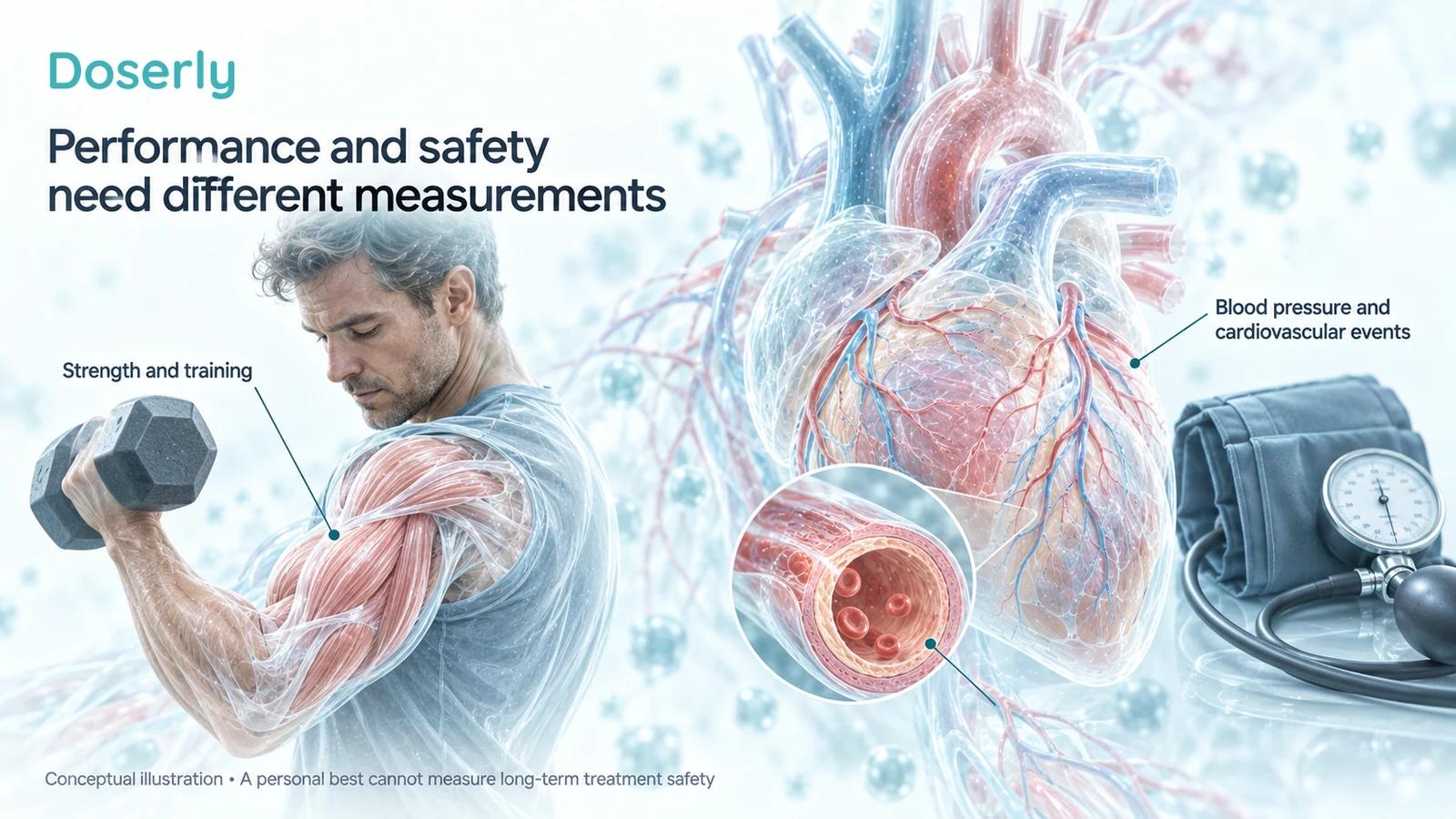
Strength and safety are assessed differently. The anatomy and equipment are illustrative; this image contains no participant data and does not imply that exercise performance predicts cardiovascular risk.
How to interpret your own training improvement
A useful record can preserve an experience without overclaiming its cause. Note the exercise, workload, repetitions and how demanding it felt, along with meaningful changes in sleep, illness, diet or the training program.
Consistency matters more than detail for its own sake. Comparing a carefully performed lift with a different technique or shorter range of motion may overstate progress. Comparing a rested session with one after poor sleep can obscure it. The goal is not laboratory perfection, but enough context to understand the trend.
Avoid treating soreness as a direct measure of productive training or tissue healing. Less soreness may feel better, but it doesn't by itself identify which tissue adapted or whether loading is appropriate after injury. Likewise, a single unusually good session may not represent a durable change.
If you are working with a clinician or physiotherapist, agree on the outcomes that matter for your situation. Those might include a specific functional task, a symptom pattern, adherence to rehabilitation or a return-to-activity assessment.
Keep training goals separate from prescription decisions
A prescribed hormone treatment can have benefits while still requiring boundaries around its purpose. The Endocrine Society recommends treatment for appropriately diagnosed hypogonadism and assessment of both response and adverse effects. Clinical guideline
A plateau in the gym does not establish inadequate replacement. Training progress can change for many reasons, and a treatment target intended to address deficiency is not automatically a target for maximum athletic performance.
If exercise tolerance deteriorates, describe the problem rather than assuming the dose needs to rise. New breathlessness, chest discomfort, fainting or marked weakness needs clinical assessment. A painful injury needs attention to its cause and loading demands, even if testosterone results are within range.
This approach also makes the benefit discussion clearer. You can value an improvement in function without using it as proof that every aspect of treatment is safe or that more exposure would be better.
Questions that connect the research to your situation
Ask what evidence applies to your diagnosis and formulation, and whether the desired outcome is muscle mass, strength, fatigue or recovery from a specific injury. If a claim relies on a study in healthy volunteers receiving supraphysiologic testosterone, ask how that relates to replacement treatment.
Discuss how training and rehabilitation should progress independently of the hormone prescription. Agree on which symptoms and safety measurements would prompt review, rather than waiting for performance to decline.
Our TRT heart-health guide explains the cardiovascular evidence in greater detail. Improvement in the gym can be meaningful, but it belongs alongside direct assessment of health, function and treatment response.
Sources
- Supraphysiologic testosterone and muscle strength, 1996.
- Mixed-esters acute performance experiment, 2020.
- Testosterone Trials, 2016.
- TRAVERSE cardiovascular trial, 2023.
- TRAVERSE fracture study, 2024.
- FDA labeling update, 2025.
- Endocrine Society guideline, 2018.