
TRT
October 16, 2026
TRT After Cancer Treatment: Why a General Safety Headline Is Not Enough
On this page
After cancer treatment, low energy, reduced sexual desire or a changed body can feel like unfinished business. A reassuring headline about testosterone replacement therapy (TRT) may seem to offer a direct answer. But “men with low testosterone” and “men after cancer treatment” are not interchangeable research populations.
The relevant details include the cancer type, treatment received, current disease status, reason for low testosterone and the benefit being sought. A man with testicular dysfunction after cancer therapy faces a different question from someone whose prostate-cancer treatment deliberately lowered androgen activity.
Research can help, including a new randomized prostate-cancer survivor trial published in 2026. It cannot replace those distinctions. The most useful conversation separates four questions: whether there is a hormone deficiency, whether TRT can improve a particular outcome, what remains uncertain about cancer safety, and how fertility fits the plan.
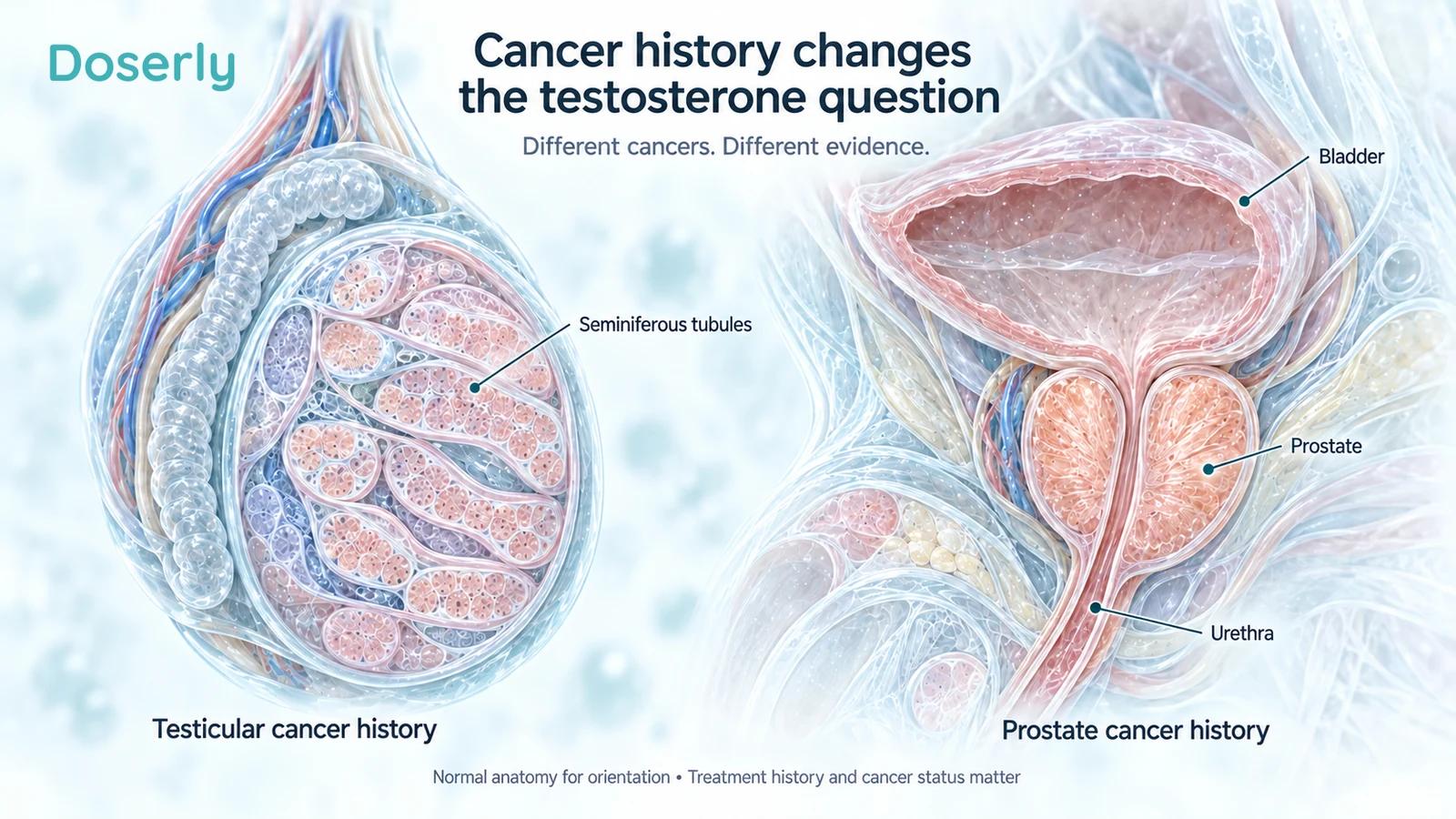
Start with the diagnosis behind the symptoms
Fatigue or sexual difficulties after treatment deserve attention, but they do not identify a single cause. The National Cancer Institute explains that cancer therapies can affect sexual function through hormones, nerves or blood vessels. Medicines, pain, sleep problems and emotional distress can also contribute. NCI sexual-health information
That makes a hormone result part of an assessment rather than a complete explanation. The Endocrine Society recommends diagnosing hypogonadism using relevant symptoms or signs together with unequivocally and consistently low testosterone, then investigating whether the problem is primarily testicular or involves hypothalamic-pituitary signaling. Endocrine Society guideline
For a survivor, the treatment history helps interpret that evaluation. Which organs or hormonal pathways were affected? Was testosterone intentionally suppressed? Is recovery still being assessed? Are there other contributors to the symptom that prompted testing?
These questions do not minimize the symptom. They make it more likely that the proposed treatment addresses the actual problem.
What a younger-survivor trial found
A 2019 randomized trial enrolled 136 male cancer survivors aged 25 to 50 with borderline-low morning testosterone. Most had survived testicular cancer; smaller groups had lymphoma or leukemia. Participants were at least a year beyond curative treatment, and hormone-dependent cancers were excluded.
Over 26 weeks, testosterone gel improved body composition compared with placebo. Whole-body fat mass was about 1.8 kg lower and lean mass about 1.5 kg higher in the adjusted between-group comparisons. The trial did not show improvement in its measured quality-of-life outcomes. Young male cancer-survivor trial
Those are useful, specific findings. They do not demonstrate that every survivor with fatigue will feel better, that treatment is suitable after every cancer, or that recurrence risk is settled.
The distinction between body composition and quality of life is especially relevant to expectations. A patient seeking help with exhaustion may value a change in lean mass, but the two outcomes should not be presented as if they were the same benefit.
What changed with the 2026 prostate-survivor trial
A randomized trial published in 2026 studied 136 men with symptomatic hypogonadism after radical prostatectomy for organ-confined, low-grade prostate cancer. Participants had Gleason 6 or 7 disease with the specified low-grade pattern, undetectable PSA for at least two years, and repeatedly low testosterone.
Twelve weeks of testosterone cypionate improved sexual activity and desire compared with placebo; erectile function did not improve. No participant in either group experienced biochemical recurrence during the trial. The investigators explicitly state that the study was too small and too short to evaluate clinical recurrence or long-term safety. Its findings do not apply to men with high-grade disease or those treated with radiation or androgen-deprivation therapy. 2026 prostate-cancer survivor trial
This is meaningful new randomized evidence. It supports discussing short-term benefit in a narrowly defined group. It does not establish a universal waiting period after surgery or show that TRT is appropriate once any patient reaches two years with an undetectable PSA.
An eligibility rule tells you whom investigators studied. It is not automatically a treatment rule for everyone else.
The study defined biochemical recurrence using a PSA threshold of at least 0.2 ng/mL. That is a study endpoint, not a universal instruction for when a survivor should call a clinician. A personal surveillance plan may respond to a trend or other findings in the context of the prior treatment. Keeping the endpoint explicit also prevents a result about a blood marker over a short period from being described as a definitive test of future clinical recurrence. 2026 trial
Why TRAVERSE does not answer the recurrence question
TRAVERSE is often invoked in broad testosterone-safety discussions. Its prostate-safety analysis included 5,204 men with hypogonadism who were carefully screened to exclude important prostate-cancer risk features. A history of prostate cancer was excluded.
High-grade prostate cancers were uncommon: five cases in the testosterone group and three in the placebo group. The difference was not statistically significant, and the confidence interval was wide. Other assessed prostate events also did not differ significantly. TRAVERSE prostate-safety analysis
That analysis concerns prostate events in a screened population without a previous prostate-cancer diagnosis. It cannot directly estimate recurrence after cancer treatment, because that is a different event in a different population.
When someone cites TRAVERSE as proof that TRT is safe “after cancer,” the missing step is not a minor technicality. The relevant patients were not enrolled. Our TRT and prostate guide provides broader context for PSA, symptoms and prostate-safety evidence.
Benefit and cancer safety need separate endpoints
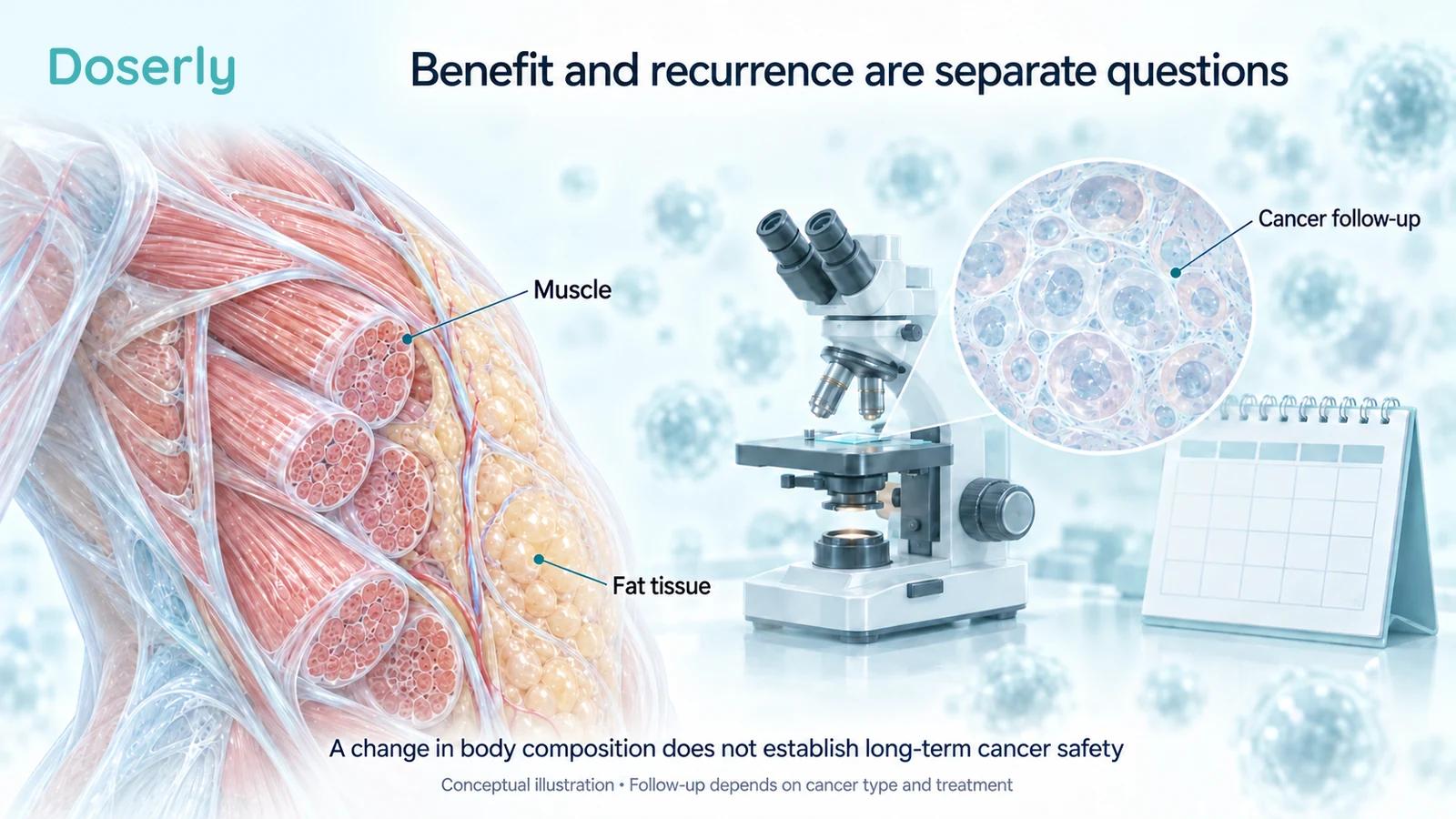
A trial can establish a short-term improvement in sexual activity or body composition without having enough participants or follow-up to evaluate cancer recurrence. Both findings can be reported honestly: there was a measured benefit, and an important safety question remains unresolved.
Similarly, no recurrence observed during a short study does not mean recurrence is impossible. The result describes what happened during observation; it does not make future events disappear.
This matters when judging a headline's strongest word. “Improved” needs an outcome attached. “Safe” needs a population, treatment exposure, duration and set of events attached. Without those details, a reader can mistake a limited but valuable study for a comprehensive answer.
The 2019 and 2026 survivor trials should therefore be read together as different pieces of evidence, not merged into one claim that testosterone has been proven safe for cancer survivors generally.
The 2026 label announcement needs a date and a verb
On June 18, 2026, HHS announced that FDA was requesting changes to testosterone-product labeling. The requested revisions included prostate-cancer information, benign prostatic hyperplasia warnings and the limitation concerning age-related hypogonadism.
For prostate cancer, the announcement described a proposed contraindication limited to metastatic disease. It also retained the need for risk assessment, screening and monitoring, and acknowledged uncertainty about long-term effects. HHS announcement
“Requested” matters. The announcement does not verify that every manufacturer has implemented identical language in every label. A clinician still needs the current prescribing information for the actual product and the patient's oncologic context.
Older guidelines and newer regulatory announcements may therefore use different wording. A responsible discussion names their dates instead of pretending the disagreement does not exist. Neither a label revision nor a safety headline determines the best decision for a particular survivor.
Fertility is not a testosterone-level question
Cancer and its treatment may affect sperm production, reproductive organs and the endocrine system. The extent depends on the treatment, exposure, baseline fertility and other individual factors. The NCI recommends discussing fertility and preservation options with the care team; sperm banking is an established option for postpubertal males when feasible, ideally considered before treatment. NCI fertility information
For someone already through treatment, the question becomes what fertility assessment and reproductive advice are appropriate now. A normal blood testosterone result cannot substitute for that evaluation.
Exogenous testosterone can suppress sperm production, and the Endocrine Society recommends against starting it in men planning fertility in the near term. Endocrine Society guideline That issue remains relevant even if the original cause of low testosterone was cancer therapy.
The fertility-preservation guide offers background for discussing goals with the treating clinician and, when appropriate, a reproductive specialist. It should not be used to promise that fertility will recover or that a particular add-on regimen will preserve it.
Desire, erections and fertility should not be bundled together
A survivor may use “sexual function” to describe several different concerns: wanting sex, getting or maintaining an erection, orgasm, ejaculation or having a biological child. These are related experiences, but they are not one interchangeable treatment outcome.
That distinction makes the 2026 trial's pattern understandable: sexual activity and desire improved while erectile function did not. It also fits the NCI's explanation that pelvic treatments can affect nerves or blood vessels, not only testosterone. A hormone-focused treatment may therefore leave another part of the problem unresolved.
A useful appointment begins with the specific concern. “My desire has changed” provides different information from “I want sex but cannot maintain an erection.” Fertility goals add another question entirely.
This level of detail can be uncomfortable to raise, but it prevents the word “testosterone” from becoming a shortcut around a more useful assessment. It also gives the patient and clinician a clearer way to judge whether treatment is helping.
Build the decision around the actual cancer history
Before discussing TRT, assemble the diagnosis and treatment details that determine whether a study resembles your situation. Useful information includes the cancer type, stage or grade when relevant, treatment dates, surgery, radiation, chemotherapy or hormone therapy, and the current surveillance plan.
Bring prior hormone results with dates and units, a symptom timeline, current medications and fertility goals. If different teams hold different parts of the record, ask who will coordinate the endocrine and cancer-related decisions.
The most productive questions are specific:
- Which parts of the available research apply to my cancer and treatment history?
- Is there a confirmed hormone deficiency, and what is its likely cause?
- What outcome are we trying to improve, and how will we recognize improvement?
- What cancer-related uncertainty remains in my situation?
- Who will review surveillance results and respond to a concerning change?
This is a decision framework, not a request for a standard panel or monitoring schedule. The appropriate surveillance depends on the cancer, treatment and clinical situation.
Follow-up should preserve both sides of the decision
If treatment is chosen, follow-up needs to address benefit as well as safety. A laboratory result can show exposure without establishing that the original symptom improved. Conversely, feeling better does not replace cancer surveillance or the usual TRT monitoring.
Agree on how the relevant clinicians will share results and which changes should trigger contact. A clear plan is more useful than a vague instruction to “keep an eye on it,” particularly when oncology, urology and primary care are all involved.
A dated record of prescribed treatment, symptoms, laboratory testing and appointments can support that coordination. Doserly can help organize the record; it does not interpret recurrence risk or replace the care team's surveillance plan.
The evidence supports a more precise conversation than either blanket reassurance or blanket dismissal. Cancer survivors have different diagnoses, different treatment histories and different goals. Their testosterone decisions should retain those differences.
Sources
- Endocrine Society clinical practice guideline
- 2019 randomized trial in young male cancer survivors
- 2026 randomized prostate-cancer survivor trial
- TRAVERSE prostate-safety analysis
- June 2026 HHS requested-label-update announcement
- NCI: Male Fertility and Cancer Treatment
- NCI: Sexual Health Issues in Men with Cancer