
HRT
October 16, 2026
The Underreported Menopause Story: Recurrent Urinary Symptoms
On this page
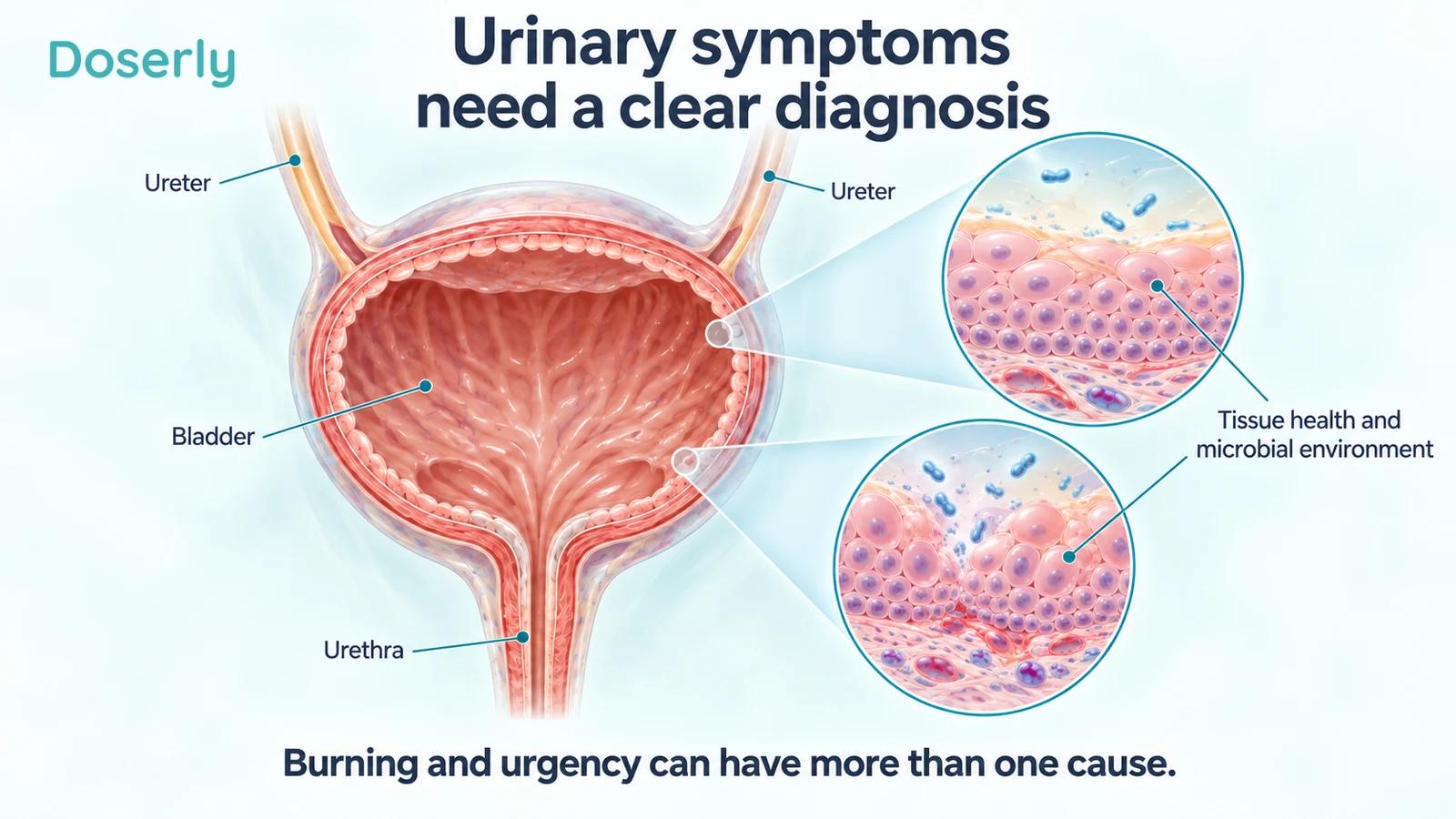
Burning, urgency and repeated trips to the bathroom can become the most disruptive part of menopause, even when hot flashes receive more attention. The difficult part is that these symptoms do not point to one diagnosis. A new bacterial infection, menopause-associated tissue changes and another bladder or pelvic condition can feel surprisingly similar.
That uncertainty matters. Repeated antibiotics will not address every cause of persistent burning. Vaginal estrogen is not an antibiotic for an infection that is already present. A useful plan separates three questions: what is causing today's symptoms, whether infections are genuinely recurring, and what could reduce the chance of another episode.
Menopause belongs in that assessment. It should neither be ignored nor used as an explanation that closes the investigation too early.
Why menopause enters the urinary conversation
The term genitourinary syndrome of menopause, or GSM, was introduced to describe a broader set of changes than vaginal dryness alone. The original consensus definition includes urinary urgency, painful urination and recurrent urinary tract infections alongside genital and sexual symptoms. It also specifies that another diagnosis should not better explain the symptoms. GSM consensus statement, 2014
Estrogen-responsive tissues extend through the lower genitourinary tract. Changes in local tissue and the vaginal microbial environment can affect susceptibility to symptoms and infection. This is why a vaginal treatment may be relevant to a urinary problem without being placed in the bladder.
The 2025 AUA/SUFU/AUGS guideline emphasizes that GSM is diagnosed from symptoms, with or without associated physical findings, after other causes and coexisting conditions are considered. Urgency, for example, also occurs with overactive bladder. The same person can have more than one contributor. GSM guideline, 2025
The GSM guide can help put urinary and vaginal symptoms into the same history. That history is more informative than assuming a normal-looking urine sample settles every question.
Recurrent symptoms and recurrent infection are different histories
Recurrent UTI is commonly defined as at least two infections within six months or three within twelve months. The crucial word is infections. Six episodes of burning, without evidence that each was bacterial cystitis, do not automatically establish the same diagnosis as six documented infections. NICE recurrent UTI visual summary
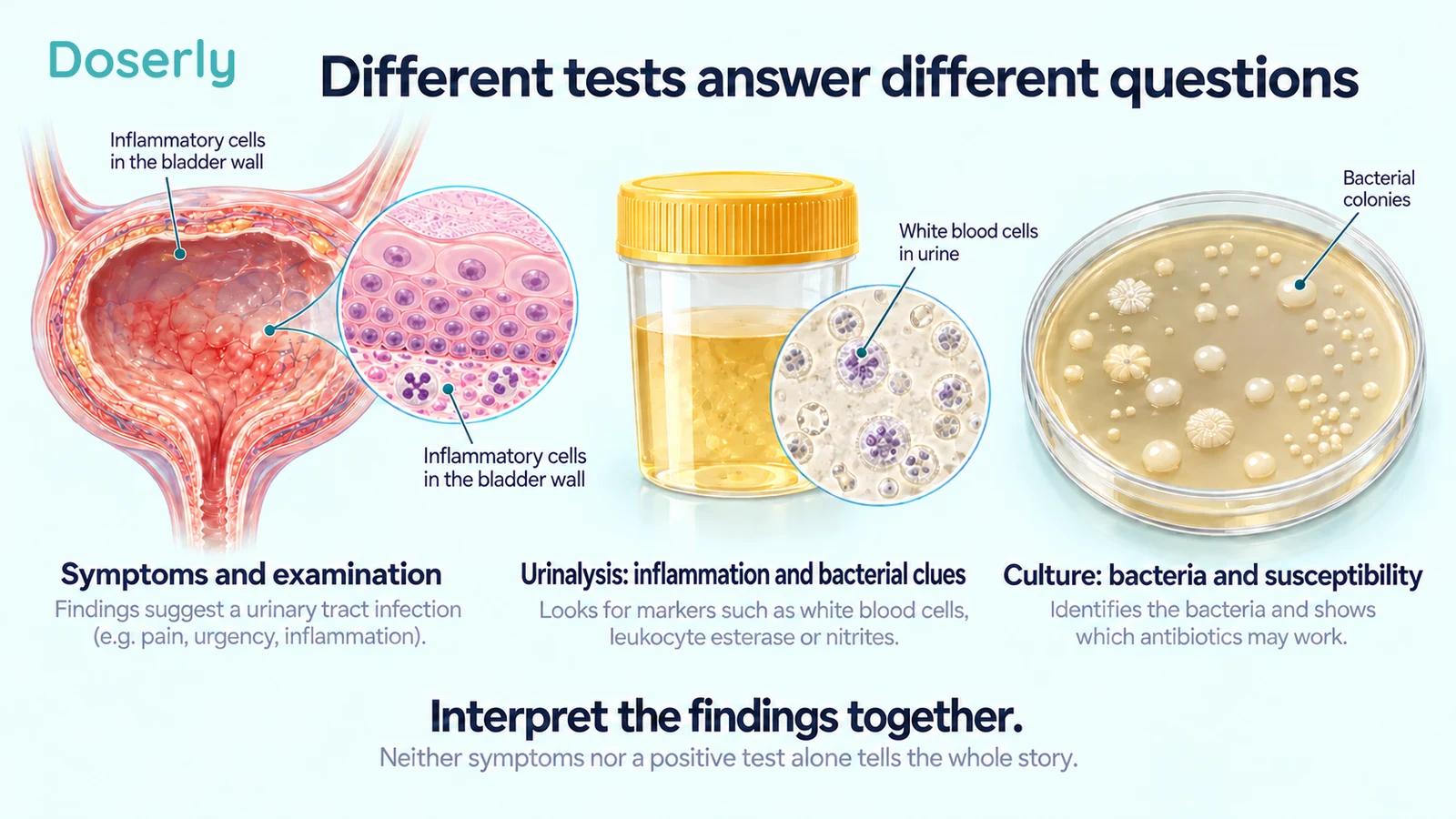
The updated AUA/CUA/SUFU guideline brings symptoms, urinary inflammation and evidence of a urinary pathogen together. A urine culture can identify bacteria and support antibiotic selection; urinalysis contributes information about inflammation. A positive test without a matching illness and symptoms without supportive testing each need interpretation. Recurrent UTI guideline, 2025
Tests also have limitations. Contamination, specimen timing and imperfect sensitivity can complicate a result. A negative culture should not be used to dismiss persistent pain, but it should prompt a wider assessment rather than an automatic assumption that another antibiotic is needed.
For someone seeing different clinicians at successive episodes, the history can become fragmented. Bring the dates of symptoms, cultures, organisms identified and treatments together. “I have had three positive cultures” gives different information from “I have had three antibiotic prescriptions.”
What to do with symptoms happening now
A prevention plan is not a substitute for assessment of a current episode. NIDDK advises contacting a healthcare professional for symptoms of a bladder infection. Fever or chills, nausea or vomiting, and pain in the back, side or groin can indicate a kidney infection and require prompt treatment. NIDDK symptom guidance
This distinction remains important after vaginal estrogen has been started. A preventive treatment can reduce the probability of future infection without making a new infection impossible. Do not wait for estrogen to work if new symptoms suggest an active infection or a more serious illness.
Similarly, a familiar pattern is not proof that the cause is unchanged. Tell the clinician if the current episode includes features that were absent before, if symptoms returned soon after treatment, or if discomfort never actually resolved. Those details affect the next diagnostic question.
What the original vaginal-estrogen trial found
A landmark randomized trial enrolled 93 postmenopausal women with recurrent UTIs and compared intravaginal estriol cream with placebo for eight months. The reported infection rate was 0.5 episodes per patient-year with estriol versus 5.9 with placebo. Only 36 of 50 estriol participants and 24 of 43 placebo participants completed follow-up, which is important context for a small study. Raz and Stamm trial, 1993
The investigators also measured vaginal cultures and pH. Lactobacilli reappeared after one month in 61% of evaluated estriol recipients and none of the placebo recipients; vaginal pH fell with estriol. These observations supported a change in the local microbial environment as a plausible mechanism.
The result was prevention during follow-up, not immediate eradication of a bladder infection. It also involved a specific estriol preparation and selected postmenopausal participants. The striking difference should not be converted into a guarantee that any estrogen product will produce the same reduction for everyone.
A newer trial supports the idea, with important size limits
A later randomized trial compared contemporary vaginal estrogen delivered by a ring or cream with placebo cream. Thirty-five women were randomized, and nine dropped out before six months. Because recruitment was slower than expected, the two estrogen groups were combined for analysis. Ferrante and colleagues
In the intention-to-treat analysis, which counted dropouts as failures, 11 of 18 estrogen participants had a UTI within six months, compared with 16 of 17 placebo participants. That favored vaginal estrogen, but the numbers were small and the comparison was not designed to establish that ring and cream were equally effective.
It also makes an often-missed point visible: many participants still developed a UTI while receiving estrogen. Prevention is a reduction in risk, not immunity. A breakthrough episode does not automatically prove that treatment has no value, although continuing episodes should lead to a review of the diagnosis and the overall plan.
The 2026 application trial answers a narrower question
The TAPER trial randomized 114 postmenopausal participants with laboratory-proven recurrent UTI to two ways of applying estradiol cream. About half in each group remained UTI-free at six months: 50.9% with periurethral application and 52.6% with intravaginal application. TAPER trial, 2026
The authors concluded that the periurethral method was noninferior under their prespecified design. However, the noninferiority margin was 25 percentage points, and the confidence interval for the difference ranged from −20.0 to 17.0 percentage points. That is a wide range, not proof that the methods are identical.
The trial was single-center and unblinded, and most participants were White, with a mean age of about 71. It compared two active application strategies rather than estrogen with placebo. It can inform a clinician's discussion about practical alternatives, but it is not a reason to change application instructions or quantities independently.
Why systemic HRT is not the same prevention strategy
NICE advises against offering systemic HRT specifically to reduce recurrent UTI risk. Its guidance distinguishes systemic hormone exposure from low-dose vaginal treatment. A patch prescribed for hot flashes should therefore not be assumed to provide the same recurrent-infection benefit as a locally directed regimen. NICE recurrent UTI guideline
This does not mean that someone already using systemic HRT has exhausted hormonal options for local symptoms. It means the clinician should identify the treatment target and choose the appropriate formulation. The vaginal estrogen therapy guide explains that product distinction in more detail.
A medication review should include local treatment even if it does not feel like a “main” prescription. Cream, inserts and rings can be omitted from lists focused on tablets, leaving the clinician without a complete picture of what has been tried.
Persistent symptoms after treatment need a fresh question
The recurrent UTI guideline recommends evaluating alternative causes when symptoms persist after microbiological cure. That is an important change of question: the goal becomes understanding the remaining discomfort, rather than repeatedly treating an organism that is no longer demonstrated. Recurrent UTI guideline, 2025
GSM, overactive bladder and other pelvic or urinary conditions can overlap. A clinician may need to revisit the examination, the timing of symptoms and whether the discomfort is mainly external, associated with bladder filling, or occurring during urination. No single description diagnoses the cause, but precise language makes the assessment more useful.
Consider two patterns. One person becomes well between clearly documented infections. Another has continuous burning that briefly improves during treatment but never disappears. Those histories may require different investigations even if both people describe the problem as “constant UTIs.”
A normal or negative test does not make ongoing symptoms unimportant. It changes what evidence is available and what should be investigated next.
Prevention can involve more than estrogen
Some people need a broader prevention plan. The ALTAR trial compared methenamine hippurate with daily low-dose antibiotic prophylaxis in women with recurrent UTIs. During twelve months, antibiotic-treated infection rates were 1.38 episodes per person-year with methenamine and 0.89 with antibiotics. The difference met the trial's prespecified noninferiority criterion. ALTAR trial, 2022
This was an open-label trial in adult women, not exclusively a menopause trial and not a comparison with vaginal estrogen. Its relevance is that prevention options can be discussed separately from repeated treatment of acute episodes. It does not establish that methenamine and estrogen are substitutes or that combining them necessarily adds benefit.
The appropriate choice depends on the documented pattern, prior cultures, other conditions, medication suitability and preferences. A clinician can explain why a strategy is being selected, what outcome will count as improvement and when it should be reviewed.
Make the next review easier to interpret
A useful log distinguishes symptoms from confirmed infections. For each episode, record when symptoms began, what they felt like, whether a urine sample was collected, the result if available, what treatment was prescribed and whether symptoms fully resolved.
Keep prevention treatment on a separate timeline. Record when it started, interruptions, application difficulties and adverse effects. That avoids attributing every good or bad week to a medicine that may have been used inconsistently or started only recently.
Do not label an untested episode as a confirmed UTI in the record. “Burning and urgency; no culture obtained” is accurate and still clinically useful. Likewise, a culture result should be recorded alongside whether symptoms were present rather than interpreted in isolation. AUA recurrent-UTI guideline
Doserly can help organize these dates for a clinician, especially when care is spread across urgent care, primary care and a specialist. The purpose is to make the history easier to assess, not to turn a tracking app into a diagnostic test.
Urinary symptoms deserve a place in menopause care. The most helpful response combines recognition of GSM with careful infection diagnosis, appropriate acute treatment and an explicit prevention plan. That approach takes the symptoms seriously without assuming that every episode has the same cause.
Sources
- GSM terminology consensus statement (2014)
- AUA/SUFU/AUGS GSM guideline (2025)
- NICE recurrent UTI visual summary
- AUA/CUA/SUFU recurrent UTI guideline, amended 2025
- NIDDK: bladder infection symptoms and causes
- Intravaginal estriol prevention trial (1993)
- Vaginal estrogen prevention randomized trial
- TAPER application-method randomized trial (2026)
- NICE recurrent UTI guideline, updated 2024
- ALTAR methenamine versus antibiotic prophylaxis trial (2022)