
HRT
October 16, 2026
The HRT timing hypothesis: what it means for heart health
On this page
Estrogen affects blood vessels, cholesterol handling and other processes relevant to cardiovascular health. That makes a reasonable question worth asking: could starting hormone therapy close to menopause have different effects from starting it many years later?
The timing hypothesis proposes that the cardiovascular response depends partly on when treatment begins and the condition of the underlying blood vessels. It has influenced research and clinical discussions. It does not mean that everyone who starts HRT early will avoid heart disease, or that treatment should be prescribed solely for that purpose.
For someone with disruptive menopausal symptoms, timing helps frame the benefit-risk conversation. For someone considering hormones only to prevent a heart attack, the required evidence is different. Looking at the actual timing studies shows why those questions should stay separate.
Why might earlier and later treatment differ?
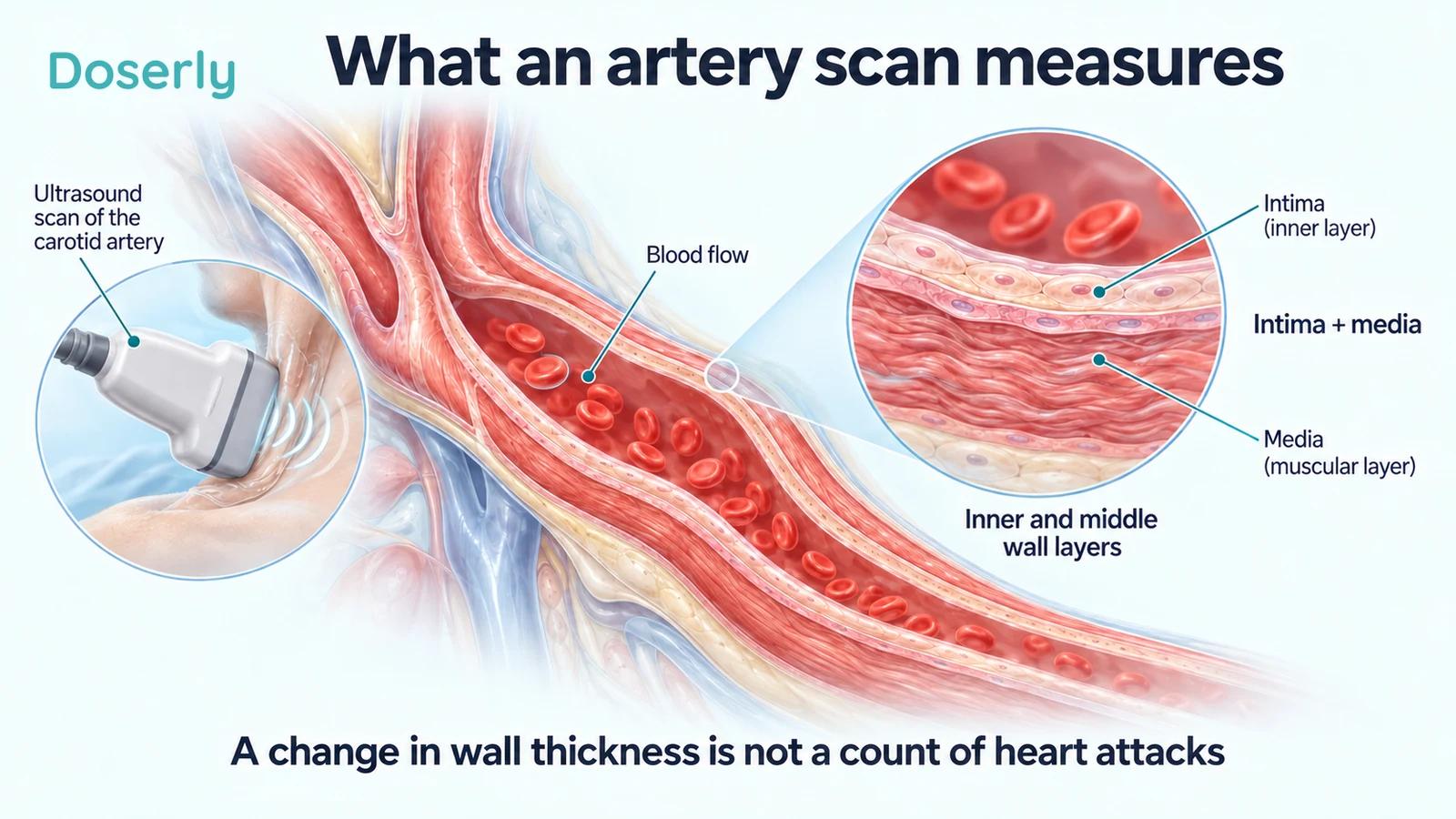
An artery is living tissue. Its inner surface, called the endothelium, helps regulate blood-vessel function. Beneath it are other layers, including smooth muscle. Over time, some arteries develop atherosclerosis, a process involving lipid accumulation, inflammation and plaque. Age, smoking, blood pressure, diabetes and other factors contribute to cardiovascular risk.
The biological idea behind timing is that adding estrogen to relatively healthy vessels might have different consequences from adding it when atherosclerosis is already established. This is a proposed explanation for differing findings, rather than a claim that every younger person's arteries are healthy or every older person's are diseased. ELITE was specifically designed to test a timing-related effect on artery-wall progression. ELITE primary report.
Age and years since menopause overlap but are not identical. Two people of the same age can have very different reproductive histories. Similarly, the same number of years since menopause does not imply identical blood pressure, cholesterol or previous cardiovascular events. A useful assessment considers these features together.
What did ELITE actually test?
ELITE randomized 643 healthy postmenopausal women within two groups: less than six years since menopause, or at least ten years since menopause. Participants received oral estradiol or placebo; those with a uterus also received sequential vaginal progesterone or matching placebo. The primary outcome was change in carotid intima-media thickness, or CIMT, measured with ultrasound.
After a median five years, CIMT progressed more slowly with estradiol in the early-menopause group. Average annual increases were 0.0044 mm with estradiol and 0.0078 mm with placebo. In the later-menopause group, the rates were not significantly different. The statistical interaction supported a difference in treatment effect between the timing groups. Cardiac CT measures of coronary calcium, plaque and narrowing did not differ significantly. ELITE primary report.
This is a positive finding for a specific artery-wall measurement. It is not a trial result showing a particular percentage reduction in heart attacks. Nor does the difference in millimeters indicate that arteries became younger or that existing plaque disappeared. Progression was slower in one group under the conditions studied.
Why an imaging result cannot stand in for a heart attack
Imaging can detect small structural changes before enough clinical events occur to make a trial feasible. That makes it valuable for testing biological hypotheses. But a medicine can influence more than one process at once, including pathways that an imaging measurement does not capture.
A heart attack typically involves a problem in coronary circulation supplying the heart muscle. Stroke concerns the brain's blood supply. Venous clots arise in another part of the circulation. Measuring layers of a neck artery does not count all of those events or reveal the complete safety profile of treatment.
The distinction is especially important when percentages are derived from small changes. A relative reduction in the rate of artery-wall thickening is a percentage of that measurement, not the same percentage fewer heart attacks. The denominator and outcome have changed. The most useful explanation keeps the original unit—millimeters per year—visible.

Did another early-menopause trial find the same thing?
The Kronos Early Estrogen Prevention Study, or KEEPS, enrolled 727 healthy women, aged 42–58, between six and 36 months after their last menstrual period. It compared low-dose oral conjugated equine estrogens, transdermal estradiol or placebo over four years, with cyclic oral progesterone in the active hormone groups.
Mean CIMT increases were about 0.007 mm per year across groups, without a significant treatment difference. The proportion showing an increase in coronary-artery calcium also did not differ significantly. Some cardiovascular risk markers improved, but the trial had insufficient statistical power to compare clinical cardiovascular events reliably. KEEPS primary report.
KEEPS therefore did not reproduce a benefit on artery-wall progression simply by enrolling people close to menopause. Its participants and regimens differed from ELITE's, so the studies are not identical tests. Together, they argue against a rule that early initiation must improve every vascular measurement.
They also illustrate why a better cholesterol or insulin-resistance measurement is not the final answer. Those changes can be informative without demonstrating that the treatment reduces clinical disease overall.
What about studies that measured actual events?
The Danish Osteoporosis Prevention Study provides a frequently cited example. It randomized 1,006 recently postmenopausal women to hormone therapy or no treatment in an open-label design, meaning treatment allocation was known. Women with a uterus received estradiol plus norethisterone acetate; those with hysterectomy received estradiol alone.
After ten years, its combined outcome of death, hospitalization for heart failure or myocardial infarction occurred in 16 treated participants and 33 controls. The hazard ratio was 0.48, with a 95% confidence interval of 0.26–0.87. Death alone occurred in 15 versus 26 participants, with an interval that crossed no difference. Danish trial report.
The combined result is encouraging and concerns clinical events rather than only scans. Its limitations still matter: the study was open-label, the number of events was small, and it studied particular regimens. Rare harms could not be excluded confidently. For example, only three deep-vein thromboses occurred across both groups, leaving very wide uncertainty around that safety estimate. “No significant increase” is not proof that an uncommon harm cannot occur.
How does the WHI timing analysis fit?
The Women's Health Initiative studied larger populations using oral conjugated equine estrogens, with or without medroxyprogesterone acetate depending on uterus status. A secondary analysis examined whether cardiovascular outcomes differed by age or time since menopause.
For coronary heart disease among participants less than ten years from menopause, the pooled hazard ratio was 0.76, with a confidence interval of 0.50–1.16. The point estimate favored hormones, but the uncertainty included no benefit. Results became less favorable farther from menopause, with a statistical trend across timing categories. WHI timing analysis.
This supports the relevance of timing, but it does not establish a precise heart-protection effect for an individual early starter. It is also a secondary analysis of two regimens, not a trial directly comparing early initiation of every modern formulation. Our WHI guide explains how the underlying trials differed.
The useful conclusion is narrower than either extreme: timing is clinically meaningful, and the evidence does not justify treating it as a guarantee of prevention.
Does established heart disease change the question?
Yes. Preventing a first event is called primary prevention. Preventing another event in someone with known disease is secondary prevention. A result in healthy, recently menopausal participants should not be transferred directly to people with established coronary disease.
The Heart and Estrogen/progestin Replacement Study, or HERS, enrolled 2,763 postmenopausal women with coronary disease, with an average age of about 67. It compared oral conjugated equine estrogens plus medroxyprogesterone acetate with placebo over an average 4.1 years. Heart attack or coronary death occurred in 172 hormone participants and 176 placebo participants; the relative hazard was 0.99, interval 0.80–1.22. The trial did not demonstrate overall coronary benefit and found more venous thromboembolic events with treatment. HERS primary report.
HERS does not answer whether a particular younger symptomatic person should receive a different regimen. It does show why hormone therapy should not be assumed to treat established coronary disease. A previous heart attack or other vascular event changes the assessment substantially and deserves specific discussion with the treating clinicians.
Why guidelines discuss a favorable window for symptom treatment
The Menopause Society's 2022 position statement describes a generally favorable benefit-risk balance for suitable people younger than 60 or within ten years of menopause who have bothersome vasomotor symptoms, provided contraindications are absent. It also recognizes bone-loss prevention and recommends individualized decisions and periodic review. Hormone-therapy position statement.
That recommendation weighs treatment benefits against risks in an appropriate clinical setting. It is not an instruction that everyone approaching 60 must start hormones before an opportunity disappears. A person without disruptive symptoms has a different benefit calculation from someone whose night sweats are severely impairing sleep.
Likewise, the age or timing boundary is not a switch that instantly changes biology on a birthday. It identifies patterns seen across populations and helps structure assessment. Personal history, treatment indication, route and formulation remain part of the decision.
What should heart prevention look like alongside menopause care?
The American Heart Association identifies the menopause transition as an important time to review cardiovascular health. Its scientific statement discusses changes in risk factors and the need for prevention strategies during midlife, while identifying continuing uncertainty about hormone formulations and cardiovascular outcomes. AHA scientific-statement summary.
That creates an opportunity to assess blood pressure, lipids, glucose, smoking, physical activity and other relevant factors rather than using a hormone prescription as a substitute for prevention. If treatment improves sleep or makes daily activity easier, that can be valuable, but it should not be recorded as proof that cardiovascular risk has fallen by a particular amount.
The US Preventive Services Task Force recommends against using systemic menopausal hormone therapy solely for primary prevention of chronic conditions. Its recommendation excludes management of menopausal symptoms and does not apply to premature or surgical menopause. Those scope limits help avoid using prevention guidance to dismiss a legitimate symptom-treatment discussion. USPSTF recommendation.
Questions that make the decision more concrete
Ask what problem the proposed hormone treatment is intended to solve and how improvement will be judged. Then ask how your age, time since menopause and cardiovascular history affect suitability. If heart protection is presented as a major benefit, ask which clinical-event study supports that claim for the proposed formulation.
It is also useful to separate the follow-up plans: one for symptoms and hormone tolerability, and another for blood pressure, cholesterol or other cardiovascular risks. Our getting started with HRT guide explains the broader treatment conversation.
The timing hypothesis gives clinicians a reason to pay attention to when treatment begins. Its strongest practical contribution is a more individualized assessment, supported by specific trial findings. It does not replace the evidence needed to prescribe a medicine for preventing heart disease.
Sources
- ELITE vascular timing trial, 2016.
- KEEPS arterial imaging trial, 2014.
- Danish early-menopause randomized trial, 2012.
- WHI age and timing secondary analysis, 2007.
- HERS secondary-prevention trial, 1998.
- The Menopause Society position statement, 2022.
- AHA menopause transition and cardiovascular-risk statement summary, 2020.
- USPSTF primary-prevention recommendation, 2022.