
TRT
October 16, 2026
An optimal testosterone level—for which outcome?
On this page
Testosterone influences muscle, blood-cell production, sexual function and other aspects of health. That broad role makes a single “optimal” level appealing: one number that promises more energy, better body composition and a lower risk of future illness.
The research doesn't establish such a number for everyone. A concentration associated with one outcome is not automatically the best target for another. A laboratory reference range also answers a different question from a treatment trial.
For someone considering or already receiving testosterone replacement, the useful starting point is the reason for treatment. Which symptom or health problem is being addressed, and how will benefit be assessed alongside adverse effects? Our TRT dosage guide discusses clinical management more broadly; this article explains why a target needs an outcome attached to it.
A reference range describes a population
A reference range usually describes the distribution of results in a selected group, measured using a particular method. It helps place a result in context. It doesn't identify the value that maximizes every aspect of health.
A 2017 study harmonized testosterone measurements across four US and European cohorts containing 9,054 men. In the healthy, nonobese subgroup aged 19–39, the reported interval was 264–916 ng/dL. Assay harmonization reduced differences between cohorts. Travison and colleagues
That interval is often repeated as though its upper end were a treatment destination. The study did not assign people to different targets or determine whether moving someone toward 916 improved health. It described a distribution in a defined population.
The distinction is familiar in ordinary measurement. Being near the top of a reference distribution is not, by itself, evidence of better function. A percentile tells you where a result sits among others; it doesn't explain what would happen if treatment moved it.
Laboratory methods matter too. A number from one assay may not be directly comparable with a number from another without appropriate calibration. This is one reason clinical interpretation uses the report's method, reference information and testing circumstances rather than a social-media target.
Diagnosis and treatment targets have different jobs
A diagnostic threshold helps assess whether a person may have a deficiency. A treatment target helps manage exposure after a diagnosis and treatment decision. Confusing them can create the impression that anyone above a cutoff is fully well or that anyone below a preferred number needs treatment.
The Endocrine Society recommends diagnosing hypogonadism using compatible symptoms and consistently low testosterone, with further evaluation of the cause. It suggests a mid-normal treatment range while considering the preparation and patient circumstances. Clinical practice guideline
The American Urological Association similarly connects therapeutic levels with symptom or sign improvement. Its guidance does not define success as achieving the highest possible result inside a laboratory interval. AUA guideline
These recommendations provide a clinical framework. They do not imply that one exact concentration is biologically ideal for every individual or that a nonspecific symptom proves the target is too low.
Different tissues respond differently
A 2001 experiment studied 61 healthy men aged 18–35. Researchers suppressed their own testosterone production and assigned different testosterone enanthate exposures for 20 weeks. The study examined body composition, muscle performance, blood measures and other outcomes. Dose-response study
Some measures, including fat-free mass and muscle performance, changed with exposure. Other outcomes did not follow the same pattern. The experiment illustrates that testosterone-dependent processes do not all share one response curve.
It does not provide a routine treatment protocol. The participants were healthy volunteers with experimentally altered hormone production, and the range included exposures beyond ordinary replacement. A relationship between exposure and muscle mass cannot tell us where the best overall health balance lies.
This is the central difficulty with an unspecified optimum. Maximizing one measured effect may not maximize wellbeing, convenience or safety. The desired outcome needs to be named before “more” can be interpreted as “better.”
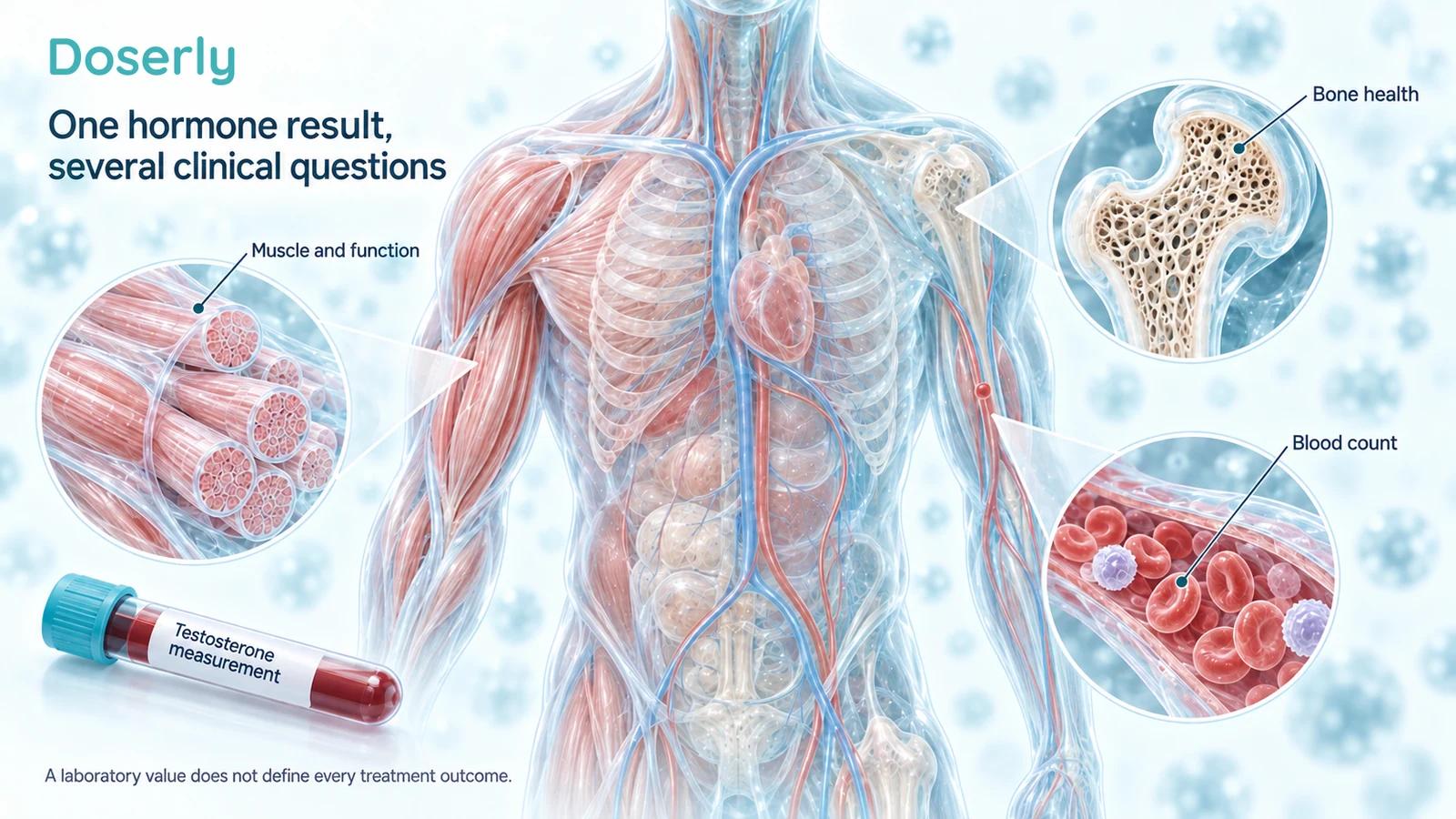
Muscle, bone and blood measurements answer different questions. This conceptual illustration does not imply that a particular testosterone value improves every tissue or that all effects increase together.
Estradiol is part of the physiology
Some testosterone is converted to estradiol by an enzyme called aromatase. Estradiol has physiological roles in men; it is not simply an unwanted by-product to eliminate.
A 2013 experiment separated some testosterone and estradiol effects. It enrolled 400 healthy men aged 20–50 across two cohorts, suppressed endogenous hormone production and assigned graded testosterone gel exposure for 16 weeks. One cohort also received an aromatase inhibitor to limit conversion to estradiol.
The findings linked androgen deficiency to losses in lean mass, muscle size and strength, while estrogen deficiency contributed substantially to increased body fat. Both hormones contributed to sexual-function changes. Finkelstein and colleagues
The study was designed to investigate physiology. It does not justify adding an aromatase inhibitor to every TRT regimen or choosing a universal testosterone-to-estradiol ratio. Suppressing a pathway can help researchers understand its role without making suppression a useful treatment goal.
If someone proposes “optimizing” testosterone by automatically lowering estradiol, ask which problem is being treated and what evidence supports that intervention. Our estradiol on TRT guide explains the clinical context and uncertainties.
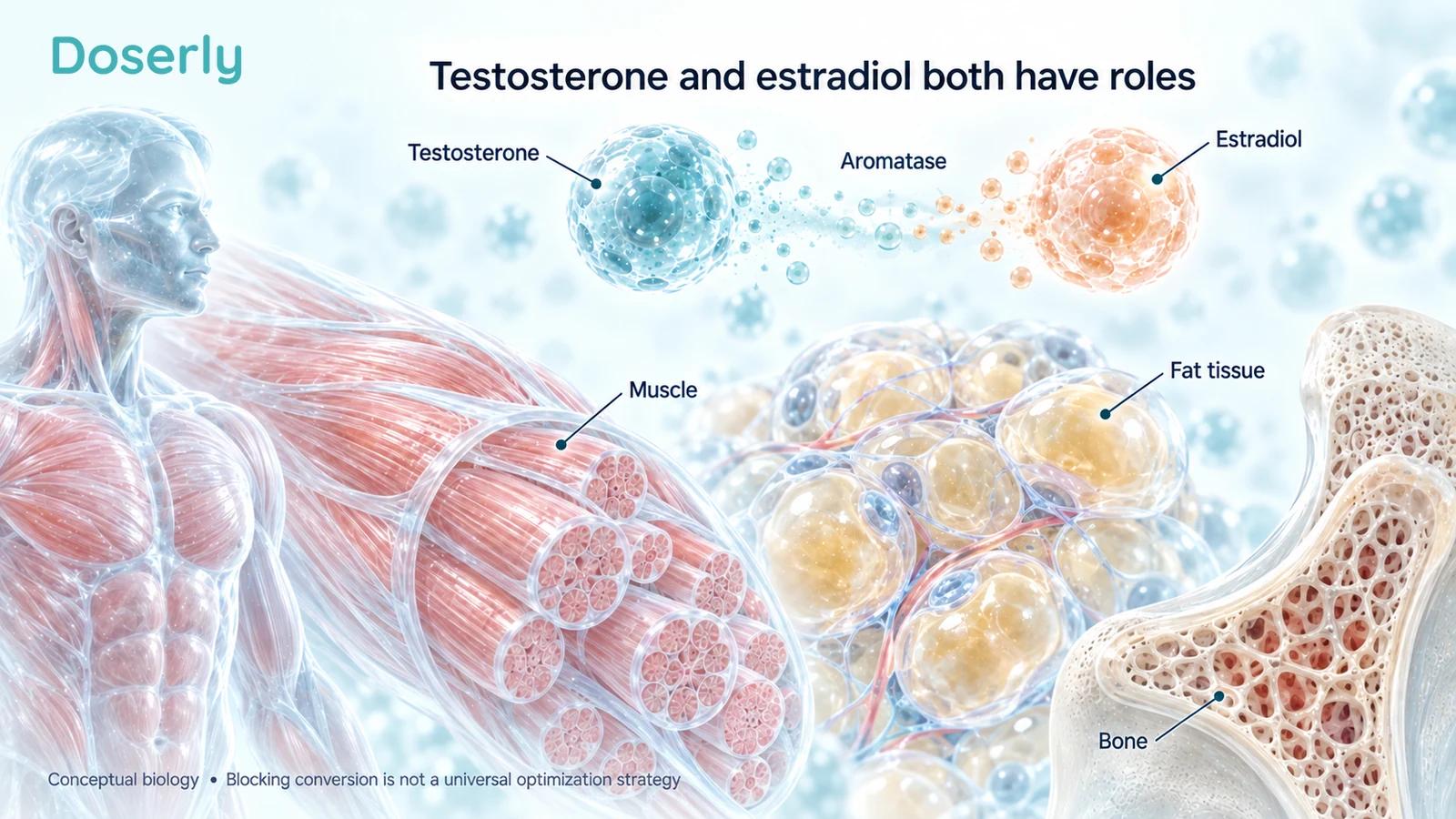
The hormone shapes are symbolic, not molecular structures. Aromatase converts testosterone to estradiol. The illustration does not prescribe a target level, ratio or aromatase-blocking treatment.
A successful laboratory change may leave a symptom unchanged
The Testosterone Trials provide a clinically useful example. In 790 older men with low testosterone and symptoms, one year of testosterone gel raised concentrations into the intended range. Sexual-function outcomes improved, but the main vitality outcome did not show a significant benefit. Testosterone Trials
That does not make the hormone measurement unimportant. It shows that biochemical response and symptom response need separate assessment.
If fatigue persists, increasing a target is only one possible explanation someone might propose. Other possibilities include an unrelated cause of fatigue, an incomplete initial diagnosis, sleep problems or a benefit that simply doesn't occur for that symptom. The clinical review should examine the symptom rather than assume the preferred number has not yet been reached.
The AUA guideline specifically advises discussing treatment cessation when levels normalize without symptom or sign improvement after an appropriate initial period. That discussion belongs with the prescriber and depends on the original indication; it is not a self-directed stopping rule. AUA follow-up guidance
Safety outcomes can move independently
An “optimal” claim often lists possible benefits while leaving the competing outcomes undefined. But a treatment decision also needs to consider adverse effects and the burden of monitoring.
FDA's 2025 testosterone labeling action illustrates the need to separate endpoints. Evidence from TRAVERSE supported revising cardiovascular warning language, while ambulatory monitoring studies led to class-wide blood-pressure warnings. FDA communication
A person can feel better while a safety measurement changes unfavorably. Conversely, a normal safety result doesn't establish that treatment is helping the original symptom. These findings need to be considered together rather than ranked by whichever number looks most reassuring.
This is also why a target derived from muscle research cannot be assumed to optimize cardiovascular health or fertility. Those questions require their own evidence and clinical priorities.
Total and free testosterone aren't competing definitions of success
Most circulating testosterone is bound to proteins; a smaller portion is free. Total testosterone includes both. Free testosterone can add useful information in selected circumstances, especially when binding-protein levels complicate interpretation.
The guideline recommends appropriate free-testosterone assessment when total testosterone is near the lower limit or when conditions alter sex hormone-binding globulin. It also emphasizes accurate methods. Endocrine Society diagnostic guidance
It is easy to move from one absolute target to another: if total testosterone doesn't explain a symptom, perhaps a particular free level will. But switching measurements doesn't remove the need to establish a diagnosis, assess sampling conditions and measure the outcome itself.
During treatment, formulation-specific timing adds another consideration. A concentration taken at one point in an interval may not represent average exposure. Comparing results without that context can turn ordinary variation into an apparent need for adjustment.
Why another person's best level may not be yours
A personal report can tell you what someone experienced. It usually cannot separate the contribution of testosterone from changes in sleep, training, relationships, other medicines or expectations.
The person's diagnosis may also differ from yours. Restoring hormone after established testicular failure is a different situation from trying to explain nonspecific symptoms in someone with a borderline measurement. Similar laboratory values do not make those histories interchangeable.
Even a well-designed trial estimates an average effect in its enrolled population. It doesn't identify a guaranteed optimum for every participant, much less for people outside the trial. Individual care uses that evidence alongside observed response and risk.
This doesn't mean personal experience should be ignored. It means the experience is more useful when described specifically: which symptom changed, how much, over what period and under which treatment conditions.
Replace an unspecified optimum with an assessable goal
A useful treatment discussion can begin with a concrete outcome: improved sexual symptoms, correction of a deficiency-related problem, or maintenance of health in established hypogonadism. The outcome should be something you and the clinician can revisit.
Then clarify the role of laboratory measurements. Are they confirming exposure, checking a possible explanation for symptoms or monitoring an adverse effect? Each purpose may require different timing or interpretation.
Finally, agree on what would count as enough benefit and what would prompt reconsideration. This avoids an open-ended search in which every remaining concern becomes evidence that a higher number is necessary.
A short dated record can help: symptoms, relevant treatment changes, sampling times and functional observations. It doesn't determine causation, but it makes the discussion more concrete than comparing isolated screenshots.
Questions to ask when someone promises an optimal number
Ask which population the number comes from and whether it was observed naturally or assigned as a treatment target. Ask which outcome improved and what happened to adverse effects. If the supporting study was short, ask what is known about longer exposure.
It also matters whether the claim describes a guideline range, a laboratory percentile, an experimental dose-response result or one person's experience. All can be informative, but they answer different questions.
The goal of treatment is a worthwhile clinical result with an acceptable balance of risks and burden. A testosterone measurement helps guide that process; it does not define the whole result.
Sources
- Harmonized testosterone reference ranges, 2017.
- Testosterone dose-response experiment, 2001.
- Gonadal steroids and tissue outcomes, 2013.
- Testosterone Trials, 2016.
- AUA testosterone-deficiency guideline.
- Endocrine Society guideline, 2018.
- FDA testosterone labeling changes, 2025.