
HRT
October 16, 2026
The hormone-panel trap in perimenopause
On this page
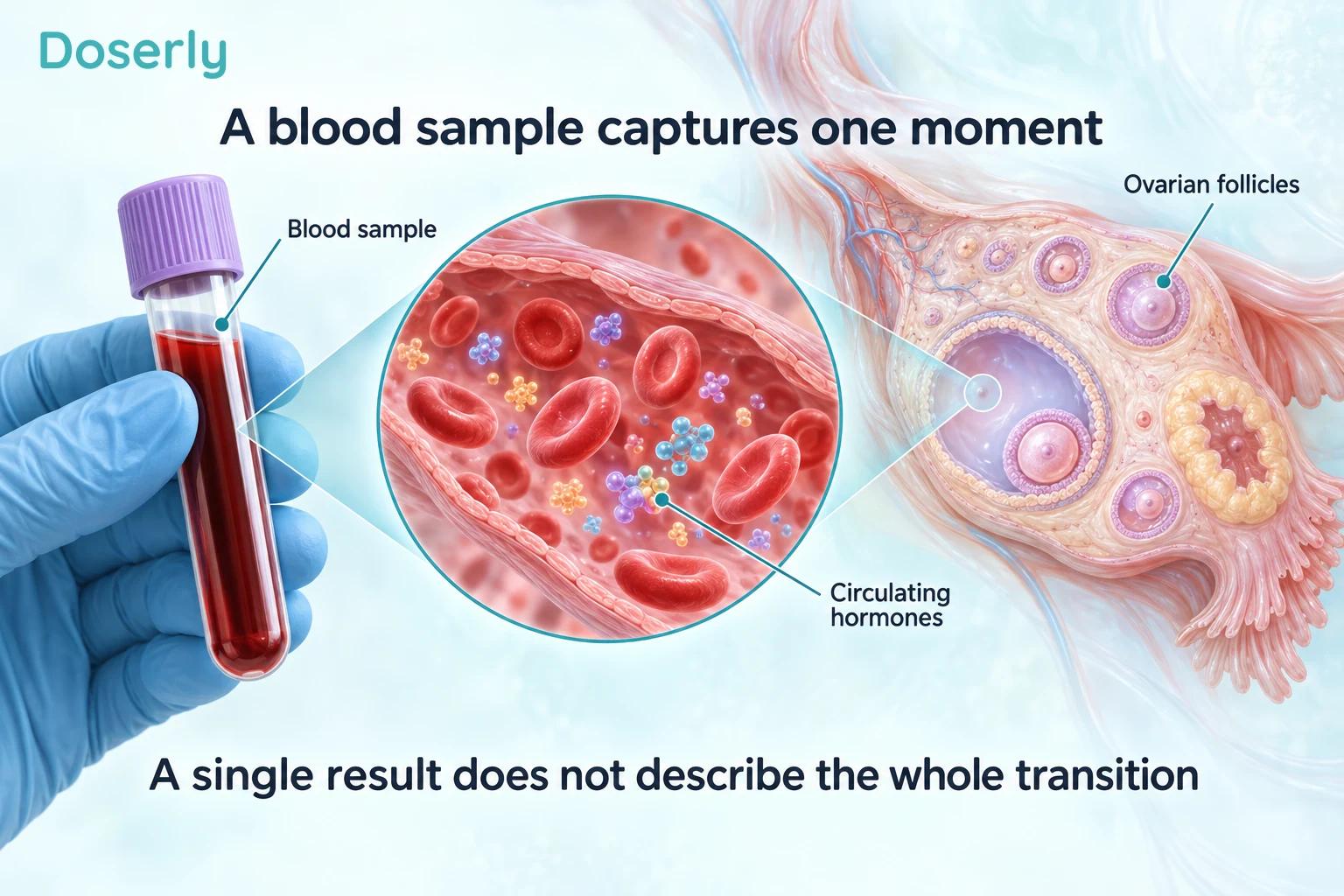
Estrogen and progesterone help coordinate menstrual cycles, but their concentrations do not simply decline in a smooth line as menopause approaches. Ovarian activity becomes variable. A blood sample can therefore be accurate for the moment it was taken and still be a poor description of the months in which you have felt different.
That is why a “normal” hormone panel does not necessarily rule out perimenopause, and an isolated abnormal result does not automatically identify the right treatment. The useful question is not whether hormones can be measured. It is whether a particular measurement will change diagnosis or care.
For otherwise healthy people aged 45 or older with a typical symptom and menstrual history, NICE recommends identifying the transition clinically rather than routinely ordering reproductive hormone tests. Younger ages and unusual presentations can require a different approach. NICE menopause guidance.
What changes during the transition?
The ovaries contain follicles, structures that support developing eggs and produce hormones. As reproductive aging progresses, the coordination between ovarian activity and pituitary signals becomes less predictable. Cycles may shorten, lengthen or be skipped, and ovulation may occur inconsistently.
Follicle-stimulating hormone (FSH) is one of the pituitary signals. Estradiol is an important estrogen produced by the ovaries. Progesterone usually rises after ovulation. Their interpretation depends partly on where a person is in a cycle and whether ovulation occurred.
STRAW+10, a widely used reproductive-aging framework, combines bleeding patterns with supporting hormonal information. Its categories describe a transition over time; they do not make every stage readable from a single blood draw. STRAW+10 consensus.
If you are experiencing changing periods and hot flashes, the absence of a dramatic laboratory abnormality does not erase that history. Our perimenopause guide explains the symptom patterns and treatment options in more detail.
What repeated measurements teach that a single value cannot
The Study of Women’s Health Across the Nation, or SWAN, collected daily urine samples over one menstrual cycle or up to 50 days from 848 midlife women in seven US cities. A published analysis examined 572 participants with evidence of a luteal transition, a hormonal pattern related to the phase after ovulation.
Researchers identified differences in the shape and coordination of hormone patterns that comparisons of single values would miss. Longer cycles showed changes in the relationship between FSH and luteinizing hormone during the luteal phase. SWAN daily hormone analysis.
This was observational physiology research, not a trial showing that daily testing improves treatment. It explains why a momentary result can be incomplete. It does not establish that everyone needs weeks of home urine testing or that a commercial panel can turn those measurements into a validated prescription.
A review lecture discussing longitudinal evidence reported that no specific endocrine change consistently characterized either the early or late transition. The finding reinforces the variability, rather than identifying one universal hormonal pattern that clinicians should try to normalize. Cycle and hormone study.
“Within range” and “not perimenopausal” are different statements
A laboratory reference interval describes how a result relates to a defined comparison range. It does not automatically describe your usual level, explain a symptom or determine your reproductive stage.
Consider someone whose periods have become noticeably less predictable and who now wakes with heat and sweating. An estradiol value within a premenopausal reference interval may be entirely compatible with fluctuating ovarian function. Repeating the test on a different day could produce a different value without either sample being wrong.
The opposite problem occurs when a single low result is treated as a complete diagnosis. A low estradiol concentration can have several contexts, including cycle timing, medicines or conditions affecting ovarian signaling. The clinical history tells the clinician which possibilities deserve consideration.
The European Society of Endocrinology likewise advises that biochemical testing is generally unnecessary for diagnosing or managing typical perimenopause in people over 45. ESE guideline. That recommendation is an approach to a common clinical situation, not a statement that all laboratory testing at midlife is useless.
When reproductive hormone testing does help
Age is an important exception. Menopause-like symptoms or persistent menstrual disturbance before 40 raise the possibility of premature ovarian insufficiency. Ages 40–45 can also warrant biochemical assessment when early menopause is suspected.
The ESE guideline recommends testing for suspected ovarian insufficiency under 40 and says testing can be considered at 40–45. If FSH is used for perimenopause assessment, its timing and interpretation should follow the clinical question. ESE guideline.
This distinction prevents a blanket “we never test hormones” rule from delaying important diagnoses in younger people. It also prevents the younger-person pathway from being applied automatically to every 49-year-old with a typical transition.
Testing may also be appropriate when the history is unclear, symptoms are atypical or another endocrine disorder is suspected. The clinician should be able to explain what result would support or weaken a diagnosis and what would happen next.
If POI is a concern, our premature ovarian insufficiency guide covers why confirmation, cause assessment and long-term care differ from routine midlife symptom management.
Medicines can change both the result and the story
Hormonal contraception can change bleeding patterns and suppress or alter reproductive hormone measurements. HRT adds an external hormone source. The result must therefore be interpreted in the context of the exact medicine and schedule.
NICE advises against using FSH to identify menopause in people taking combined estrogen-progestogen contraception or high-dose progestogen. It also recognizes that hormonal treatments can make the menstrual history harder to interpret. NICE recommendations.
A missed bleed while taking a method that suppresses bleeding is not the same as a naturally absent period without treatment. A scheduled withdrawal bleed is not proof that a natural ovulatory cycle occurred.
Do not stop contraception or HRT simply to make a test easier to interpret. Ask whether the result is necessary and, if so, how the clinician wants to arrange testing without creating avoidable symptoms or a gap in pregnancy prevention.
Bring the product name, dose schedule, time of the last dose and any recent changes. Even when no reproductive hormone test is needed, those details help explain symptoms and bleeding.
What about AMH and “ovarian age”?
Anti-Müllerian hormone (AMH) is produced by cells associated with small ovarian follicles. It has uses in reproductive medicine, but that does not make it a universal perimenopause test or an exact countdown to the final menstrual period.
NICE advises against using AMH, estradiol, inhibins, antral follicle count or ovarian volume to identify perimenopause or menopause routinely in people aged 45 or older. NICE guidance.
A fertility-related marker and a symptom-treatment decision are different questions. A result may be useful in one setting while adding little in another. Likewise, a test associated statistically with reproductive aging is not necessarily precise enough to tell one person when periods will stop.
Be cautious when a report converts several measurements into a single “hormone age” or “balance” score. Ask how that score was validated and which clinical decision it is intended to improve. A visually polished report does not itself establish clinical usefulness.
Testing for other causes is a separate decision
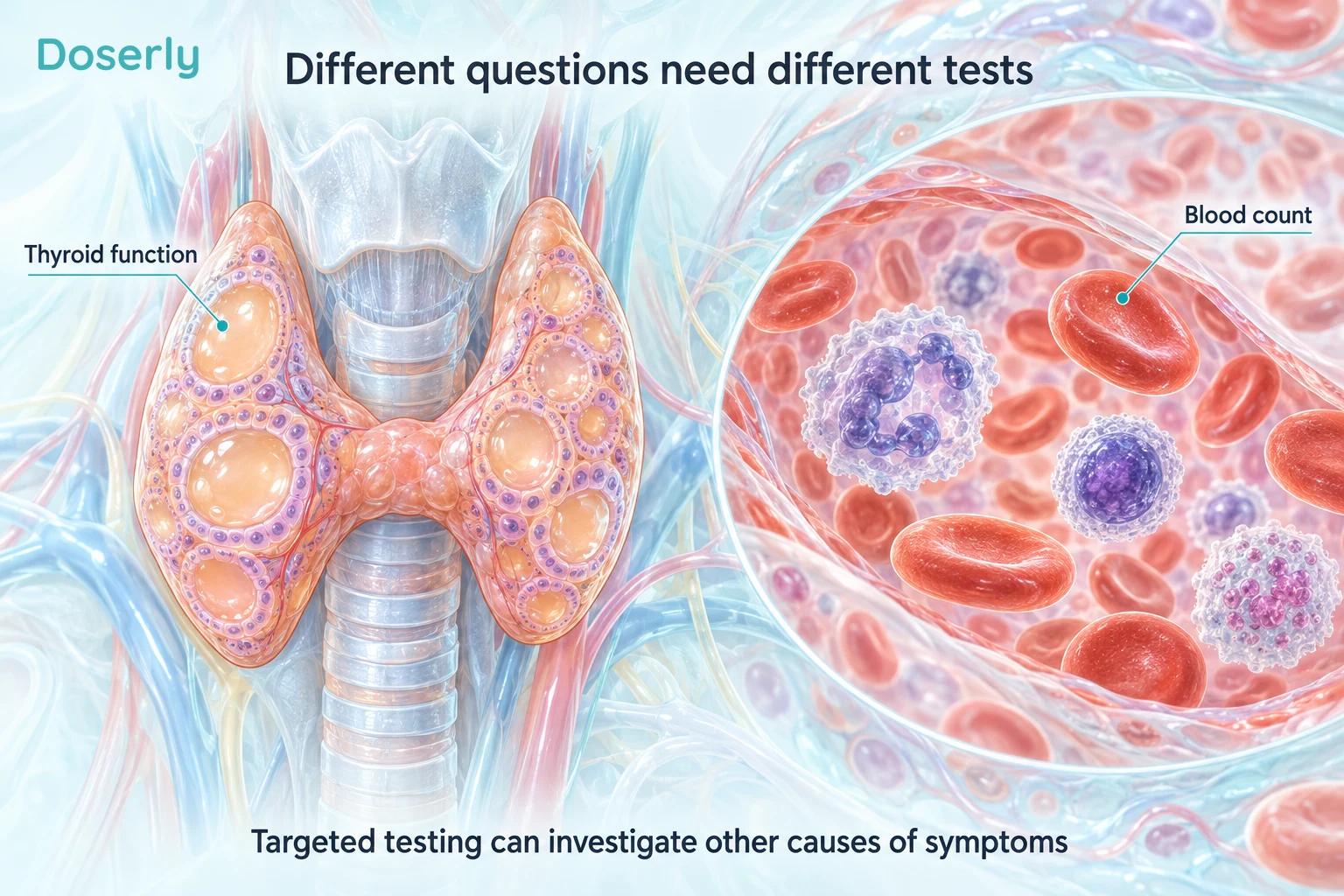
Fatigue, sleep disruption, palpitations and menstrual changes can have more than one contributor. A clinician may investigate thyroid disease, anemia or another condition when the history and examination suggest it. Pregnancy also remains relevant when biologically possible.
The ESE guideline explicitly recommends considering other diagnoses when symptoms or menstrual disturbance could have another explanation. It includes general health assessment and targeted testing alongside menopause care. ESE guideline.
For example, heavy bleeding with fatigue may justify a blood count and assessment of blood loss. Symptoms suggesting thyroid dysfunction may lead to thyroid testing. These are focused investigations for particular questions, not evidence that every patient needs a large “menopause panel.”
A typical menopause history and another medical problem can coexist. Finding one should not automatically end the search for the other if symptoms remain unexplained.
Why saliva-guided hormone dosing is a different claim
Some services offer repeated saliva, urine or blood panels to customize compounded hormone preparations. The claim is stronger than simply saying a test can measure a hormone: it proposes that adjusting treatment to those results improves outcomes.
ACOG states that evidence for interpreting adjunct hormone tests to prescribe or dose compounded menopausal hormone therapy is limited and does not recommend them for that purpose. It also recommends approved products when suitable options exist rather than routine compounded treatment. ACOG clinical consensus.
Research measurements, commercial testing packages and a validated treatment-monitoring strategy are therefore separate things. A study describing hormonal fluctuations does not validate a service that promises to balance them precisely.
If testing is proposed, ask which target is being used, how it was established and whether reaching it has been shown to improve symptoms or safety. A prescriber should also explain how adverse effects and bleeding are assessed, rather than relying on the laboratory report alone.
How treatment can be reviewed without chasing a number
A useful review starts with the symptom that prompted treatment. Are night sweats less frequent? Is sleep more restorative? Has vaginal discomfort improved? Are adverse effects, bleeding or practical difficulties making the plan harder to follow?
The ESE guideline recommends reassessing symptom treatment after about three months and reviewing the dose or formulation when response, adverse effects or tolerance are unsatisfactory. ESE guideline.
That does not mean symptoms alone settle every safety question. Medical history, examination when indicated and appropriate preventive care still matter. It means that a treatment aimed at improving daily life should be evaluated partly by what happens to daily life.
An arbitrary serum target can distract from a more important finding: someone may have an apparently satisfactory number while still sleeping poorly because of pain or sleep apnea, or may feel much better without a dramatic laboratory change. Those examples call for clinical interpretation, not automatic dose escalation.
Prepare information that makes the visit useful
A brief record of period dates, hot flashes, sleep disruption and medication changes can help establish a pattern. Include how symptoms affect work, exercise or relationships. A manageable record kept consistently is more useful than an elaborate diary abandoned after several days.
Describe unusual features clearly: very heavy bleeding, bleeding after a long settled interval, new pelvic symptoms, major changes in weight or persistent symptoms unlike your usual pattern. These details may change the investigation more than another estradiol measurement.
Before agreeing to a panel, ask: what question are we answering, how will this result change the plan, and what happens if it is normal? If the test will not alter care, it may add expense and uncertainty without improving the decision.
A clinical diagnosis should still feel like an assessment. You deserve an explanation of why the history fits, what else has been considered and when to return. Avoiding an unnecessary hormone panel should never mean dismissing symptoms or leaving you without a treatment discussion.
Sources
- NICE menopause recommendations.
- ESE menopause and perimenopause guideline, 2025.
- SWAN daily urinary hormone profiles, 2007.
- Cycle and hormone changes study, 2008.
- STRAW+10 consensus, 2012.
- ACOG compounded hormone therapy consensus, 2023.