
Peptides
October 16, 2026
The case for following amylin drugs beyond the GLP-1 headlines
On this page
GLP-1 has become shorthand for a major change in weight-management medicine. That shorthand is useful until it hides other biology. Amylin is a different meal-related hormone, and drugs designed around its signaling are generating important evidence both alone and alongside incretin therapies.
The reason to follow amylin research is not that every new hormone target must replace the previous one. It is that obesity and glucose regulation involve several interacting signals, and different interventions may offer different combinations of benefit, tolerability and treatment burden. Those possibilities deserve testing in people.
The evidence already spans an established diabetes medicine, randomized obesity trials, larger combination studies and an expanding eloralintide program. But these are not interchangeable achievements. An approved amylin analogue used with insulin is not the same product as an investigational weekly obesity treatment. A result from two drugs together is not the effect of either component alone.
Understanding those distinctions makes the amylin story more interesting, and more clinically useful, than a race between headline weight-loss percentages.
Amylin adds a distinct biological starting point
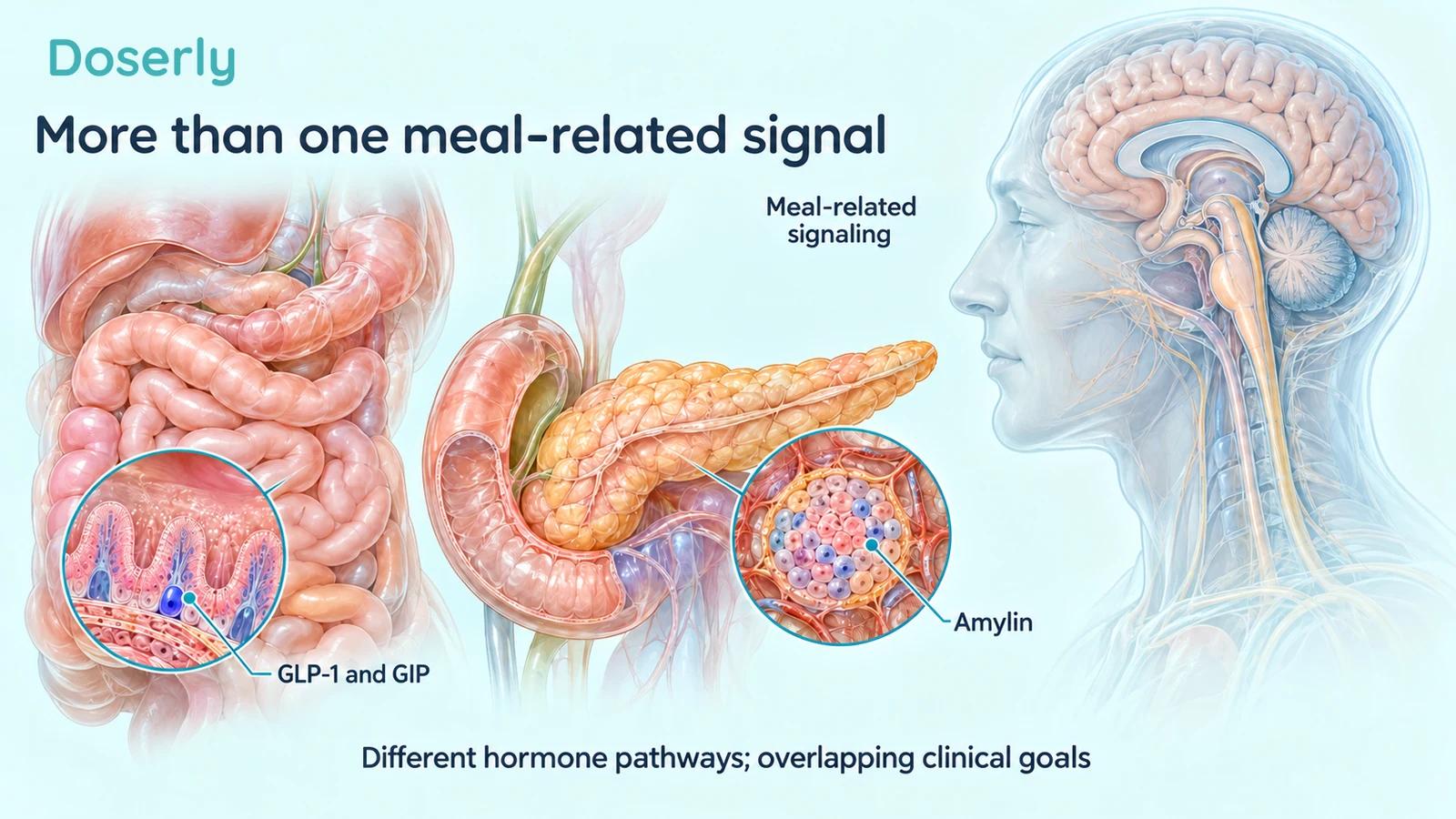
Native amylin is a 37-amino-acid hormone released from pancreatic beta cells alongside insulin. Its signaling participates in the body’s response to eating, including the regulation of food intake. GLP-1 and GIP belong to the incretin pathways associated with signals from the intestine. These systems interact within a broader network; they are not different names for one receptor.
Amylin receptors also have a particular molecular organization. They involve the calcitonin receptor paired with receptor activity-modifying proteins, often abbreviated RAMPs. Different pairings produce receptor subtypes. That structure helps explain why two drugs described as amylin agonists can have different receptor-activity profiles. Eloralintide discovery report
This biology creates a rationale for new medicines, but it does not determine the clinical result in advance. Receptor experiments measure responses under controlled laboratory conditions. A person’s experience also depends on exposure, treatment duration, the population studied and effects elsewhere in the body.
Nor does a shared downstream goal make the drugs equivalent. Two treatments may both influence food intake while differing in their molecular targets, clinical evidence and practical limitations. The relevant question is what a particular regimen has demonstrated, not whether it belongs to a fashionable hormone category.
Pramlintide shows that amylin medicine is not entirely new
The established example is pramlintide, marketed as Symlin. Its prescribing information describes an amylin analogue used as an adjunct in selected patients with type 1 or type 2 diabetes who use mealtime insulin and have not achieved adequate glucose control.
The label describes effects on gastric emptying, meal-related glucagon secretion and satiety. It also carries a prominent warning about severe hypoglycemia when used with insulin. That combination of mechanism, benefit and risk is specific to its clinical use. Symlin prescribing information
Pramlintide matters historically because it shows that amylin signaling can be used therapeutically in humans. It does not establish that every later amylin candidate has the same indication, dosing pattern or safety profile. In particular, its diabetes label should not be presented as regulatory approval for eloralintide or cagrilintide as obesity treatments.
The reverse inference is also unreliable. A favorable obesity result for a newer agent does not erase pramlintide’s insulin-related precautions or alter the evidence supporting its approved use. A drug class can contain related molecules with different development histories and clinical contexts.
Cagrilintide established a weight-management signal on its own
Cagrilintide is a long-acting amylin analogue with its own clinical program. A 26-week phase 2 dose-finding trial randomized 706 participants across cagrilintide doses, liraglutide and placebo. Participants had obesity, or overweight with specified conditions, and did not have diabetes.
Under the trial-product estimand, mean weight reduction reached 10.8% in the highest cagrilintide group, compared with 3.0% with placebo. Gastrointestinal events were prominent in the safety findings. This was evidence for a specific amylin-based intervention, not merely an extrapolation from receptor biology. Cagrilintide phase 2 trial
The trial also illustrates why the details surrounding a number matter. Its treatment duration was 26 weeks. Its enrolled population and analysis were defined in advance. A result from a 48-week or 68-week study of a different drug cannot be placed beside it and treated as a randomized comparison.
The Doserly cagrilintide guide provides more background on the molecule and its development. For this broader story, the important point is that amylin-directed weight loss has been tested as monotherapy, not only as an accessory to another drug.
Eloralintide tests a different receptor profile
Eloralintide is a selective amylin receptor agonist whose laboratory profile favors AMY1 over some related receptors. Selective does not mean exclusive: the discovery report describes relative activity in specified assays, not a switch that turns one receptor on and every other receptor off.
That distinction matters when early explanations suggest that selectivity must produce a cleaner clinical experience. It is a research hypothesis to test, not a substitute for human tolerability data. Animal comparisons and human receptor experiments can guide development without establishing comparative safety in patients. Discovery and translational study
The 48-week phase 2 obesity trial provided a more direct clinical answer. It randomized 263 adults without type 2 diabetes and found mean weight reductions of approximately 9% to 20% across active schedules under its efficacy estimand, versus about 0.4% with placebo. Nausea and fatigue varied across groups. Eloralintide phase 2 trial
Those findings support continued development. They do not establish that eloralintide is better than cagrilintide, because the two molecules were not randomized against one another in those studies. Differences in study duration, participants and treatment schedules are enough to make a simple ranking unreliable. The Doserly eloralintide guide explains its separate program.
Combining pathways is a clinical experiment
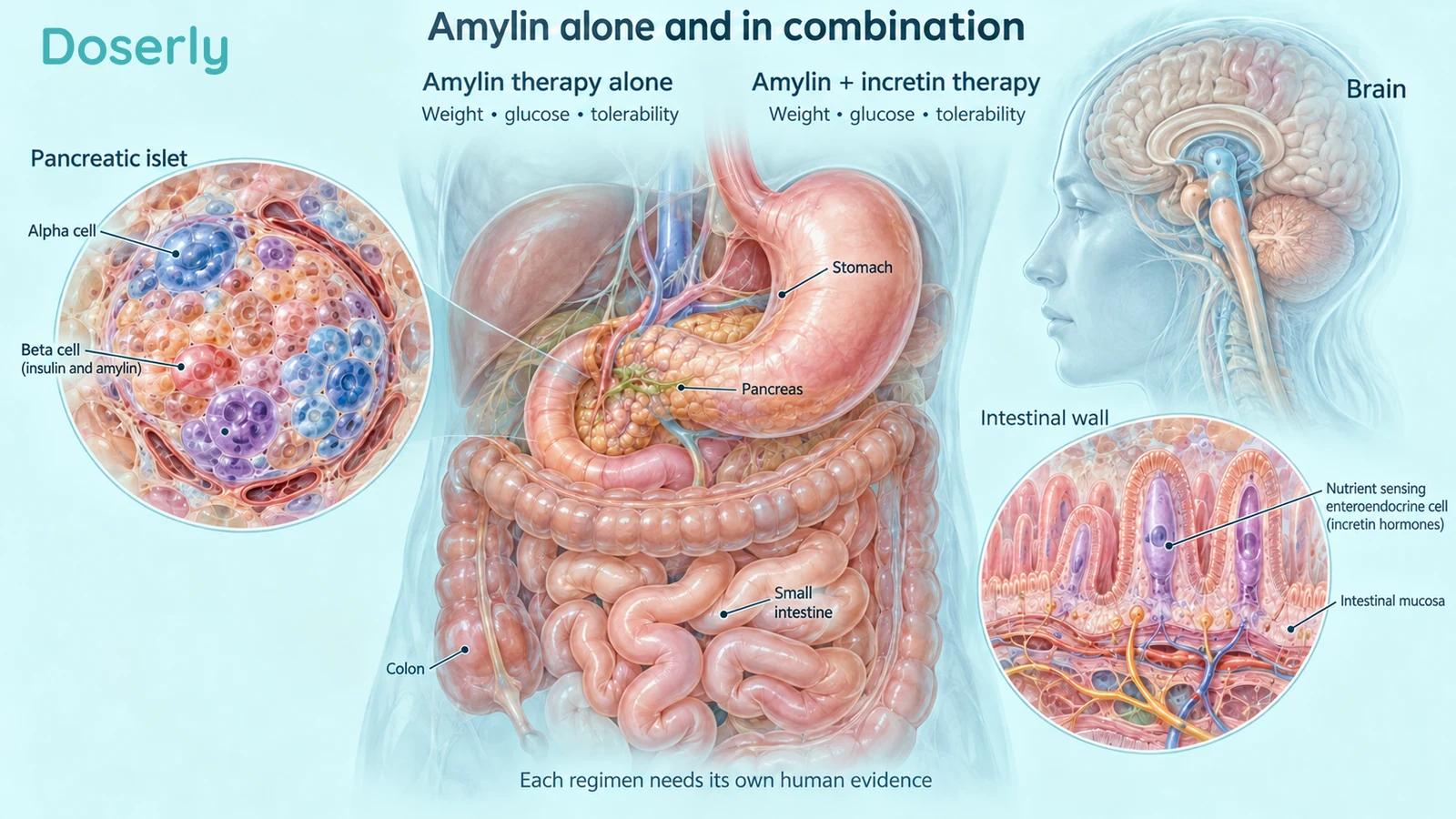
If amylin and incretin signaling contribute to overlapping physiological goals through different receptors, combining them is a plausible strategy. Plausibility is only the starting point. A combination can change both efficacy and the frequency of unwanted effects.
CagriSema combines cagrilintide with semaglutide. The REDEFINE 1 trial randomized 3,417 adults without diabetes to the combination, its individual components or placebo over 68 weeks. Under the treatment-policy estimand, mean weight reduction was 20.4% with the combination and 3.0% with placebo. REDEFINE 1 primary publication
That result belongs to the combination. It should not be labeled “cagrilintide weight loss” without identifying semaglutide’s contribution. The component groups are valuable because they permit comparisons within the same trial setting, which is more informative than comparing unrelated studies.
The treatment-policy approach also matters: it addresses the assigned treatment strategy while accounting for treatment discontinuation according to the analysis plan. Its number should not be silently mixed with an efficacy estimate that asks what would happen under continued treatment assumptions.
A larger combination effect does not automatically establish pharmacological synergy. Synergy is a more specific claim about interaction than “the combination did better.” It requires an appropriate design and analysis rather than an appealing description of two complementary pathways.
Eloralintide plus tirzepatide now has a reported phase 2 result
The combination story moved forward on September 30, 2026. Lilly reported results from a 48-week phase 2b trial of eloralintide and tirzepatide in 367 adults with obesity or overweight and type 2 diabetes. This was a sponsor disclosure associated with an EASD presentation, not a peer-reviewed full report in the evidence reviewed here.
Under the reported efficacy estimand, the highest combination group lost an average of 23.3% of body weight, compared with 14.8% for tirzepatide alone and 3.0% for placebo. Gastrointestinal events were more frequent with combinations. Treatment discontinuation because of adverse events ranged from 10.8% to 27.0% across combination groups, compared with 2.9% for tirzepatide and 16.7% for placebo. The primary comparison was against placebo; other comparisons were secondary.
The study used separate injections. A future co-formulated product and an optimized escalation schedule were development plans, not the formulation already tested. Original Lilly disclosure
These results are worth following, including their tolerability tradeoffs. They are not a reason to construct a personal combination from independently obtained products.
The diabetes population changes the question
The registered combination study required type 2 diabetes and specified background treatment: diet and exercise alone, or stable metformin with or without an SGLT2 inhibitor. Its eligibility criteria also excluded several conditions and treatment situations. This was not a study of every person already using insulin or an incretin medicine. NCT06603571 protocol
That context prevents two common errors. The first is assigning the combination result to people without diabetes as though the population were irrelevant. The second is treating the trial as evidence for adding eloralintide to any existing regimen in everyday practice.
Weight and HbA1c are also separate outcomes. Both can matter to a person with diabetes, but an improvement in one does not tell the full story of the other. Background medicines, baseline glucose control and the actual glucose endpoint need to remain visible.
The live registry provides the protocol and study structure. At the time checked, it did not contain posted results. The numerical findings above therefore remain attributed to the sponsor disclosure; registration alone does not independently confirm the outcome table.
Phase 3 should broaden the picture
Eloralintide’s monotherapy program includes ENLIGHTEN-1 in people without type 2 diabetes and ENLIGHTEN-2 in people with it. Both plan a 64-week primary weight assessment. The separate populations should help address questions that one early obesity study cannot answer. ENLIGHTEN-1, ENLIGHTEN-2
The protocols also include outcomes beyond weight. ENLIGHTEN-1 lists body-fat and patient-reported measures and longer follow-up in participants with prediabetes; ENLIGHTEN-2 includes HbA1c. These are plans for generating evidence, not results to advertise before the studies report.
Longer observation is particularly valuable for understanding persistence and the balance between benefits and symptoms. It can also reveal how a favorable average relates to the range of individual responses. A participant who stops early, one who tolerates the regimen and one whose response is modest all belong in the clinical account.
Still, a protocol’s list of endpoints is not a promise that every endpoint will improve. Nor does a change in a cardiovascular risk marker establish fewer cardiovascular events. Later reports should be read with the same attention to the actual measurement and analysis as the early trials.
What would make an amylin option useful?
For someone considering treatment with a clinician, the useful question is broader than which molecule produces the largest average percentage in a presentation. It includes the indication being treated, the person’s other conditions, the likelihood of remaining on treatment, and the quality of evidence for outcomes that matter to them.
A medicine with a substantial average effect may have a treatment burden that some people find difficult. A combination may improve one endpoint while increasing symptoms. A therapy studied in a selected population may still need evidence in people with different comorbidities or medication backgrounds. Those are clinical questions, not objections to innovation.
Following amylin research therefore means keeping several lines of evidence in view: established physiology, drug-specific randomized trials, direct component comparisons, patient experience and longer-term follow-up. It also means distinguishing a current result from a development plan.
Amylin deserves attention because it expands the set of testable treatment approaches. Its future role will depend on what individual medicines and combinations demonstrate in people, including how well those people can live with the treatment.
Sources
- Eloralintide discovery and clinical proof of concept
- Symlin prescribing information
- Cagrilintide phase 2 dose-finding trial
- Eloralintide phase 2 obesity trial
- REDEFINE 1 randomized trial
- Lilly EloraTZP phase 2b disclosure, September 30, 2026
- Eloralintide and tirzepatide protocol, NCT06603571
- ENLIGHTEN-1 registry
- ENLIGHTEN-2 registry