
HRT
October 16, 2026
Testosterone for women: desire, energy and strength are different questions
On this page
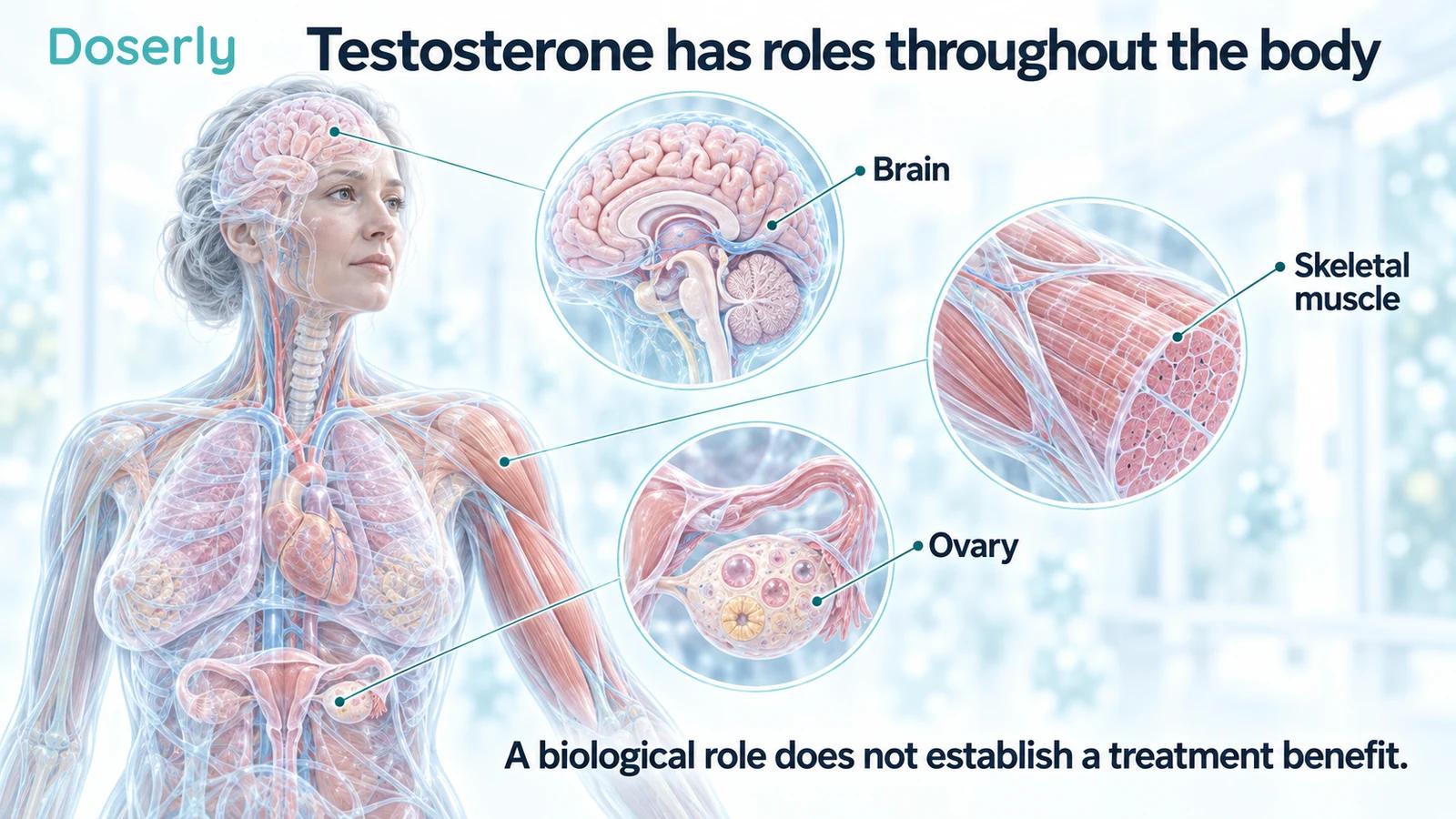
Testosterone is part of female physiology, not a hormone found only in men. Its presence in the body helps explain why researchers have studied it for sexual function, cognition and muscle-related outcomes. But a hormone having a biological role does not establish that giving more of it improves every symptom associated with that role.
For postmenopausal women, the best-supported treatment use is hypoactive sexual desire disorder, or HSDD: persistently low sexual desire that causes personal distress, assessed in its medical and personal context. Evidence for that indication should not be extended into a general promise of more energy, sharper thinking or stronger muscles. Global consensus statement
That distinction is not intended to minimize fatigue or brain fog. It helps make sure that an important problem receives the right assessment, rather than becoming a reason to prescribe a hormone without a clear treatment target. It also allows the real sexual-health evidence to be discussed on its own merits.
Low desire is not automatically a disorder
People vary in how much sexual interest they experience and how they feel about changes over time. A low frequency of sex is not, by itself, a diagnosis. The person's own distress matters; a partner's expectations should not define whether treatment is needed.
A clinical assessment considers when the change began, whether it is persistent, how it affects the person and what else may contribute. Pain, dryness, medications, mood, relationship circumstances and other health problems can all be relevant. The ISSWSH guideline recommends a biopsychosocial assessment—meaning biological, psychological and social factors—before considering systemic testosterone. ISSWSH clinical guideline
For example, someone who avoids sexual activity because it hurts may need assessment and treatment of the pain. Someone who is exhausted by night sweats may need help with sleep and vasomotor symptoms. These can coexist with distressing low desire, but the treatments do not become interchangeable because all affect sexual life.
Our menopause sexual-health guide explains pain, dryness, desire and related treatment options. It can help you name the specific problem before an appointment, especially if “low libido” feels too broad to describe what is happening.
What a placebo-controlled trial found
One influential study enrolled 814 postmenopausal women with HSDD who were not taking systemic estrogen. Participants were randomly assigned a patch delivering 150 or 300 micrograms of testosterone daily or placebo. Efficacy was assessed over 24 weeks, with safety follow-up extending to 52 weeks.
At 24 weeks, the 300-microgram group reported an average increase of 2.1 satisfying sexual episodes per four weeks, compared with 0.7 with placebo. The 150-microgram group did not significantly outperform placebo on that primary outcome. Desire and distress measures provided additional information beyond event counts. APHRODITE trial
The placebo comparison is important. The treatment-associated difference was about 1.4 episodes per four weeks, not the entire 2.1-event improvement. That average may be worthwhile to some people and unimportant to others. It does not prescribe how often anyone should have sex or imply that more activity is always the correct goal.
The study tested a particular transdermal exposure in a defined population. It did not demonstrate that a pellet, an injection or a higher blood level provides the same benefit. The patch amounts describe the trial and should not be used to calculate a personal dose from another formulation.
Why the blood test cannot answer the whole question
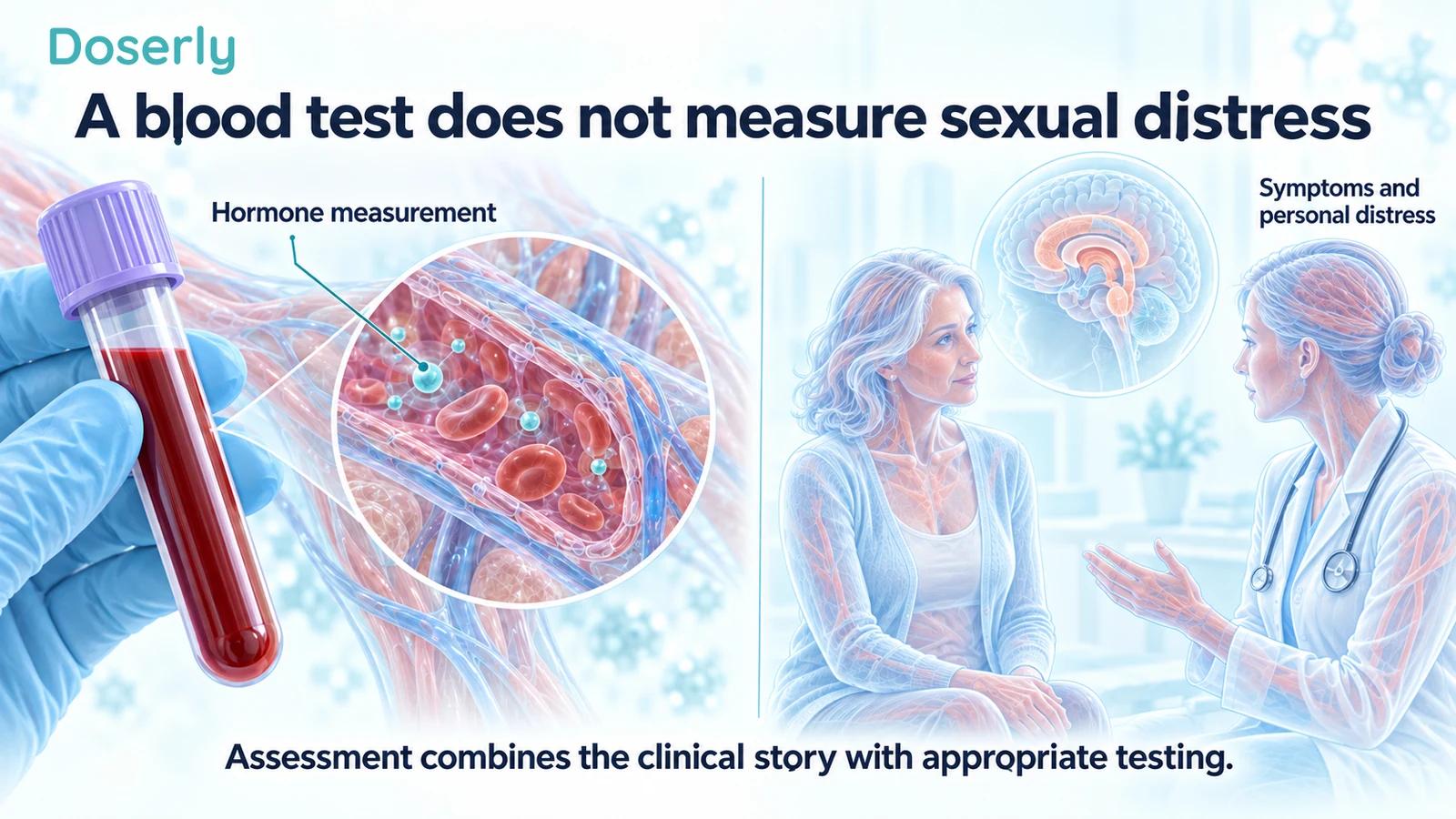
A blood testosterone result does not measure sexual desire or distress. There is no validated cutoff that reliably separates women with HSDD from women without it. Testing can still be useful when treatment is being considered, particularly to avoid excessive exposure and interpret the clinical picture. It is not a stand-alone diagnostic test for the complaint. Endocrine Society guideline
This can feel counterintuitive. If testosterone is involved in sexual function, why not simply replace it whenever a result is low? The problem is that symptoms do not map neatly onto one blood concentration, and laboratory measurement does not capture every influence on sexual experience. A result near the bottom of a reference interval is not proof of the cause of fatigue, relationship difficulties or loss of desire.
The practical implication is to start with the clinical question. Ask what the test is intended to establish, how it will change management and what range is appropriate for monitoring. A treatment plan aimed at reaching a clinic's “optimal” number without a defined benefit is harder to evaluate than one aimed at reducing a particular symptom.
What about energy and general wellbeing?
Feeling depleted is a common reason for seeking help at midlife. It can affect relationships, work, physical activity and the ability to enjoy anything, including sex. It deserves attention even if testosterone is not the answer.
The British Menopause Society states that randomized studies have not demonstrated benefits of testosterone for energy, mood, cognition or musculoskeletal health, and identifies persistent low desire after appropriate assessment as its clinical focus. That is a statement about the adequacy of treatment evidence, not a claim that no individual ever feels different while taking it. BMS testosterone statement
A personal improvement may be real while its cause remains uncertain. Better sleep, relief of another symptom, changes in medication or expectations can accompany treatment. If someone says “I have more energy,” a clinician can ask what changed in daily life, how long it lasted and whether adverse effects occurred. That is more informative than either dismissing the experience or treating it as proof of a universal effect.
If fatigue is the main complaint, make it the main clinical question. A visit should consider the pattern and relevant causes rather than automatically relabeling it as testosterone deficiency. This also prevents a disappointing response from leading to repeated dose escalation without a sound reason.
Cognition research contains signals, but not a treatment recommendation
It would be inaccurate to say that no testosterone study has ever reported a positive cognitive result. A randomized trial in 92 postmenopausal women aged 55–65, not using systemic hormone therapy, compared transdermal testosterone with placebo for 26 weeks. Its primary outcome was a verbal learning and memory task. The testosterone group performed better by an adjusted mean 1.57 points, with a 95% confidence interval of 0.13 to 3.01. Davis and colleagues, 2014
That result concerns performance on a particular test in a small, selected group. It does not establish prevention of dementia, treatment of all menopause-related brain fog or a durable improvement in everyday cognitive function. Larger and longer studies would be needed to answer those questions and evaluate the balance of benefits and harms.
The global consensus therefore judged evidence insufficient to recommend testosterone for cognitive enhancement or prevention of cognitive decline. Global consensus statement
For a reader struggling with concentration, the distinction matters. You can acknowledge a promising research result without being told that a treatment has already been validated for your particular problem. New or progressive cognitive symptoms also deserve assessment rather than an assumption that they are all hormonal.
Muscle mass, strength and physical performance need separate evidence
Testosterone's association with muscle biology makes strength claims sound plausible. Yet effects at high or male-range exposures cannot be borrowed to justify routine therapy in women at physiological female concentrations. A treatment might change tissue measurements without improving walking, lifting or everyday function, and increasing exposure can change the risk profile.
The global consensus found no statistically significant effect of physiological testosterone treatment on lean body mass, total body fat or muscle strength in the available evidence. It also noted limitations in the musculoskeletal studies, including small samples and concurrent estrogen use. Global consensus statement
If strength is your main concern, describe the task that has changed: getting out of a chair, carrying shopping or completing a familiar activity. That gives the clinician something concrete to assess. It also creates a useful outcome for any exercise, rehabilitation or medical plan, rather than assuming that a hormone concentration tells the whole story.
Formulation and exposure are part of the treatment question
“Testosterone for women” is too broad to describe a single intervention. Products differ in route, concentration, duration and how easily exposure can be adjusted. Much of the supportive HSDD evidence concerns transdermal treatment intended to keep concentrations within the physiological female range.
ISSWSH recommends careful monitoring and advises against compounded products because efficacy and safety data are inadequate. Availability and licensing differ by country, so a clinician should explain whether the exact product is licensed for the intended use or prescribed off-label. ISSWSH guideline
Off-label prescribing and a lack of evidence are not synonymous, but off-label use still needs a clear rationale and follow-up. A product being described as “bioidentical” also does not establish appropriate exposure or clinical benefit. Ask which formulation the supporting trials used and how the proposed treatment compares.
A long-acting product deserves particular thought if you are unsure how you will respond. Being able to stop applying a medicine differs from having an implanted product that continues releasing hormone. Convenience is a legitimate preference, but it should be considered alongside adjustability and the evidence for the actual route.
Benefits and adverse effects should be reviewed together
A trial of therapy should begin with an agreed target: for example, a worthwhile reduction in distressing low desire. Follow-up should assess that target, unwanted androgenic effects and whether exposure remains appropriate. Blood monitoring supports safety; it does not replace asking whether treatment helps.
In APHRODITE, androgenic adverse events, particularly unwanted hair growth, were more frequent with the higher-dose patch. Breast cancers occurred in testosterone recipients and not in placebo recipients during the reported study period, but the trial could not determine a causal relationship or establish long-term breast safety. Its authors specifically called for longer-term safety research. APHRODITE trial
That is a reason for an informed discussion, not a claim that the trial proved testosterone causes breast cancer. Small numbers, selected participants and limited follow-up constrain both reassurance and harm estimates. Tell the prescriber about new acne, hair changes, voice changes or other symptoms rather than waiting for a routine appointment if they are concerning.
A focused next conversation
You can ask: “Which symptom are we treating, and what evidence supports testosterone for that symptom?” Then ask how the clinician assessed other contributors, what benefit would justify continuing and what would lead to stopping or changing the plan.
If your main concern is energy or strength, say so directly. If the issue is distressing low desire, that concern deserves a respectful discussion on its own terms. You should not have to accept a broad “hormone optimization” package to receive care for a specific sexual-health problem.
Our HRT monitoring guide explains how treatment reviews combine symptoms, medical history and appropriate testing. The goal is a benefit that matters to you, supported by evidence for the actual problem and balanced against the uncertainties of treatment.
Explore the research
- APHRODITE trial, 2008: randomized transdermal testosterone in postmenopausal HSDD without systemic estrogen.
- Verbal learning and memory trial, 2014: a small cognitive study, not dementia-prevention evidence.
- Global consensus statement, 2019: indication-specific conclusions and safety limits.
- ISSWSH clinical guideline, 2021: assessment, treatment selection and monitoring.
- Endocrine Society guideline, 2014: limits of diagnosing an androgen-deficiency syndrome in women.
- BMS testosterone statement, 2023: clinical focus and unsupported broader claims.