
Peptides
October 16, 2026
Tirzepatide versus semaglutide: what SURMOUNT-5 actually compared
On this page
For years, comparing tirzepatide with semaglutide meant placing results from separate studies beside each other. That could suggest a difference, but it could not remove differences between the studies themselves. SURMOUNT-5 put the two medicines into one randomized trial and asked a direct question about weight reduction.
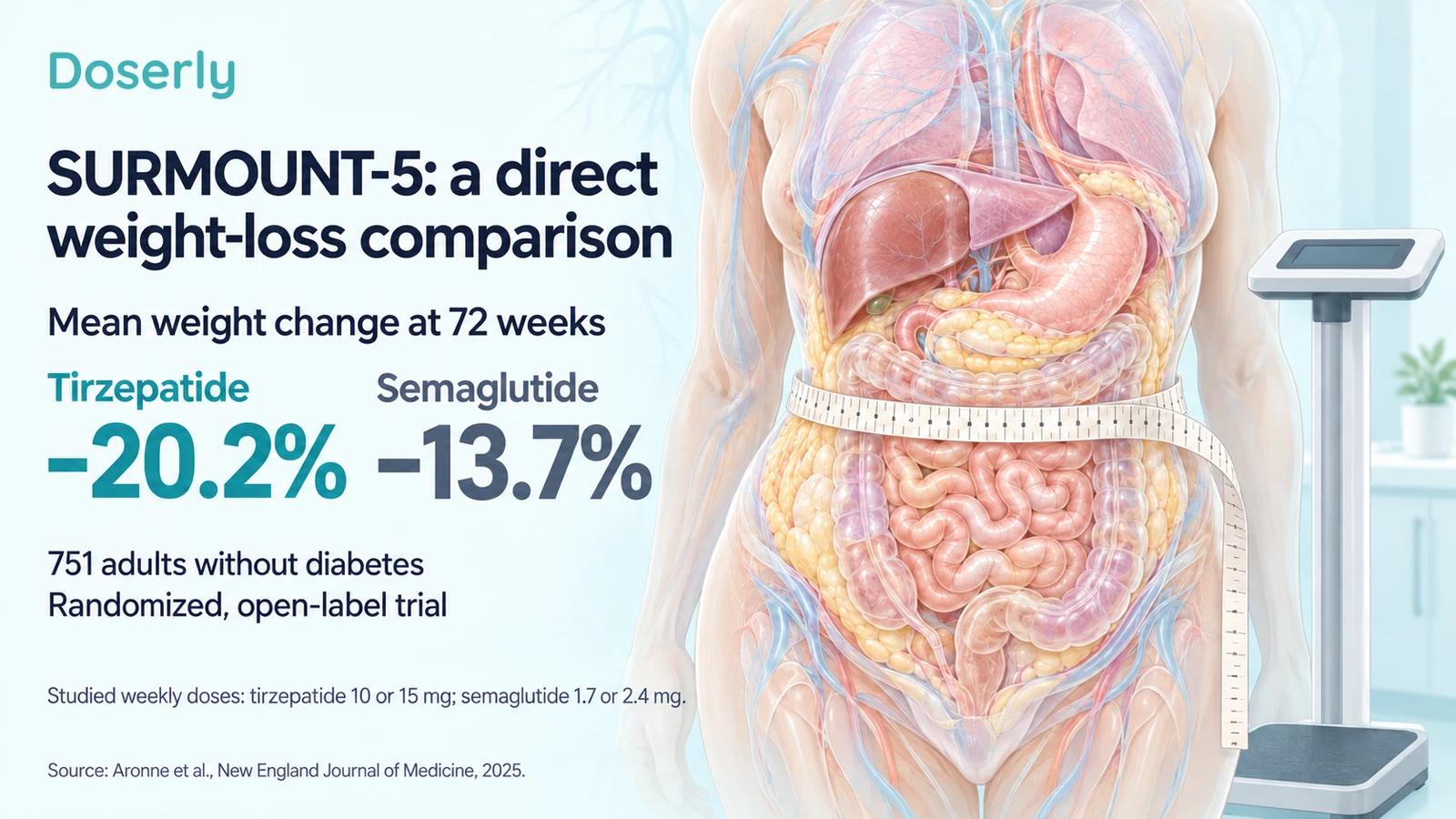
At 72 weeks, average weight change was −20.2% with tirzepatide and −13.7% with semaglutide under the regimens studied. Tirzepatide also produced a larger average reduction in waist circumference. This is strong evidence for that comparison in adults without diabetes. It is not a universal ranking of every benefit, formulation or patient experience. SURMOUNT-5
Understanding what the trial adds requires keeping the population, doses and outcome together. Those details make the finding more useful when discussing treatment, rather than reducing it to a competition between brand names.
Why a direct comparison matters
Suppose one trial enrolls people with diabetes and another excludes diabetes. Suppose one lasts longer, provides different follow-up or handles treatment discontinuation differently. Comparing their average weight losses can mix treatment effects with differences in the study framework.
A randomized head-to-head trial reduces that problem by allocating eligible participants to treatments within the same protocol. Randomization helps make the groups comparable at the start, including on characteristics researchers might not have thought to measure. A shared follow-up period also makes the outcome comparison easier to interpret.
This is different from a large observational comparison. A 2024 study using electronic health records and dispensing information found greater on-treatment weight loss associated with tirzepatide than semaglutide. It used matching to improve comparability, but treatment was not randomly assigned. The products studied were formulations labeled for type 2 diabetes, used on or off label. Real-world comparative cohort
That cohort provided useful evidence from clinical practice. SURMOUNT-5 supplied a different kind of evidence: a prospective randomized comparison of specified obesity-treatment regimens. The studies can inform one another without being treated as interchangeable.
Who entered SURMOUNT-5?
The trial randomized 751 adults. Eligibility included obesity, or overweight with a qualifying weight-related condition, and excluded diabetes. The registry also required a history of at least one unsuccessful dietary effort to lose weight. It was a phase 3b parallel-group study with no masking. Trial registry
The distinction between obesity and overweight matters because eligibility was not simply “anyone who wants to lose weight.” Likewise, excluding diabetes means the average result should not be presented as a direct estimate for people with diabetes.
A trial population sets the boundary of the most direct evidence. A clinician may still consider broader information when treating someone whose circumstances differ, but that involves an additional judgment. The trial itself does not erase differences in age, other illnesses, previous treatment or ability to tolerate medication.
For someone reading the headline, the useful first comparison is therefore between their situation and the study question. A result can be highly credible and still answer only part of the decision in front of them.
What doses were compared?
Participants received weekly subcutaneous tirzepatide at a maximum tolerated dose of 10 or 15 mg, or semaglutide at a maximum tolerated dose of 1.7 or 2.4 mg. Treatment lasted 72 weeks. The primary outcome was percentage change in body weight from baseline. Trial methods
“Maximum tolerated” is important. This was a comparison of treatment regimens with specified dose options, not a claim that every participant took the highest numerical dose throughout follow-up. It also was not an equal-milligram comparison: milligram amounts are not a common potency scale across different molecules.
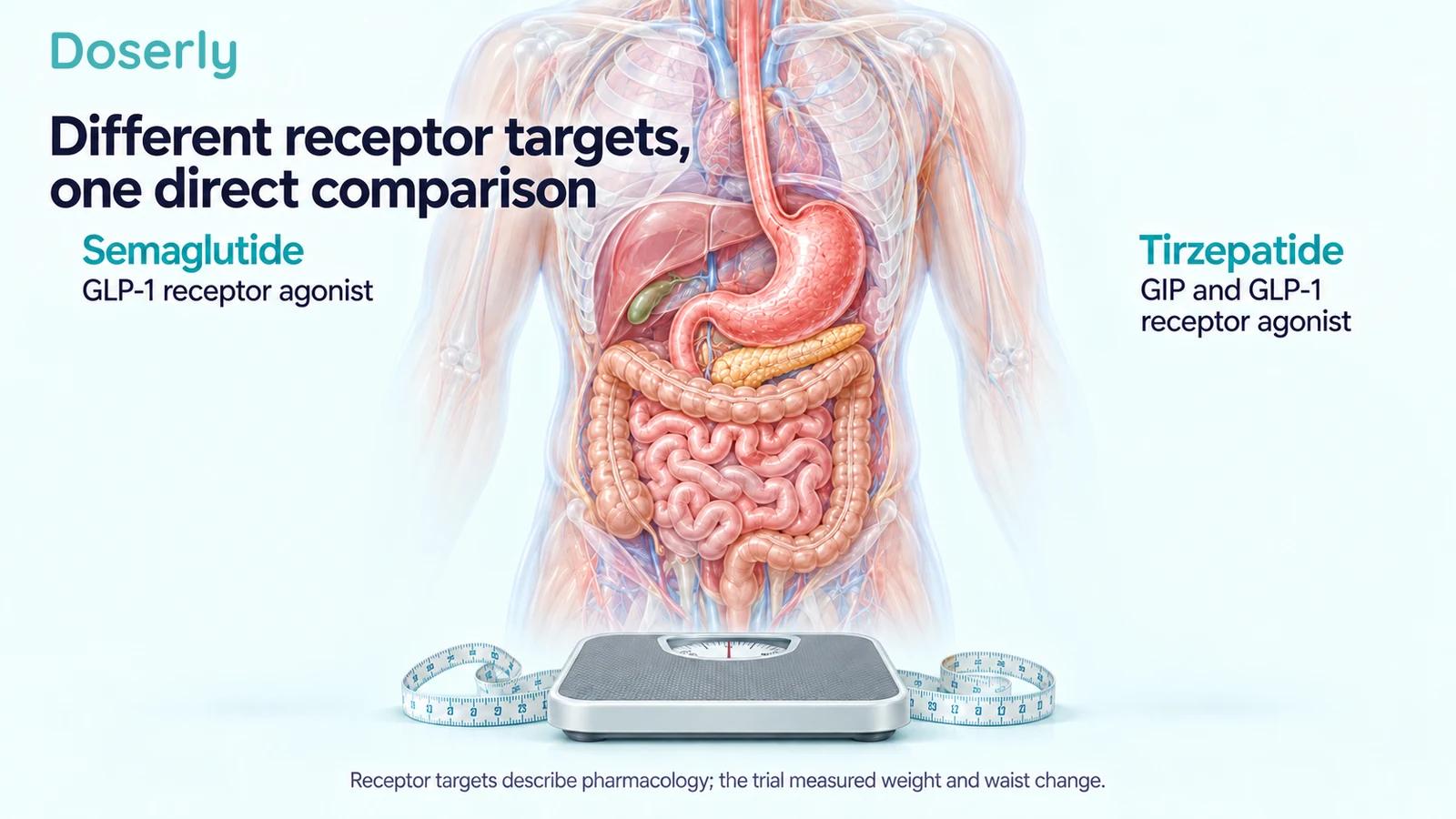
Semaglutide acts at the GLP-1 receptor. Tirzepatide acts at both GIP and GLP-1 receptors. Those pharmacological descriptions help identify the medicines, but the number of receptor targets is not, on its own, proof of clinical superiority. The randomized outcome is the evidence for the weight comparison. Wegovy label, Zepbound label
This distinction prevents an attractive mechanism story from doing more work than it can support. A treatment may have a plausible biological advantage and still need direct testing for each important outcome.
What do the weight numbers mean?
The reported mean reductions differ by 6.5 percentage points: 20.2 minus 13.7. That is a difference in the proportion of starting body weight lost. It is not a 6.5-kilogram difference for every participant, because starting weights differ.
As a purely arithmetic illustration, a 100-unit starting weight would correspond to a 20.2-unit reduction at one average and a 13.7-unit reduction at the other. This helps explain the percentages; it is not a prediction for someone starting at a particular weight.
The headline “nearly 50% more weight loss” uses a different denominator. Dividing the 6.5-point difference by 13.7 yields roughly 47%. That relative comparison does not mean tirzepatide participants lost half their body weight, and it does not mean every person obtained 47% more benefit.
Keeping the absolute percentage-point difference alongside the group averages makes the result easier to understand. Relative language can be mathematically legitimate while creating a much larger impression if its denominator is omitted.
Another reading detail is the analysis population. An estimate intended to reflect the assigned treatment strategy can differ from an estimate focused on what happens while people remain on treatment. Missing measurements also require explicit handling. Before comparing a headline with a figure from another paper, check that they use the same kind of analysis. Otherwise, a difference may partly reflect how discontinuations were counted. This is especially relevant to the real-world cohort, which explicitly evaluated on-treatment outcomes; it should not be casually combined with a randomized trial average as though both represented every person who started medication.
What did waist circumference add?
Average waist circumference decreased by 18.4 cm with tirzepatide and 13.0 cm with semaglutide. The trial also found higher proportions of tirzepatide participants reaching several prespecified weight-loss thresholds. Secondary outcomes
Waist circumference adds information about body size beyond total weight, but it is not a direct measurement of every tissue compartment or a count of prevented heart attacks. It should retain its own meaning.
Threshold outcomes answer another question: how many people crossed a specified level of weight reduction? They complement the mean because a group average does not describe the whole distribution. Neither an average nor a threshold proportion guarantees an individual response.
A reader should also avoid turning a threshold into a universal treatment target. The amount of weight reduction appropriate for one person depends on health goals and clinical circumstances. Crossing a trial's reporting threshold is not the only way treatment can be useful.
Does open-label design weaken the finding?
Open label means participants and study personnel knew which medicine was assigned. It does not mean treatment assignment was nonrandom or that the weight measurements were imaginary. Randomization and masking address different sources of uncertainty.
Knowledge of assignment can influence expectations, behavior and reports of symptoms. Body weight is more directly measured than a subjective impression, but the experience of taking treatment can still affect whether someone continues it and attends follow-up.
The reasonable interpretation is to retain both facts: this was a direct randomized trial, and it was not blinded. Discarding it because it was open label would ignore an important strength. Calling it a perfectly blinded comparison would ignore a real limitation.
The same balanced approach applies to sponsorship. Eli Lilly funded the study. Funding and investigator relationships belong in a critical reading, alongside the design, prespecified outcomes and reporting. Sponsorship alone does not substitute for examining what the study actually did.
What about side effects and staying on treatment?
Gastrointestinal events were the most common adverse events in both groups; most were mild to moderate and occurred mainly during escalation. Those broad findings do not mean that everyone tolerated treatment easily or that one person's experience can be predicted from the average. Safety findings
An average weight-loss advantage is valuable only in the context of a regimen a person can use. Persistent symptoms, other medications and practical barriers can affect that decision. The current prescribing information for each product describes its own contraindications, warnings and interactions. Semaglutide label, Tirzepatide label
A trial result is not an instruction to escalate despite significant symptoms or to change treatment without a plan. It gives a better estimate of expected group effects under a defined protocol. Individual treatment still requires assessment of response and tolerability over time.
Similarly, a medicine that works well for someone should not be considered a failure simply because another group average is larger. The comparison informs choices; it does not invalidate an individual's benefit.
Why this was not a diabetes trial
There was an earlier randomized comparison, SURPASS-2, in people with type 2 diabetes. It compared several tirzepatide doses with semaglutide 1 mg weekly over 40 weeks, with glycated hemoglobin as the primary outcome. That was a different population, comparator regimen and primary question. SURPASS-2
This explains why saying “the first comparison ever” is too broad. SURMOUNT-5's contribution was a direct obesity-treatment comparison using its particular regimens in adults without diabetes.
It also explains why numbers from the two trials should not be combined into one expected result. A glucose-control trial and a weight-management trial can both be informative without being interchangeable. Matching the question to the evidence is more useful than searching for the largest percentage across studies.
What did SURMOUNT-5 leave unanswered?
It did not compare the studied tirzepatide regimen with oral semaglutide or with the 7.2 mg injectable semaglutide option included in the June 2026 Wegovy label. New formulations or doses do not retroactively become part of the 2025 comparison. Current Wegovy formulations and dosing
It also did not establish which treatment better prevents heart attacks, strokes or cardiovascular death. SELECT directly studied cardiovascular events with semaglutide versus placebo in a high-risk population. That is valuable evidence for a different question, not a head-to-head cardiovascular comparison with tirzepatide. SELECT
Other unanswered questions include what happens after switching an established responder from one medicine to the other and which approach best maintains benefit over many years. A trial of initial assignment cannot automatically prescribe a switching strategy.
These boundaries are not reasons to minimize the weight finding. They identify where the evidence is direct and where another study or clinical judgment is needed.
How to use the result in a treatment discussion
Start with the outcome that matters: weight reduction, a specific complication, tolerability, function or maintaining a response. Then discuss which approved treatment and regimen fit that goal, the person's health history and practical access.
The headline averages can be part of that discussion, but so can the uncertainty around an individual's response. A useful follow-up plan asks how benefit will be assessed and what would prompt a change. It does not need to assume that the largest trial average is always the only meaningful goal.
Doserly's tirzepatide guide and semaglutide guide provide the broader evidence and safety context. SURMOUNT-5 makes one comparison clearer: under the studied weekly regimens, tirzepatide produced greater average weight and waist reduction at 72 weeks. Keeping that conclusion precise is what makes it useful.