
TRT
October 16, 2026
Stopping TRT: why recovery timelines should come with uncertainty
On this page
Testosterone treatment changes more than the amount of testosterone circulating in blood. It also suppresses the signals that normally support the body's own production and sperm development. When treatment stops, the medicine's disappearance, recovery of those signals and changes in symptoms do not necessarily happen together.
That is why a promise such as “everything will be normal in three months” is too simple. The starting diagnosis, formulation, duration of exposure, current health and reproductive goals all affect what recovery would mean. Someone treated for permanent testicular failure is not trying to return to the same baseline as a healthy volunteer in a contraceptive study.
Human research can help set expectations, but it needs to be matched to the question. A study measuring sperm concentration does not establish when energy or libido will improve. A normal testosterone result during recovery treatment does not prove that untreated production has resumed. Understanding these distinctions makes a supervised stopping plan more useful and less dependent on a countdown.
Define the outcome before estimating the time
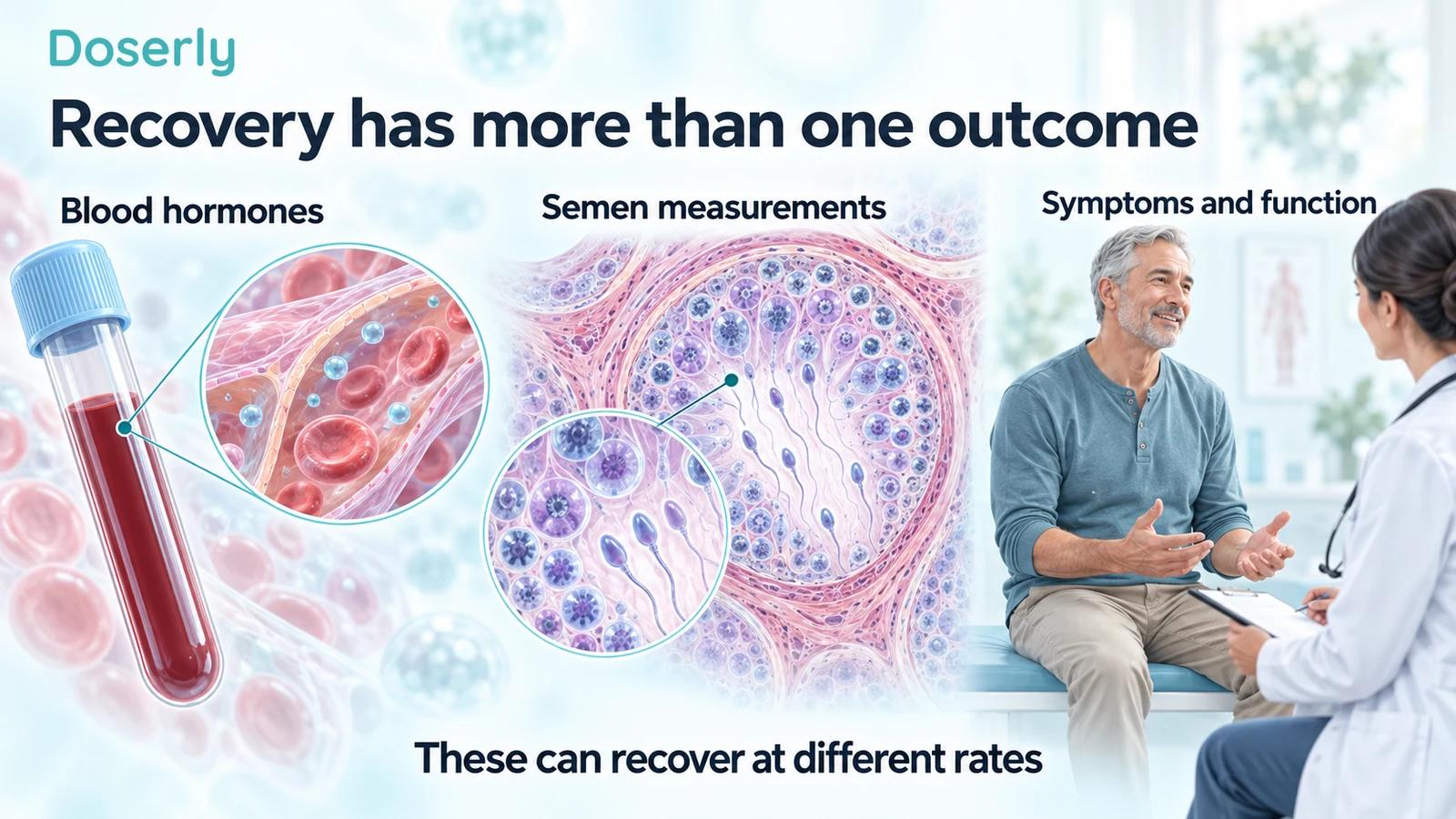
There are at least three different outcomes to discuss. Hormonal recovery concerns the return of the body's own testosterone production and the pituitary signals LH and FSH. Spermatogenic recovery concerns sperm production. Clinical recovery concerns symptoms and function, including sexual interest, mood and energy.
The word “normal” also needs a definition. It might mean crossing a laboratory threshold, returning to a previous baseline or reaching a level compatible with a particular reproductive goal. Those definitions can give different answers for the same person. Someone whose pretreatment level was genuinely low might recover their original physiology and still have a deficiency.
The Doserly guide to stopping TRT provides background on the clinical issues. A useful first appointment question is: “Which outcome are we trying to recover, and how will we measure it?” That is more informative than choosing a stop date without a follow-up plan.
The original reason for TRT still matters
If testosterone was prescribed for established primary testicular disease, stopping it does not remove that disease. A central cause may also persist. Conversely, a potentially reversible contributor may have changed since treatment began. The original diagnostic records help distinguish these possibilities.
Ask for the untreated testosterone measurements, their collection times, LH and FSH results, and the documented explanation for treatment. A result obtained while taking testosterone cannot reconstruct that baseline by itself. Nor can an isolated low result shortly after stopping establish permanent failure to recover.
Guidelines emphasize symptoms, consistently low testosterone and investigation of the cause when diagnosing hypogonadism. That same framework is valuable when reviewing whether ongoing replacement is needed. Endocrine Society guideline.
This is a clinical reassessment, not a test of willpower. Some people continue to need replacement for a well-established condition. Others need evaluation because their initial diagnosis was uncertain or their health has changed. The purpose of reviewing treatment is to find an appropriate plan for the present situation.
Stopping administration is not the same as ending exposure
Different formulations release testosterone differently. A long-acting injection leaves a depot from which medicine continues to enter circulation. Its effects cannot be inferred from the date of the last injection alone. This is especially relevant when interpreting early laboratory results after discontinuation.
A 2022 study examined recovery after two years of injectable testosterone undecanoate or placebo. The follow-up included 303 men with glucose intolerance who did not have pathological hypogonadism. Assessment began three months after the last injection and continued for a further year. LH and FSH recovered gradually, and the authors described slow, progressive reproductive hormone recovery across the fifteen months after the final injection. Handelsman and colleagues.
The study does not mean everyone stopping every testosterone product needs fifteen months. It concerns one long-acting preparation after prolonged exposure in a specific trial population. It does show why the drug and the duration belong in any discussion of timing. It also highlights binding proteins: persistent proportionate changes in SHBG and total testosterone were not interpreted simply as proof of continuing androgen deficiency.
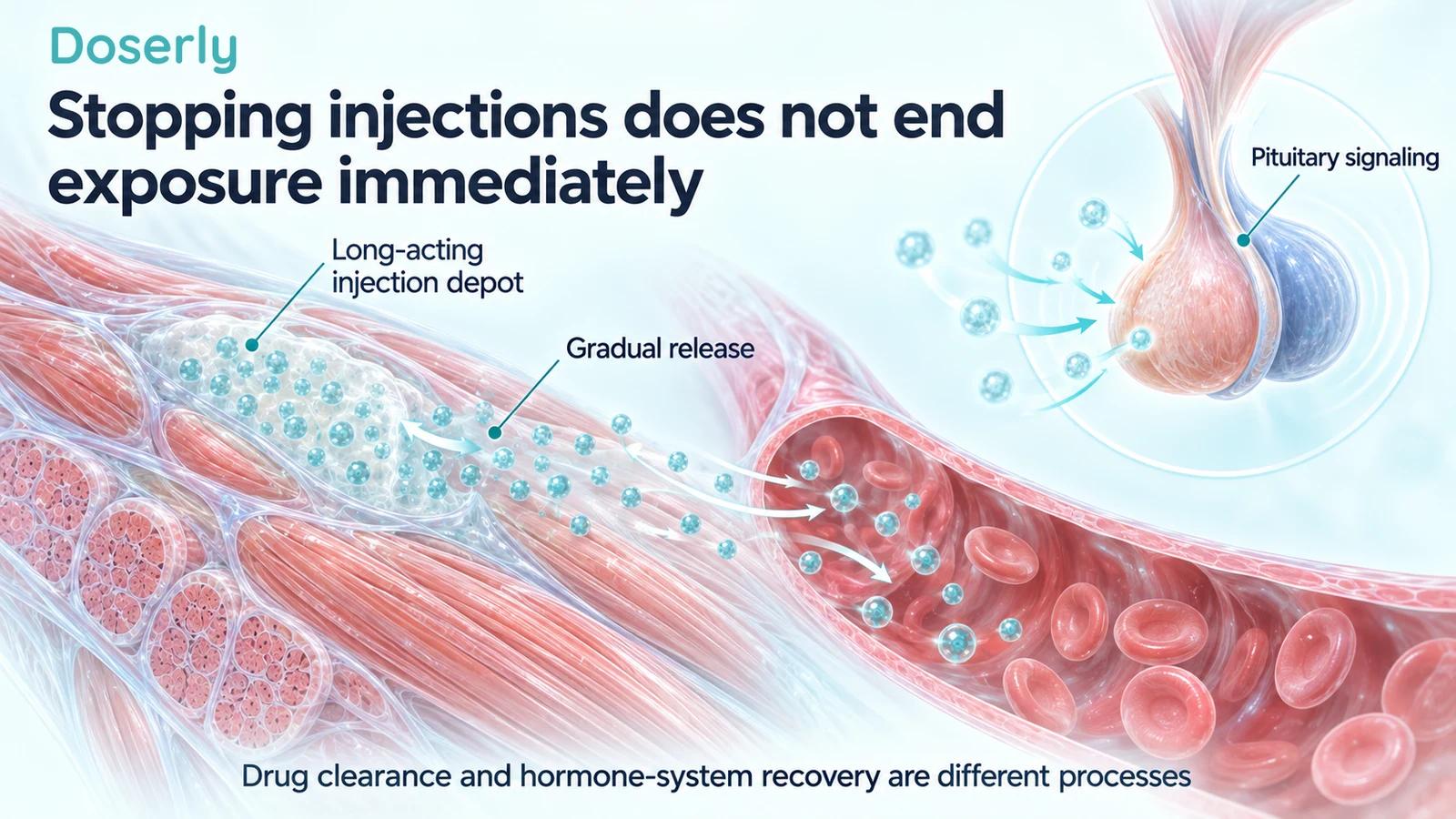
Image sources: Long-acting testosterone follow-up study
What contraceptive studies can tell us about sperm recovery
A frequently cited integrated analysis combined individual data from hormonal male-contraception studies. It included 1,549 healthy men with normal reproductive hormone function before treatment. The median time to recover a sperm concentration of 20 million/mL was 3.4 months. Recovery estimates also differed according to the sperm threshold chosen. Liu and colleagues, 2006.
A median is the middle of the observed time distribution, not a deadline. It does not mean every participant recovered by that time, and the threshold was a semen measurement rather than a pregnancy outcome. The participants were selected healthy volunteers, not a representative sample of older men with longstanding hypogonadism or years of varied androgen exposure.
These data are reassuring that suppression can be reversible under the studied conditions. They cannot provide a personal guarantee after clinical TRT. In particular, a man whose sperm production was impaired before treatment may not return to the same state as a volunteer who entered a contraception trial with normal reproductive function.
It is also misleading to treat the study's historical concentration threshold as a complete fertility assessment. Fertility involves more than concentration, and both partners' circumstances matter. A reproductive specialist interprets the semen analysis in that wider context.
What happens in men referred for testosterone-associated infertility?
A clinical series studied 66 men with testosterone-associated infertility who stopped testosterone and received hCG/SERM treatment under specialist care. Forty-six, or 70%, achieved a total motile sperm count above five million. Increasing age and longer testosterone exposure were associated with slower recovery at the six- and twelve-month assessments. Kohn and colleagues.
Total motile sperm count combines the number of sperm with the proportion that move; it is not the same as sperm concentration per millilitre. The outcome also does not mean that 70% achieved a pregnancy. This was a retrospective clinical series with active recovery treatment, not a randomized comparison of treatment against waiting.
That limits the conclusion in two directions. The results cannot prove that the medicines caused all of the recovery, because spontaneous recovery could contribute. They also cannot establish how long the same men would have taken without those medicines. The study is useful for counseling about variability, but it is not a do-it-yourself post-cycle protocol.
An apparently conflicting age effect across different studies should not be smoothed away into one universal rule. Healthy contraceptive volunteers and men referred to an infertility clinic differ in starting function, exposure and treatment. Predictors identified in one population do not necessarily behave identically in another.
Why anabolic-steroid recovery stories are a separate category
The HAARLEM study prospectively followed 100 male amateur athletes using androgens. Testosterone normalized within three months after discontinuation in most participants, while sperm production took longer. At the final assessment, some still had low testosterone or low total sperm counts. Smit and colleagues, 2021.
The timing needs careful reading: the final visit was one year after the start of the cycle, not uniformly one year after stopping. Participants also differed in compounds, exposure and prior androgen use. This is informative research on androgen use, but it is not a standardized prescription-TRT withdrawal trial.
A story about recovery after a short cycle therefore cannot predict the outcome after years of prescribed treatment, and the reverse is also true. The important similarities involve suppression of reproductive signaling. The differences in exposure and pretreatment health determine how much can reasonably be transferred between groups.
If nonprescribed androgen use is part of your history, an accurate account helps the clinician interpret testing. Product labels may not reliably describe every exposure, so uncertainty about what was taken should be stated rather than replaced with a falsely precise estimate.
Why post-cycle treatment is not proof of independent recovery
A medicine that stimulates reproductive signaling can raise testosterone while it is being taken. That is an on-treatment response. Demonstrating stable function after the medicine is withdrawn is a different observation.
Similarly, a good semen result during fertility treatment may be clinically useful even if the underlying condition has not resolved. The goal may be conception rather than permanent medication-free function. These goals should be explicit so that treatment success is not judged by a standard the clinician and patient never agreed upon.
EAU guidance describes specialist treatment of hypogonadotropic hypogonadism and distinguishes it from testosterone treatment, which should not be used as therapy for male infertility. EAU male-infertility guideline. It does not support assuming that one combination or calendar works for every cause of suppression.
Do not use an online schedule to interpret an unexpectedly low result or add medicines without review. The next useful step may be repeat testing, checking exposure timing, investigating the original diagnosis or obtaining a semen analysis, rather than increasing stimulation.
What should a supervised follow-up plan include?
The plan should specify the treatment being stopped, the reason for stopping and the first outcome to assess. It should also make clear who will interpret results and how symptoms between appointments will be handled. This is particularly important when the prescribing clinic and fertility specialist are different services.
Record the actual dates and formulations used, including any recovery medicines. For each laboratory test, note whether you were still receiving treatment that could affect the result. A dated record makes it easier to avoid comparing a treated result with an untreated one as though they represented the same physiological state.
If fertility is urgent, discuss that urgency early. Waiting for symptoms or testosterone alone to normalize can delay the semen assessment that answers the reproductive question. The fertility-preservation guide explains why planning can matter before treatment changes as well as afterward.
Symptoms need attention even when uncertainty remains about hormone recovery. Marked deterioration in mood, thoughts of self-harm or severe functional impairment should prompt urgent clinical help rather than waiting for a predicted recovery date. A calendar is not a reason to leave a serious symptom untreated.
A realistic expectation is a series of reassessments
Recovery estimates are most useful when they describe a population, a treatment and an outcome. “Median time to a specified semen threshold in healthy contraceptive volunteers” is a different claim from “time until a particular patient feels well after TRT.” Keeping those descriptions intact prevents a useful study from becoming an unreliable promise.
Ask what findings would indicate progress, what would prompt investigation of another cause and when the treatment goals should be reconsidered. You should know how the next decision will be made even when the exact recovery date cannot be predicted.
The evidence supports cautious optimism for some situations and ongoing replacement or fertility care for others. The practical goal is a plan that can respond to your measurements and symptoms as they develop, rather than requiring your body to match someone else's timeline.
Sources
- Endocrine Society testosterone guideline, 2018.
- Handelsman et al., 2022: endocrine recovery after prolonged testosterone undecanoate.
- Liu et al., 2006: integrated male-contraception recovery analysis.
- Kohn et al., 2017: treated clinical infertility cohort.
- Smit et al., 2021: HAARLEM prospective androgen-use cohort.
- EAU male-infertility guideline.