
Peptides
October 16, 2026
SS-31 before MOTS-c: what each peptide does and what the research shows
On this page
SS-31 and MOTS-c both have a connection to mitochondria, the parts of your cells that help turn food into usable energy. But researchers are interested in them for different reasons. SS-31 is being studied for its effects on mitochondrial function, while MOTS-c research looks at how cells respond to exercise and changes in their energy supply.
The idea behind taking SS-31 first is that improving mitochondrial function might help the body respond to MOTS-c afterward. It's an understandable theory. We don't yet have human trial results showing that this order improves energy, exercise capacity or metabolic health. The studies discussed below examine the peptides separately, and some measure the body's own MOTS-c without giving it as a treatment.
So what have researchers found, and how does it relate to the benefits you might be interested in? Let's start with how the two peptides differ, then look at the human studies on muscle function, fatigue and metabolism. For a broader introduction to either peptide, our SS-31 guide and MOTS-c guide cover their mechanisms, uses and safety in more detail.
How SS-31 and MOTS-c work differently
To understand SS-31, it helps to look inside a mitochondrion. Its inner membrane has folds that provide space for the processes involved in producing energy. Cardiolipin, a fat-like molecule in that membrane, helps organize the proteins that do this work. SS-31, also called elamipretide, is a lab-made peptide that associates with cardiolipin. Researchers have investigated whether this interaction can improve mitochondrial function in people with diseases that affect it. Early randomized elamipretide study
MOTS-c is a peptide the body makes from information encoded in mitochondrial DNA. Research connects it with responses to metabolic stress: situations in which cells need to adapt to changes in energy demand or supply. One pathway involves AMPK, a protein that helps regulate how cells use energy. Much of what we know about giving MOTS-c to influence these pathways comes from cell and animal experiments. Human research has also examined how the body's own MOTS-c changes during exercise. Reynolds and colleagues, 2021
This helps explain the interest in combining them. One approach focuses on mitochondrial function; the other concerns signals involved in how cells use fuel. Whether these effects complement each other in a person is a separate question. We would need to see that SS-31 changes mitochondrial function in that person, and that the change leads to a better response to MOTS-c. The mechanisms alone don't tell us whether that happens or how long any effect would last.

Can SS-31 improve fatigue or physical function?
For someone interested in SS-31 for energy, the practical question is whether it helps people feel or function better. The MMPOWER-3 trial, reported in 2023, tested this in 218 participants with genetically confirmed primary mitochondrial myopathy, a disease that affects energy production in muscle. Researchers randomly assigned 109 people to elamipretide and 109 to placebo for 24 weeks. Neither participants nor investigators knew who received which treatment, helping reduce the influence of expectations on the results.
The two main outcomes were distance walked in six minutes and fatigue measured with a disease-specific questionnaire. Neither main outcome showed a significant benefit. The estimated treatment difference in walking distance was −3.2 metres, with a 95% confidence interval from −18.7 to +12.3 metres. That interval describes the uncertainty around the estimate; it includes both worse and better performance. MMPOWER-3 primary report
For these patients, elamipretide did not produce a clear improvement in the two measures the trial was designed to test. That matters if you're hoping it will improve fatigue or endurance. The participants had a specific muscle disease, so the result doesn't answer every question about other uses. But it also doesn't support a general promise of more energy in otherwise healthy people.
What about its effect on cellular energy production?
A smaller trial asked a more specific question: could elamipretide change how much energy a muscle could produce? This 2021 randomized study enrolled 39 adults aged 60–85 who had low mitochondrial function despite otherwise good general health. Researchers examined a small hand muscle after a single two-hour elamipretide infusion, using specialized scans to estimate its capacity to make ATP, a molecule cells use to transfer energy.
Immediately after treatment, average ATP-capacity increases were 27% with elamipretide and 12% with placebo. The statistical result depended on the analysis: the percentage-change comparison had p=0.045, while the absolute-change comparison had p=0.055. One narrowly crossed the conventional statistical threshold of 0.05; the other narrowly missed it. These p-values are not the probability that the treatment works, and the difference makes the strength of the result sensitive to the chosen analysis.
There was no between-group difference at day seven and no significant benefit on the prespecified muscle fatigue-resistance analysis, meaning the analysis chosen before examining the results. Additional analyses were exploratory: useful for developing questions, but less conclusive than a successful planned test. Roshanravan and colleagues, 2021
The immediate ATP finding is a reason to study the drug further. It suggests that elamipretide may affect energy production under the conditions tested. What it doesn't tell us is whether someone would feel less tired over the following weeks or become better able to exercise. Those benefits need to be measured directly; they can't be inferred from the scan alone.
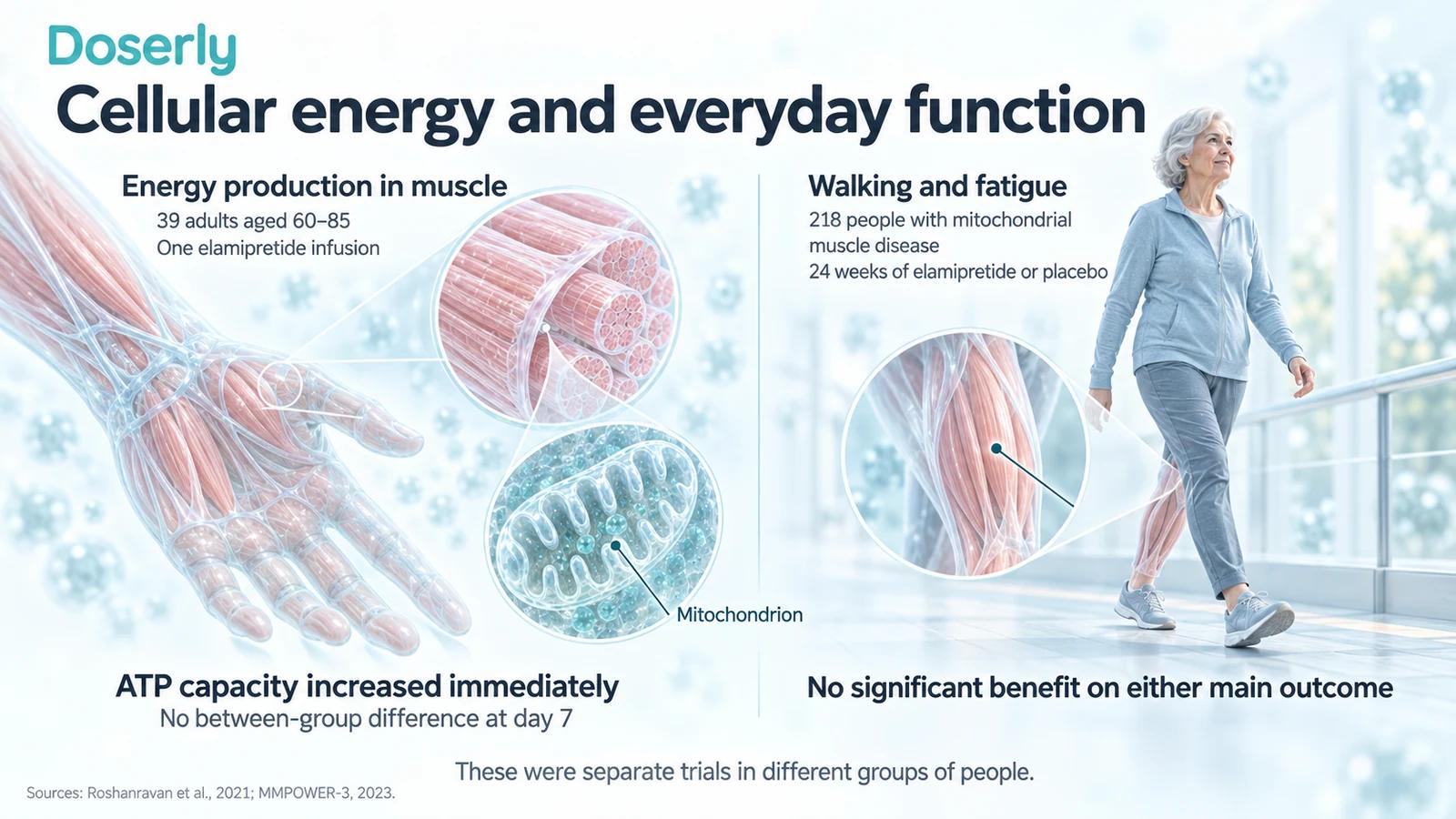
Image sources: older-adult ATP study; MMPOWER-3
Why is elamipretide approved for Barth syndrome?
In September 2025, FDA granted accelerated approval to Forzinity, the prescription elamipretide product, to improve muscle strength in adults and children with Barth syndrome weighing at least 30 kg. Barth syndrome is a specific rare disease; this is not a general approval for fatigue or healthy aging.
FDA describes a small study involving 12 patients. The initial randomized period did not demonstrate superiority on its main walking and fatigue outcomes. Knee-extensor strength improvements were observed during the longer open-label extension, when treatment was known and there was no concurrent placebo comparison. Continued studies are needed to confirm clinical benefit under the accelerated-approval pathway. FDA Forzinity trial snapshot
Forzinity also has known side effects. FDA identifies injection-site reactions as common and warns about potentially serious allergic reactions. These risks matter when weighing a possible benefit, including when someone proposes combining elamipretide with another substance. FDA safety information
The approval applies to this particular medicine in people with Barth syndrome. It doesn't establish a benefit for general fatigue, healthy aging or a combination with MOTS-c. Our SS-31 guide's human research section explains the wider clinical trial results if you'd like to compare them.
Has MOTS-c ever been tested as a treatment in people?
We know less about administering MOTS-c to people than we do about elamipretide. In its briefing for the July 2026 Pharmacy Compounding Advisory Committee meeting, FDA reported that its review had not identified clinical studies or human exposure data for the MOTS-c substances being evaluated. It also found gaps in human pharmacokinetic information: how the substance is absorbed, distributed through the body and cleared. FDA MOTS-c briefing, pages 27–30
You may still come across papers described as “human MOTS-c research.” That description can be accurate even when nobody received MOTS-c. Some studies measure the peptide already present in blood or muscle. Others investigate a modified drug based on it. Understanding which kind of study you're reading helps explain what its results mean for potential treatment benefits.
A trial registration is useful for finding out what researchers plan to test, but it doesn't tell us whether a treatment worked. For that, we need the results. The two examples below show what the available human findings can tell us so far.
What do we actually know about MOTS-c in people?
Exercise changes the body's own MOTS-c
In the human portion of a 2021 study, 10 sedentary, healthy young men completed a stationary-bike exercise session. Researchers collected blood and muscle samples around the session and during recovery. MOTS-c measurements increased with exercise, and circulating levels returned toward baseline after four hours of rest.
The researchers were measuring endogenous MOTS-c, meaning the peptide already produced within the body. The men were not given MOTS-c. The same paper included experiments in which animals received treatment, but the human part was an exercise study. Human exercise results in Reynolds and colleagues
This suggests that MOTS-c is involved in the body's response to exercise. It doesn't yet tell us whether giving additional MOTS-c would improve that response, reproduce exercise's benefits or help someone with fatigue. The study also didn't establish a target blood level or identify a deficiency that treatment should correct.
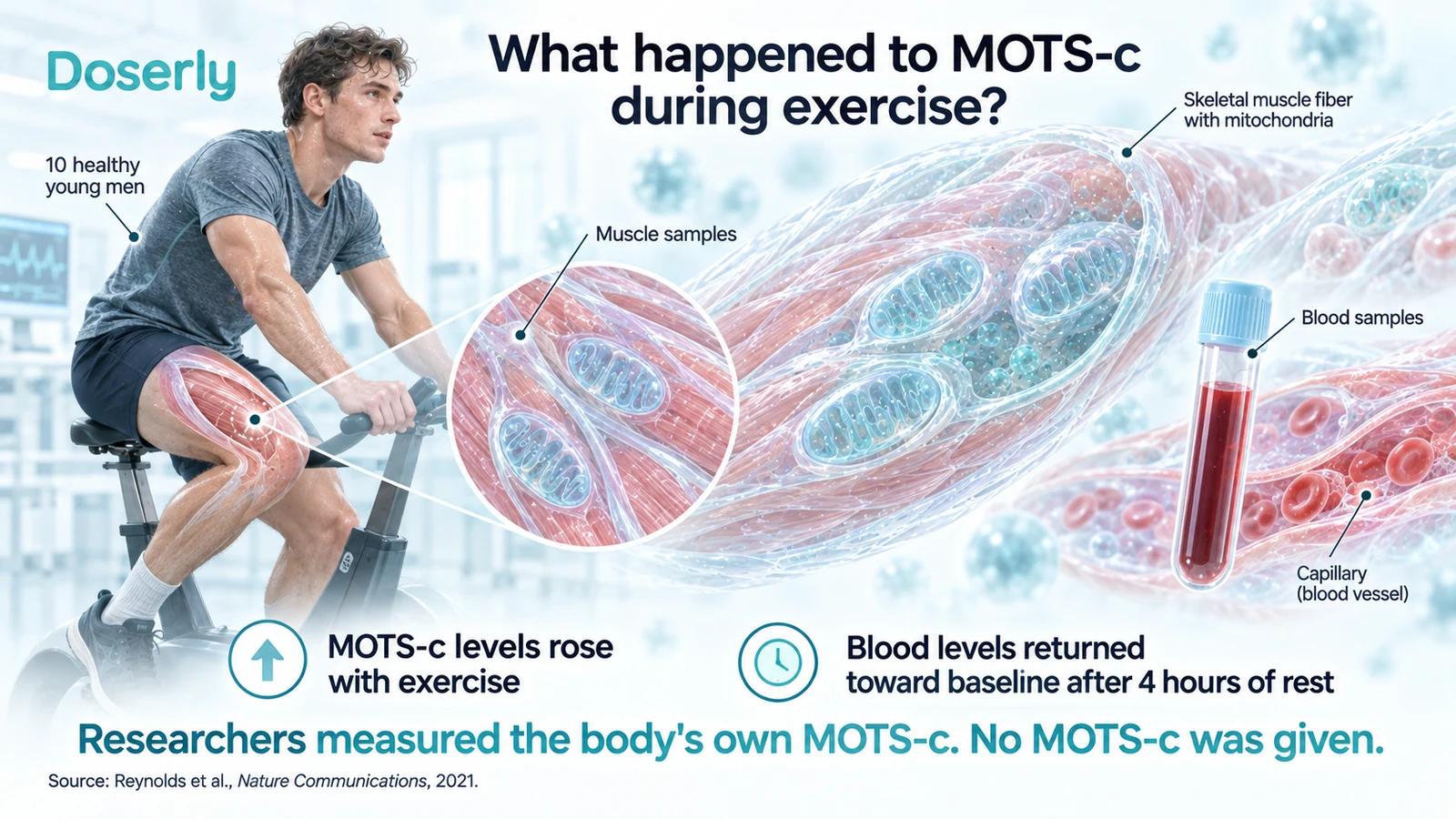
Image sources: Source: Reynolds and colleagues, 2021
CB4211 is a modified molecule, with early human data
CB4211 is an analogue of MOTS-c: a modified molecule developed as a drug candidate. In its original 2021 results presentation, sponsor CohBar described a randomized, blinded, placebo-controlled phase 1b study in adults with obesity and fatty liver. Twenty-three participants were randomized; 20 completed the four-week assessments, including 11 receiving CB4211 and nine receiving placebo. Safety and tolerability were the main objectives. CohBar study presentation filed with the SEC
The sponsor reported exploratory changes including a 21% decrease in ALT with CB4211 versus a 4% increase with placebo. ALT is a blood marker associated with liver-cell injury; lowering it is not the same as demonstrating that liver disease has resolved. Liver fat decreased in both groups. Original study presentation
Injection-site reactions occurred, and no serious adverse events were reported. These were early, sponsor-reported findings, not a large confirmatory efficacy trial. A study this small cannot rule out uncommon harms. Original CB4211 results release
For readers interested in metabolic health, CB4211 provides an early example of testing a drug based on MOTS-c in people. But modifying a molecule can change its behavior, so we can't assume that native MOTS-c would have the same effects or safety profile. Nobody in this trial received SS-31 beforehand, either.
Would taking SS-31 first make MOTS-c more effective?
We don't have a human comparison that answers this. Even if future trials find that each peptide helps with a particular condition, researchers would still need to test whether using both adds a worthwhile benefit and whether their order changes the result.
It's possible that the first treatment could improve the response to the second. It's also possible that the order would make no difference, or that combining them would add side effects without enough benefit to justify them. These are possibilities to investigate, not findings from the studies above.
Personal experiences can help identify questions worth studying. If someone says they felt better after using both peptides, that's useful to hear about. But if they also changed their sleep, exercise or other treatments, it becomes difficult to know which change helped. Even when nothing else changed, that experience doesn't tell us whether the reverse order or one peptide alone would have worked as well.
How could researchers test the proposed order?
A useful trial would first choose a specific problem to treat. For example, researchers could study walking capacity in people with mitochondrial disease, or metabolic control in people with prediabetes. Those are different questions, and a result in one group wouldn't automatically apply to the other.
To test order specifically, researchers could compare SS-31 followed by MOTS-c with the reverse order, using otherwise comparable treatment periods and follow-up. To establish that the combination adds anything, they would also need appropriate single-treatment or control comparisons. That is a proposed research approach, not an established protocol.
For the results to be useful, the trial would need:
- Comparable exposure: If one group receives more total treatment or is assessed later, an apparent advantage may reflect that difference instead of order.
- A main outcome chosen in advance: If the goal is less fatigue, researchers need to measure fatigue. A change in a blood marker can help explain what's happening, but it doesn't answer whether people feel better.
- Measurements between stages: If the theory involves “preparing” mitochondria, the study should measure the proposed preparation before the second treatment starts and examine whether it relates to the eventual benefit.
- Enough follow-up: Immediate laboratory changes, durable symptom improvement and delayed adverse effects require different observation periods.
- Transparent reporting: Dropouts, adverse events and uncertainty around the estimates are part of the answer, including when the findings are disappointing.
Until a study tests these questions, we can't identify a proven interval between SS-31 and MOTS-c or estimate the extra benefit and risks of using them together.
Questions worth taking to a clinician
If you're considering these peptides because of fatigue, reduced exercise capacity or a metabolic concern, start by explaining that problem to your clinician. It gives you a specific goal to discuss and a way to assess whether any proposed treatment is helping.
Ask whether the supporting study involved people with a similar condition, which molecule and formulation it used, and what improved. If your main concern is fatigue, a study measuring fatigue or daily function will be more directly relevant than one measuring a temporary change in a blood sample.
If SS-31 followed by MOTS-c is suggested, ask: “Why use them in this order, and what results support that choice?” A clinician may be drawing on a biological theory or their experience with patients. Understanding that basis helps you distinguish an established treatment effect from a hypothesis. You can also ask how improvement would be measured, which side effects to watch for and what would lead to stopping or changing treatment.
For more background before that conversation, the SS-31 guide explains elamipretide's clinical uses and risks, while the MOTS-c guide covers its biology and the gaps in treatment research.
Sources
- MMPOWER-3: elamipretide in primary mitochondrial myopathy, randomized trial (2023)
- Elamipretide and mitochondrial ATP production in older adults, randomized trial (2021)
- Early randomized elamipretide study in mitochondrial myopathy (2018)
- FDA: Forzinity trial and approval evidence
- FDA: MOTS-c advisory committee briefing (July 2026)
- Reynolds and colleagues: MOTS-c and exercise, including the human sampling study (2021)
- CohBar: original CB4211 results release (August 2021)
- CohBar: CB4211 study design and participant flow (August 2021)