
Peptides
October 16, 2026
SS-31 and primary mitochondrial disease: why diagnosis changes applicability
On this page
A study of “mitochondrial disease” can sound relevant to anyone struggling with energy or exercise. But the phrase describes a clinical category, not a general explanation for tiredness. The diagnosis determines which research question was tested and how much of the answer can reasonably apply to someone else.
This is particularly important for SS-31, also called elamipretide. Its research includes genetically confirmed primary mitochondrial myopathy, Barth syndrome and selected older adults with low measured mitochondrial function. Those populations share an interest in mitochondrial biology, but they are not interchangeable.
The largest published myopathy trial did not meet its main walking or fatigue endpoints. Later genetic analyses suggested a more specific hypothesis worth testing. Separately, Forzinity received a disease-specific accelerated approval for muscle strength in Barth syndrome. Understanding these distinctions is more useful than putting every result under a single “mitochondrial support” claim.
Primary mitochondrial disease has a specific meaning
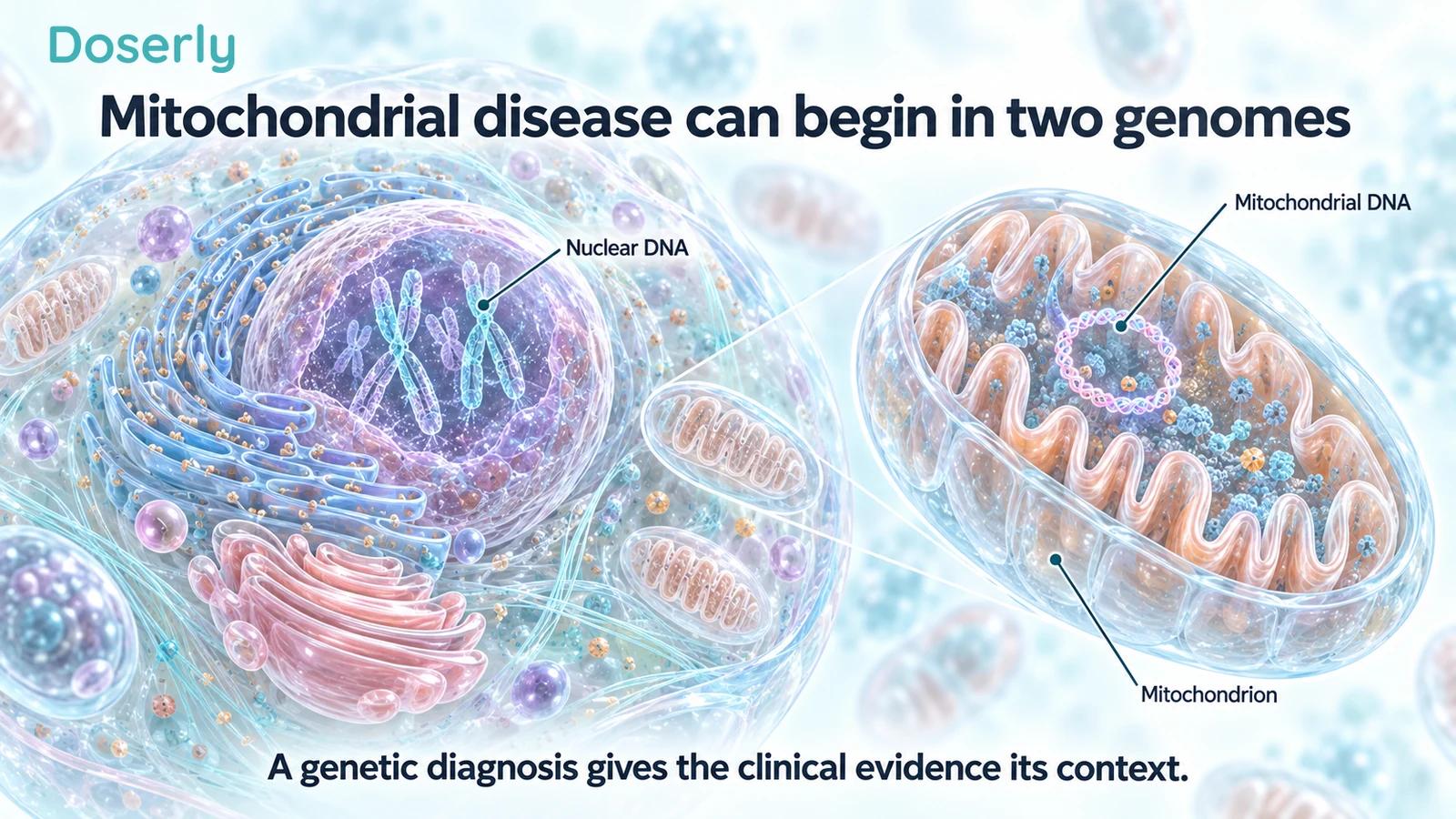
Primary mitochondrial disorders arise from genetic changes affecting mitochondrial function. The relevant genetic change can be in mitochondrial DNA or nuclear DNA. Mitochondria carry some genetic information themselves, while many proteins they need are encoded in the cell's nucleus.
Myopathy means muscle disease. Primary mitochondrial myopathy therefore concerns muscle involvement in a primary mitochondrial disorder. It does not mean that every problem with exercise or fatigue has been traced to that diagnosis.
The Mitochondrial Medicine Society's diagnostic consensus describes evaluation that can involve clinical findings, biochemical measurements, genetic testing and, in selected circumstances, tissue studies. It also explains why a single biochemical finding can be nonspecific or affected by sample handling. Mitochondrial Medicine Society consensus
For a reader, the practical point is about classification rather than self-testing. A research result from genetically confirmed myopathy cannot establish the cause of unexplained symptoms. Diagnosis comes before deciding whether the trial population resembles the person seeking help.
The symptom is not the study's entry criterion
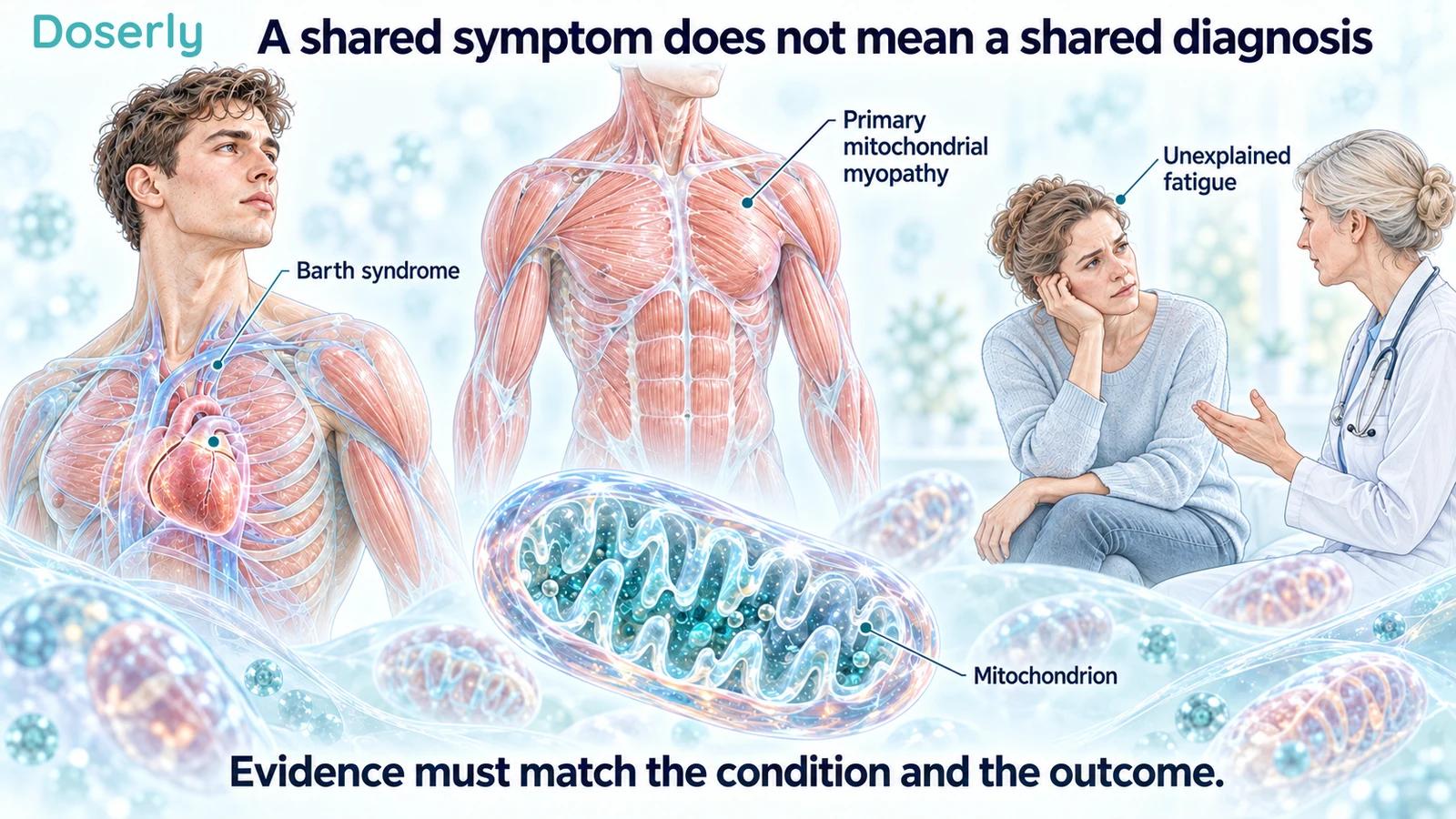
Imagine two people who both say that stairs are exhausting. One has an established genetic muscle disorder. The other has not yet had the symptom evaluated. Their experiences may sound similar, but the evidence does not place them in the same clinical category.
A trial's entry criteria create the group to which its findings most directly apply. “Genetically confirmed primary mitochondrial myopathy” is therefore essential information, not a technical detail that can be removed from a summary.
Even within a diagnosis, eligibility can depend on age, disease stability and ability to perform the selected test. A study built around walking cannot automatically answer the same question in someone unable to complete that assessment.
This is why applicability should be discussed in layers: the diagnosis, relevant subtype, participant characteristics, treatment exposure and intended outcome. A shared symptom is a starting point for a conversation, not enough to establish that all those layers match.
What the early MMPOWER trial actually tested
The first MMPOWER trial enrolled 36 people with genetically confirmed primary mitochondrial myopathy. It used intravenous treatment over five days and assessed walking distance, alongside other outcomes.
The highest-dose group improved more than placebo on the walking measure, but the unadjusted comparison narrowly missed conventional statistical significance. Dose-response and covariate-adjusted analyses were encouraging. The authors called for larger studies with longer treatment periods. MMPOWER, 2018
This was a reasonable basis for further development. It was not a demonstration that all forms of mitochondrial disease, all routes of treatment or general fatigue would respond similarly.
A common reading error is to extract the most favorable number from an early trial and treat it as a settled estimate of benefit. The development sequence matters: small, short studies help identify a signal, while later trials test whether that signal holds under more demanding conditions.
MMPOWER-2 narrowed some questions and left others open
MMPOWER-2 enrolled 30 people in a blinded crossover trial. Participants received subcutaneous elamipretide and placebo in separate four-week periods, with a washout between them. Its primary six-minute walking comparison did not reach statistical significance.
Several secondary patient-reported fatigue measures favored treatment. Those findings supported continuing the research, but they were not a replacement for the primary endpoint or a guarantee that a larger trial would confirm benefit. MMPOWER-2, 2020
The design also changed from the earlier short intravenous study. That matters when claims move casually between “SS-31 research” and a specific treatment practice. The molecule's name does not make every exposure equivalent.
These early studies are best read as part of a developing hypothesis. They helped define what should be measured next and how long treatment might need to be studied, while leaving uncertainty about the size and consistency of benefit.
The larger trial did not confirm the main benefits
MMPOWER-3 randomized 218 people with genetically confirmed primary mitochondrial myopathy to elamipretide or placebo for 24 weeks. It did not demonstrate a significant benefit on either primary outcome: six-minute walking distance or disease-specific fatigue.
For walking, the estimated between-group difference was −3.2 meters, with a confidence interval spanning −18.7 to 12.3 meters. That result does not support a general walking benefit in the overall trial population. MMPOWER-3, 2023
The result deserves more weight than a promotional summary built only around early encouraging findings. It directly tested the proposed clinical effects in a larger group over a longer period.
At the same time, the overall result does not show that every genetic subtype behaves identically. It leaves a further research question: could a biologically narrower group respond differently? Answering that question requires careful subgroup analysis and confirmation, rather than assuming the answer from the mechanism.
Why nuclear and mitochondrial DNA became important
A later report examined genetic patterns in MMPOWER-3. The original study had distinguished nuclear-DNA and mitochondrial-DNA causes, and the report describes a prespecified exploratory comparison by those categories. Additional, more detailed genotype analyses were performed after the trial.
Many participants in the nuclear-DNA group had changes in genes involved in maintaining mitochondrial DNA, including POLG and TWNK. The later analyses focused on this maintenance machinery, often called the replisome. Genotype-specific analysis, 2024
This is a more specific biological idea than “mitochondrial disease responds to mitochondrial treatment.” It asks whether a particular kind of underlying defect identifies a group in which the drug is more likely to affect function.
It is also important to keep the analysis categories straight. A broad prespecified exploratory comparison and a subsequent post-hoc examination of narrower subgroups do not have the same status as a successful primary endpoint in a prospectively targeted trial.
How much can the subgroup findings establish?
The 2024 report described a walking signal in participants with nuclear-DNA-related disease. In the narrower mitochondrial-DNA-maintenance analysis, the overall walking comparison had a p value of 0.06. A subgroup with chronic progressive external ophthalmoplegia showed a stronger signal. The detailed analyses used participants who completed the trial per protocol. Genotype-specific analysis, 2024
These observations can guide the design of a new trial. They cannot retrospectively turn the negative overall primary result into a positive trial for everyone with myopathy.
The distinction matters because examining many smaller groups creates more opportunities to find a favorable pattern by chance. A credible biological explanation makes a pattern interesting, but does not remove the need to test it independently.
For someone with a relevant genetic result, the finding may be worth discussing with a specialist. It is not a reliable personal prediction, and it should not be presented as proof that everyone carrying a particular gene change will benefit.
A follow-up hypothesis is not a completed result
The genotype paper describes the rationale for the follow-up NuPOWER program. That is evidence of how investigators planned to test a more focused population, not evidence that the planned trial succeeded.
When reading a development update, separate three things: a study being registered or described, participants being followed, and results being reported. A design paper can explain eligibility and endpoints while containing no new treatment outcomes from the planned trial.
The same applies to a confident title or an attractive mechanism diagram. Neither supplies the missing comparison. A useful clinical claim needs results from the relevant study, interpreted in light of its design.
This article uses the published MMPOWER findings and their subsequent analyses. It does not treat future or planned NuPOWER outcomes as observed evidence.
Why Barth syndrome should remain separate
Barth syndrome involves a particular problem in cardiolipin remodeling associated with TAFAZZIN. That biology is relevant to elamipretide's interaction with the inner mitochondrial membrane, but it is not the same enrollment category as the broad MMPOWER myopathy program.
In September 2025, the FDA granted accelerated approval to Forzinity to improve muscle strength in adults and children with Barth syndrome weighing at least 30 kg. This is a specific indication, rather than approval for all primary mitochondrial diseases. FDA approval announcement
The Barth trial's blinded walking and fatigue endpoints were not met; the regulatory decision considered the longer-term knee-extensor strength findings. The prescribing information describes the accelerated-approval basis and the need for confirmation of clinical benefit. Forzinity prescribing information
Neither direction of extrapolation is justified: the Barth approval does not establish benefit for every myopathy, and MMPOWER-3's overall result does not erase the separate Barth indication.
What the mechanism can contribute
Elamipretide is described in the prescription label as a cardiolipin binder that localizes to the inner mitochondrial membrane. That provides a biological rationale for investigating it. It does not identify the cause of a person's symptoms or determine their likely response on its own.
A useful mechanism explains a possible route from treatment to an outcome. Clinical evidence then asks whether that route matters enough to produce a measurable benefit in the condition being studied.
This distinction is especially important when the underlying genetic defect affects a different part of mitochondrial function. A drug can interact with its target without correcting every problem that limits the patient's activity.
The SS-31 guide provides more detail on the membrane mechanism and the separate clinical programs. The mechanism is valuable context for those programs, rather than permission to merge their findings.
What to bring to a specialist discussion
For someone already diagnosed, the most useful starting information is the exact diagnosis and, when available, the interpreted genetic report. A gene name alone may leave out the specific variant, whether it is considered disease-causing and how it fits the clinical picture.
Then define the desired outcome. Improving walking distance, reducing fatigue, increasing strength and changing a laboratory measurement are different goals. Ask which study measured the outcome that matters to you in a comparable population.
It is also reasonable to discuss what the evidence does not establish: durability, the likelihood of individual response, treatment burden and adverse effects. Forzinity's label includes injection-site reactions and potentially serious hypersensitivity, so an attractive biological rationale is only one part of the decision.
For unexplained symptoms, the priority is an appropriate clinical evaluation. An elamipretide study cannot substitute for that process or diagnose mitochondrial disease from a resemblance to its participants' complaints.
Read the diagnosis before the headline
The most informative summary of a study names the condition and population before describing the result. “Primary mitochondrial myopathy” should not disappear when a finding is turned into a claim about “energy.”
The MMPOWER sequence shows why: early signals led to a larger trial, its primary results were negative, and later genetic analyses generated a narrower hypothesis. The Barth program adds a separate, specific regulatory indication.
Keeping those stories distinct allows the evidence to be useful without making it broader than it is. It also gives a clinician and patient a better starting question: which finding, if any, actually matches this diagnosis and this treatment goal?
Sources
- Mitochondrial Medicine Society consensus: diagnostic context and genetic categories.
- MMPOWER, 2018: early intravenous study.
- MMPOWER-2, 2020: crossover trial.
- MMPOWER-3, 2023: larger randomized results.
- Genotype-specific analysis, 2024: exploratory genetic findings.
- FDA approval announcement: Barth-specific decision.
- Forzinity prescribing information: indication, mechanism and safety.