
Peptides
October 16, 2026
Forzinity, SS-31 and longevity: what the FDA approval actually means
On this page
Elamipretide, also known in research as SS-31, is a peptide that interacts with cardiolipin in the inner mitochondrial membrane. Mitochondria help cells produce usable energy, so a medicine aimed at their function naturally attracts interest beyond a single disease. That interest became more visible when FDA approved the prescription product Forzinity in September 2025.
The approval was an important development for people with Barth syndrome. It was not an approval for healthy aging, general fatigue or extending human lifespan. Understanding what it did establish makes it easier to discuss both its clinical value and the separate longevity research without treating them as the same claim.
Here we'll examine the exact indication, the accelerated-approval evidence and the aging studies often mentioned alongside it. Our SS-31 guide covers the broader mechanism and clinical program.
What FDA approved on September 19, 2025
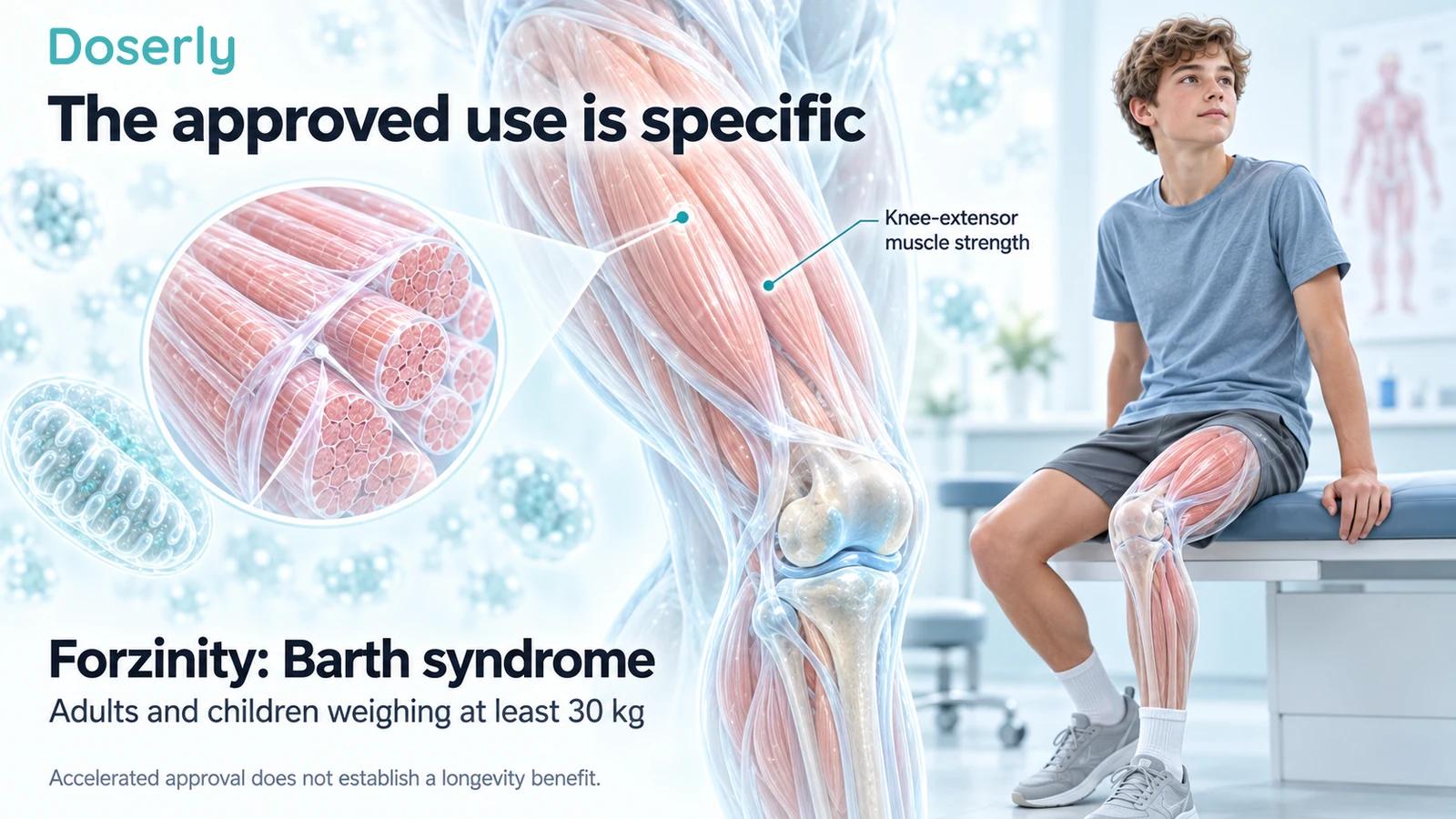
Forzinity is indicated to improve muscle strength in adults and children with Barth syndrome who weigh at least 30 kg. FDA granted accelerated approval, a pathway that allows approval on evidence considered reasonably likely to predict clinical benefit while further study is required. The product is administered by subcutaneous injection. FDA approval announcement
Each part of that indication matters. It names a prescription product, a disease population and an intended benefit. It doesn't say that any product labeled SS-31 has demonstrated the same quality or clinical performance. It doesn't describe treatment of ordinary age-related tiredness, and it doesn't claim reduced mortality.
A person can be interested in the mechanism without fitting the approved population. That is precisely where the evidence needs to be reconsidered: what study supports the proposed use in that person's circumstances? The approval cannot answer a different clinical question simply because mitochondria are involved in both.
Why Barth syndrome is a specific biological setting
Barth syndrome is a rare genetic disorder associated with abnormal cardiolipin biology. Cardiolipin is a lipid, a fat-like molecule, that helps organize the inner mitochondrial membrane. This membrane is central to the processes that couple fuel oxidation with ATP production.
The connection gives elamipretide a biological rationale in this disease. The prescribing information describes it as a mitochondrial cardiolipin binder that localizes to the inner membrane. That mechanism is part of the explanation for studying the drug, not a declaration that every mitochondrial problem will respond to it. Forzinity prescribing information
A genetic disease with a defined molecular context differs from the broad collection of changes that accompany aging. Two conditions can share a biological process while differing in its importance, reversibility and relationship to symptoms. A successful treatment decision in one setting therefore doesn't automatically transfer to the other.
This is also why “mitochondrial support” is too broad to serve as an indication. A clinical claim needs to identify the problem being treated and the outcome expected to improve.
What evidence supported the accelerated approval?
FDA's trial snapshot describes twelve male participants with genetically confirmed Barth syndrome. The initial blinded crossover study compared elamipretide with placebo. It did not show superiority on the main walking-distance and fatigue outcomes. Ten participants entered the longer open-label extension, and eight participated through week 168. FDA trial snapshot
The approval relied on increases in knee-extensor muscle strength observed during the longer extension. That is the force produced by muscles that straighten the knee, measured with a handheld dynamometer. It is a meaningful physical measurement, but the extension had no concurrent placebo group and treatment was known.
Those design features explain why accelerated approval and further confirmation appear together. The evidence was considered sufficient for the specific regulatory decision while important uncertainty remained. It would be misleading to retell this as a large, unequivocally positive randomized trial or as proof of benefit across all functional outcomes.
The requirement for confirmation is explicit in FDA's approval letter. It concerns verifying clinical benefit in Barth syndrome, not validating an unrelated longevity indication. FDA approval letter
Does an approved medicine become proven for other uses?
Approval is not a general certificate for every claim associated with an active ingredient. Evidence for a different use needs to address that use. For longevity, the question could mean living longer, delaying disability, preserving physical function or changing a biological marker. These are related interests, but they require different outcomes and follow-up.
For example, a short study could assess muscle ATP production within hours. It could not establish that participants live longer. A longer physical-function trial might show a useful benefit without establishing a change in biological aging. The clinical claim should match the measurement rather than expanding to the broadest attractive interpretation.
This is particularly important when approval language appears beside a wellness claim. “FDA-approved elamipretide exists” and “elamipretide improves healthy aging” are separate statements. The first does not supply the evidence needed for the second.
What has been tested in older adults?
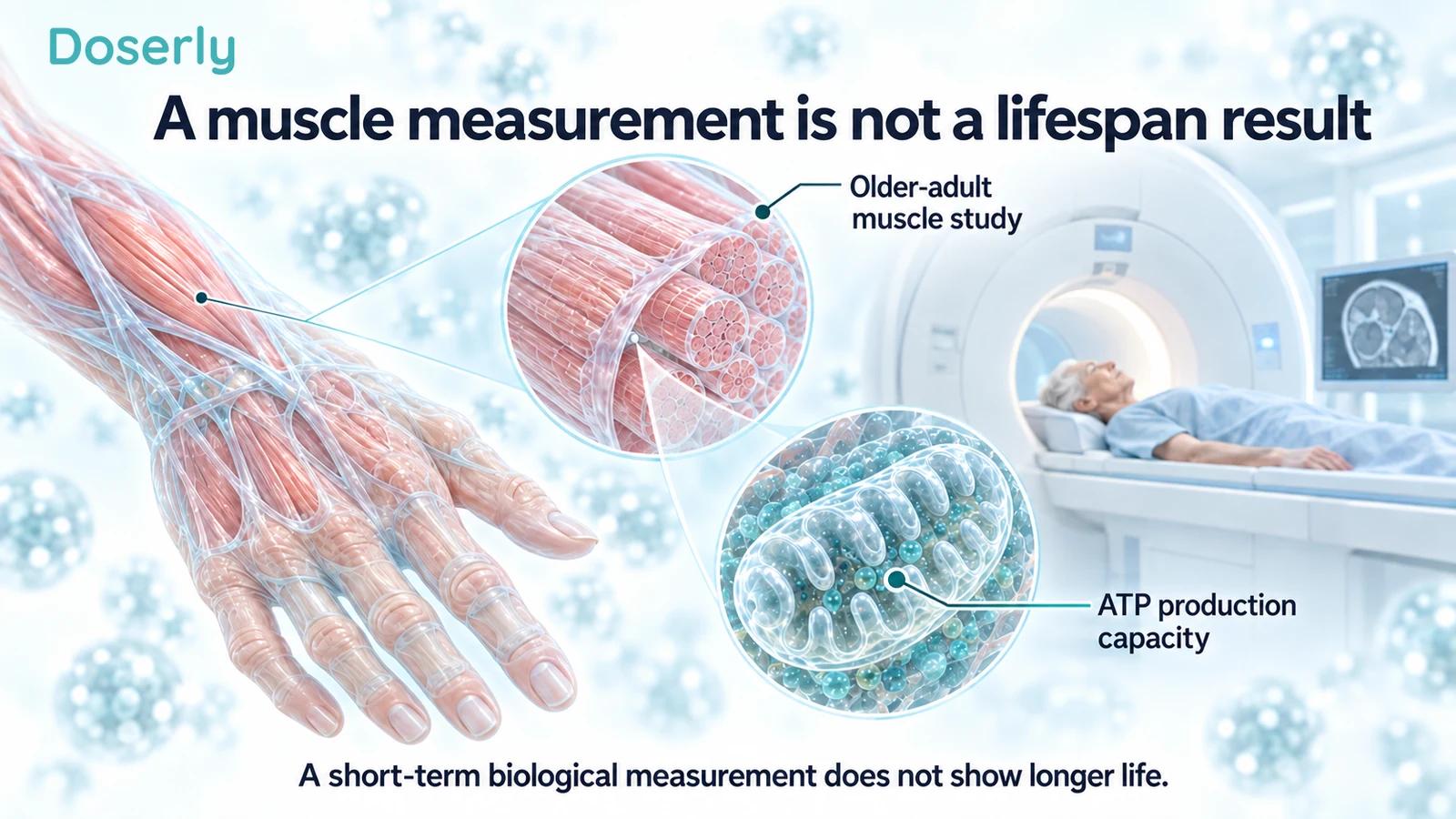
A 2021 randomized study enrolled 39 adults aged 60–85 selected for low mitochondrial function despite otherwise good general health. After a single two-hour infusion, researchers used spectroscopy to assess ATP-production capacity in a small hand muscle. Mean increases were 27% with elamipretide and 12% with placebo. The percentage-change comparison had p=0.045, while the absolute-change comparison had p=0.055. Roshanravan and colleagues, 2021
There was no between-group difference at day seven and no significant benefit on the prespecified muscle fatigue-resistance analysis. The study provides an immediate physiological signal with statistical sensitivity to the analysis; it does not demonstrate sustained whole-body function or longer life.
It also involved an infusion, selected participants and a specialized measurement. Those details should remain attached to the result. They cannot be replaced with an assumption about a different product, route, schedule or general population.
Why the larger muscle-disease trial still matters
The MMPOWER-3 trial studied 218 participants with genetically confirmed primary mitochondrial myopathy, a disease category affecting muscle energy production. Participants received elamipretide or placebo for 24 weeks. Neither primary endpoint—six-minute walking distance or disease-specific fatigue—showed a significant benefit. The estimated walking difference was −3.2 metres, with a 95% confidence interval of −18.7 to +12.3 metres. MMPOWER-3 primary report
This wasn't a healthy-aging trial, so it cannot definitively rule out every potential aging application. It does show why biological plausibility alone is insufficient: even a population selected for mitochondrial muscle disease did not necessarily gain the expected functional benefit.
The result should be considered alongside the smaller ATP study, rather than erased by it. One trial measured a short-term physiological effect; the other tested walking and fatigue over months in a different population. Their findings can coexist because their questions differ.
What do aging experiments in mice show?
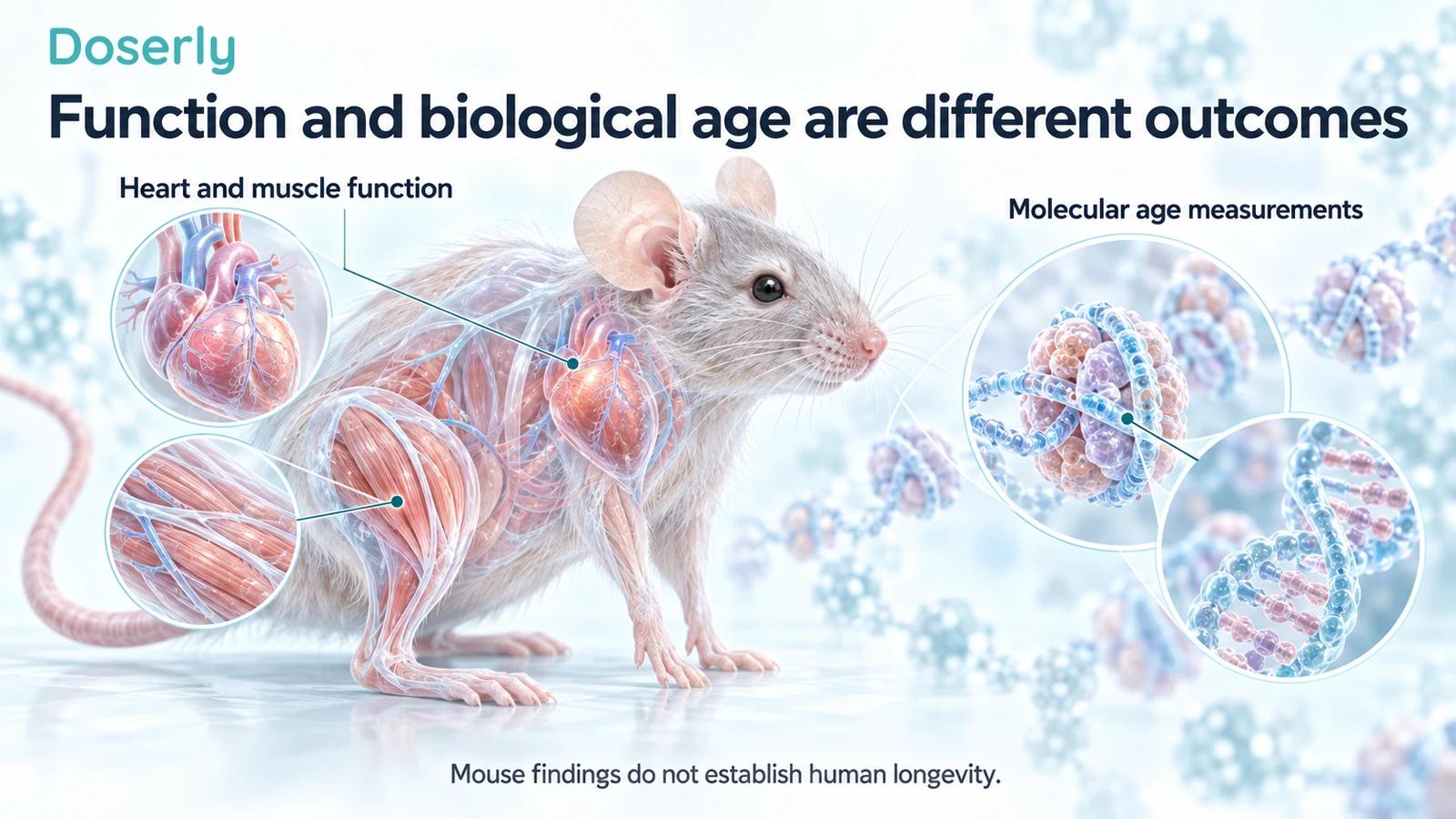
A 2025 primary study examined eight weeks of elamipretide treatment in mice, with measurements of frailty, cardiac function, skeletal-muscle function and molecular indicators of age. The investigators reported improvements in some functional measures without detecting significant changes in most gene-expression or DNA-methylation profiles indicating reduced biological age. Mitchell and colleagues, 2025
That distinction is useful even before considering translation to humans. Better function and a younger molecular-age estimate are not the same result. A treatment can affect one measured feature without changing another. The paper does not establish human lifespan extension, and its molecular findings should not be rewritten as proof that elamipretide reverses biological age.
Animal work can help researchers choose hypotheses and endpoints for human trials. It is especially valuable for examining tissues and mechanisms in ways that are difficult in people. But its experimental control does not remove species differences or establish the balance of benefit and risk for long-term human use.
The product distinction is part of the evidence
Forzinity is a defined prescription formulation with labeling, manufacturing requirements and clinical-development evidence. The term SS-31 identifies the peptide in research, but a vial marketed under that name is not automatically the approved product.
The label describes a sterile solution with specific ingredients, handling requirements and contraindications. Its safety and administration information pertains to that product. It should not be used to validate an unrelated supplier's identity, purity, sterility or concentration. Forzinity prescribing information
This isn't a minor naming issue. A clinical result is produced by a particular intervention under particular conditions. Changing the formulation or supply chain adds questions that the original trial did not answer. Even verified chemical identity would not establish the clinical benefit of a new use.
How should safety enter a longevity discussion?
The label identifies injection-site reactions and warns about hypersensitivity, including serious allergic reactions requiring emergency care. Such risks belong in the same discussion as any proposed benefit. They don't disappear when the purpose is prevention or healthy aging. Official safety information
The acceptable balance can differ between treating a serious diagnosed disease and pursuing an uncertain improvement in an otherwise healthy person. A disease-specific approval therefore cannot supply a ready-made benefit–risk judgment for wellness use.
The duration also matters. An acute physiological study cannot establish long-term tolerability, and an absence of a particular adverse event in a small study does not prove that it cannot occur. A useful longevity program would need sustained outcomes and adequate safety follow-up in the people intended to receive treatment.
Questions that keep the claim connected to the evidence
If a longevity proposal relies on Forzinity's approval, ask which part of the proposal was actually tested. Is the expected benefit improved daily function, reduced fatigue, prevention of a disease event or longer survival? Which study measured that outcome in similar people?
Then identify the product and route. Ask whether the evidence concerns the approved formulation, an experimental infusion or another preparation. Finally, ask how benefit would be measured over time and what would lead to a change in the plan. These questions help distinguish an evidence-based clinical use from a research hypothesis.
Forzinity's approval is significant for Barth syndrome and for development of mitochondrial therapeutics. Its significance doesn't require expanding it into a claim the studies didn't test. The SS-31 guide provides the wider clinical context, including the positive signals, negative trials and known safety considerations.
Sources
- FDA approval announcement, 2025: indication and accelerated approval.
- Forzinity prescribing information: product, mechanism and safety.
- FDA trial snapshot: controlled and extension evidence.
- FDA approval letter: confirmatory obligations.
- Roshanravan and colleagues, 2021: older-adult ATP study.
- MMPOWER-3, 2023: mitochondrial myopathy walking and fatigue outcomes.
- Mitchell and colleagues, 2025: mouse functional and molecular-age findings.