
HRT
October 16, 2026
Sleep improves on HRT: the hormones, the night sweats, or both?
On this page
Waking hot, throwing off the covers and then struggling to get back to sleep can make menopause exhausting. Hormone replacement therapy (HRT) can reduce hot flashes and night sweats, so sleeping better after treatment is an understandable and valuable result. The harder question is what to make of that improvement: did treatment remove the sweats, affect sleep more directly, or help through several routes?
Human trials suggest that sleep improvement on HRT is not always explained entirely by relief of vasomotor symptoms, the medical term for hot flashes and night sweats. But that does not make HRT a general treatment for every cause of insomnia. Understanding which part of the night improved helps you and your clinician decide what to do when the remaining problem is lying awake, feeling unrefreshed or struggling through the next day. Estradiol sleep trial
Our menopause guide explains the broader hormonal transition. Here, the focus is narrower: what sleep studies can tell us about HRT, and how to recognize when sleep needs attention of its own.
A disrupted night can contain several different problems
“Poor sleep” can mean taking a long time to fall asleep, repeatedly waking, waking too early, or spending enough hours in bed without feeling restored. Those experiences may overlap, but they are not identical treatment targets. Someone whose main difficulty is waking soaked in sweat has a different starting point from someone who lies awake worrying before the first hot flash occurs.
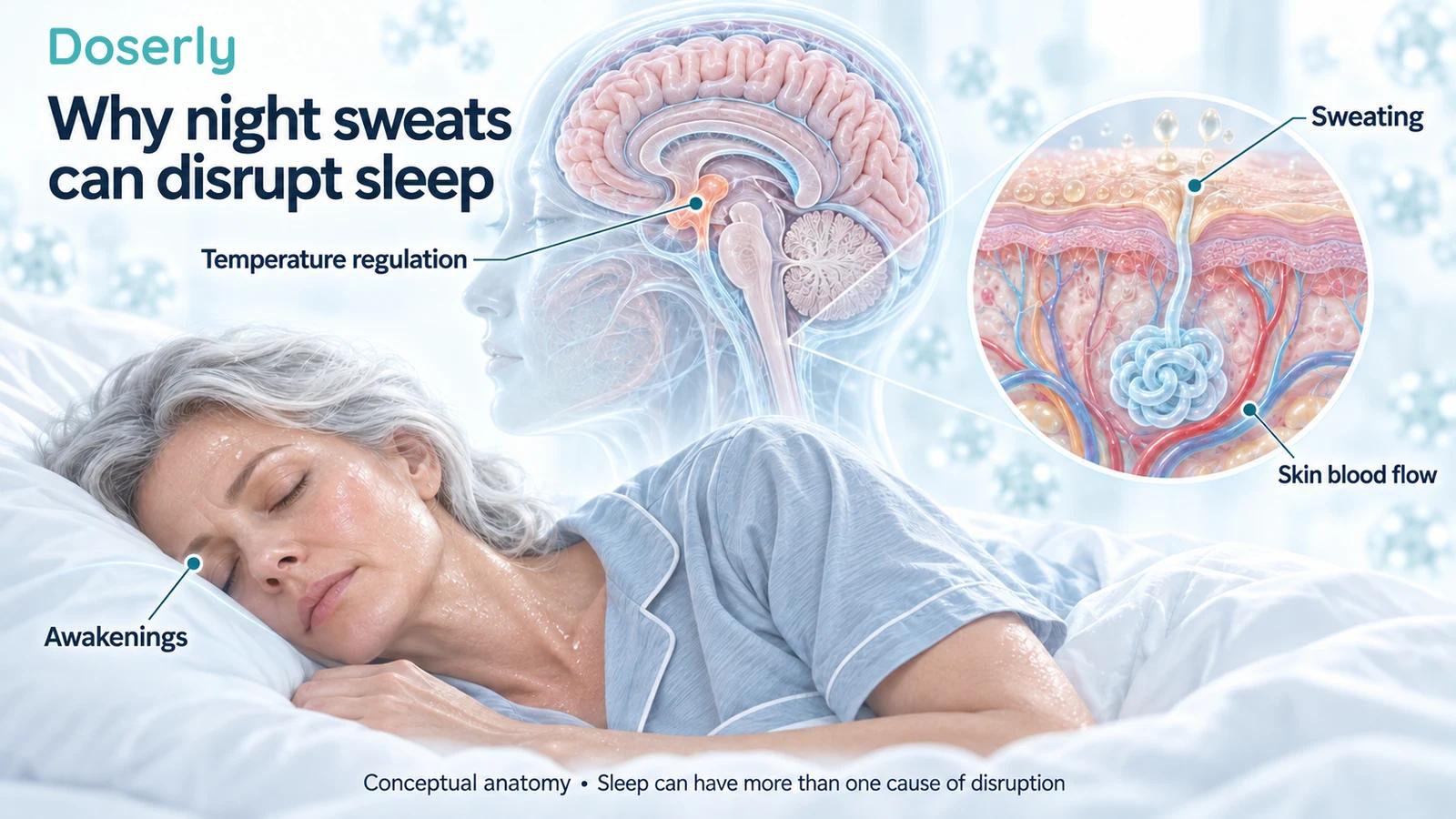
During a hot flash, the body's temperature-control system triggers responses such as sweating and increased blood flow near the skin. At night, those symptoms can accompany awakenings and discomfort. Removing a disruptive symptom can make sleep easier without proving that every sleep-regulating process has changed. NICE recommends offering HRT for menopause-associated vasomotor symptoms and considering menopause-specific cognitive behavioral therapy for associated sleep problems. NICE menopause recommendations
It is also possible for more than one problem to be present. You might have fewer sweats after starting treatment but still spend an hour awake after each awakening. That pattern does not erase the benefit of reducing sweats. It tells you that symptom control and restoring sleep may require separate parts of the care plan.
What the larger hormone trial found
The Kronos Early Estrogen Prevention Study, or KEEPS, provides useful evidence in recently menopausal women. Its sleep analysis included 653 participants who completed the Pittsburgh Sleep Quality Index, a questionnaire covering several aspects of sleep. Participants received oral conjugated estrogens, transdermal estradiol delivered through the skin, or placebo; the active hormone groups also received cyclic micronized progesterone. Assessments extended over four years.
Average global questionnaire scores improved by 1.27 points with oral treatment, 1.32 with transdermal treatment and 0.60 with placebo. Lower scores mean better reported sleep. These are questionnaire points, not additional hours slept, and the improvement attributable to treatment was smaller than the entire change within either active group. Changes in vasomotor symptoms were associated with changes in sleep measures. KEEPS sleep analysis
That finding is useful without being universal. The participants were recently menopausal; this was not a trial enrolling everyone with chronic insomnia or sleep apnea. Nor does an average change tell us that each participant felt a worthwhile benefit. A patient who can finally return to sleep after a sweat may value that improvement greatly, while someone whose main problem is difficulty falling asleep may need a different approach.
Could there be an effect beyond fewer sweats?
A separate randomized, placebo-controlled study followed 172 healthy women in the menopause transition or early postmenopause for 12 months. It tested transdermal estradiol with intermittent progesterone and used repeated questionnaires about sleep, vasomotor symptom bother and depressive symptoms.
Participants assigned hormone treatment reported improvements in time taken to fall asleep and number of awakenings. The treatment association remained after the researchers statistically accounted for changes in vasomotor symptom bother and depressive symptoms. This supports the possibility of effects beyond those measured symptoms. It does not identify one proven biological route, isolate estradiol from the whole treatment regimen or provide a universal estimate of extra sleep. Perimenopausal estradiol trial
Statistical adjustment is useful, but it is not the same experiment as holding every other symptom perfectly constant. Questionnaires may miss some nighttime events, and symptoms can influence one another. The practical interpretation is that “you only slept better because you stopped sweating” is too restrictive, while “HRT directly fixes insomnia” goes further than this study established.
Progesterone deserves its own explanation
Progesterone is part of many HRT regimens because people with a uterus generally need a progestogen to protect the uterine lining when using systemic estrogen. That purpose matters even when sleep is the symptom someone notices most. A treatment choice cannot be based solely on whether a medicine feels sedating. Our micronized progesterone guide explains that distinction and the different preparations.
Small experiments have also investigated progesterone and sleep directly. A randomized crossover study in 10 healthy postmenopausal women aged 54–70 compared oral progesterone and placebo over treatment periods lasting three weeks. Researchers recorded sleep-related brain activity and tested cognition. Progesterone reduced wakefulness on the sleep recording, while the study did not establish a general cognitive benefit. The small sample, short duration and specific formulation limit how widely the result can be applied. Schüssler and colleagues
This is a reason to discuss the actual medication, rather than treating every “progesterone” or “progestin” product as interchangeable. It is not a reason to add an extra hormone or adjust a prescribed schedule yourself. A clinician needs to consider uterine protection, bleeding, tolerability and the original reason for treatment alongside sleep.
Feeling better and changing sleep physiology are different findings
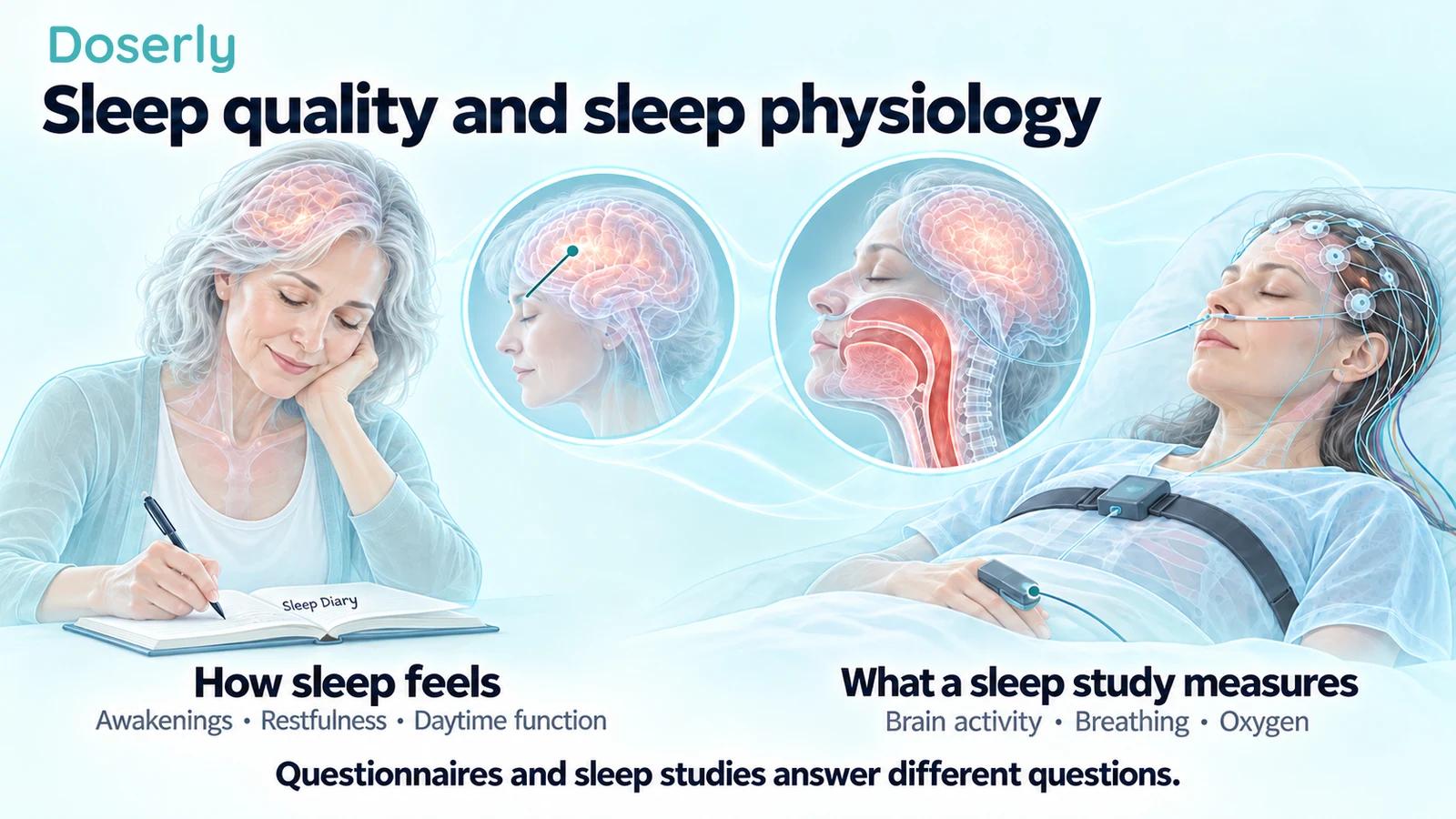
A questionnaire asks about lived experience: how long sleep seems to take, whether awakenings are troublesome and how the following day feels. Those outcomes matter. Sleep is not successful merely because a device produces an attractive number while the person remains exhausted.
A laboratory sleep study, or polysomnography, records physiological signals such as brain activity and breathing. It can help investigate a suspected sleep disorder. A better questionnaire score does not by itself demonstrate more deep sleep, fewer breathing interruptions or a particular change in sleep stages. The HRT trials described above therefore should not be summarized as proof that all hormone regimens “restore sleep architecture.”
The reverse mistake is also unhelpful: dismissing improved restfulness because a study used a questionnaire. Patient experience is a legitimate outcome. The key is to describe the measurement accurately and use further assessment when the clinical question calls for it. NHLBI notes that suspected sleep apnea may require a sleep study to establish the diagnosis. NHLBI sleep apnea information
When the sweats improve but insomnia remains
Persistent insomnia is not evidence that you failed treatment or imagined the original hormonal contribution. An awakening can be followed by worry about tomorrow, clock-watching and a long period of trying to force sleep. The experience can continue even after the symptom that first disturbed the night becomes less frequent.
Cognitive behavioral therapy for insomnia, or CBT-I, addresses behaviors and thoughts that sustain insomnia. It is more structured than general advice to relax or avoid screens. NHLBI describes it as a usual first treatment for long-term insomnia; it may include a tailored sleep schedule, reducing wakeful activities in bed and working on thoughts that interfere with sleep. NHLBI insomnia treatment
In a randomized MsFLASH trial, 106 women aged 40–65 with insomnia symptoms and at least two daily hot flashes received six telephone CBT-I sessions or menopause education over eight weeks. Insomnia Severity Index scores fell by 9.9 points with CBT-I and 4.7 with education. Benefits persisted at 24 weeks. Daily hot-flash frequency did not differ between groups, demonstrating that sleep can improve even without reducing the number of flashes. This was a single-site trial with a predominantly white sample, which limits representation. MsFLASH trial
The useful question is therefore not always whether to choose “hormones or sleep treatment.” Someone may benefit from treatment for vasomotor symptoms and targeted treatment for insomnia. The combination should follow an assessment of the actual problems, rather than an assumption that one intervention must account for everything.
Do not overlook breathing problems during sleep
Obstructive sleep apnea occurs when the upper airway repeatedly becomes blocked during sleep. Its risk increases during and after menopause. Women may describe fatigue, headaches, frequent waking or insomnia, and may not recognize the condition because prominent snoring is absent. These symptoms can be mistaken for menopause alone. NHLBI: sleep apnea in women
Tell your clinician about witnessed breathing pauses, waking gasping, substantial daytime sleepiness or persistent unrefreshing sleep. A partner's observations can be useful, but living alone or not having someone notice snoring does not exclude a problem. HRT-related improvement in sweats should not substitute for evaluating symptoms that suggest disordered breathing.
A sleep-focused appointment can also review pain, urinary symptoms, medication timing and other health concerns. Bringing a complete medication list helps avoid treating one complaint with a medicine that aggravates another. The aim is to understand the whole night, rather than interpreting every symptom through one hormone level.
A simple record can make the next appointment more useful
For a manageable period before review, write a brief morning note separating four things: sweats, awakenings, time awake and daytime function. Record changes in treatment or routine alongside them. You do not need to calculate sleep stages or reconstruct every minute. A rough, consistent description is more useful than an elaborate log that becomes another source of worry.
For example, “I still wake twice, but I no longer need to change clothes and fall asleep again quickly” describes a meaningful benefit. “The sweats stopped, but I remain awake until three and feel unsafe driving” describes an unresolved problem requiring attention. These are illustrative examples, not diagnostic rules.
At review, ask what improved, what remains and which finding would change the plan. If HRT is being considered or adjusted, the decision should account for your medical history, formulation, route and treatment goals. If insomnia or a breathing disorder is suspected, ask about the corresponding assessment rather than assuming that a larger hormone dose is the next step.
Better sleep after HRT is worth taking seriously. So is the part that has not improved. Separating those observations makes room for both effective menopause care and effective sleep care.
Explore the research
- KEEPS sleep analysis: four-year randomized hormone-treatment comparison using self-reported sleep domains.
- Perimenopausal estradiol trial: 172 participants, 12 months, with statistical adjustment for vasomotor bother and depressive symptoms.
- Schüssler progesterone study: small short-term crossover experiment with sleep recordings.
- MsFLASH CBT-I trial: telephone insomnia treatment compared with menopause education.
- NICE menopause recommendations: symptom treatment and menopause-specific CBT.
- NHLBI insomnia treatment: structured behavioral treatment for insomnia.
- NHLBI sleep apnea in women: symptom recognition during and after menopause.
- NHLBI sleep apnea overview: breathing interruptions and diagnostic assessment.