
Peptides
October 16, 2026
Sermorelin versus tesamorelin: shared signaling, different clinical evidence
On this page
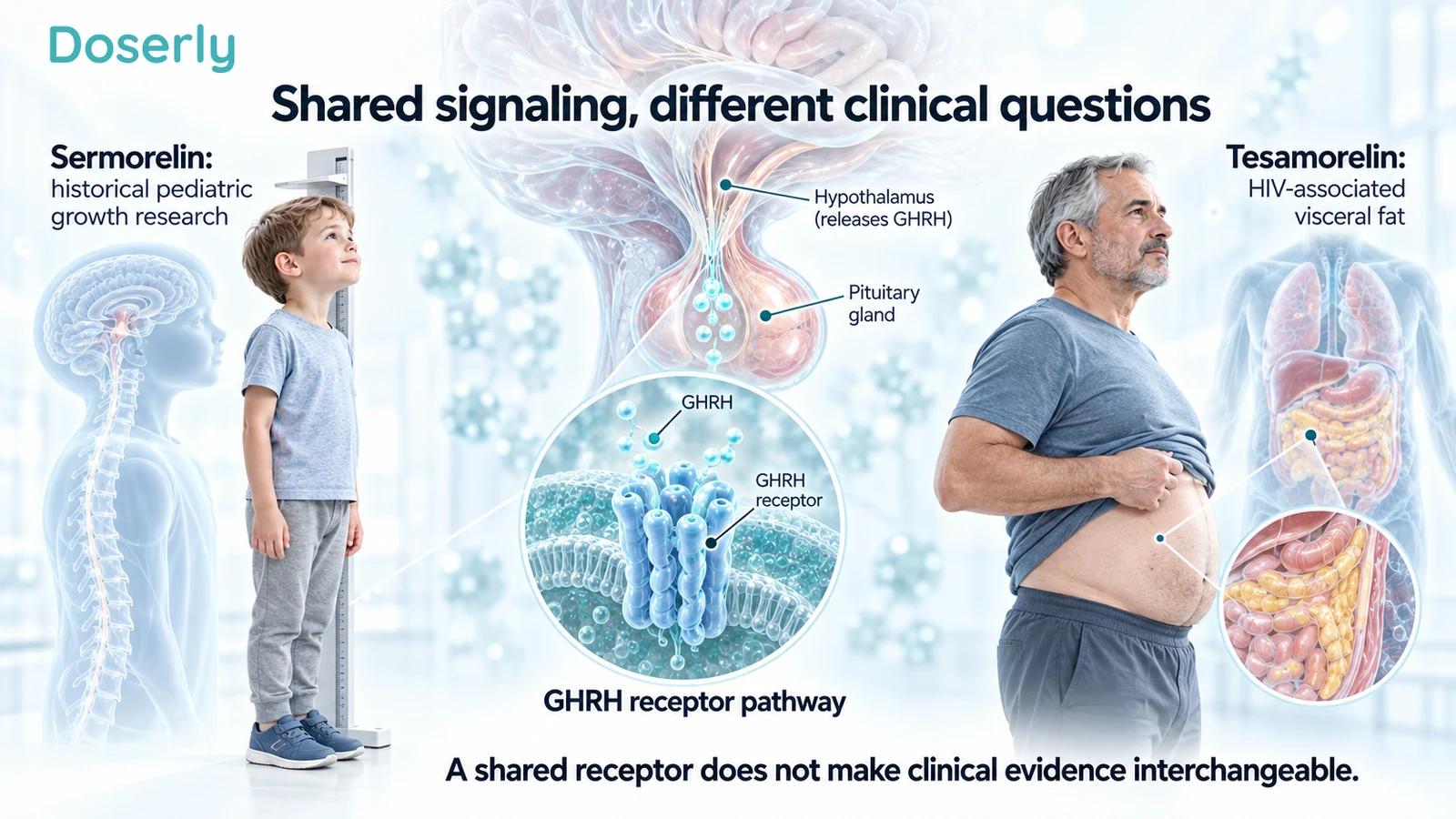
Sermorelin and tesamorelin can stimulate growth hormone release through the same receptor system. That makes them biologically related. It does not make them interchangeable treatments, and it does not mean one drug’s clinical results can be assigned to the other.
The most consequential difference is the evidence behind their uses. Sermorelin has a history in growth hormone testing and treatment of children with growth hormone deficiency. Tesamorelin has randomized trial evidence and a US-approved indication for reducing excess abdominal fat in adults with HIV-associated lipodystrophy. Neither description establishes a general treatment for healthy aging or ordinary weight loss.
A useful comparison therefore starts with the patient and outcome, then works backward to the molecule.
Shared signaling does not establish equal treatment effects
Growth hormone-releasing hormone, or GHRH, is a signal from the hypothalamus that stimulates the pituitary to release growth hormone. Growth hormone acts on multiple tissues and stimulates production of insulin-like growth factor 1, or IGF-1. Drugs that activate this pathway can change hormone concentrations without necessarily producing the same changes in body composition, symptoms, or long-term health.
Sermorelin corresponds to the biologically active first 29 amino acids of human GHRH. The archived Geref diagnostic product information describes its use to assess pituitary capacity to release growth hormone. Tesamorelin is a modified GHRH analogue based on the 44-amino-acid sequence; its modification increases resistance to enzymatic degradation, as described in the EGRIFTA WR prescribing information.
Those molecular differences matter for how a signal reaches and stimulates its receptor. They do not, by themselves, establish which drug would be more effective for a particular person. A longer sequence is not a clinical ranking, and resistance to degradation is not proof of better sleep, greater strength, or fewer adverse effects.
Even comparing the size of an IGF-1 increase would answer only a hormonal question. To compare clinical benefit, researchers need comparable patients, treatment conditions, follow-up, and outcomes. The studies discussed here did not randomize the same population to sermorelin versus tesamorelin.
Sermorelin’s history belongs to specific diagnostic and pediatric settings
The historical Geref record is frequently compressed into the phrase “FDA-approved peptide.” That phrase omits the indication and the product’s subsequent history.
In its 2013 Federal Register determination, the FDA described Geref products used to evaluate pituitary growth hormone secretion and to treat certain children with growth hormone deficiency and growth failure. The agency determined that the products had not been withdrawn from sale for reasons of safety or effectiveness.
That is a meaningful regulatory fact. It does not mean that every sermorelin preparation currently offered is FDA-approved, or that the agency approved adult anti-aging treatment. A historical approval, a withdrawal determination, and the status of an individual compounded preparation are different questions.
The research population matters just as much. A 1993 randomized study enrolled 60 children with growth hormone deficiency attributed to hypothalamic dysfunction. It compared two GHRH(1–29) regimens delivered by continuous infusion with growth hormone treatment over six months. The investigators measured childhood growth, including height velocity.
That is direct evidence about a defined deficiency setting and a pediatric outcome. It cannot tell a healthy adult how much visceral fat they would lose with a different administration schedule. It also cannot show that sermorelin is an equivalent substitute for tesamorelin in HIV-associated lipodystrophy. Those are different clinical questions requiring their own trials.
For readers looking up the compound itself, the Doserly sermorelin guide provides a separate reference point. The relevant question remains which population supports the particular benefit being proposed.
Tesamorelin’s indication is narrower than “fat loss”
The current EGRIFTA WR label indicates tesamorelin for reducing excess abdominal fat in adults with HIV who have lipodystrophy. It explicitly states that the product is not indicated for weight-loss management and describes its effect as weight neutral. Long-term cardiovascular safety has not been established.
This distinction is easy to miss because “abdominal fat” sounds like a general cosmetic concern. HIV-associated lipodystrophy is the specific clinical context studied for the approved use. Results in that setting do not automatically apply to otherwise healthy adults with a larger waist, people seeking overall weight reduction, or people whose principal concern is subcutaneous fat.
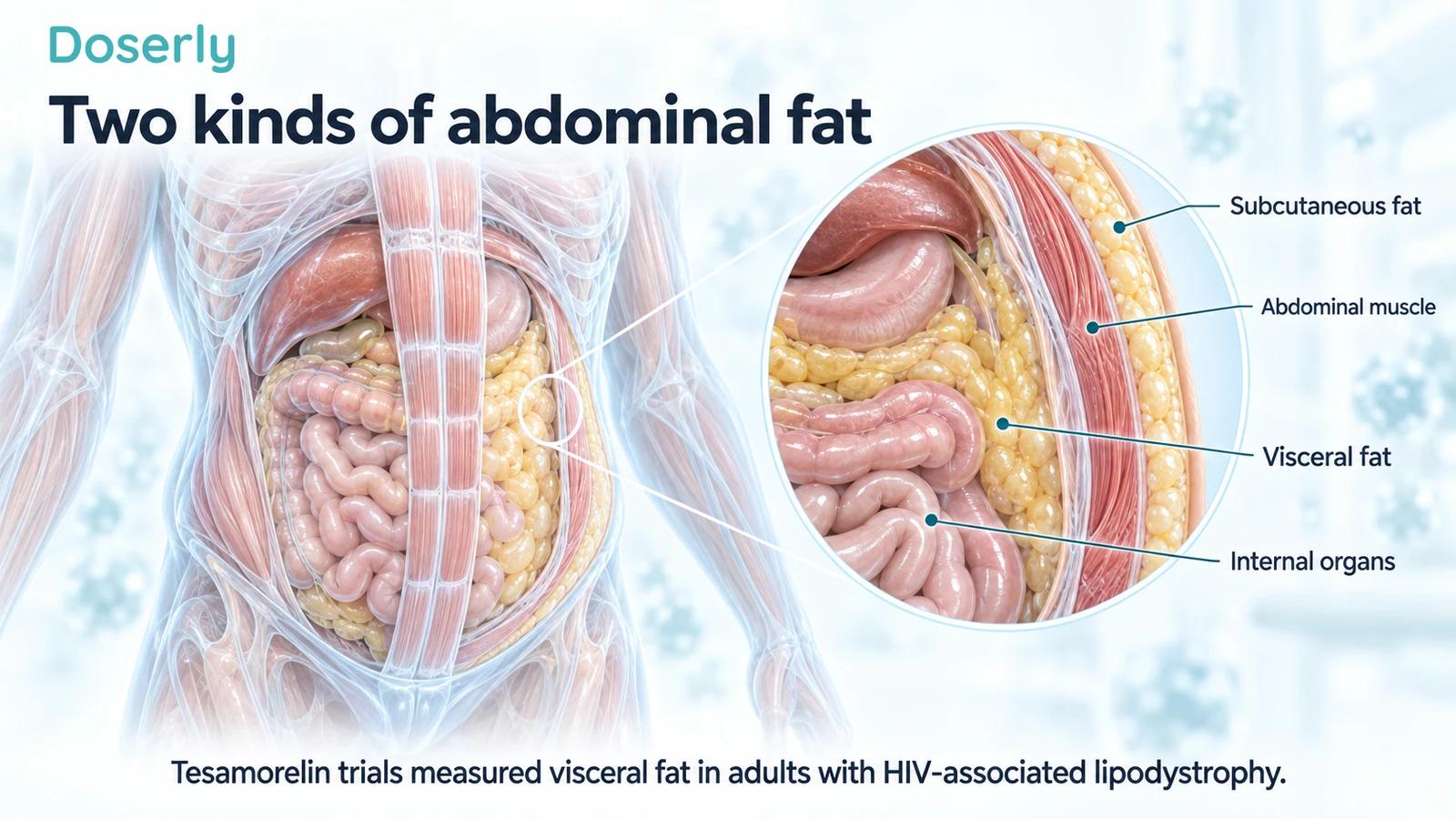
It also matters which abdominal tissue is being measured. Subcutaneous fat lies beneath the skin and outside the abdominal muscle wall. Visceral fat lies within the abdominal cavity around internal organs. They contribute differently to a person’s shape, and a change in one need not produce a matching change in the other.
Tesamorelin trials used imaging to quantify visceral adipose tissue. A bathroom scale measures total body mass; a tape measure captures abdominal circumference affected by multiple tissues and measurement conditions. Neither provides the same information as a CT measurement of visceral fat.
The Doserly tesamorelin guide can help orient that terminology. For treatment eligibility, the precise approved indication and the person’s clinical history still matter more than a general description such as “stubborn belly fat.”
What the pivotal tesamorelin results actually show
A pooled analysis of two phase 3 trials included 806 adults with HIV receiving antiretroviral therapy who had excess abdominal fat. Participants received tesamorelin or placebo during a 26-week primary treatment period.
The analysis reported a visceral fat treatment effect of approximately 15.4% in favor of tesamorelin. That figure describes the comparison between treatment groups on a specific imaging outcome. It does not mean that participants lost 15.4% of their body weight, and it does not mean that everyone experienced the average effect.
The same analysis reported changes in other measures, including IGF-1 and triglycerides. These outcomes help characterize the treatment, but they should not be collapsed into a claim that the drug prevents heart attacks or extends life. A favorable change in a risk-related measurement is different from demonstrating fewer clinical events over sufficient follow-up.
The trial design also tells us what remains unanswered. There was no sermorelin treatment arm. Therefore, the study can support a tesamorelin-versus-placebo conclusion in its enrolled population; it cannot support a tesamorelin-versus-sermorelin ranking.
That remains true even if a clinician or patient has observed a similar hormonal response with sermorelin. Similarity in an intermediate measurement is a hypothesis about clinical equivalence, not evidence that equivalence has been tested.
The extension studies do not show a permanent reset
The duration of benefit matters when someone considers a treatment for body composition. A short treatment course that permanently changes fat distribution would be a different proposition from treatment whose effect depends on continued exposure.
A tesamorelin extension study followed participants beyond the initial treatment period. Continued treatment sustained the reduction in visceral fat, while participants switched from tesamorelin to placebo lost the treatment benefit as visceral fat reaccumulated.
This finding argues against describing the studied intervention as a permanent metabolic reset. It also makes treatment burden and ongoing monitoring part of the benefit discussion.
The extension should still be interpreted within its design. People who reach and participate in an extension are a selected follow-up population. A result relative to the original baseline is not necessarily the same numerical comparison as a randomized treatment effect at the initial endpoint. Combining percentages from different analyses without checking the denominator and time point can make the apparent benefit look larger or more certain than the underlying report supports.
None of these continuation findings tells us how sermorelin would perform under the same conditions. That comparison remains absent from the cited trials.
Safety cannot be ranked by how much is published
Tesamorelin’s label provides a relatively detailed account of contraindications, adverse effects, and monitoring. That visibility should not be mistaken for evidence that a less extensively studied alternative is safer.
The prescribing information identifies important concerns involving elevated IGF-1, fluid retention, glucose intolerance or diabetes, hypersensitivity, and injection-site reactions. Active malignancy and disruption of the hypothalamic-pituitary axis are among its contraindications. Previous malignancy requires a separate assessment described in the prescribing information; it should not be reduced to a blanket reassurance.
The glucose findings illustrate why a group average is not the whole safety story. Although the pooled trial analysis described no significant deterioration in average glucose measures, the prescribing information reports a higher incidence of diabetes defined by HbA1c during the trials. A modest average change can coexist with clinically important changes in a subset of participants.
Monitoring therefore needs to match the specific risk, rather than assuming that an acceptable average trial result protects every individual. The label calls for assessment of glucose status and monitoring of IGF-1, among other precautions.
Sermorelin’s older diagnostic and pediatric evidence does not provide a matched long-term safety comparison in adults with HIV-associated lipodystrophy. Nor does a history of stimulating endogenous hormone release eliminate the possibility of downstream adverse effects. “Your own growth hormone” describes where the hormone comes from; it does not establish that every induced level or exposure pattern is appropriate.
Product identity is part of the comparison
A clinical study evaluates a particular intervention. Ingredient name alone does not establish that another product has the same quality, exposure, or performance.
This is especially relevant when comparing an approved tesamorelin product with a compounded sermorelin preparation. The FDA explains that compounded drugs are not FDA-approved, and that it does not verify their safety, effectiveness, or quality before they are marketed. This does not mean every compounded medicine is defective. It means that approval of a historical branded drug cannot be transferred to a newly prepared product by using the same ingredient name.
There are product distinctions even within tesamorelin. The EGRIFTA WR label states that WR and EGRIFTA SV are not substitutable. Their formulations and instructions differ. A reader should therefore check the exact product rather than borrowing preparation or administration instructions from another version.
A comparison that ignores formulation can appear precise while comparing interventions different from those actually studied. The same caution applies when a source discusses GHRH generally, a modified analogue, or another growth hormone secretagogue as though all were the same drug.
A more useful way to discuss the choice
Before asking which peptide is “better,” identify the clinical problem and the result that would count as improvement.
For an adult with HIV-associated lipodystrophy and excess abdominal fat, tesamorelin has direct evidence and a defined approved indication, alongside specific limitations and risks. For a child with growth failure or someone undergoing endocrine evaluation, the diagnostic context and specialist assessment are different. For a healthy adult seeking general fat loss or anti-aging benefits, the cited evidence does not establish either option as an interchangeable solution.
A productive clinical discussion can focus on four questions:
- Does the evidence include people with this diagnosis and treatment background?
- Did the study measure the desired outcome directly, or only a hormone associated with it?
- What happens if treatment is stopped, and what monitoring accompanies continued use?
- Is the proposed product the formulation evaluated in the supporting evidence?
Those questions preserve what the research does show without extending it beyond its population. Sermorelin and tesamorelin share an important signaling pathway. Their clinical evidence, product histories, and supported uses remain distinct.
Explore the research
- EGRIFTA WR (tesamorelin) prescribing information (2025): Product-specific indication and risk information; not a sermorelin comparison.
- Effects of tesamorelin (TH9507), a growth hormone-releasing factor analog, in human immunodeficiency virus-infected patients with excess abdominal fat: a pooled analysis of two multicenter, double-blind placebo-controlled phase 3 trials with safety extension data (2010): Two pooled trials in a specific HIV population; no sermorelin comparator.
- Long-term safety and effects of tesamorelin, a growth hormone-releasing factor analogue, in HIV patients with abdominal fat accumulation (2008): Extension population and baseline-relative comparisons differ from initial randomized treatment effect.
- Determination That GEREF (Sermorelin Acetate) Injection Was Not Withdrawn From Sale for Reasons of Safety or Effectiveness (2013): Historical determination does not approve modern compounded products or anti-aging use.
- A comparative study of growth hormone (GH) and GH-releasing hormone(1-29)-NH2 for stimulation of growth in children with GH deficiency (1993): Continuous-infusion pediatric study; does not establish adult healthy-aging benefit.
- Geref 50 Summary of Product Characteristics (2004): Archived Irish diagnostic product document, printed 2006; not current adult wellness approval.
- Understanding the Risks of Compounded Drugs (accessed 2026): General compounding guidance; does not establish a defect in a specific product.