
Peptides
October 16, 2026
Sermorelin and body recomposition: what should be measured?
On this page
Body recomposition usually means losing fat while preserving or increasing lean tissue. Someone considering sermorelin may also hope to become stronger, look different or find everyday activity easier. Those goals overlap, but they are not the same outcome.
Sermorelin stimulates the pituitary to release growth hormone, which can affect tissue metabolism and insulin-like growth factor 1, or IGF-1. The crucial question is what happens after that hormonal response. A higher IGF-1 result is not a measurement of fat loss, muscle strength or improved function. Each needs to be assessed directly.
The human evidence offers useful examples: a small older-men study found more overnight growth hormone without a clear body-composition change; a randomized Geref study in men with HIV-related fat redistribution found some regional changes without a significant reduction in total fat. Neither supports a simple promise of universal recomposition. Let's look at what was actually measured and how to make those measurements useful in a clinical discussion.
What does a body-composition scan tell you?
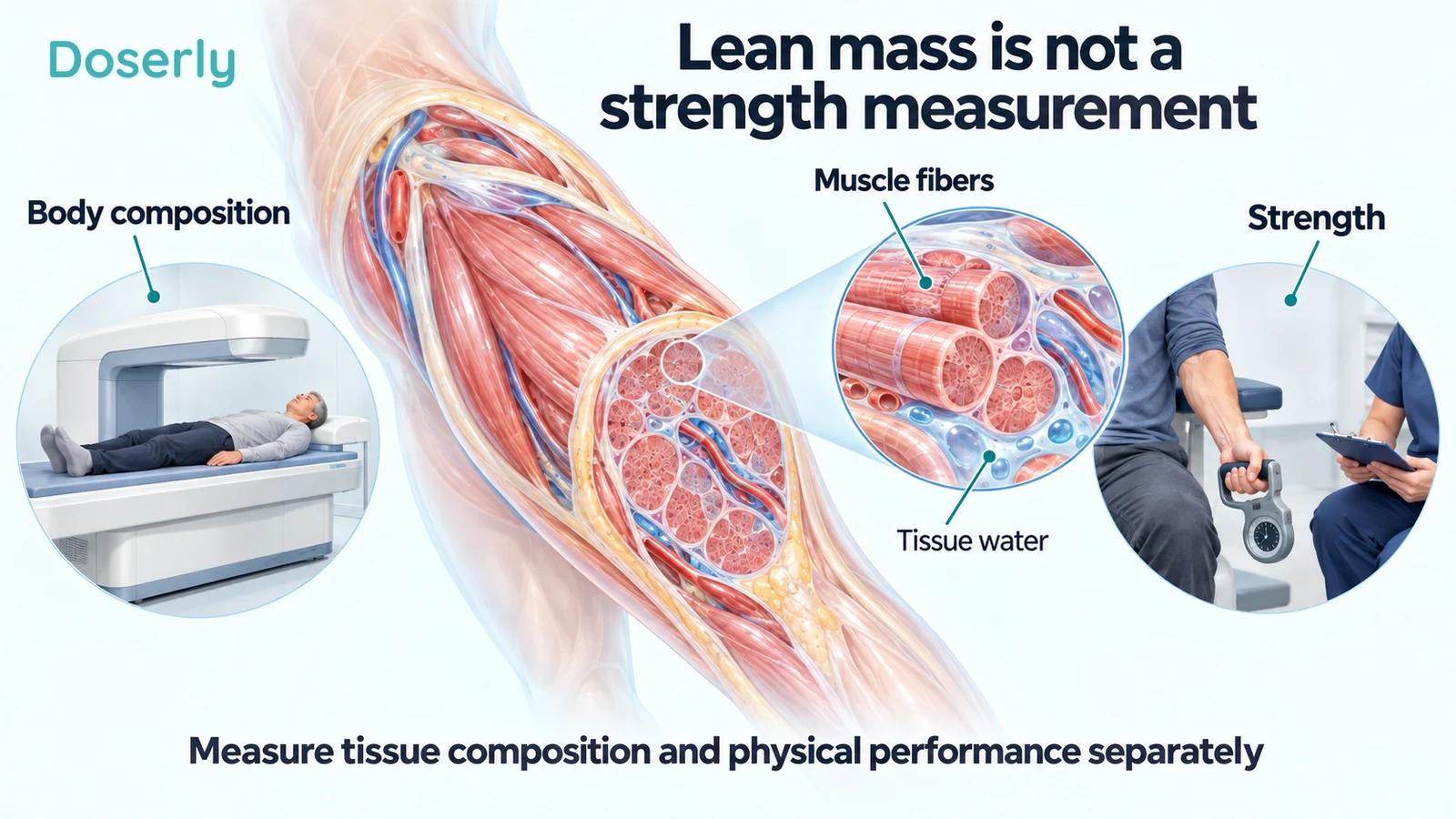
A scale gives total body weight. A body-composition assessment separates that weight into estimated compartments. Dual-energy X-ray absorptiometry, usually called DXA, is commonly used to estimate fat, lean soft tissue and bone mineral content.
Lean soft tissue is broader than the muscle fibers that produce force. It includes water and other nonfat components. This matters when a treatment changes fluid balance or when follow-up conditions differ. A larger lean-mass estimate is not automatically a matching increase in working muscle.
A primary analysis of testosterone and growth-hormone supplementation in older men illustrates the issue. Early lean-mass gains were not accompanied by similarly large performance improvements, and the investigators discussed hydration and noncontractile tissue as possible explanations. This was not a sermorelin trial; its relevance is to interpreting measurements. Schroeder and colleagues.
What did the six-week sermorelin study find?
Vittone and colleagues studied 11 healthy, non-obese men aged 64–76 with low baseline IGF-1. Participants used nightly GHRH(1-29) for six weeks. Researchers measured overnight growth-hormone secretion, DXA body composition, muscle testing and metabolic variables.
Growth-hormone release increased, but IGF-1, weight, waist-to-hip ratio and DXA muscle and fat measurements did not change significantly. Two of six strength tests and one endurance test improved. The study had no placebo comparison, so repeated testing and other influences cannot be separated confidently from treatment effects. Vittone et al., 1997.
That is a mixed result, not evidence that every outcome improved. It also isn't proof that no future regimen could affect composition. The small sample and short duration limit both positive and negative conclusions. The useful lesson is concrete: evidence that the pituitary responded did not establish the body-composition benefit people often expect.
The participants were selected older men, not a representative sample of adults attending wellness clinics. Applying their results to younger adults, women or people taking several other hormones would require additional evidence.
A randomized Geref trial provides another perspective
A 2004 trial enrolled 31 men with HIV and lipodystrophy, an altered distribution of body fat. It compared Geref, explicitly identified as GHRH(1-29), with placebo over 12 weeks. Twenty-nine participants completed follow-up. This was direct research with the sermorelin product, not a tesamorelin study.
Lean mass increased by an average of 0.9 kg in the GHRH group and fell by 0.3 kg with placebo. Trunk fat fell by 0.4 kg versus a 0.2 kg increase. Total fat did not differ significantly. The CT visceral-fat comparison had P=0.07, so it did not meet the study's conventional significance threshold. Koutkia et al., JAMA.
These findings concern selected men with HIV-associated fat redistribution. They do not establish a general weight-loss treatment or improvements in strength. They also show why “fat loss” is too vague: regional DXA changes, total fat and CT visceral fat produced different answers in the same trial.
The control group makes this a stronger comparison than a before-and-after clinic photograph. But a small, short randomized trial still has limits. Its results cannot answer durability over years, uncommon harms or effectiveness in a different population.
Why the location of fat matters
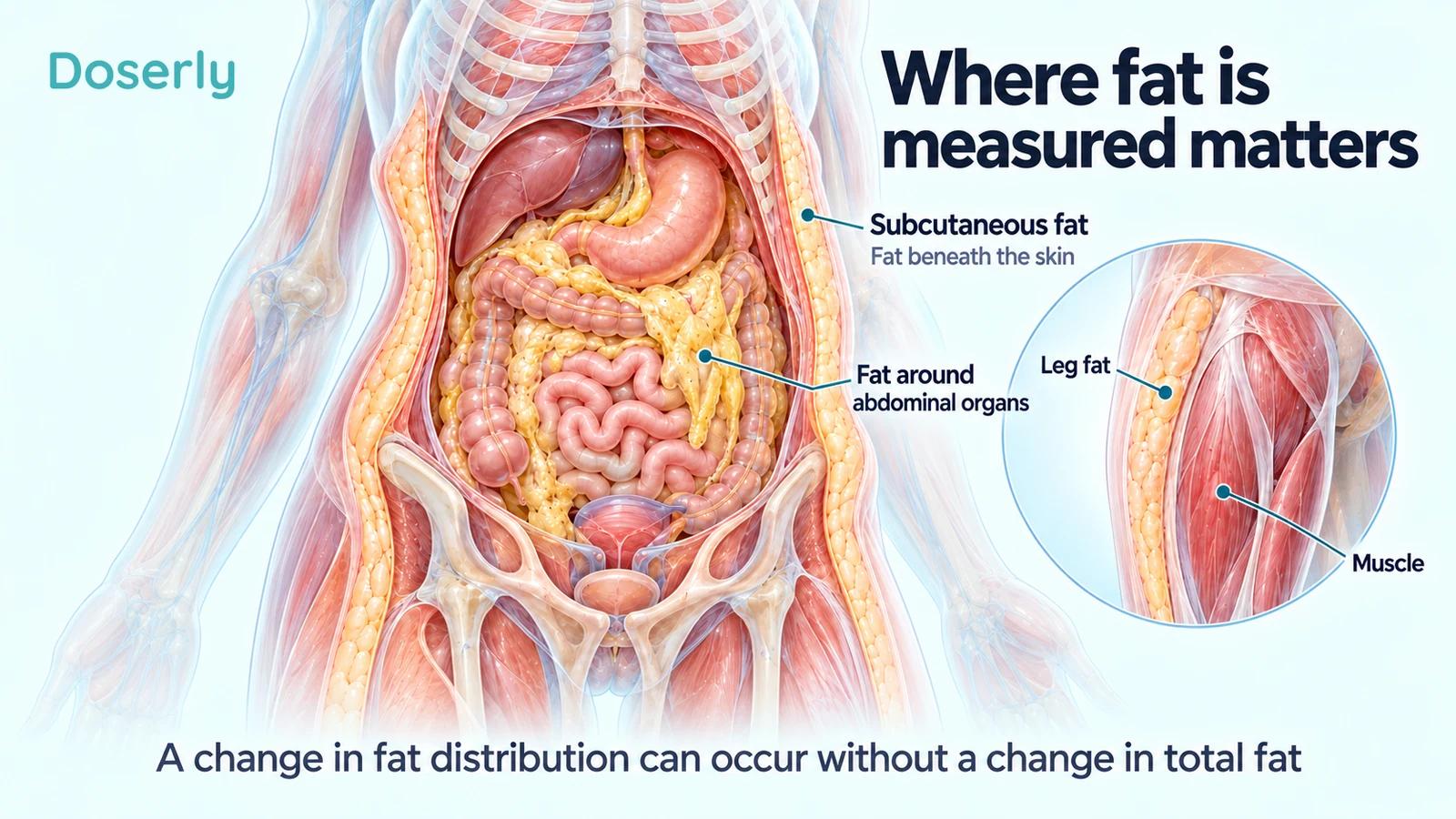
Fat directly beneath the skin is called subcutaneous fat. Fat within the abdomen around organs is called visceral fat. Fat within an organ, such as liver fat, is another measurement again. A study can find changes in one without demonstrating the same change in the others.
A trunk-fat estimate includes a body region. It should not be rewritten as if it measured only deep abdominal fat. Similarly, a change in a ratio can occur because its numerator, denominator or both change. A lower trunk-to-leg-fat ratio is not the same statement as an equal percentage reduction in total fat.
For someone with HIV-related lipodystrophy, preserving peripheral fat while reducing central accumulation can be a different goal from losing weight generally. This is one reason the population in the Geref trial matters. The anatomical problem being treated helps determine which result is useful.
Can growth-hormone studies fill the gaps?
They can teach us about the broader biology, but they cannot be counted as sermorelin trials. Giving growth hormone directly and stimulating its release are different interventions.
A randomized six-month study in 52 healthy men older than 69 compared growth hormone with placebo. Lean mass increased and fat mass decreased, but knee strength, grip strength and endurance did not show significant clinical improvement. Adverse effects were more frequent with growth hormone. Papadakis and colleagues.
The study supports a measurement distinction: composition can improve without a functional gain. It does not supply an effect size or side-effect rate for sermorelin. Nor does it prove that all lean-mass gains are water. That would go beyond what the trial established.
The same rule applies to tesamorelin. Its evidence and approved indication concern a different molecule and specific patients. Our tesamorelin guide explains that research; it shouldn't be used to rename a tesamorelin result as a sermorelin result.
Strength, endurance and daily function need separate tests
Strength describes the force someone can produce. Endurance describes how long an activity can be sustained. Daily function includes tasks such as climbing stairs, carrying groceries or getting out of a chair. Improvement in one does not ensure a comparable improvement in all three.
If a treatment is being considered because stairs have become difficult, the evaluation should include that problem or a suitable functional measure. If the goal is to preserve muscle during another treatment, body composition may be relevant, but performance still helps interpret what the tissue measurement means.
Repeated assessments need comparable conditions. A different machine, unfamiliar exercise, changing technique or different effort can change a performance result. The point is not to create an elaborate home experiment. It is to agree with the clinician on a practical measure that answers the original question and can be repeated meaningfully.
A single favorable test among several is also different from a consistent improvement across the outcomes chosen in advance. The older-men sermorelin study's mixed strength findings are a reason to report the complete pattern rather than selecting the best-looking result.
What should be recorded alongside the measurements?
Training, diet, weight-loss medication and hormone treatment can all change during a body-composition program. If several changes begin together, a before-and-after result cannot identify how much sermorelin contributed.
A 2017 clinic-record study is a useful caution. It examined a combination of sermorelin, GHRP-2 and GHRP-6 in men already receiving testosterone. The reported rise in IGF-1 was a hormone finding, not a demonstration that sermorelin alone improved body composition. Sigalos and colleagues.
A dated record of major changes helps interpret follow-up: treatment start and stop dates, alterations in other medicines, training changes and the timing of scans or blood tests. It is particularly useful when a scan result and symptoms appear to disagree. It also prevents a temporary change from being remembered later as a durable benefit.
Photographs can document appearance, but lighting, posture and camera distance matter. They cannot identify visceral fat or measure strength. Treat them as one kind of information rather than a substitute for the clinical outcome under discussion.
Safety belongs beside the body-composition result
A favorable scan does not complete the benefit-risk assessment. Symptoms, glucose measurements and other relevant clinical findings still matter. Someone can have a measurable tissue change that is too small to justify unwanted effects or the burden of treatment.
If a clinician suspects actual growth-hormone deficiency, the diagnosis also needs appropriate evaluation. The Endocrine Society guideline usually calls for stimulation testing to confirm adult deficiency, with specific exceptions. Low energy or a body-composition goal alone is not that diagnosis. Adult growth-hormone-deficiency guideline.
Discuss in advance what would count as enough improvement to continue, what would prompt reassessment and how long the initial evaluation period should be. These decisions should be tied to the actual clinical situation. The published studies do not establish a universal adult sermorelin recomposition schedule.
A more useful way to frame the goal
Instead of asking only whether sermorelin “works for recomposition,” separate the desired changes. Is the priority lower total fat, a change in fat distribution, preserved lean tissue, improved strength or easier daily activity? Then identify which measurement would answer each relevant question.
The evidence reviewed here does not support treating all those outcomes as interchangeable. It contains limited direct sermorelin research, including a randomized trial in a specific HIV population, and broader hormone studies that clarify why scans and function can diverge.
A productive discussion keeps the original goal visible even when a laboratory number changes. If the goal was to feel stronger, ask whether strength improved. If it was a change in fat distribution, ask which tissue compartment was measured. The sermorelin guide offers further background for making those questions specific.
Sources
- Vittone et al., 1997: nightly GHRH(1-29) in older men.
- Koutkia et al., 2004: randomized Geref trial in HIV lipodystrophy.
- Schroeder et al.: muscle performance and lean mass.
- Papadakis et al., 1996: growth hormone and functional ability.
- Sigalos et al., 2017: combination secretagogues and IGF-1.
- Endocrine Society: adult growth-hormone deficiency.