
Peptides
October 16, 2026
Retatrutide's three receptors: what the glucagon signal adds
On this page
Retatrutide is an investigational medicine designed to activate three hormone receptors: GIP, GLP-1 and glucagon. GIP and GLP-1 are familiar from incretin medicines used for diabetes and weight management. Glucagon is the additional signal that makes retatrutide a triple agonist.
The idea is biologically interesting because glucagon can influence how the liver handles fuel and how the body uses energy. But a three-receptor design does not mean three times the effect, and large weight loss does not reveal exactly what each receptor contributed.
This article explains the rationale, the animal experiments behind part of it and the human findings that test the complete drug. Our retatrutide guide provides the wider research context.
One molecule, three targets
An agonist activates a receptor, a protein through which a cell responds to a signal. Retatrutide, originally called LY3437943, is a single engineered peptide with activity at three receptor types. It is not a blend of three independently dosed medicines. Discovery paper
That difference matters. In a fixed molecule, changes to the dose change exposure to the whole molecule. They do not let someone independently turn the GIP, GLP-1 and glucagon components up or down.
Nor does the word triple establish equal activity at each target. Receptor activation depends on the molecule, concentration and experimental conditions. A simple diagram can identify targets but cannot represent all that pharmacology with three equally powerful arrows.
Informal names such as GLP-3 can be misleading. The relevant fact is activation of three established hormone-receptor systems, not the discovery of a new hormone called GLP-3.
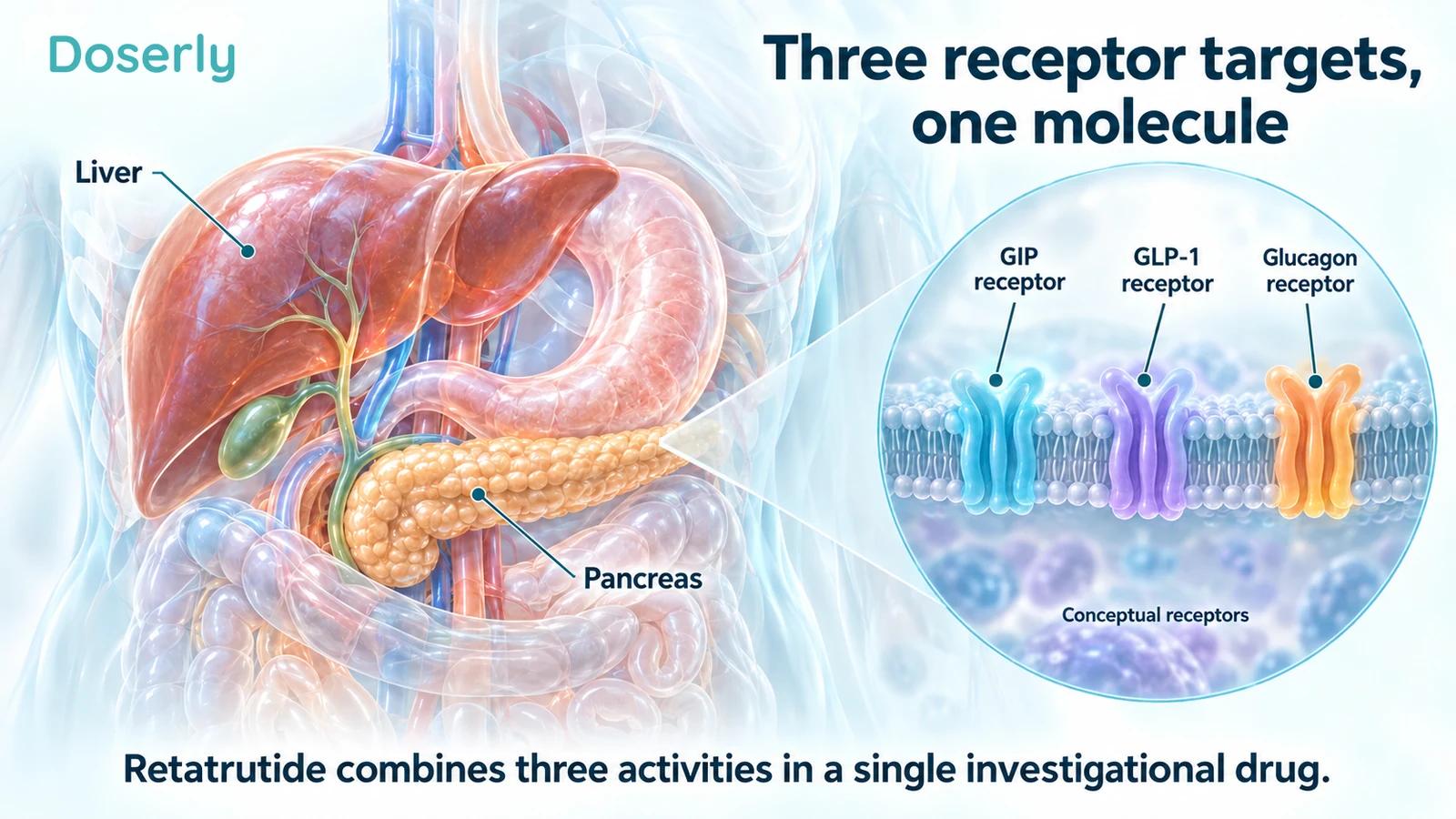
The targets are conceptual. Their size does not represent potency, and the illustration is not a precise map of which cells express every receptor.
Why include glucagon at all?
Glucagon helps regulate fuel availability, including glucose production by the liver. That may sound surprising in a diabetes drug: why activate a hormone associated with raising glucose?
The rationale is to combine activities so that the whole drug improves metabolic outcomes. Glucagon-related effects on fuel use and energy expenditure may complement incretin-related effects on food intake and glucose regulation. Whether the combination produces a useful net effect has to be tested. Discovery and proof-of-concept research
This is different from claiming that glucagon simply burns fat while the other receptors suppress appetite. Hormones interact with organs and feedback systems; they don't divide the body's functions into three independent compartments.
It is also different from taking glucagon by itself. Findings for a co-agonist cannot be assumed to apply to a single hormone given separately, at a different exposure or for another purpose.
What did the animal experiments show?
The original development work included experiments in diet-induced obese mice. Researchers investigated how glucagon-receptor activity contributed to energy expenditure alongside changes in food intake. The experiments supported an additional expenditure-related contribution to weight loss in those mice. Original paper, including the energy-expenditure experiments
Animal studies are particularly useful for this kind of question because researchers can control food intake and manipulate receptor pathways in ways that are difficult or inappropriate in people. They can compare conditions designed to separate possible mechanisms.
Those strengths do not remove the species boundary. A mouse's response, energy balance and drug exposure are not a direct estimate of an adult person's daily calorie use. The same paper's early human findings should not be merged with its mouse mechanism experiments into one undifferentiated statement about people.
The appropriate conclusion is that the design has experimental support, including a plausible glucagon contribution in animals. It isn't a validated promise that a person will burn a specified extra number of calories each day.
Energy intake and energy expenditure answer different questions
Energy intake is the energy obtained from food and drink. Energy expenditure is energy used by the body, including resting processes, movement and other demands. A change in body weight reflects the combined course of many processes; it doesn't directly measure either side on its own. Intake and metabolism study description
For example, if someone loses substantial weight while eating less, the weight result cannot tell us whether expenditure rose, stayed similar or fell by less than expected. Researchers need measurements beyond the scale to distinguish those possibilities.
Body size also changes during weight loss. Comparisons of expenditure therefore need to consider what is being compared: total energy use, energy use relative to body composition, or adaptation beyond what would be expected from a smaller body.
This is why a headline about metabolism needs a named measurement. Resting expenditure, sleeping metabolic rate and energy used over a full day are related but different. A result from one should not silently become a claim about all of them.
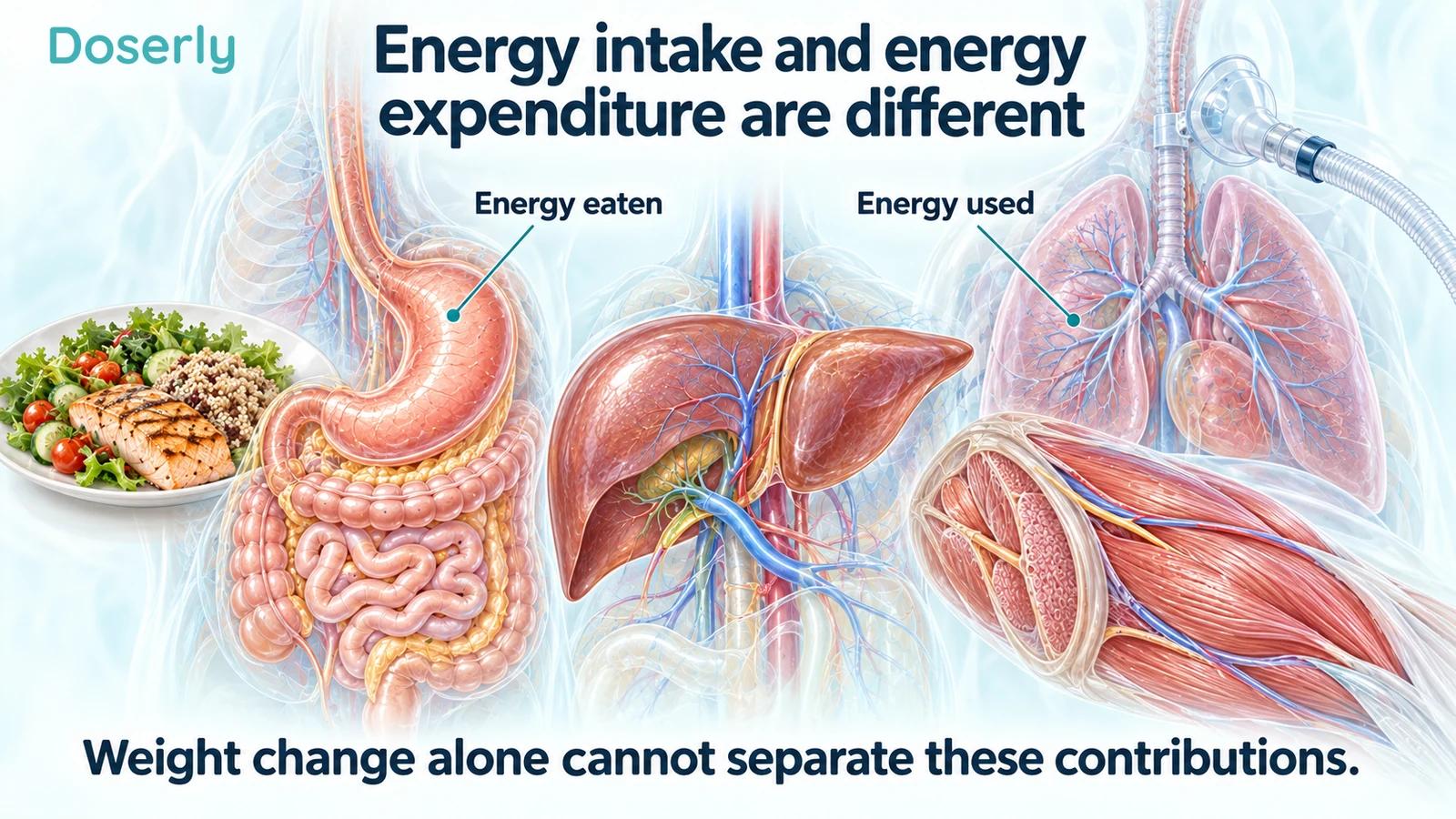
Food-intake and energy-use assessments ask different questions. The equipment and display are illustrative, not actual trial equipment or participant data.
Are researchers measuring this in people?
Yes, the development program includes a study specifically intended to examine calorie intake, energy metabolism and appetite. The sponsor identifies it as NCT06313528. Its existence shows that investigators recognize the need to measure these processes rather than infer them from weight alone. Sponsor study description
A study description is a plan, however. It doesn't establish the size or durability of a metabolic effect. The sources reviewed for this article did not provide a verified quantitative human energy-expenditure result from that study.
That gap should be stated narrowly. It is not evidence that there is no effect; it means this article cannot give a supported number for the effect. Nor should a planned measurement be presented as if its result has already confirmed the theory.
For a future result to be useful, readers will need the treatment duration, comparison group, measurement conditions and how changes in body size were handled. Those details determine what a calorie-use estimate actually means.
What did the human obesity trial establish?
The phase 2 obesity trial included 338 adults and followed treatment for 48 weeks. In the highest-dose group, the reported average body-weight reduction was 24.2% at week 48. The study also documented gastrointestinal adverse effects and dose-related heart-rate increases. Phase 2 primary publication
That is direct evidence about the complete investigational drug in people. It is stronger evidence for a weight effect than a receptor theory or an animal experiment.
It is not an experiment that selectively removes glucagon activity while leaving every other aspect of retatrutide unchanged. It therefore cannot assign a particular percentage of weight loss to the third receptor.
The distinction is useful when someone says retatrutide's weight result proves that its extra receptor accelerates human metabolism. The result supports the drug's overall effect under the trial conditions. The proposed mechanism requires its own measurements.
Can glucose improve despite glucagon-receptor activation?
Human diabetes studies provide a direct test of the net glucose effect. An early phase 1b study investigated repeated doses over 12 weeks in people with type 2 diabetes. Later, the phase 3 TRANSCEND-T2D-1 trial studied retatrutide in 537 participants whose diabetes was inadequately controlled with diet and exercise. Early human trial, TRANSCEND-T2D-1
The phase 3 trial reported improvements in glycemic control and weight relative to placebo. This shows why knowing one hormone's familiar action is not enough to predict the complete drug's clinical behavior.
It doesn't mean glucose monitoring becomes irrelevant or that every person will respond the same way. A trial result concerns a defined population, regimen and set of outcomes. Diabetes duration, other medicines and clinical circumstances can change the practical treatment question.
It also doesn't turn retatrutide into three separate therapies. The net response belongs to the tested molecule. Someone cannot recreate the trial by combining unrelated products advertised as acting on similar pathways.
Does the third receptor make retatrutide better than tirzepatide?
The receptor count alone cannot answer that. A direct comparison must specify the population, doses, duration and endpoint. Better average weight loss, better glucose control, fewer adverse effects and fewer cardiovascular events are different claims.
Separate trials are especially easy to overcompare when one produces a larger headline percentage. Participants with diabetes may differ from those without it, and a longer study offers more time for weight to change. Different handling of treatment discontinuation can alter the estimate too.
A mechanism can explain why a comparison is worth doing. It doesn't predetermine the answer. The same principle applies to safety: an additional target may add useful effects, unwanted effects or both.
If you want background on the dual-receptor medicine, the tirzepatide guide explains its evidence. The comparison should remain anchored in clinical studies rather than a simple one-versus-two-versus-three hierarchy.
What safety questions accompany the design?
The phase 2 study's heart-rate and gastrointestinal findings illustrate why the full molecule needs safety evaluation. A receptor rationale cannot establish long-term tolerability or rule out uncommon harms. Phase 2 trial
A rise in pulse should not be treated as a useful sign that more calories are being burned. It is a cardiovascular measurement with its own clinical context. Likewise, feeling hot, nauseated or unable to eat is not a reliable measure of a beneficial metabolic effect.
The human trials use defined investigational products, eligibility criteria and monitoring. Products sold online under the same name do not become equivalent because a seller describes the same receptor targets.
As checked in October 2026, FDA continues to identify retatrutide as an unapproved drug and warns about products marketed for research while being sold for human use. The sponsor also describes it as investigational. FDA safety information, Sponsor development information
What is the most useful way to understand the glucagon component?
Think of it as a scientifically motivated part of the drug's design, supported by laboratory and animal work and incorporated into a molecule with substantial human trial effects. Keep three statements separate: the receptor is activated; a mechanism occurs under particular experimental conditions; a clinical outcome improves in people.
Those statements can all be true without the second fully explaining the third. The remaining work is to measure the contribution in people and determine whether it adds worthwhile benefit relative to its risks.
For now, retatrutide's three-receptor design is a reason for careful interest, not a personal metabolism guarantee. The important questions remain concrete: what improved, in whom, over how long, with which adverse effects, and how directly was the proposed mechanism measured?
Sources
- Discovery and proof-of-concept paper, 2022.
- Phase 2 obesity trial, 2023.
- Phase 1b diabetes trial, 2022.
- TRANSCEND-T2D-1, 2026.
- Calorie-intake and energy-use study description.
- FDA unapproved GLP-1 drug concerns.
- Lilly retatrutide development information.