
Peptides
October 16, 2026
Retatrutide and liver fat: impressive images are not the whole diagnosis
On this page
The liver stores and processes nutrients, including fat. When too much fat accumulates inside liver cells, imaging can reveal a change long before a person notices symptoms. Reducing that fat is a meaningful research goal, particularly when obesity and metabolic dysfunction are part of the picture.
Retatrutide produced a large reduction in MRI-measured liver fat in a small randomized substudy. The finding is promising. The important clinical question is what else it establishes: did inflammation resolve, did scar tissue improve, or did the risk of liver failure fall?
Those are separate questions. A fat measurement can improve substantially without providing all the information needed to answer them. Understanding that distinction lets readers appreciate the result without turning it into a diagnosis of a “healed liver.”
Fat, inflammation and fibrosis describe different features
Steatosis means fat accumulation in the liver. Metabolic dysfunction-associated steatotic liver disease, or MASLD, places that finding in a cardiometabolic context. Its spectrum includes more than the amount of fat visible on a scan.
MASH, metabolic dysfunction-associated steatohepatitis, involves liver-cell injury and inflammation. Fibrosis is scar tissue; advanced fibrosis and cirrhosis are especially important when assessing future liver-related risk. A person does not receive a complete disease stage simply from being told that a scan shows fatty liver. EASL-EASD-EASO guideline.
A useful analogy is to think of a clinical report as answering several separate questions rather than assigning one overall liver score. How much fat is present? Is there evidence of active injury? How much scarring is there? Is liver function affected? Different tests contribute different pieces.
This matters because the language of a research endpoint often gets shortened in conversation. “Resolution of steatosis” can become “liver disease resolved,” even though those statements do not cover the same findings.
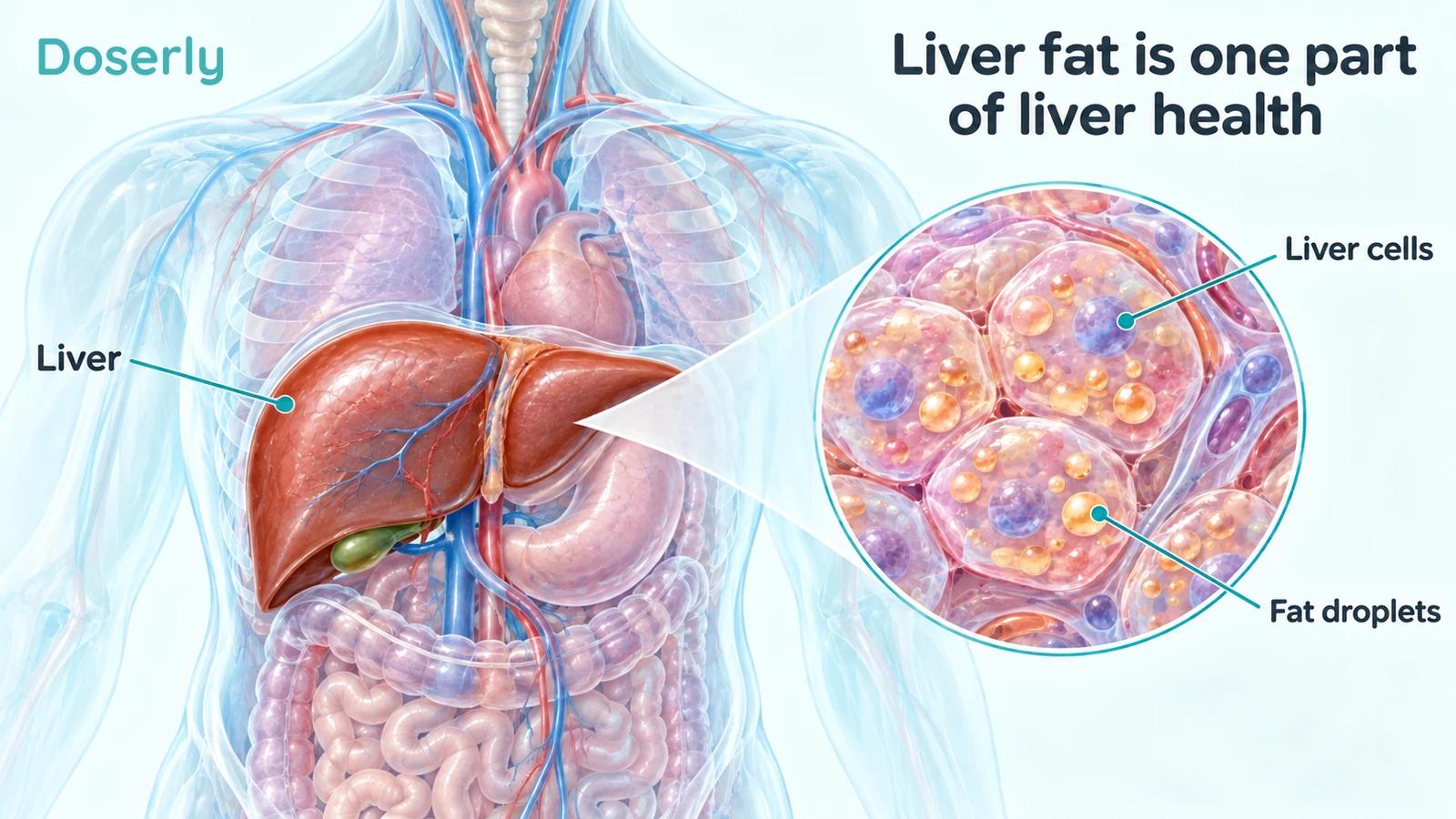
Conceptual anatomy shows fat within liver cells. The image is not a trial scan, and it does not depict a before-and-after treatment response.
What the retatrutide substudy measured
The 2024 Nature Medicine report analyzed 98 participants from a larger obesity trial. They had at least 10% liver fat by MRI-PDFF at baseline and did not have type 2 diabetes. The primary substudy question was relative liver-fat change at 24 weeks.
With 12 mg retatrutide, the estimated mean relative reduction was 82.4%, compared with a 0.3% increase on placebo. Separately, an estimated 86% in the 12 mg group reached liver fat below 5%, the study's normal-fat threshold, compared with 0% on placebo. These are different measures: change in fat versus the proportion reaching a threshold. Primary substudy.
The dose identifies a research group, not a treatment recommendation. Retatrutide remains investigational, and the result does not establish an approved liver-treatment regimen.
The broader Doserly retatrutide guide explains the triple-receptor design. Here, the key issue is the endpoint: this was a liver-fat imaging study within an obesity trial, not a trial selecting participants by biopsy-proven advanced MASH.
What MRI-PDFF tells you
MRI-PDFF stands for magnetic resonance imaging proton density fat fraction. It is a quantitative estimate of liver fat based on the MRI signal. That makes it useful for measuring a change that an ordinary visual impression of an image may not capture reliably.
The percentage is not the proportion of the entire liver that has disappeared, nor the percentage of cells that have died or recovered. It describes a fat measurement. It should therefore be reported as such rather than converted into a claim about total liver health.
Other imaging methods answer different questions. Elastography, including magnetic resonance elastography, assesses stiffness and contributes to fibrosis evaluation. The fact that two tests involve imaging, or even use an MRI scanner, does not make them interchangeable. NIDDK distinguishes fat imaging, stiffness measurements and tissue examination in its explanation of liver assessment. NIDDK diagnostic reference.
For a reader reviewing their own results, the name of the test matters. “My MRI improved” is less informative than knowing which measurement improved and what the clinician is using it to assess.
Relative reduction and percentage points are easy to confuse
Suppose an illustrative liver-fat measurement falls from 20% to 4%. That is a decrease of 16 percentage points. Relative to the starting value, it is an 80% reduction: 16 divided by 20.
Those numbers describe the same hypothetical change. The 80% figure does not mean the person's final liver-fat value is 80%, or that 80% of their liver disease has been cured. It is a calculation relative to the starting fat measurement.
A threshold result asks another question. If a study reports that 80% of a group crossed a specified threshold, it is counting how many participants met that criterion. It does not mean the group's average fat content fell by 80%.
The retatrutide report contains both kinds of results, so the distinction is practical. Before repeating a number, identify its noun: percentage reduction in fat, percentage-point change, or percentage of participants reaching a target. Similar-looking percentages can answer quite different questions.
These arithmetic examples are educational illustrations, not individual participant data from the trial.
Why a low fat measurement is not proof that fibrosis has disappeared
A threshold is useful because it gives a clear, reproducible definition of one outcome. It does not automatically carry information about outcomes that were not measured.
An MRI fat value below a study's threshold cannot, by itself, show that scar tissue is absent. Nor does it establish that a person with a prior diagnosis of MASH no longer has the relevant injury and inflammation. A claim about those features requires evidence suited to those features.
Liver biopsy examines tissue, including injury, inflammation and scarring. It is invasive and is not recommended for everyone with suspected fatty liver. Noninvasive assessment is often used to decide who needs further evaluation. The point is not that every person needs a biopsy; it is that a research claim must match the measurement used to support it. NIDDK diagnostic reference.
This distinction also protects against false reassurance. A favorable fat measurement should be discussed alongside the person's previous fibrosis assessment and clinical history, not used to erase that history.
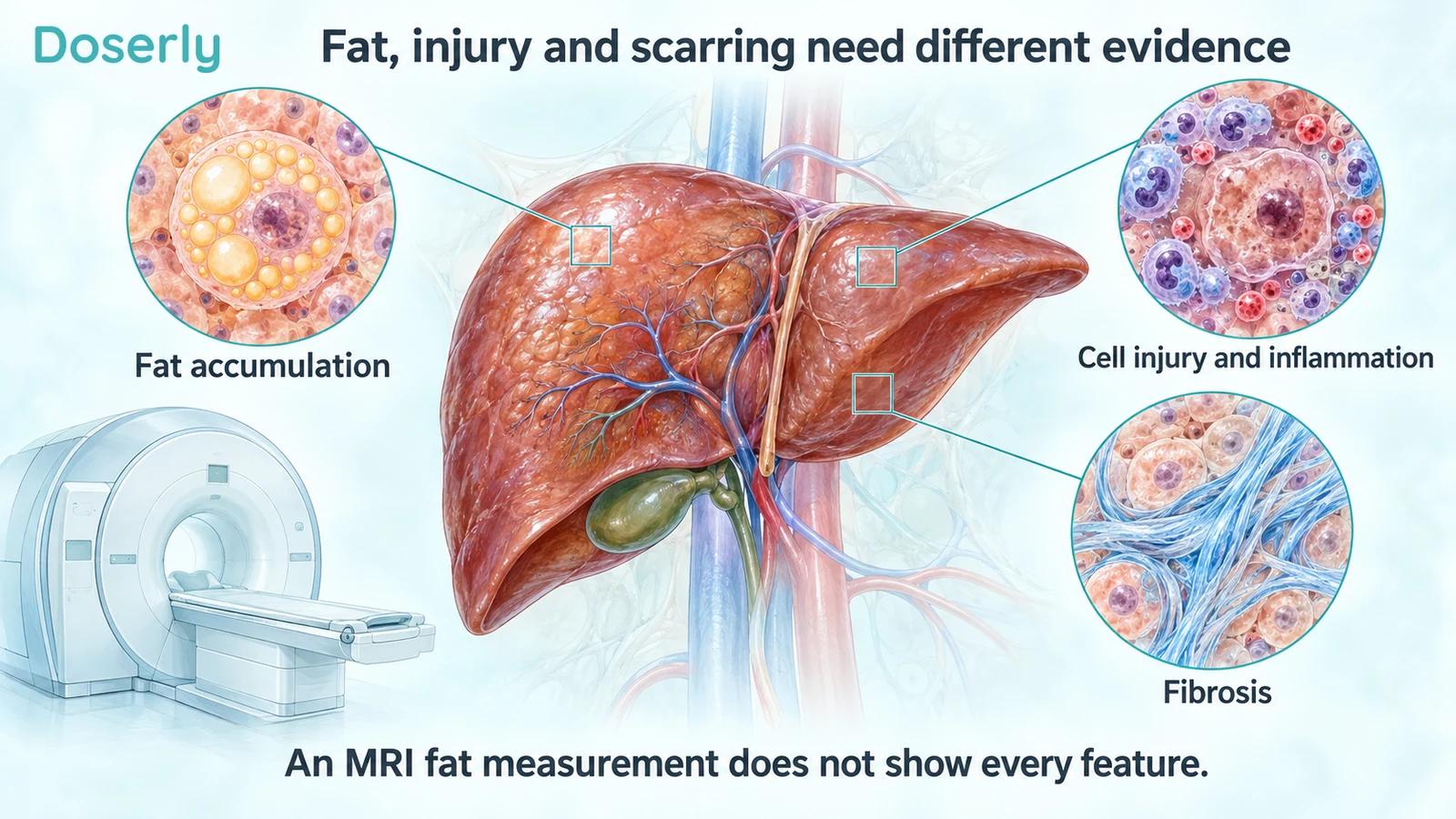
The tissue views distinguish biological features; they do not show stages reversing after retatrutide. MRI fat measurement and fibrosis assessment are not the same test.
What limits the confidence of the substudy?
The study had no liver histology and was not enriched for advanced MASH or significant fibrosis. MRI data were available for 78.6% at 24 weeks but only 43.9% at 48 weeks. Mean ALT, AST, FIB-4 and ELF did not consistently improve versus placebo. The authors also identified small sample size and multiple statistical comparisons as limitations. Study methods and limitations.
Missing follow-up measurements matter because people with observed scans may not represent everyone originally enrolled. Statistical methods can address some missing data under assumptions, but they cannot turn an unobserved scan into directly observed evidence.
Likewise, a small substudy can detect a large imaging effect without settling uncommon harms or long-term disease progression. A dramatic percentage does not make those design limitations disappear.
The appropriate response is to preserve both parts of the finding: a substantial liver-fat signal and an incomplete answer about the broader disease. Neither dismissing the study nor expanding its endpoint into a cure helps the reader.
Does the glucagon component directly explain the liver result?
Retatrutide activates GIP, GLP-1 and glucagon receptors. A direct hepatic contribution from glucagon signaling is biologically plausible, alongside effects associated with weight loss. In the substudy, fat reduction tracked changes in body weight and other metabolic measures; the design did not isolate how much benefit came from each receptor pathway. Mechanistic discussion.
That leaves an important distinction between a plausible explanation and a demonstrated allocation of effect. A correlation with weight change does not prove that weight loss explains everything. The presence of glucagon activity does not prove that it explains everything else.
To separate those contributions, researchers would need a design that can compare the relevant mechanisms while accounting for differences in weight loss, exposure and other influences. A single triple-agonist group cannot be mathematically split into three proven clinical effects merely because the molecule has three targets.
For readers, the practical implication is modest: the mechanism helps explain why the result is interesting, but the clinical conclusion still rests on what was measured.
What stronger evidence would add
A biopsy-based trial could test whether MASH resolves or fibrosis improves under prespecified definitions. A longer clinical-outcomes trial could test whether treatment reduces events such as major liver complications. Those are advances in the question being answered, not simply more attractive scan images.
The SYNERGY-Outcomes master protocol, NCT07165028, is studying whether retatrutide and tirzepatide can prevent major adverse liver outcomes in people with high-risk MASLD identified using noninvasive tests. This is a prospective research program. Its existence does not provide results or prove that the two medicines have equivalent liver effects. Trial summary.
An imaging change, tissue endpoint and clinical event may all be valuable, but they occupy different positions in a treatment assessment. A patient deciding about care needs to know which level of evidence supports a particular option.
Existing treatments make accurate framing more important
The treatment landscape has changed since the retatrutide substudy was written. The FDA approved resmetirom in 2024 for adults with noncirrhotic MASH, then termed NASH, with moderate-to-advanced fibrosis. In 2025 it approved semaglutide injection for an indicated MASH population. Those decisions should not be attributed to retatrutide or generalized to every person with liver fat. Resmetirom decision, semaglutide decision.
Both decisions used the accelerated-approval pathway, which links surrogate evidence to a requirement to confirm clinical benefit. Even an approved tissue-based endpoint is not identical to already having proven fewer liver failures or deaths.
The Doserly semaglutide guide supplies broader background on that different molecule. A comparison between treatments should respect their distinct formulations, eligible populations and evidence, rather than ranking unrelated liver-fat percentages from separate studies.
Useful questions after a fatty-liver result
A clinical conversation can begin with the diagnosis and risk assessment rather than a particular investigational drug:
- Which test showed liver fat, and what exactly did it measure?
- Has fibrosis risk been assessed, and is additional testing needed?
- Are other causes of liver injury or relevant alcohol exposure being considered?
- How do diabetes, blood pressure, lipids, nutrition and weight management fit into the plan?
- Which treatments have evidence and approval relevant to this person's disease stage?
The EASL-EASD-EASO guideline supports staged assessment using blood-based scores such as FIB-4 followed, when appropriate, by elastography. It also emphasizes management of the broader metabolic context. Clinical guideline.
These questions do not require a reader to interpret a fibrosis score alone. They help connect the test result to the next clinical decision.
A promising trial medicine is not an online liver remedy
The FDA's current warning identifies retatrutide as unapproved and cautions against unknown-quality products marketed for human use with research labels. FDA warning.
A separate Australian alert described six liver-injury cases associated with unapproved products labelled retatrutide, with possible contaminants under investigation. That does not establish toxicity of the controlled trial medicine. It does make it inappropriate to assume that a product bought online carries the trial's safety or imaging findings. Victorian alert.
Retatrutide's MRI result is a strong reason for further clinical research. It is evidence of reduced liver fat in the studied group, with important limits. The reader's liver-health question remains broader: the amount of fat, the presence of injury and fibrosis, and the risk of future complications all need their own evidence.
Sources
- Nature Medicine: randomized liver-fat substudy.
- NIDDK: diagnostic tests for fatty liver and steatohepatitis.
- EASL-EASD-EASO: MASLD clinical practice guideline.
- SYNERGY-Outcomes: prospective trial summary.
- FDA: semaglutide MASH approval.
- FDA: resmetirom approval.
- FDA: unapproved GLP-1 product concerns.
- Victoria Department of Health: product-related liver-toxicity alert.