
Red Light Therapy
October 17, 2026
Red light therapy, mitochondria and longevity: how far does the evidence go?
On this page
Mitochondria give red light therapy one of its most appealing explanations. These structures help cells convert nutrients into usable energy. They are also involved in the biology of aging. Put those facts together, and it is easy to imagine that a light device could recharge aging tissues and help us live longer.
The idea is more interesting, and less settled, than that simple story suggests. Researchers have measured biological responses to particular forms of light in human tissue. Some clinical trials report benefits for specific outcomes. But neither a change in an optical signal nor an improvement in a short cognitive test establishes that someone will remain independent longer or live more years.
As of October 2026, the human studies discussed here do not demonstrate that photobiomodulation extends lifespan. They do provide useful clues about what light may do, what it sometimes fails to do, and how to distinguish a promising mechanism from an established healthy-aging intervention. That distinction lets us take the science seriously without asking it to support a promise it has not tested.
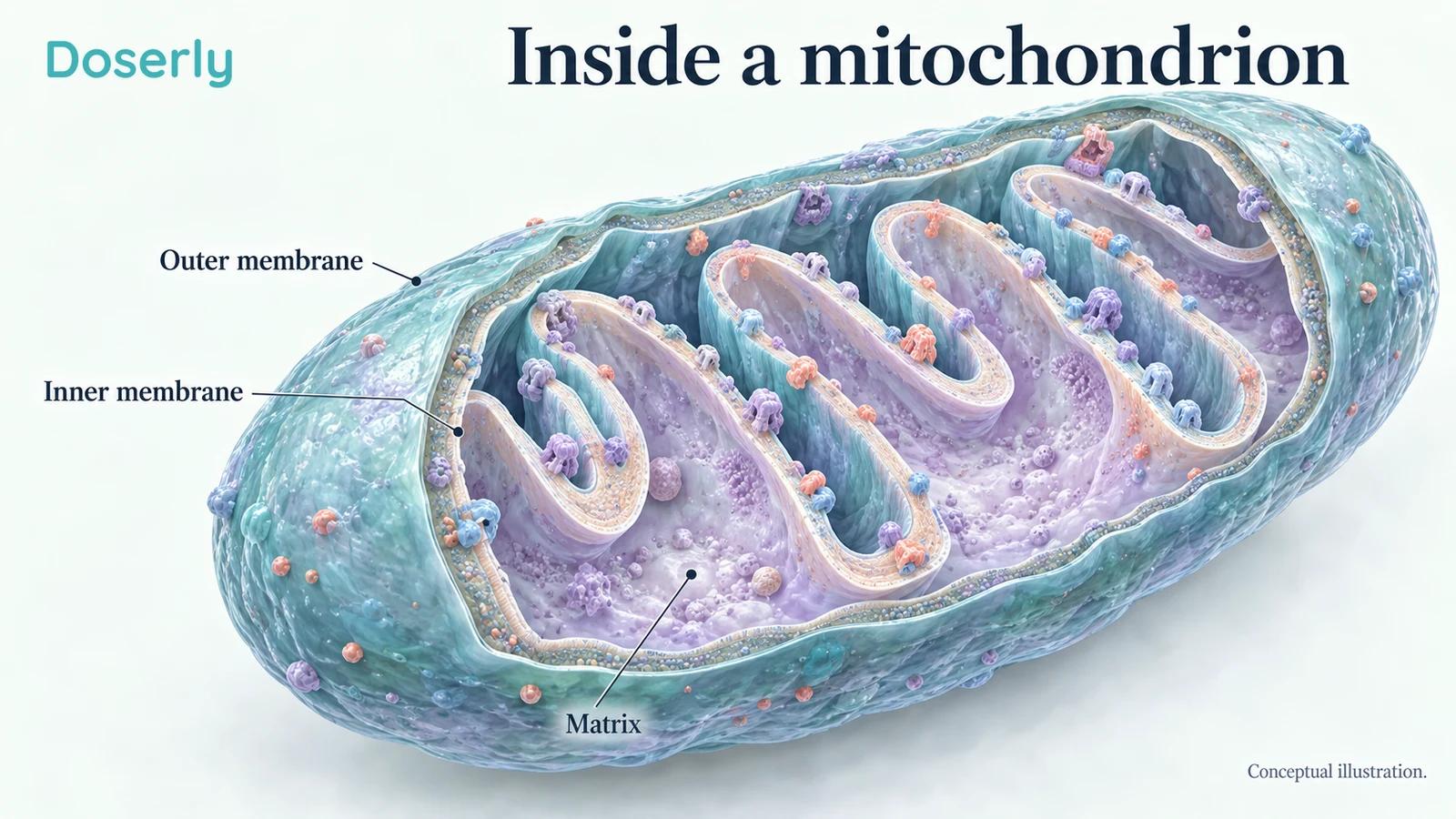
What “mitochondrial energy” actually means
ATP is a molecule cells continually make and use to support work, including muscle contraction, transport across membranes and many chemical reactions. Mitochondria contribute much of that production through processes involving their inner membrane. The folds in that membrane, called cristae, provide space for the machinery involved.
This is a regulated system. Cells need energy production to match their circumstances. More activity in one part of the system is not automatically better, and a momentary increase does not mean that the entire organelle has become healthier. Researchers therefore measure several different things: oxygen consumption, ATP-production capacity, protein abundance, membrane properties and responses to stress.
Those measurements are related, but they are not interchangeable. Think of evaluating a vehicle: fuel consumption, engine capacity and the distance it can reliably travel answer different questions. Likewise, a tissue's oxygen use does not by itself tell us how much useful work a person can perform, whether symptoms improve, or whether the body ages more slowly.
This matters when a product says it “boosts ATP.” The useful follow-up is where ATP was measured, in what kind of experiment, and for how long. A result in cultured cells is different from a result in an older person's muscle. A measurement inferred from spectroscopy is different from directly examining a tissue sample. Each can be informative when its limits remain visible.
The cytochrome c oxidase explanation is a hypothesis to test
One prominent explanation for photobiomodulation involves cytochrome c oxidase, often shortened to CCO. It is part of the mitochondrial respiratory chain. Researchers have proposed that interactions between light and this system could influence cellular energy metabolism and downstream signaling.
There is human evidence consistent with some version of that idea. A 2016 study of 11 healthy participants used near-infrared spectroscopy during laser and placebo exposure of the forearm. The investigators reported changes in the CCO-related optical signal and oxygenated hemoglobin at the treated site. This was a small physiological experiment, not a trial showing better health or longer life. Original human forearm study.
The simplest direct-enzyme account is not uncontested. A separate 2016 laboratory study exposed isolated CCO to red or near-infrared light and did not find a significant change in the measured reaction kinetics. An isolated enzyme lacks the environment of an intact cell, so this does not rule out all biological effects of light. It does challenge the idea that shining red light on CCO invariably makes the enzyme work faster. Original isolated-enzyme experiment.
It is possible for light to produce a clinical effect before every mechanism is understood. It is also possible for an attractive mechanism to fail to produce a useful clinical effect. The right response to that uncertainty is to test both questions, rather than treating a detailed molecular story as proof of benefit.
Nitric oxide and redox signals are not simple switches
Other proposed explanations involve nitric oxide and redox signaling. Redox refers to reactions involving the transfer of electrons. Reactive oxygen species, often discussed only as damaging “free radicals,” can also participate in cellular signaling. Their meaning depends on context, amount, location and timing.
An experiment in neurons cultured from embryonic mouse brains illustrates that complexity. Investigators measured ATP, mitochondrial membrane potential, calcium, reactive oxygen species and nitric oxide after different light exposures. The responses were not a straightforward upward line: lower and higher exposures produced different patterns, and some initially increased measures fell at higher exposures. This was a mouse-cell experiment, not a human dosing study. Original neuronal dose-response study.
A 2026 laboratory study adds another useful boundary. Broad-spectrum red or blue exposure at low, daylight-equivalent levels did not significantly increase nitric oxide release from skin-cell monolayers at the individual time points tested. That finding applies to the tested conditions. It does not establish that every clinical light source has no effect, or that ordinary sunlight reproduces a medical device. Original nitric-oxide experiment.
For someone reading longevity claims, the lesson is practical. “Reduces oxidative stress” and “increases signaling” are not universal descriptions that can be attached to every device. Nor does the existence of a curved dose response tell you the correct exposure for your own tissues. A culture dish cannot supply a personalized treatment schedule.
What has actually been measured in the human brain?
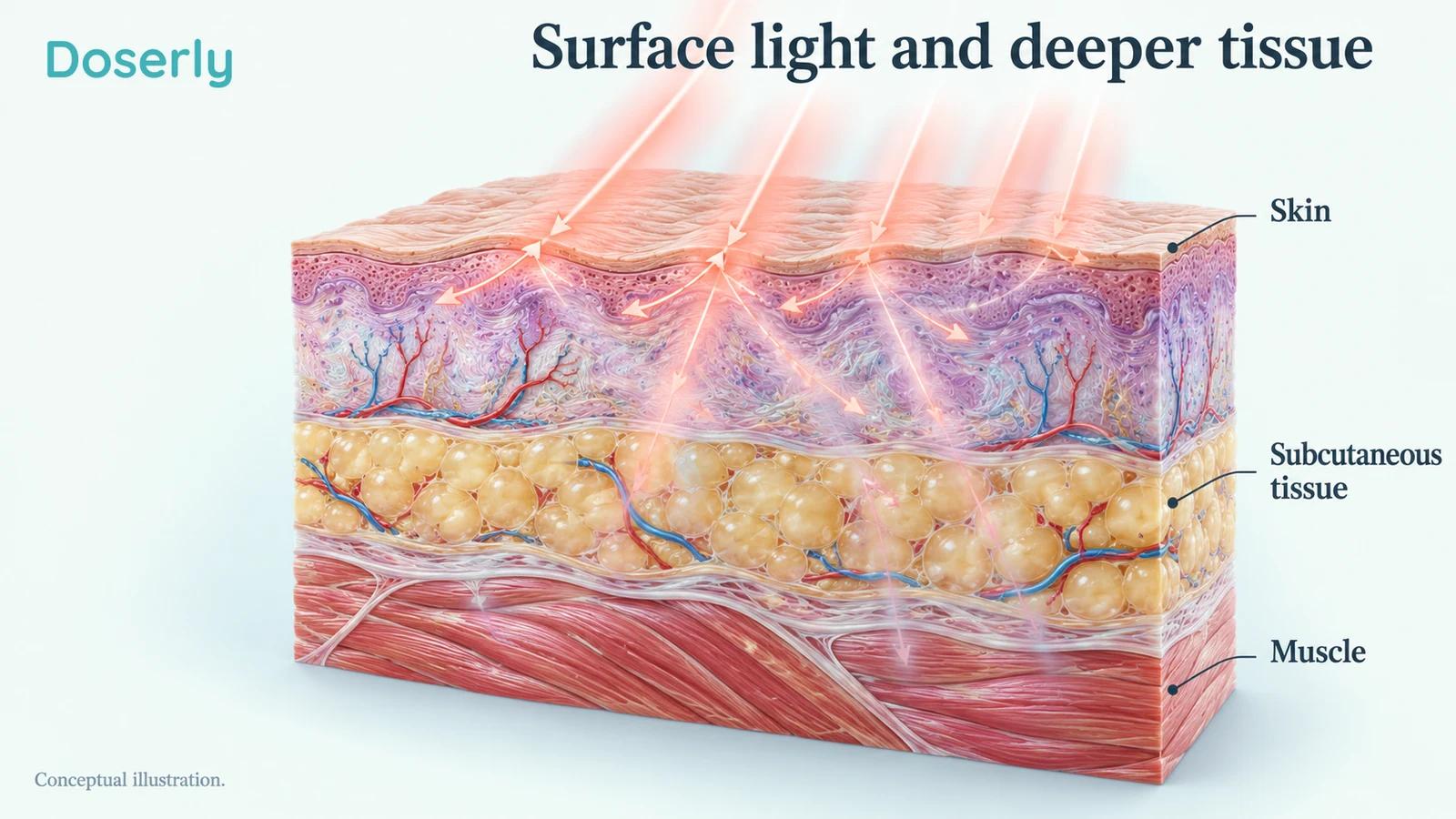
A 2020 study examined near-infrared laser exposure using broadband spectroscopy in 15 younger and five older adults. It reported increases in oxygenated hemoglobin and the oxidized CCO signal relative to sham. The researchers also acknowledged an important limitation: they could not clearly separate how much of the CCO signal originated in the scalp versus deeper brain tissue. Original human spectroscopy study.
That is an interesting physiological result, but it should not be described as direct proof that every brain cell made more ATP. Only five older participants were studied, and the measurements were acute. The experiment did not show prevention of dementia, preservation of independence or extension of life.
This distinction is easy to lose because the language of measurement can sound definitive. A sophisticated instrument can precisely detect a signal while uncertainty remains about what produced it and what it means clinically. The question is not whether spectroscopy is useful. It is whether the claim being made goes further than the measurement permits.
It also matters where treatment is delivered. A forehead experiment cannot validate a distant body panel simply because both use near-infrared light. The intervening tissues, illuminated area and exposure conditions differ. “Targets mitochondria” is too broad a description to establish that two interventions are equivalent.
A 2026 human tissue study found no respiratory boost
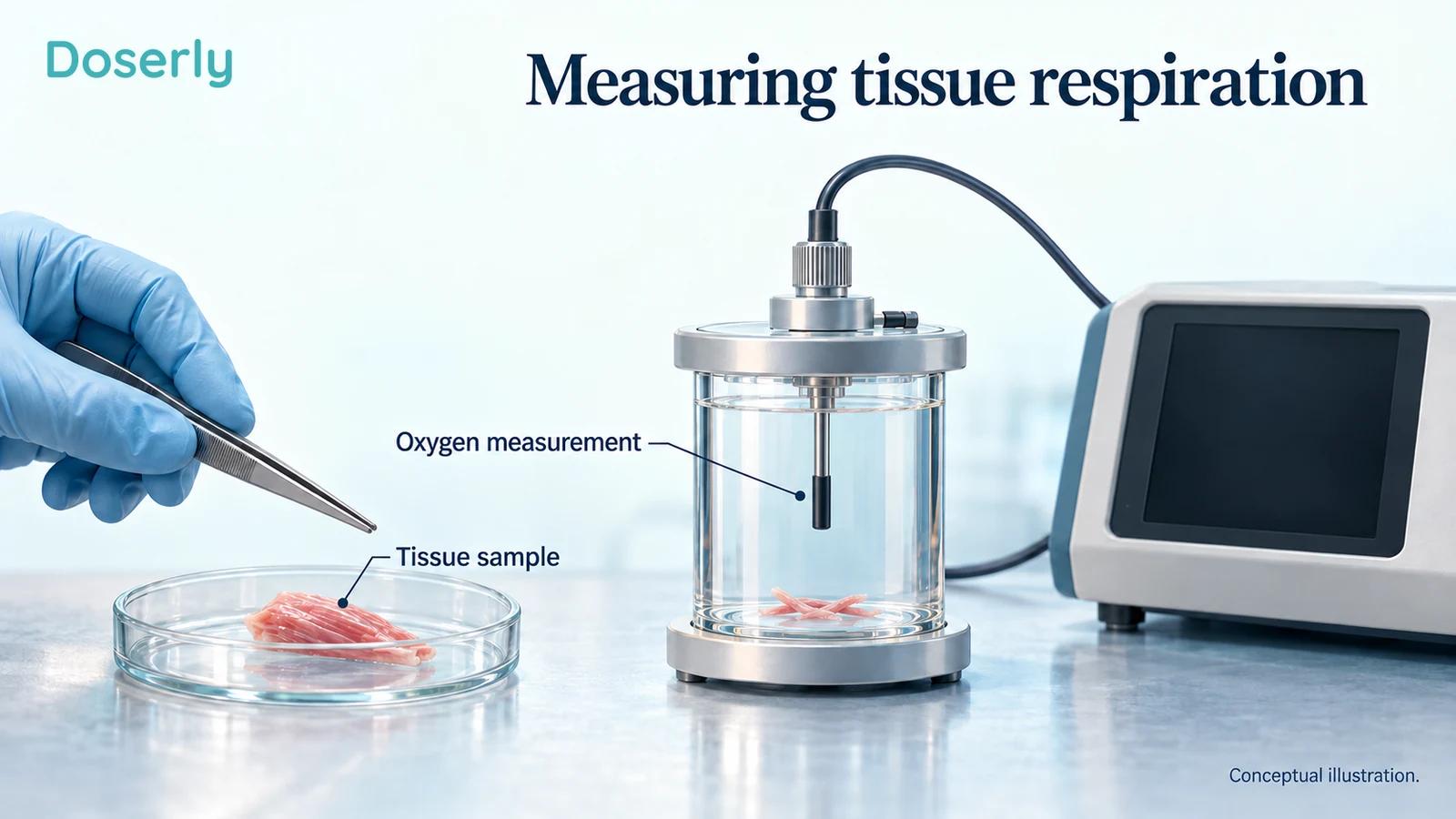
One of the most directly relevant recent experiments tested the claim that photobiomodulation increases mitochondrial respiration in human skin and muscle. Twelve healthy adults received active treatment on a randomly selected leg and sham on the other. Researchers then collected tissue samples and measured mitochondrial respiration outside the body.
They found no significant difference in maximal respiration between treated and control skin or muscle. Muscle sensitivity to ADP, another part of cellular energy metabolism, also did not differ significantly. Skin temperature increased by about 8°C on the treated side. Original August 2026 human study.
This was one session in healthy young adults, using a particular intervention. It does not settle what repeated treatment might do in another population. It does, however, provide a clear counterexample to the sweeping claim that light reliably increases mitochondrial respiration whenever it is applied to human tissue.
The temperature finding also deserves attention. Calling something photobiomodulation does not remove the need to measure heating. A study should distinguish the biological questions it is asking from accompanying thermal effects. A warm sensation is not a readout of ATP production, and more warmth is not evidence of a stronger healthy-aging effect.
Negative results like this improve the field. They help researchers identify which assumptions need revision and which conditions require replication. They also protect consumers from treating a mechanism as a guaranteed response.
Burning more energy is a different claim
A 2025 crossover study examined acute resting energy expenditure in 16 women with obesity and 16 normal-weight women. After the tested light exposure, the obesity group had a higher measured resting energy-expenditure rate than at baseline. The study used indirect calorimetry, and skin temperature also rose. It did not establish a lifespan benefit or directly measure improved mitochondrial efficiency. Original resting-metabolism study.
The difference between energy use and efficiency is important. Using more energy does not necessarily mean obtaining more useful work from the same fuel. A brief measurement expressed as calories per day is also a rate extrapolated into daily units, not proof that the person burned that many additional calories over an entire day.
Longevity discussions sometimes turn any metabolic movement into a favorable sign. A higher value is presented as rejuvenation in one context, while a lower value is celebrated in another. Before deciding that a change is good, ask what the measurement represents and whether the study connected it to a patient benefit. A number can move without answering the question you care about.
Clinical improvements matter, but they retain their boundaries
Some newer brain studies provide more than acute optical measurements. A 2026 randomized, double-blind trial in 80 people with mild cognitive impairment attributed to Alzheimer's disease reported an improvement in its primary cognitive score after a specific home-based treatment. Mean MoCA-K scores rose 3.87 points with active treatment and fell 0.74 points with placebo. The study reported no device-related adverse events. Original 2026 confirmatory cognitive trial.
That is a clinically relevant research signal. It is not evidence that healthy adults should use a panel to prevent Alzheimer's disease, and it does not establish reduced conversion to dementia or longer survival. The participants had a defined clinical condition, and the follow-up addressed a much shorter question than lifelong prevention.
A separate 2026 pilot randomized 20 people with mild cognitive impairment to active or sham treatment. It reported improvements in selected cognitive outcomes, changes in blood lactate and pyruvate, and altered brain-network connectivity. Ten participants reported adverse events, four in the active group and six in sham; none were serious. The trial was single-blind and small. Original multimodal pilot.
Blood metabolites are not a direct measurement of ATP production inside neurons. When clinical, metabolic and imaging findings move together, they can support a hypothesis and guide the next study. They still do not prove the proposed chain of causation. Larger studies need to determine whether benefits are reproducible, durable and important in everyday life.
There is room to value a symptom-specific result without attaching a longevity label. Helping a particular patient think more clearly would matter on its own. The evidence does not become more useful by stretching it into a claim about all forms of aging.
Looking younger and aging more slowly are separate outcomes
The phrase “anti-aging” can refer to skin appearance, physical function, disease risk or survival. A study may answer one of those questions while advertising language quietly implies all four.
For example, a 2025 sham-controlled trial in 60 adults evaluated an LED and infrared mask for crow's feet. It reported improvements in wrinkle grading with the tested device. The participants were seeking a temporary aesthetic improvement, and the outcomes concerned skin appearance. Original mask trial.
That finding cannot tell us whether organs are biologically younger or whether the person has gained healthy years. Cosmetic benefit can be a legitimate goal; it simply needs to be named accurately. A photograph of smoother skin is not a measure of systemic aging.
The same reasoning applies to a laboratory “biological age” score. To support a treatment decision, a change needs to mean more than a more flattering number. Ideally, it should predict an outcome that matters and reliably reflect how treatment changes that outcome. Without that connection, a before-and-after score can create confidence without telling us whether the person is healthier.
Exercise offers both mitochondrial and functional evidence
Exercise research is a useful comparison because it has tested biology and function rather than relying only on a mitochondrial narrative. In a 2017 human study, different training approaches produced different adaptations over 12 weeks. Interval and combined training improved aerobic capacity and muscle mitochondrial respiration, while changes in proteins and their production helped explain the adaptations. These were supervised research interventions, not proof that one demanding routine is suitable for everyone. Original exercise and mitochondrial study.
A separate trial asked a more directly practical question. The LIFE study randomized 1,635 older adults at risk of disability to structured physical activity or health education. Over an average of 2.6 years, major mobility disability occurred in 30.1% of the activity group and 35.5% of the education group, an absolute difference of 5.4 percentage points. Participants had physical limitations but could initially walk 400 meters. Original LIFE trial.
These studies do not prove that exercise prevents every consequence of aging, and they are not head-to-head comparisons with light therapy. Their value is that they connect interventions to outcomes at different levels, including an ability important for independence.
The practical comparison is therefore about evidence and priorities, not competition between technologies. If a person has limited time or money, a proposed device should be evaluated alongside approaches already being used to preserve function. A clinician or physical therapist can help adapt activity to health conditions and capacity. An exercise study in one population should not be converted into an instruction to push through illness or post-exertional symptoms.

SS-31 shows why a mitochondrial result needs careful translation
Elamipretide, also known as SS-31, is a useful comparison because it is explicitly studied as a mitochondrial-targeted intervention. It is a different treatment from light, with different delivery, risks and evidence.
In a randomized study of 39 older adults selected for low mitochondrial function, a single infusion produced a short-lived signal of increased ATP-production capacity. The percentage-change comparison reached statistical significance, while the absolute-change comparison narrowly did not. There was no significant improvement in the measured fatigue resistance, and the ATP effect was not present seven days later. The manufacturer funded the work. Original older-adult elamipretide trial.
That example makes the distinction unusually clear: even a result close to the proposed energy mechanism did not automatically yield a functional benefit. It also did not establish a healthy-aging treatment course or lifespan extension.
There is now a specific US regulatory approval that should not be overlooked or generalized. In September 2025, FDA granted accelerated approval to Forzinity, the elamipretide product, to improve muscle strength in adults and children with Barth syndrome weighing at least 30 kg. The agency describes strength improvements during an open-label extension; the randomized portion did not show superiority on its primary walking and fatigue endpoints. Confirmation of clinical benefit remains required. FDA trial snapshot.
That approval concerns a particular medicine and rare disease. It does not validate research-market SS-31 vials for longevity or establish a light-and-peptide combination. The Doserly SS-31 guide explains the distinction between the approved product and broader research claims.
MOTS-c is not evidence that a combination will work
MOTS-c often appears in the same discussions because it is a peptide encoded by mitochondrial DNA and investigated in metabolic biology. A 2021 study reported that exercise increased endogenous MOTS-c in human muscle and circulation. The experimental treatment findings for improved physical capacity and late-life healthspan came from mice. Original MOTS-c study.
Those are different parts of the paper. A human body's production of a molecule during exercise does not establish that administering that molecule recreates exercise, and mouse treatment results do not establish a human longevity benefit. The Doserly MOTS-c guide provides background on that research distinction.
Adding several plausible interventions together creates another unanswered question. If light, a peptide and a supplement are all described as affecting mitochondria, their effects cannot simply be added on paper. They may act at different points, produce no useful combined effect, or introduce additional burdens. A combination needs its own evidence for the intended outcome.
This is especially important when an elaborate routine is described as “covering every pathway.” More components make it harder to determine what caused a change. A list of proposed mechanisms is not a clinical trial, and complexity does not make a routine more likely to extend life.
Supplements illustrate the same separation of outcomes
Urolithin A has also been studied in relation to mitochondrial biology. In a randomized trial of 66 older adults, it improved some secondary muscle-endurance measures, but did not significantly improve the primary walking-distance or maximal ATP-production outcomes compared with placebo. The study followed participants for four months. Amazentis funded the study and participated in its design, conduct and analysis; several authors reported company employment or financial interests. Original urolithin A trial.
This is neither an argument for taking the supplement nor evidence against light. It shows why a paper's individual outcomes need to be read separately. An intervention can produce an interesting endurance finding while leaving its primary tests negative. Describing the entire study as proof of “mitochondrial rejuvenation” would conceal that mixed result.
For longevity claims, the most useful habit is to keep the measured outcome in the sentence. “Changed a biomarker,” “improved a contraction test” and “reduced disability over several years” communicate very different levels of evidence. None should silently become “makes you live longer.”
What would make the longevity claim convincing?
A useful healthy-aging study would begin with a clearly defined population and goal. Preventing loss of mobility in older adults is different from treating a symptom in a diagnosed disease. The study would specify the device, include an appropriate comparator, follow participants long enough, and measure both benefits and harms.
It would also distinguish an effect during treatment from one that persists afterward. A transient physiological response may be scientifically valuable, but a person deciding on years of use needs to know about sustained benefit, burden and safety. Adherence, withdrawals and the experience of people who did not benefit belong in the results.
Survival is an even larger claim. It requires evidence about survival, or a convincingly validated relationship between the measured treatment effect and that outcome. A short trial cannot directly answer a decades-long question simply by calling its biomarker an aging marker.
For now, red light therapy is best evaluated through the specific human question being tested. Some results justify further research, some offer promising clinical signals, and others challenge broad mechanistic assumptions. Mitochondria are a reasonable place to investigate healthy aging. They are not a shortcut around demonstrating that a treatment helps people stay well, remain independent or live longer.