
TRT
October 16, 2026
Primary hypogonadism: why some restart advice misses the biology
On this page
The testes need hormonal stimulation to produce testosterone, but stimulation is only one part of the process. The tissue must also be able to respond. In primary hypogonadism, the main limitation is in the testes themselves. Increasing a signal that is already elevated may not overcome that limitation.
This matters when advice about “restarting natural production” is offered as though every low testosterone result has the same cause. A treatment designed to stimulate an underactive signaling system is addressing a different problem from absent or substantially impaired testicular tissue. Neither a supplement claim nor a medication name can substitute for identifying that difference.
Primary hypogonadism is not a verdict that every part of reproductive function has stopped. The degree of impairment and the underlying cause vary. It is a reason to be precise about what treatment is trying to achieve: more circulating testosterone, improved symptoms, sperm production or a pregnancy. These are connected goals, but they are not interchangeable.
What the testosterone and LH pattern tells you
LH, or luteinizing hormone, is released by the pituitary and stimulates Leydig cells in the testes to produce testosterone. When testosterone is low because the testes are not responding adequately, LH commonly rises. The pituitary is already increasing its signal.
That differs from secondary hypogonadism, where LH is low or inappropriately normal for the low testosterone level. Measuring LH and FSH helps distinguish the patterns once a testosterone deficiency has been confirmed. A diagnosis still depends on symptoms, repeat measurements and the clinical context. Endocrine Society guideline.
There are less clear-cut situations. A man may have elevated LH while testosterone remains within the reference interval, sometimes described as a compensated pattern. That is not the same as established symptomatic testosterone deficiency. Medicines, previous hormone use and mixed testicular and central problems can also complicate interpretation.
The useful question is not whether a single LH number is “good” or “bad.” It is whether the combination of measurements makes sense in this person's circumstances. Our primary hypogonadism guide gives more background on that evaluation.
The testes perform two related jobs
Leydig cells make testosterone. Sperm develop within seminiferous tubules, supported by a different cellular environment and hormonal inputs. Damage can affect these functions to different degrees. A person can have impaired sperm production without a severely low testosterone concentration, or low testosterone alongside substantial fertility impairment.
FSH, or follicle-stimulating hormone, adds information about the sperm-producing system. An elevated FSH can suggest impaired sperm production, but it does not tell a clinician exactly what every small area of testicular tissue is doing. Semen analysis is needed to assess sperm in the ejaculate, and some fertility questions require specialist investigations. EAU male-infertility guideline.
This distinction is essential when evaluating a treatment claim. An increase in blood testosterone does not demonstrate restored sperm production. Successful sperm retrieval during a procedure does not mean testosterone production has normalized. And retrieving sperm is an earlier step than achieving fertilization, pregnancy or a live birth.
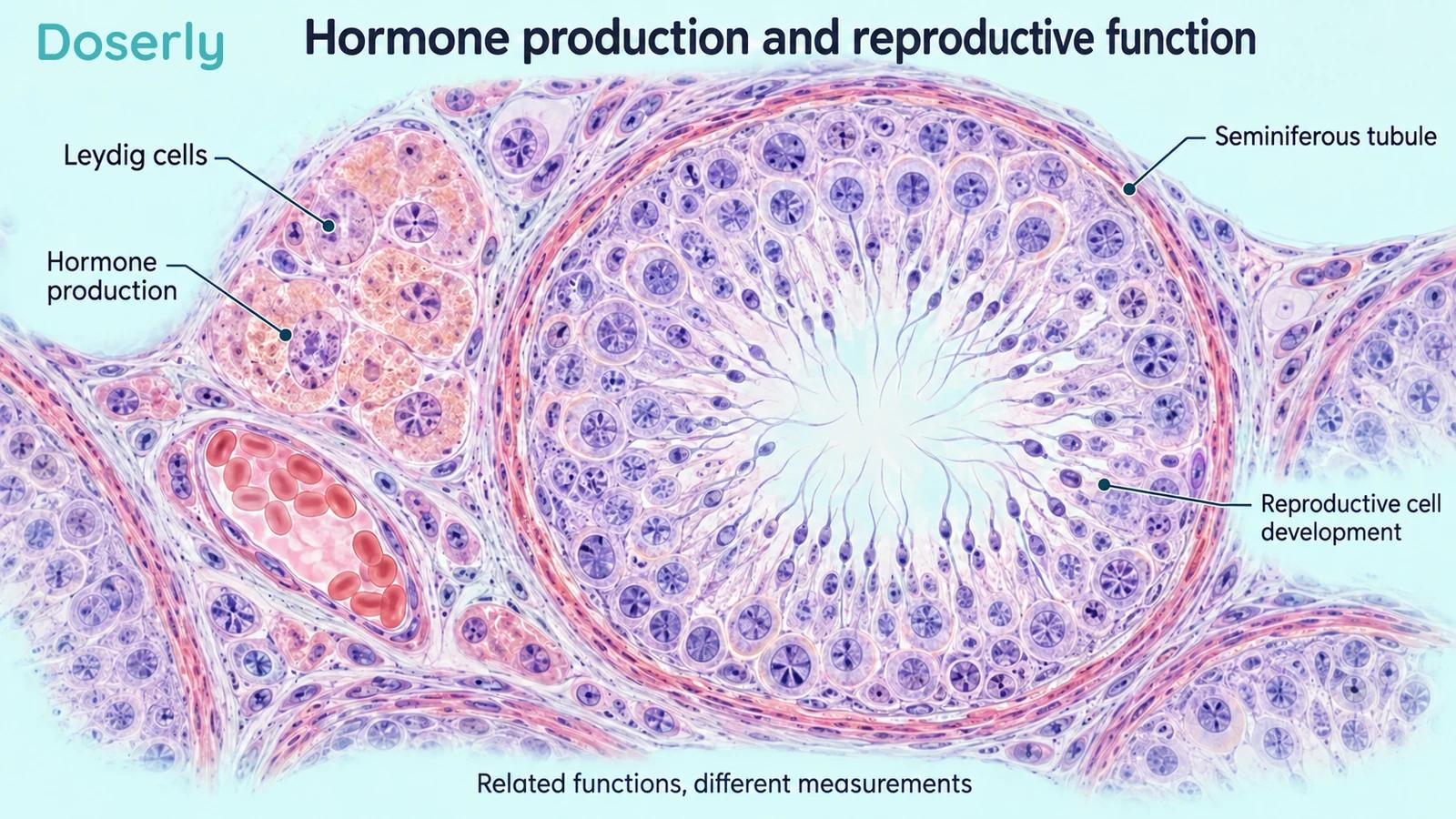
Conceptual histology shows different cellular compartments. The illustration explains functions rather than depicting a biopsy, a diagnosis or a treatment response.
What can cause primary hypogonadism?
The history may point to a genetic condition, testicular injury, prior infection, undescended testes, surgery or cancer treatment. These possibilities have different implications for recovery, monitoring and fertility. The effects of a particular treatment depend on factors such as what tissue remains and which therapies were received.
For example, cancer treatments can affect reproductive function through different mechanisms. Chemotherapy, radiation and surgery do not all have the same effect, and their consequences vary by treatment. The National Cancer Institute recommends discussing fertility preservation before treatment when possible, rather than waiting until infertility is discovered afterward. NCI fertility information.
A diagnosis also should not be inferred from appearance or testicular size alone. The clinician combines history, examination, hormone results and, when indicated, genetic or other testing. Someone who has had one testis removed has a different situation from someone with no functioning testicular tissue; the remaining testis and the rest of the medical history matter.
These details explain why a generic “restart” schedule is a poor substitute for the original records. Knowing what caused the deficiency can be more useful than knowing which product raised someone else's testosterone online.
Klinefelter syndrome shows why treatment goals must be separated
Klinefelter syndrome usually involves an additional X chromosome, commonly described as 47,XXY. Its effects vary. Some people have low testosterone, small testes, fertility difficulties or other developmental and health needs. It should not be treated as a uniform experience.
Testosterone can address deficiency in selected people with Klinefelter syndrome, but it does not correct the chromosome pattern or reliably restore fertility. NICHD specifically distinguishes treatment for low testosterone from treatment of infertility. It also notes that not every person with XXY has the same need for testosterone treatment. NICHD treatment information.
For a reader, this is a useful example of cause-specific care. The plan may include endocrine treatment, fertility counseling and support for other health needs. Asking one hormone prescription to solve all those issues creates expectations that the treatment cannot meet.
It also shows why “natural” versus “replacement” is often the wrong basis for comparison. A therapy should be judged by whether it addresses the person's physiology and goals, with an acceptable burden and safety profile. Supplying a hormone that tissue cannot adequately produce can be appropriate care; it is not evidence that the person failed to stimulate the system correctly.
What do medicines marketed as stimulators actually do?
Selective estrogen receptor modulators, or SERMs, can alter feedback at the hypothalamus and pituitary and increase gonadotropin signaling. Clomiphene is one example used off-label in men. Human chorionic gonadotropin, or hCG, acts at the LH receptor. These approaches do not supply new testicular tissue.
AUA/ASRM guidance permits selected hormonal approaches in infertile men with low testosterone, while noting limited evidence and distinguishing them from testosterone treatment. Such recommendations are not a statement that all forms of testicular failure can be reversed. AUA/ASRM male-infertility guideline.
If the limiting factor is inadequate stimulation and the testes can respond, increasing that stimulation has a biological rationale. If stimulation is already high because tissue capacity is impaired, the same intervention may have much less to work with. The response depends on the diagnosis, not the appeal of calling the treatment a restart.
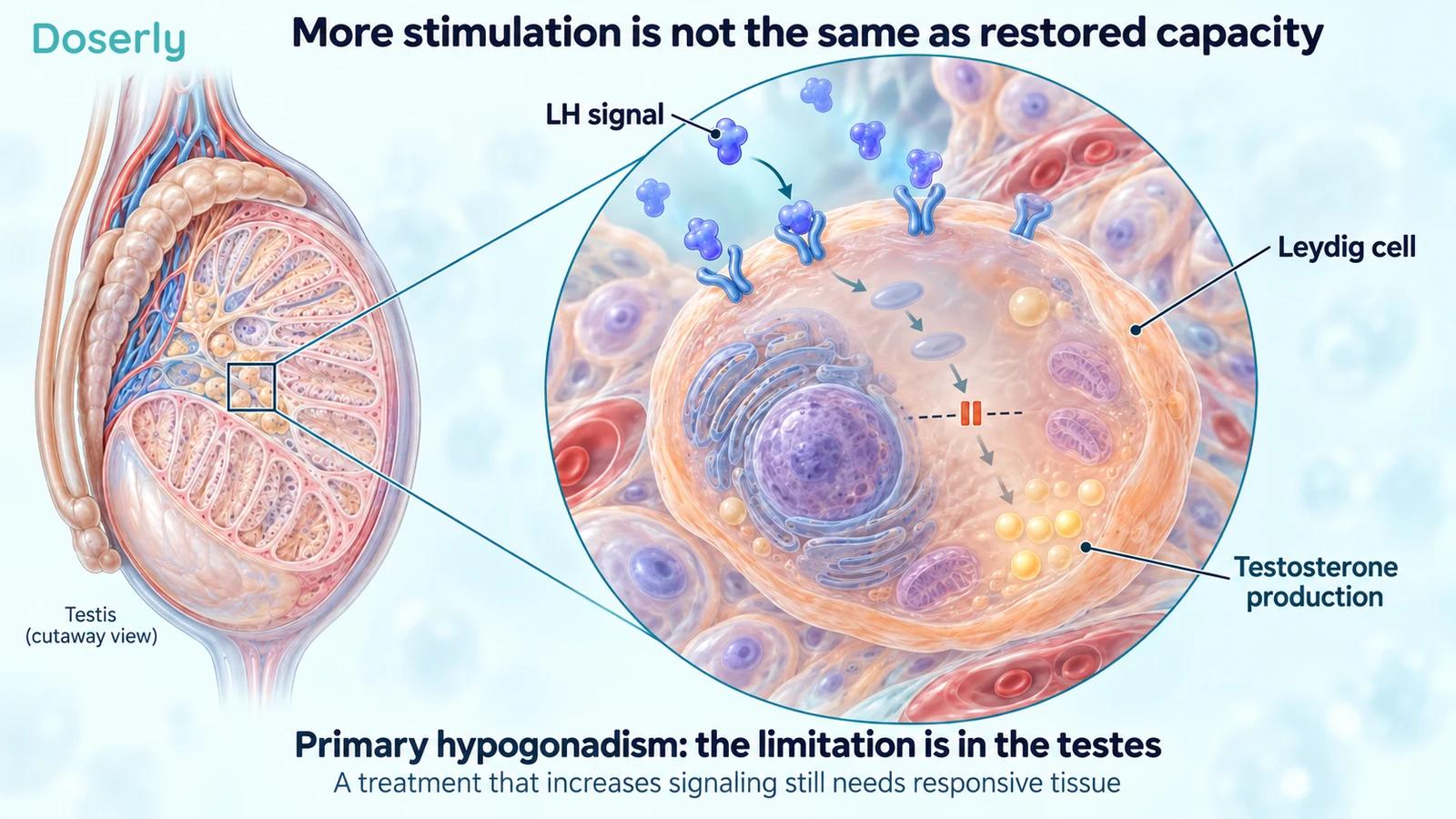
The signal and the tissue's ability to respond are different parts of physiology. The simplified intracellular pathway is conceptual; it is not a molecular map or evidence that a particular drug repairs testicular tissue.
Why one LH cutoff cannot predict every response
The human clomiphene literature adds nuance. A 2014 study included 76 men with hypogonadism who chose clomiphene treatment. Forty-seven, or 62%, met the investigators' biochemical response definition. Pretreatment testicular volume and LH were associated with the likelihood of response. Mazzola and colleagues.
A later retrospective study of 332 men treated at two fertility centres found that 73% had an increase of at least 200 ng/dL in total testosterone. Median initial follow-up was six weeks. In that cohort, baseline LH and FSH did not significantly predict the testosterone response in the reported regression analyses. Keihani and colleagues, 2020.
These are selected treatment cohorts, not trials proving that severe primary testicular failure can be reversed. Their different findings also argue against treating one laboratory cutoff as a universal predictor. The endpoint was a biochemical change during treatment, not durable untreated recovery or a live-birth outcome.
The careful conclusion is that some men respond to stimulation, and simple predictors are imperfect. It does not follow that stimulation works regardless of the cause. A clinician can use the full history and pattern of results to decide whether a monitored trial has a reasonable rationale, rather than escalating treatment indefinitely because the number has not risen.
Fertility options can exist without a hormonal restart
Severe impairment of sperm production does not always mean that no sperm can be found anywhere in the testes. In selected cases, reproductive specialists consider surgical sperm retrieval for assisted reproduction. This is different from restoring normal production throughout the organ.
A small prospective pilot enrolled 15 adolescents and young adults with Klinefelter syndrome, aged 12–25. None had sperm in the ejaculate. Ten underwent microdissection testicular sperm extraction, and sperm were retrieved in five. Nahata and colleagues, 2016.
That is an example of a possible fertility pathway, not a 50% personal guarantee. The study was small and descriptive; retrieval was not the same as pregnancy or birth. It also does not establish that an invasive procedure should be offered to everyone at a particular age. Decisions require specialist counseling, including the person's preferences and readiness.
If fertility matters now or may matter later, raise it before starting or changing testosterone. The Doserly fertility-preservation guide explains why semen testing, preservation discussions and hormone treatment should be coordinated.
What replacement can and cannot accomplish
Testosterone replacement aims to treat an established deficiency and its consequences. It can raise blood testosterone without requiring the testes to produce it. That is a useful property when production is inadequate, but it does not establish repair of the original problem.
Monitoring therefore needs to assess both the intended benefit and treatment risks. The conversation should cover symptoms, the chosen formulation, blood tests and other clinical factors relevant to that product. If symptoms fail to improve despite an appropriate hormone level, the clinician should reconsider their cause rather than assume that ever-higher exposure is the answer.
Fertility remains a separate issue because exogenous testosterone can suppress reproductive signaling. Someone may need a coordinated plan that addresses deficiency while preserving or pursuing reproductive options. That plan depends on the underlying condition and should not be inferred from a friend's response to TRT.
Questions that make restart advice testable
Ask what evidence shows that your system is under-stimulated rather than already responding with elevated LH. Ask which part of the testes is believed to retain useful function and what outcome the proposed treatment is meant to change. A clinician should be able to explain why the approach fits the diagnosis.
Also ask how success will be measured. A higher on-treatment testosterone result, sustained levels after treatment ends, improved sexual symptoms and sperm in the ejaculate are different results. The follow-up plan should identify which matters and what would lead to stopping an ineffective approach.
Finally, bring the original diagnostic information whenever possible. Previous surgery, cancer treatment, genetic testing and untreated hormone results can prevent a misleading interpretation of today's treatment-influenced measurements. Primary hypogonadism calls for realistic, individualized care—not an assumption that every production problem can be solved by increasing the signal.
Sources
- Endocrine Society testosterone guideline, 2018.
- EAU male-infertility guideline.
- NCI: Male fertility and cancer.
- NICHD: Treatment for Klinefelter syndrome.
- AUA/ASRM male-infertility guideline.
- Mazzola et al., 2014: predictors of biochemical clomiphene response.
- Keihani et al., 2020: baseline gonadotropins and clomiphene response.
- Nahata et al., 2016: small prospective sperm-retrieval pilot.