
Peptides
October 16, 2026
Petrelintide combinations: a plan is not a result
On this page
The appeal of combining an amylin medicine with an incretin medicine is easy to understand. If the treatments influence appetite through partly different receptor systems, perhaps using both can improve weight management. The difficult questions begin after that sentence: how much does the second medicine add, what happens to side effects, and can people continue the treatment long enough to benefit?
Petrelintide is now supported by published human monotherapy trials. Its combination story is less mature. Laboratory compatibility experiments, studies in rats and a registered human combination trial all exist, but they sit at different points in development. Reading them as one continuous body of proven clinical results makes the evidence look further along than it is.
This article separates those stages using evidence available on October 15, 2026. The petrelintide guide provides broader background on the amylin analogue.
Why combining these signals is biologically plausible
Amylin is a hormone released by pancreatic beta cells alongside insulin. Amylin-based drugs seek to reproduce selected effects of that signaling system. Incretin-based drugs act through other receptors: semaglutide activates the GLP-1 receptor, while tirzepatide activates GLP-1 and GIP receptors.
Different targets make a combination worth investigating. They do not guarantee independent benefits. Two pathways can converge on similar downstream processes, and greater biological activity can increase unwanted effects as well as desired ones. A useful combination must therefore demonstrate more than an attractive receptor diagram.
Petrelintide's published ZUPREME-1 trial establishes that the medicine itself can reduce weight in adults with overweight or obesity without diabetes. That is an important foundation for combination development. It does not tell us the additional benefit of putting it alongside another active medicine, because ZUPREME-1 compared petrelintide doses with placebo, not with a petrelintide–incretin combination. ZUPREME-1 publication
The same boundary applies to the October 2026 sponsor-reported results in people with type 2 diabetes. Those results broaden the monotherapy evidence into another population. They do not become combination evidence simply because many participants were also receiving background diabetes treatment. The trial allowed metformin with or without an SGLT2 inhibitor; that is a different question from adding a specified investigational incretin medicine. ZUPREME-2 announcement
Two meanings of “together”
Co-administration means giving two medicines within the same treatment regimen. They can remain separate pharmaceutical products. Co-formulation means developing a preparation that contains both active medicines together.
These are distinct scientific and manufacturing problems. A clinical trial can test whether separately administered medicines work well together without showing that they remain stable in one container. A laboratory experiment can show that a particular combined preparation retains acceptable properties without showing that it produces a useful clinical outcome.
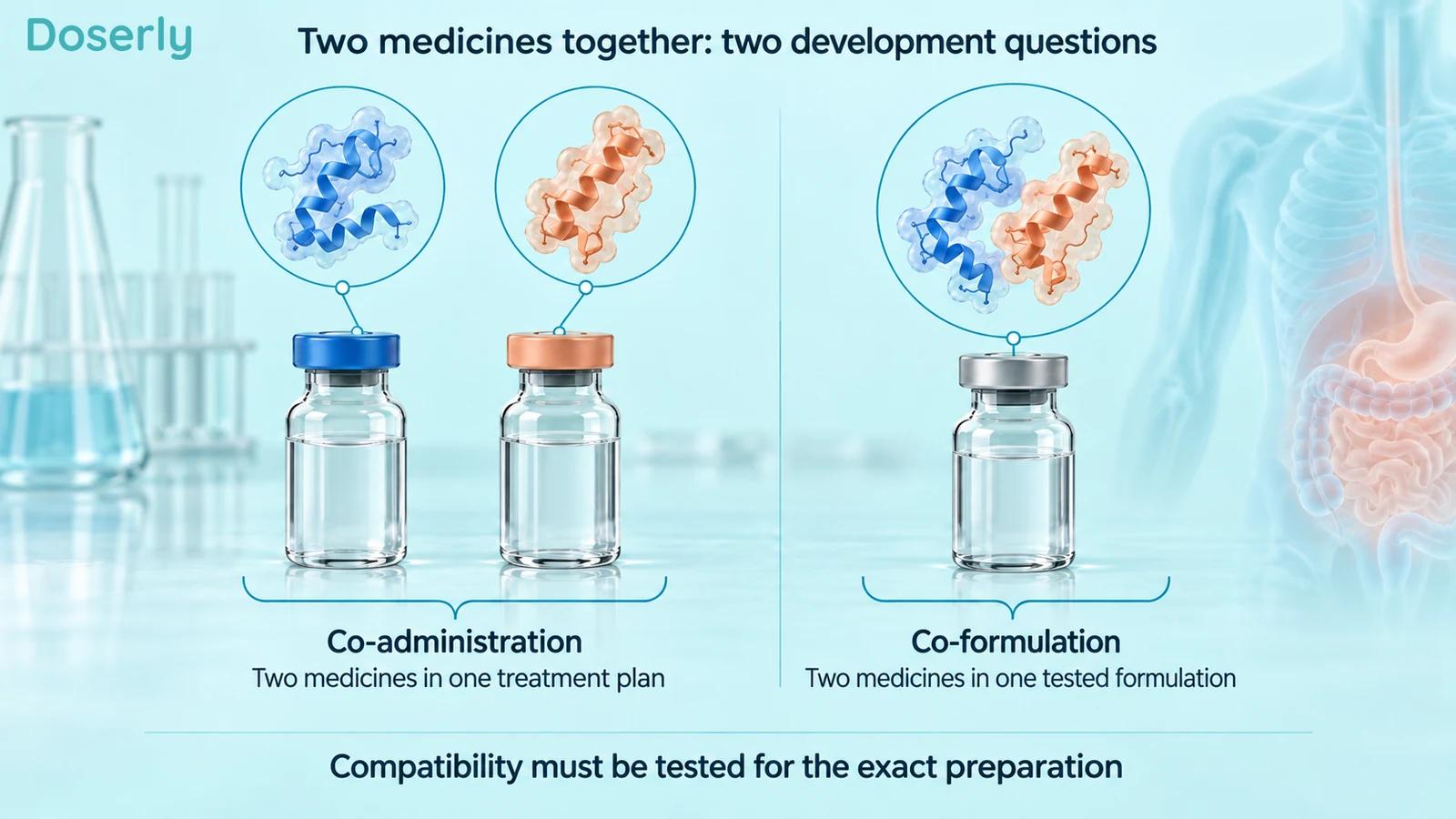
For peptide medicines, formulation conditions matter. The precise molecules, concentrations, acidity, excipients, container and storage conditions can influence whether the preparation remains suitable. Compatibility belongs to the preparation that was actually tested. It is not a general permission to combine products that happen to contain related ingredients.
That distinction is especially relevant to petrelintide because its development included work on stability and compatibility. These are genuine advantages to investigate. They are not evidence that any available vial can be mixed with another medicine, or that a commercial product already exists.
What the semaglutide poster actually studied
A 2022 ObesityWeek poster examined ZP8396, the development code for petrelintide, with semaglutide. It included laboratory formulation work and experiments in rats with diet-induced obesity.
The formulation experiment examined specific solutions under specified conditions, including storage for four weeks at 40°C. The animal work included semaglutide treatment followed by addition of the amylin analogue, with body weight and food intake measured during the experiment. The investigators also considered separate and combined formulations. Original 2022 poster
This is more informative than a purely theoretical proposal. It demonstrates that the developers did experimental work on both biological activity and a formulation question. But the animals were rats, the observation period was short compared with chronic obesity treatment, and the tested preparation was a research formulation.
The accurate conclusion is that these findings supported further development. They did not establish a human weight-loss percentage, a human side-effect rate, a convenient final injection device or long-term product stability under ordinary use conditions.
The distinction remains important even if the poster uses confident language such as “additive.” That word describes the authors' interpretation of their experiment. It should not be expanded into a promise that a person will obtain the sum of two separate trial percentages.
What the tirzepatide experiment adds
A later poster investigated petrelintide with tirzepatide in another diet-induced obesity rat experiment. Animals first received tirzepatide, then the amylin analogue was added during the subsequent treatment period. Body weight and food intake were again central measurements. Original 2023 poster
The sequence matters. Adding a treatment after an initial response can explore a different question from starting two treatments simultaneously. It can help identify whether another pathway still changes the measured response after the first medicine has been acting.
It still does not reproduce routine human care. Human treatment involves much longer exposure, different dose adjustment schedules, more diverse health conditions and practical interruptions. A rat experiment also cannot establish how people experience fullness, nausea, fatigue or the burden of treatment.
These posters are therefore useful evidence of a development rationale. They are weak grounds for predicting personal outcomes, comparing commercial treatments or recommending an untested combination.
The registered human study is a different combination
The human trial registered as NCT07589686 evaluates petrelintide co-administered with RO7795068, also known as enicepatide or CT-388. It is not the semaglutide experiment and not the tirzepatide experiment.
The registration describes a phase 2, randomized, double-blind, placebo-controlled dose-finding study in adults with obesity or overweight. Estimated enrollment is 486 participants. Six groups include three combination regimens, each individual medicine with a matching placebo, and double placebo. A primary weight outcome is measured at week 40. Trial registration
The component groups are particularly valuable. If a combination is compared only with placebo, it may be difficult to determine how much the second medicine contributes. Including each medicine alone makes the added benefit and added burden more directly assessable.
The registration also describes safety measurements and secondary outcomes, including metabolic measures. These are planned observations, not reported improvements. Registering an HbA1c outcome does not mean that the combination has already lowered HbA1c.
As checked on October 15, the record's latest posted update was September 9, 2026, and its recruitment status remained “not yet recruiting.” It listed an estimated September 30 start. Because an estimated date had passed, it would be tempting to describe the trial as underway. The record does not justify that inference. Recruitment status can lag events, but a reader should be told what has actually been verified.
No results were posted in that record. The correct description is a registered study plan with specified comparisons and endpoints, not a completed human demonstration.

Another combination provides proof of principle, not a shortcut
Cagrilintide plus semaglutide offers relevant human evidence for the broader amylin–incretin approach. In the phase 3 REDEFINE-1 trial, 3,417 adults without diabetes were assigned to the combination, either component alone or placebo for 68 weeks.
Under the treatment-policy analysis, mean weight change was −20.4% with the combination, −14.9% with semaglutide, −11.5% with cagrilintide and −3.0% with placebo. That analysis addresses outcomes regardless of treatment discontinuation or rescue intervention. Gastrointestinal adverse events occurred in 79.6% of combination participants and 39.9% of placebo participants. REDEFINE-1 primary report
This supports the proposition that an amylin–GLP-1 combination can have substantial clinical effects. It also illustrates why both efficacy and tolerability must be measured. Larger weight changes do not remove the need to understand symptoms, discontinuation and dose adjustment.
The results belong to cagrilintide and semaglutide, with that trial's population, formulation, escalation flexibility and duration. They cannot be assigned to petrelintide and enicepatide. Even medicines described as members of the same class can differ in exposure, receptor activity and the way they are used.
The cagrilintide guide helps place that separate development program in context.
What a useful result would need to report
A headline percentage will be only one part of a meaningful combination result. The component comparisons should show whether adding petrelintide improves outcomes beyond the partner medicine, and whether any improvement is large enough to matter alongside additional adverse effects or treatment burden.
Dose matters to that interpretation. A combination might make a lower dose of one component useful, or it might produce its largest effect only when both components are pushed toward their tested targets. Those scenarios have different implications for tolerability and convenience. A dose-finding trial is designed to investigate such tradeoffs; it does not assume that the highest exposure is automatically best.
The analysis also needs to explain what happened after participants stopped treatment. A result estimated under continued adherence answers a different question from an analysis that retains discontinuation and other events in the treatment strategy. Presenting only the most favorable number makes comparison harder.
Safety reporting should include individual symptoms, their severity and duration, discontinuations and serious events. Pooling everything into “gastrointestinal effects” can conceal useful differences between nausea, vomiting, constipation and diarrhea. Equally, the absence of a rare event in a few hundred participants cannot establish that it never occurs.
Longer follow-up would help address durability and continued participation. A week-40 study can support an important development decision without answering what happens after several years of care or after treatment ends.
What this means when reading the next announcement
The first question is which combination was actually tested. Petrelintide with semaglutide, tirzepatide or enicepatide are different interventions. The second is whether the evidence comes from a laboratory, animals, a registered plan or a completed human trial. The third is which comparison supports the claim.
For someone managing an existing treatment with a clinician, these distinctions prevent research news from being mistaken for instructions. The available petrelintide combination material does not establish a personal regimen, a safe mixing procedure or a reason to change a prescribed medicine.
Petrelintide's combination program is scientifically credible enough to deserve careful study. Its next useful milestone is a human result that shows what the second medicine adds, what it costs in tolerability and how the findings depend on the tested regimen. Until then, the plan is valuable precisely because it defines questions that remain unanswered.
Sources
- ZUPREME-1 primary phase 2 publication.
- ZUPREME-2 sponsor announcement.
- Petrelintide–semaglutide preclinical poster.
- Petrelintide–tirzepatide preclinical poster.
- Registered human combination study.
- REDEFINE-1 primary report.