
TRT
October 16, 2026
Opioids and low testosterone: the medication link worth asking about
On this page
Opioid medicines can make an important difference to pain, but they also interact with hormone systems. In some men receiving long-term treatment, testosterone falls because the signals that normally support its production are suppressed. The resulting problem is often called opioid-induced androgen deficiency, or OPIAD. Androgens are hormones that include testosterone.
The connection is easy to overlook. Fatigue, reduced sexual interest, difficulty with erections and lower activity can occur during chronic pain for several reasons. A hormonal contribution may be present alongside sleep disruption, depression, medication sedation or the physical limitations of the painful condition.
Recognizing that possibility gives you something concrete to discuss with your clinician. It does not mean that opioids explain every symptom, that testosterone will relieve the pain, or that you should stop an opioid yourself. The best evaluation connects the pain treatment, the symptoms and the hormone results in one care plan.
How opioids can affect testosterone production
Testosterone production depends on communication between the brain and testes. The hypothalamus releases gonadotropin-releasing hormone, or GnRH, in pulses. This stimulates the pituitary to release luteinizing hormone, or LH, which tells testosterone-producing cells in the testes to work. Follicle-stimulating hormone, or FSH, participates in sperm production.
Opioids can suppress this reproductive signaling. Testosterone may become low without the compensatory rise in LH expected when the testes are the main source of the problem. This is a secondary, or centrally mediated, pattern. It is a clue about where to investigate, not proof of a single cause. Other illnesses and medicines can produce a similar pattern. Endocrine Society diagnostic guidance.
The FDA required opioid labeling changes in 2016 addressing decreased sex-hormone levels as well as adrenal insufficiency and serotonin syndrome. Its review acknowledged limitations in the underlying studies, including difficulty separating medication effects from medical, physical and psychological factors. FDA safety communication.
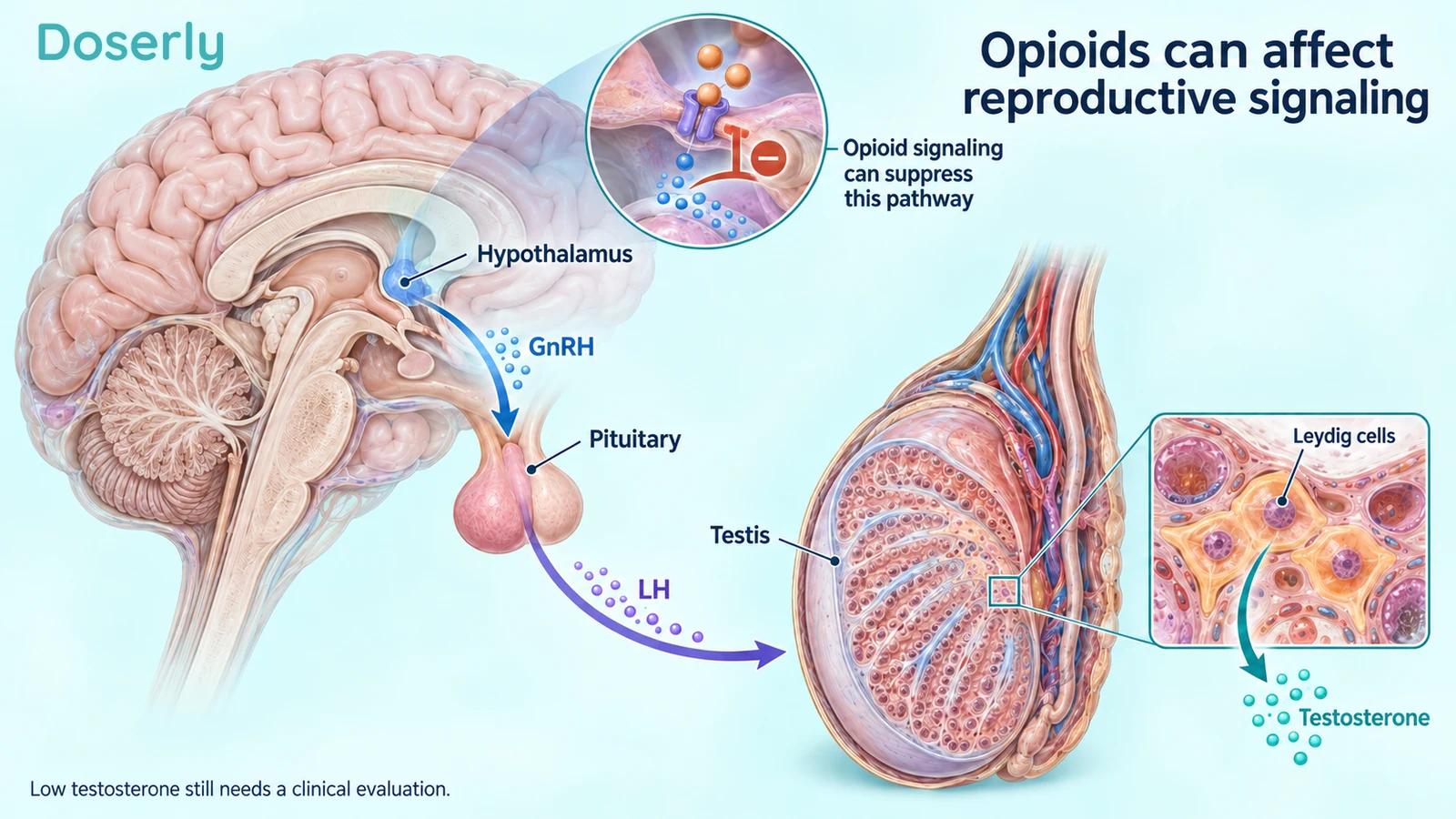
This simplified physiological diagram shows a pathway opioids can suppress. Organ sizes and distances are schematic. A person's laboratory pattern still needs clinical interpretation, including other potential causes.
Which symptoms deserve a conversation?
Reduced sexual desire, erectile changes and fertility concerns are worth mentioning explicitly. People sometimes omit them because an appointment is focused on pain, or because they assume these changes are an unavoidable part of taking medication. FDA advises patients to report symptoms suggesting reduced sex hormones and clinicians to consider laboratory evaluation when these symptoms occur. FDA communication.
Describe what changed and when. Was sexual interest already low before the opioid began? Did symptoms appear after a change in treatment? Is the main problem desire, the ability to obtain an erection, pain during activity or exhaustion? These distinctions help the clinician decide what to investigate.
A chronological association can be useful without being conclusive. For example, increasing pain may lead to both a higher opioid dose and worse sleep. If fatigue follows, the dose change alone cannot explain everything. Similarly, erectile dysfunction can have vascular, neurological, psychological or medication-related contributors even when testosterone is low.
Our guide to opioid-induced androgen deficiency offers background on the hormone connection. Bring your concerns to the clinician managing the opioid and, when needed, an endocrinologist or urologist so that the interpretation fits your broader care.
Do all opioid treatments carry the same hormonal effect?
The available evidence suggests differences, but it does not provide a simple ranking that patients should use to switch medicines themselves. A retrospective cohort examined men aged 18–80 taking a stable single-opioid regimen for chronic noncancer pain. Compared with hydrocodone, fentanyl, methadone and oxycodone were associated with higher odds of androgen deficiency after adjustment for several measured factors. Rubinstein and Carpenter, 2017.
This was an analysis of existing clinical data, not a randomized medication-switching trial. The people receiving each medicine could differ in pain severity, prior treatment, health and other ways the analysis could not fully capture. An association does not establish that switching an individual to the comparison drug will restore testosterone or preserve pain control.
Duration of action, exposure, dose and the person's health all deserve review. However, an opioid prescribed for pain and a medicine used in treatment of opioid use disorder have different clinical contexts. A hormone finding should not be used to undermine an effective addiction-treatment plan. The clinician must consider the consequences of changing that treatment, not only a testosterone measurement.
How should a low result be checked?
An isolated low testosterone measurement is not enough to settle the diagnosis. Clinicians generally confirm a low morning result and assess whether the symptoms fit. The interpretation can also require SHBG, the protein that binds much of the testosterone in blood, and a suitable free-testosterone measurement or calculation.
LH and FSH help distinguish a signaling problem from a testicular one. Depending on the history and examination, further evaluation may include prolactin or investigation of pituitary disease. The fact that an opioid can suppress hormones does not remove the need to consider other causes. Endocrine Society guidance.
It helps to bring the full medication list, including nonprescription products, rather than only the opioid name. Include the formulation, how long it has been used and any recent changes. Also mention previous testosterone or anabolic-steroid exposure, because that can affect the same signaling system and complicate interpretation.
Keep the laboratory reports themselves. Units, collection time and the laboratory's reference interval matter. A remembered result such as “my level was under 300” omits information the clinician needs. The Doserly blood-work guide explains the different measurements commonly used in evaluation and follow-up.
Does testosterone treatment help pain?
The most important trial distinction is between experimental pain sensitivity and clinical pain. Experimental testing applies a controlled stimulus, such as pressure, and measures the response. Clinical pain is the pain a person experiences in daily life. A treatment can change one without clearly improving the other.
In a randomized, double-blind trial, 84 men using opioids for chronic noncancer pain were assigned testosterone gel or placebo for 14 weeks. Their testosterone was below 350 ng/dL at entry. Sixty-five provided follow-up efficacy data. Testosterone improved several experimental pain-sensitivity measures, sexual desire and body composition, but there was no significant between-group improvement in self-reported clinical pain. Basaria and colleagues, 2015.
For someone hoping to need less pain medication, that result has a clear limit. The trial did not establish testosterone as a substitute for analgesic treatment. Its small size, single-centre design, attrition and short duration also limit conclusions about long-term benefit and safety. A plausible biological effect on pain processing is not the same as demonstrated relief of the person's ongoing painful condition.
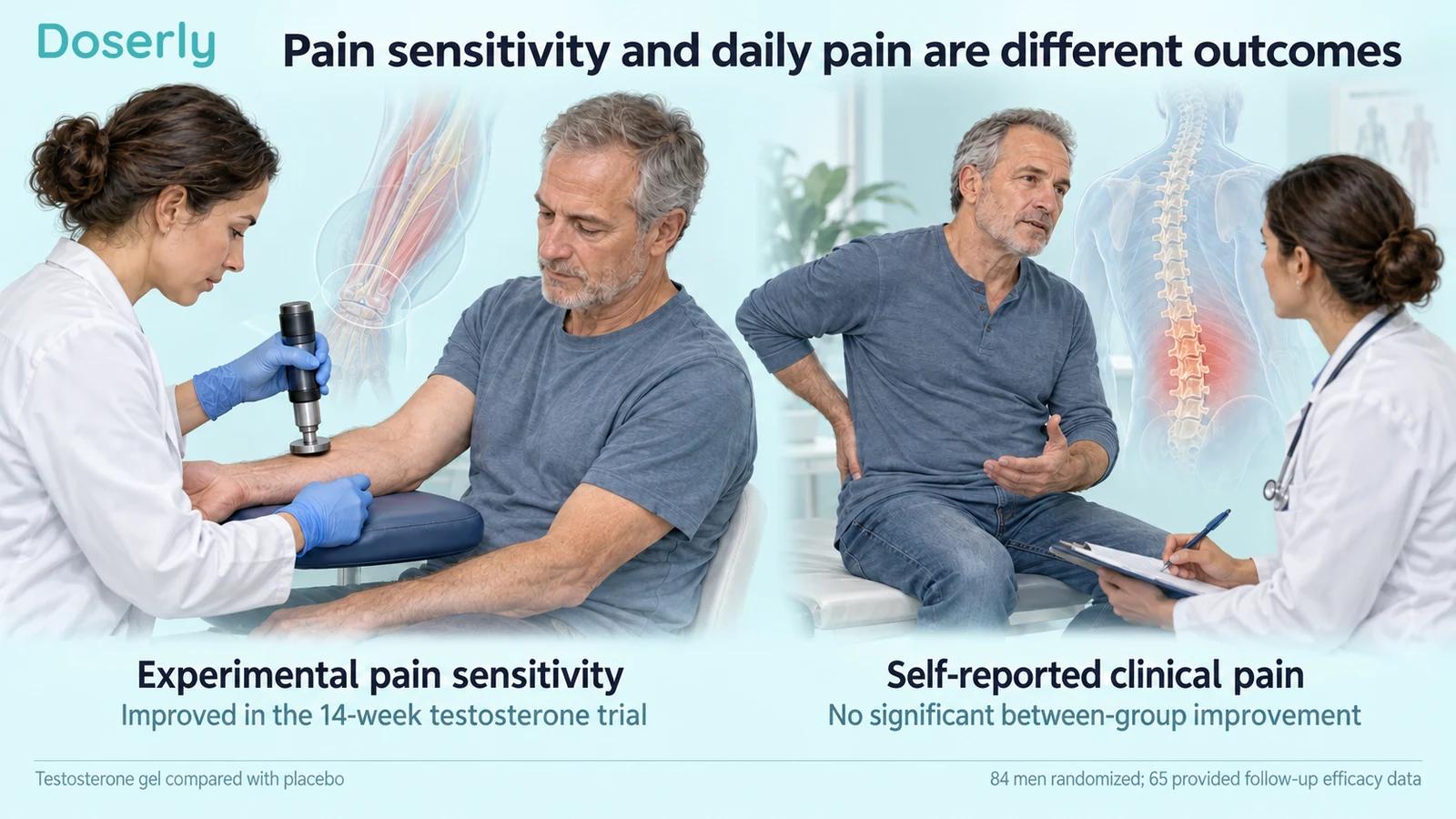
The 14-week trial improved experimental sensitivity measures but did not show a significant between-group improvement in self-reported clinical pain. The scenes illustrate different assessments; they do not depict a participant or a promised treatment response. The forearm scene is a generic pressure-pain assessment, not the trial's testing site; handheld pressure testing in the trial used the thumb metacarpophalangeal joint and trapezius muscle. Trial report.
What did a second randomized trial add?
A separate double-blind study randomized 41 men with opioid-treated chronic nonmalignant pain and total testosterone below 12 nmol/L. Twenty received testosterone undecanoate injections and 21 received placebo over 24 weeks. Investigators measured body composition, pain perception, quality of life and adrenal responses. Testosterone improved body composition but did not demonstrate improved pain perception. Glintborg and colleagues, 2020.
The finding reinforces the need to specify the intended benefit. An increase in lean mass is a body-composition change; it does not automatically mean less pain or better everyday function. A later report from the same 41-man trial examined muscle function and gait performance and did not find improvement despite the lean-mass increase. This was another analysis of the same trial, not an independent replication in 41 additional patients. Muscle-function report.
These studies leave room for selected men with confirmed deficiency to benefit from treatment of androgen-related symptoms. They do not justify a general claim that TRT makes opioids unnecessary, restores physical performance or treats chronic pain itself. A reasonable discussion names the symptom being targeted and how improvement would be assessed.
Why changing the opioid needs a coordinated plan
If an opioid is contributing to hormone suppression, reviewing that treatment makes sense. The review may consider whether it is still helping, what other pain treatments are available and whether a gradual change is appropriate. It should also account for the risks of destabilizing pain control or causing withdrawal.
The CDC's 2022 guideline advises against abrupt discontinuation or rapid dose reduction in physically dependent patients unless there is a life-threatening situation such as signs of impending overdose. When a change is appropriate, it emphasizes an individualized approach developed with the patient. CDC opioid guideline.
This is not a reason to leave an adverse effect unaddressed. It is a reason to solve it with the prescriber rather than through an improvised medication holiday. A hormone concern can be evaluated while the pain plan is reviewed. If more than one clinician is involved, ask who will coordinate the changes and who will interpret subsequent hormone tests.
Avoid making several changes at once without a clear plan. If the opioid regimen, testosterone treatment and sleep medicines all change together, it becomes difficult to tell why symptoms improved or worsened. A dated medication and symptom record can help the team understand the sequence, even though the record alone cannot prove causation.
If TRT is considered, what should the goal be?
The goal should be a clinically meaningful benefit for confirmed androgen deficiency. That might involve sexual symptoms or another specific problem identified during evaluation. A higher testosterone number alone is not a complete measure of success, especially if the original concern was fatigue or pain that has several contributors.
Discuss fertility before starting. Testosterone treatment can suppress sperm production, so treating a low blood result with testosterone may conflict with reproductive goals. Also ask what monitoring the particular product requires, who reviews blood pressure and blood counts, and how adverse effects will be handled. Treatment convenience does not remove those responsibilities.
A useful follow-up note separates several questions: Did the targeted symptom improve? Did the hormone measurement reach the intended range? Did the pain itself change? Were there adverse effects? These answers may differ. Keeping them separate prevents an improved blood test from being mistaken for success in every part of health.
The conversation worth having
You can start simply: “Could my pain treatment be contributing to these sexual or energy changes, and should we evaluate testosterone?” Follow with your timeline and the symptoms that matter most. You do not need to arrive with a proposed diagnosis or a replacement-drug request.
If deficiency is confirmed, ask how strongly the clinician thinks the opioid contributes, which other causes have been considered and whether the pain and hormone teams should coordinate. If treatment is proposed, ask what benefit is realistic and what would count as a reason to reconsider it.
The medication link is worth recognizing because it can reveal a treatable part of a complicated health picture. The strongest evidence supports thoughtful evaluation and specific treatment goals. It does not support promises that correcting testosterone will resolve chronic pain or make a careful opioid plan unnecessary.
Sources
- FDA opioid safety communication, 2016: endocrine effects and symptom evaluation.
- Endocrine Society testosterone guideline, 2018: diagnosis and cause assessment.
- Rubinstein and Carpenter, 2017: observational comparison of opioid-associated androgen deficiency.
- Basaria et al., 2015: randomized gel trial and distinct pain outcomes.
- Glintborg et al., 2020: 24-week injection trial.
- Muscle-function analysis, 2022: another report from that same trial.
- CDC opioid prescribing guideline, 2022: coordinated, individualized treatment changes.